


What if the greatest risk to your business in 2026 isn’t market competition, but the 40-page lease agreement you’re about to sign? This is a common anxiety for entrepreneurs navigating commercial leases in Brampton, Mississauga, Toronto, Windsor, and across Ontario. You’re focused on growth, location, and serving your customers, yet the dense legal language of a commercial lease can feel overwhelming. Without the guidance of a skilled Brampton commercial lease lawyer, it’s easy to overlook clauses that could trigger unexpected TMI escalations or expose you to significant personal liability.
We understand that fear of the unknown. Nanda & Associate Lawyers Professional Corporation is dedicated to providing clarity and confidence as you navigate the complexities of Ontario commercial tenancies. This article will walk you through the process, showing you how to identify critical clauses, understand your financial obligations, and secure terms that protect both your business and your personal assets. By learning how to approach these crucial negotiations, you can transform your commercial lease from a source of risk into a strategic asset for your company’s long-term success.
Key Takeaways
-
Understand why your commercial lease is a critical operating contract that defines your business’s value, profitability, and future exit strategy.
-
Learn about the Ontario Commercial Tenancies Act, including powerful landlord rights like ‘distress,’ which allows for the seizure of assets without a court order.
-
Discover which high-stakes clauses, such as ‘Additional Rent’ (TMI/CAM) and personal guarantees, a Brampton commercial lease lawyer must negotiate to protect your personal and business assets.
-
Recognize the vital due diligence steps for any Brampton business, from verifying municipal zoning and ‘permitted use’ to assessing environmental compliance in Peel Region.
Table of Contents
-
The Strategic Importance of a Brampton Commercial Lease Lawyer in 2026
-
The Legal Framework: Navigating the Ontario Commercial Tenancies Act (CTA)
-
Deciphering High-Stakes Clauses: What Every Brampton Tenant Must Negotiate
-
Why Nanda & Associate Lawyers is Your Strategic Brampton Partner
The Strategic Importance of a Brampton Commercial Lease Lawyer in 2026
For any business operating in Brampton, a commercial lease is far more than a simple rental agreement. It’s the foundational operating contract that dictates your day-to-day rights, long-term stability, and even your eventual exit strategy. The terms negotiated within this document directly impact your profitability, your ability to adapt to market changes, and the ultimate value of your enterprise. A poorly negotiated lease can become a significant liability, while a well-crafted one provides a stable platform for growth.
Brampton’s economic landscape is evolving at an unprecedented pace. The city’s 2040 Vision continues to fuel development, from the expansion of major logistics hubs near Highways 410 and 407 to the revitalization of retail and mixed-use spaces in the downtown core. This rapid growth, while exciting, introduces unique risks for commercial tenants. As property values rise and redevelopment opportunities emerge, landlords are more likely to include aggressive ‘Demolition’ and ‘Relocation’ clauses. These provisions can give a landlord the power to terminate your lease or move your business with minimal notice, potentially destroying the goodwill you’ve built at your location. In this environment, a proactive brampton commercial lease lawyer isn’t a luxury; it’s a strategic necessity.
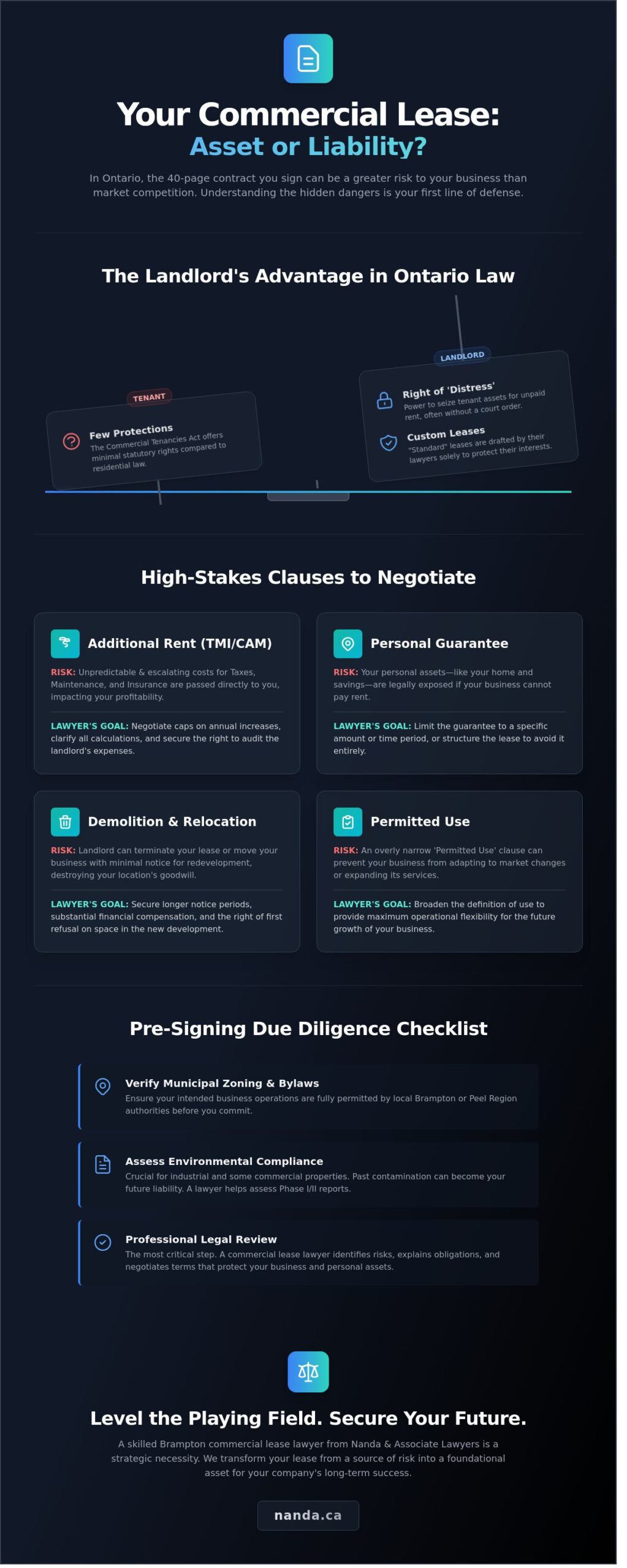
Ontario’s Commercial Tenancies Act offers tenants very few protections compared to residential law. The legal framework inherently favours the landlord, creating a significant power imbalance from the outset of negotiations. Our role is to level this playing field, ensuring your rights are protected and the lease serves your business interests, not just the landlord’s.
Why ‘Standard’ Leases Don’t Exist in Commercial Law
Unlike residential tenancies, which are governed by a government-mandated standard lease form, the commercial world operates on the principle of ‘freedom of contract.’ This means that whatever you agree to and sign, the courts will most likely enforce. A landlord’s ‘standard’ lease is a document drafted exclusively to protect their interests. For a Brampton startup or small business, accepting this template without a thorough legal review is a high-risk gamble that can lead to unforeseen costs and operational restrictions down the road.
Local Expertise: Navigating Brampton’s Business Corridors
Understanding the local market is critical. An industrial lease for a warehouse in the Steeles Avenue corridor has vastly different priorities, such as shipping access and environmental compliance, than a retail lease in a new Mount Pleasant development, where clauses on exclusivity, signage, and common area costs are paramount. Our deep familiarity with Brampton’s distinct business zones allows us to provide tailored advice. These complex negotiations often extend beyond the lease itself, requiring the guidance of experienced business lawyers in Brampton to align the agreement with your overall corporate strategy.
The Legal Framework: Navigating the Ontario Commercial Tenancies Act (CTA)
For any business owner in Brampton, understanding the commercial leasing landscape begins with one critical piece of legislation: the Ontario Commercial Tenancies Act (CTA). This Act provides the foundational rules governing the relationship between commercial landlords and tenants. However, unlike residential tenancy law, the CTA is not an exhaustive code. It sets out specific rights and remedies but remains silent on many crucial issues, leaving them to be defined by the language of the lease agreement itself. This is where the risks and opportunities for your business truly lie.
One of the most powerful tools the CTA grants landlords is the right of ‘distress’. This allows a landlord to seize a tenant’s assets on the premises to cover unpaid rent, a remedy that can be exercised without a court order. Conversely, tenants are often bound by demanding obligations, particularly under a ‘Triple Net’ (NNN) lease structure. In an NNN lease, the tenant is responsible not only for rent but also for a proportionate share of the property’s taxes, maintenance costs, and insurance (TMI). These costs can fluctuate significantly, creating financial uncertainty if not carefully negotiated.
The interpretation of lease clauses is constantly evolving. For instance, landmark Ontario court decisions following the 2020 business disruptions have significantly clarified the use of ‘Force Majeure’ clauses. Courts have consistently ruled that for such a clause to excuse a tenant from paying rent due to unforeseen events like a pandemic, the lease language must be exceptionally clear and specific. Vague wording is rarely sufficient, a lesson many businesses learned the hard way. A seasoned brampton commercial lease lawyer understands these precedents and ensures your lease accounts for them.
Default and Termination: The Landlord’s Nuclear Option
The CTA gives landlords swift and potent remedies for tenant defaults. For non-payment of rent, a landlord can change the locks and terminate the lease on the 16th day after the rent was due, without any formal notice. This ‘Right of Re-entry’ is a powerful tool. While a tenant may apply to the Ontario Superior Court of Justice for ‘Relief from Forfeiture’ to have the lease reinstated, it’s a discretionary remedy that requires immediate action and payment of all arrears.
Dispute Resolution and Litigation
In the Peel Region, commercial lease disputes frequently arise from disagreements over TMI calculations, responsibility for major structural repairs, or the scope of permitted use. While mediation can offer a faster and more cost-effective path to resolving these conflicts, some disputes inevitably require court intervention. When complex financial or contractual interpretations are at stake, you need robust representation from experienced civil litigation lawyers who can effectively argue your position.
Ultimately, the CTA sets the stage, but your lease agreement directs the play. Ensuring that contract is meticulously drafted and reviewed is the single most important step you can take to protect your business’s future. Understanding your rights and obligations from day one is not just good practice; it’s essential for survival and growth in Brampton’s competitive commercial market.
Deciphering High-Stakes Clauses: What Every Brampton Tenant Must Negotiate
A commercial lease is far more than a simple agreement on rent and term length. It’s a complex legal document where seemingly minor clauses can have major financial consequences for your business. For Brampton entrepreneurs, where the commercial landscape is increasingly competitive, what you fail to negotiate can be as costly as what you agree to. A diligent brampton commercial lease lawyer focuses on several critical, high-stakes clauses to protect your investment and secure your future operational stability.
Key areas demanding meticulous review include:
-
TMI and CAM (Additional Rent): Many tenants focus solely on base rent, only to be surprised by "Additional Rent." This covers your proportionate share of the property’s Taxes, Maintenance, and Insurance (TMI) or Common Area Maintenance (CAM) fees. These costs are not fixed. A major capital repair to the building’s HVAC system or a significant property tax reassessment can cause your monthly TMI payments to spike, sometimes even exceeding your base rent. We work to negotiate caps on annual increases or exclude major capital expenditures from the calculation to ensure budget predictability.
-
Personal Guarantees and Indemnities: Landlords almost always demand a personal guarantee, making you personally liable for the lease obligations if your corporation defaults. This pierces the corporate veil and puts your personal assets, including your home and savings, at risk. Negotiating to limit the guarantee’s duration (e.g., for the first two years only) or cap the total monetary amount is a critical step in separating your business risk from your personal financial security.
-
Assignment and Subletting: Your business needs flexibility. An opportunity might require you to relocate, or you may wish to sell your business. An assignment (transferring the entire lease to a new tenant) or subletting clause provides a vital exit strategy. While the Ontario Commercial Tenancies Act states a landlord cannot unreasonably withhold consent, a well-drafted clause will clearly define what constitutes a "reasonable" refusal, preventing arbitrary and costly roadblocks.
-
Exclusivity and Non-Compete: Imagine opening your specialty coffee shop in a Brampton plaza, only for the landlord to lease the adjacent unit to a major coffee chain three months later. An exclusivity clause prevents this. It grants you the sole right to conduct your specific type of business within the property, protecting your investment and customer base from direct, on-site competition.
The Danger of Demolition and Relocation Clauses
As Brampton pursues its 2040 Vision for urban intensification, landlords increasingly insert demolition or relocation clauses to maintain flexibility for future redevelopment. These clauses give them the right to terminate your lease with notice or move you to another unit. For a tenant, this could mean losing a prime location and thousands of dollars in renovations. We negotiate these clauses to include robust tenant protections, such as extended notice periods (e.g., 270 days instead of 90) and mandatory compensation for the full "unamortized value" of your leasehold improvements.
Continuous Operation and Early Termination
A "Continuous Operation" clause can be a trap, legally obligating you to remain open for business during specific hours. This is often unworkable for seasonal businesses, startups, or operations that require flexible hours. A more balanced alternative our experienced brampton commercial lease lawyer can negotiate is a "kick-out" clause based on gross sales. If your revenue falls below an agreed-upon threshold for a set period, this clause gives you the right to terminate the lease early, providing a crucial financial safety net. This is just one of many complex issues where our team of real estate lawyers Brampton provides strategic counsel.
Due Diligence and Brampton Municipal Compliance
Signing a commercial lease is a significant commitment. Before you finalize the agreement, a thorough due diligence process is essential to uncover potential liabilities and confirm the property is suitable for your business needs. What the lease document says is only one part of the story; municipal regulations, property title issues, and environmental conditions can pose substantial risks if overlooked. At Nanda & Associate Lawyers Professional Corporation, we manage this critical investigation to provide you with the clarity and confidence needed to move forward.
A comprehensive review goes far beyond the four corners of the lease agreement itself. It involves several key investigative steps:
-
Verifying Zoning Compliance: We directly engage with the City of Brampton’s planning department to confirm that your intended business operations align with the property’s official zoning designation under By-law 270-2004. A landlord’s promise is not a legal guarantee of permitted use.
-
Environmental Assessments: For industrial properties in Brampton and the wider Peel Region, we advise on the necessity of Phase I Environmental Site Assessments (ESAs). This step is crucial for identifying potential land contamination from previous users, protecting you from inheriting costly remediation obligations.
-
Sublease Agreement Scrutiny: If you are subletting, your rights are tied to the ‘Head Lease’ between the landlord and the original tenant. We meticulously review this primary document to ensure its terms don’t conflict with your sublease or put your tenancy at risk if the original tenant defaults.
-
Title and Encumbrance Searches: An experienced brampton commercial lease lawyer will conduct a thorough title search to confirm the landlord’s legitimate ownership and identify any mortgages or liens registered against the property. A landlord in default with their lender could put your right to possession in jeopardy through foreclosure proceedings.
Brampton Zoning and Occupancy Permits
The ‘Permitted Use’ clause in your lease must perfectly match the City of Brampton’s zoning by-laws. A discrepancy can render your lease useless, preventing you from legally operating. Responsibility for securing a Certificate of Occupancy typically falls to the tenant, especially when renovations are involved. Specialized businesses, like a dental clinic or a licensed restaurant, often require a formal ‘Change of Use’ application, a process that can take 3-6 months and involves significant planning and documentation.
Measurement Standards and Net Rent Calculations
Are you paying for space you can’t use? Many Brampton commercial leases use BOMA (Building Owners and Managers Association) standards to calculate square footage. This means your ‘Rentable’ area includes your ‘Usable’ office space plus a percentage of common areas like lobbies and hallways. In some Brampton office towers, this "gross-up" factor can be as high as 18%, significantly impacting your costs. In addition to your base rent, ‘Additional Rent’ is a variable operating cost that covers your proportionate share of the building’s property taxes, maintenance, and insurance.
Navigating these technical and regulatory details is a complex process where guidance from a brampton commercial lease lawyer is essential to protect your investment. Our team ensures that every detail, from municipal permits to rent calculations, is verified before you sign. Contact us to manage the due diligence for your commercial lease and secure your business’s future.
Why Nanda & Associate Lawyers is Your Strategic Brampton Partner
Choosing a legal representative for your commercial lease is about more than just reviewing a document; it’s about securing a strategic partner invested in your business’s long-term success. At Nanda & Associate Lawyers, we don’t simply read the fine print. We align our legal strategy with your commercial objectives, ensuring your lease serves as a foundation for growth, not a source of future liability.
Our unique strength lies in our collaborative, multidisciplinary approach. We combine the transactional precision of our business law team with the foresight of our real estate litigation experts. This means that while one team ensures your lease terms are commercially sound, our litigators are simultaneously stress-testing the agreement for potential conflicts. We identify the ‘ticking time bombs’-ambiguous repair clauses, restrictive assignment rights, or unfair demolition clauses-that can detonate into costly disputes years down the line. It’s this proactive risk mitigation that sets our counsel apart.
We understand that Brampton’s vibrant economy is built on businesses of all sizes and backgrounds. Our team provides tailored solutions, whether you’re a solo entrepreneur signing your first retail lease or an industrial developer negotiating a complex multi-site agreement. To support Brampton’s diverse business community, we proudly offer services in over 15 languages, ensuring you receive clear, precise advice without language barriers. When you need a brampton commercial lease lawyer who understands both the legal and cultural nuances of our city, our team is prepared to assist.
Comprehensive Legal Solutions for Brampton Businesses
Our support extends across the entire lifecycle of your tenancy. We provide strategic guidance on lease renewals, expansions, subletting, and planned exit strategies. Should a dispute arise, our formidable litigation team has a proven track record defending our clients’ interests in the Ontario Superior Court of Justice. Our deep understanding of commercial tenancies is complemented by our broader corporate counsel, connecting your real estate decisions to your overall growth strategy. This integrated approach is why businesses also trust our business lawyers Mississauga team for comprehensive corporate support.
Take the Next Step: Secure Your Business Future
An ounce of prevention is worth a pound of cure. Our fixed-fee lease review is a modest investment designed to prevent potential six-figure mistakes, like being unexpectedly liable for a C$100,000 HVAC replacement. To make your initial consultation as productive as possible, we recommend you prepare by bringing:
-
A complete copy of the draft lease or offer to lease.
-
A list of your key business objectives and "deal-breakers."
-
Any questions or specific clauses that concern you.
Don’t leave your company’s future to chance. Protect your investment and gain peace of mind. Contact Nanda & Associate Lawyers for a consultation on your commercial lease today.
Secure Your Commercial Success in Brampton for 2026 and Beyond
A commercial lease is more than a rental agreement; it’s a foundational document for your business’s future. Successfully navigating the complexities of the Ontario Commercial Tenancies Act and negotiating critical clauses related to rent, repairs, and renewals requires specialized legal foresight. Overlooking even a single detail can expose your business to significant financial and operational risks. It’s a high-stakes process where professional guidance isn’t just an advantage, it’s a necessity for long-term stability.
At Nanda & Associate Lawyers, our team has provided strategic legal counsel to businesses in Brampton and Mississauga since 2003. Our comprehensive understanding of both business and real estate law ensures your interests are protected at every stage. When you partner with a dedicated brampton commercial lease lawyer from our firm, you gain an advocate committed to securing favourable terms and mitigating future risks, allowing you to focus on your company’s growth.
With multilingual support available in over 15 languages, we are equipped to serve Brampton’s diverse business community. Take the proactive step to protect your investment and secure your peace of mind. Book a consultation with a Brampton Commercial Lease Lawyer to discuss your needs.
Frequently Asked Questions About Brampton Commercial Leases
Is there a standard commercial lease form in Ontario like there is for residential?
No, there isn’t a mandatory standard form for commercial leases in Ontario. Unlike residential tenancies, which are governed by the Residential Tenancies Act, 2006, and use a standard agreement, commercial leasing relies on customized contracts. These agreements are primarily shaped by negotiations between the landlord and tenant and are governed by the Commercial Tenancies Act. Every commercial lease is unique and should be reviewed carefully to protect your interests.
Can my landlord in Brampton lock me out if I am only a few days late on rent?
A landlord’s right to lock you out depends on the terms of your lease and the Commercial Tenancies Act. The Act allows a landlord to change the locks 16 days after rent is due. However, your specific lease might grant this right sooner. A landlord cannot use force and must follow a precise legal process. Acting without proper legal grounds can expose a landlord to significant liability, making professional legal advice essential in these situations.
What is the difference between a ‘Gross Lease’ and a ‘Triple Net (NNN) Lease’?
The key difference is how operating expenses are paid. In a Gross Lease, you pay one flat rental amount, and the landlord covers all property expenses like taxes, maintenance, and insurance. With a Triple Net (NNN) Lease, you pay a lower base rent plus a proportionate share of the building’s property taxes, insurance, and common area maintenance costs. NNN leases are common but can lead to unpredictable monthly costs for the tenant.
Can I break my commercial lease early if my business is not profitable?
No, a lack of profitability does not give you a legal right to terminate a commercial lease. A lease is a binding contract for a fixed term. To exit early, you would need a specific termination clause in your agreement, or you must negotiate a surrender of the lease with your landlord. Alternatively, you could assign or sublet the space, but this typically requires the landlord’s consent. You remain liable for the rent until a solution is found.
Who is responsible for repairs in a commercial lease in Brampton?
Responsibility for repairs is determined entirely by the terms negotiated in your lease agreement. There are no default rules under Ontario law that assign these duties. Generally, a lease will make the tenant responsible for interior, non-structural repairs, while the landlord handles major structural elements like the roof and foundation. A Brampton commercial lease lawyer can ensure these obligations are clearly and fairly defined before you sign.
What does ‘TMI’ stand for in an Ontario commercial lease?
TMI stands for Taxes, Maintenance, and Insurance. These are the primary components of what is often called "additional rent" in net leases. The "Taxes" portion refers to municipal property taxes. "Maintenance" covers the costs for common area maintenance (CAM), such as landscaping or snow removal. "Insurance" refers to the landlord’s commercial property insurance. You pay a proportionate share of these costs based on the square footage of your unit.
Does the landlord have to be ‘reasonable’ when I want to assign my lease to a buyer?
Yes, in most cases, a landlord cannot unreasonably withhold consent for a lease assignment. Section 23 of Ontario’s Commercial Tenancies Act specifies that consent cannot be withheld without a valid reason. A landlord’s assessment of what is "reasonable" usually focuses on the proposed new tenant’s financial stability and business experience. If your lease requires consent, it’s best to present a strong candidate to avoid a potential dispute.
What happens to my lease if the building is sold to a new owner?
Your lease remains valid and enforceable even if the building is sold. The new owner inherits the previous landlord’s obligations and is bound by all the terms and conditions of your existing agreement. This principle is known as "the lease runs with the land." You will continue your tenancy as before, simply directing your rent payments to the new property owner. Your rights and responsibilities under the lease do not change.