


Key Takeaways
-
Gain a clear understanding of the legal distinctions between Open and Employer-Specific permits to ensure your stay in Ontario remains compliant with the Immigration and Refugee Protection Act.
-
Partnering with a Brampton Work Permit Lawyer: How to Apply for a Canadian Work Permit provides the strategic guidance needed to navigate the rigorous LMIA process and secure job offers within the local labor market.
-
Learn how to align your application with Brampton’s thriving logistics and manufacturing sectors to better position yourself for success in the 2026 economic landscape.
-
Identify common reasons for permit refusals and understand the procedural differences between filing a re-application and seeking a Judicial Review.
-
Discover practical strategies for navigating the ESDC portal and managing employer-employee relationship disputes while maintaining your legal status with the help of an experienced immigration lawyer.
Table of Contents
-
Understanding the Legal Framework: Employer-Specific vs. Open Work Permits
-
Navigating Refusals: Why Legal Representation Matters in Brampton
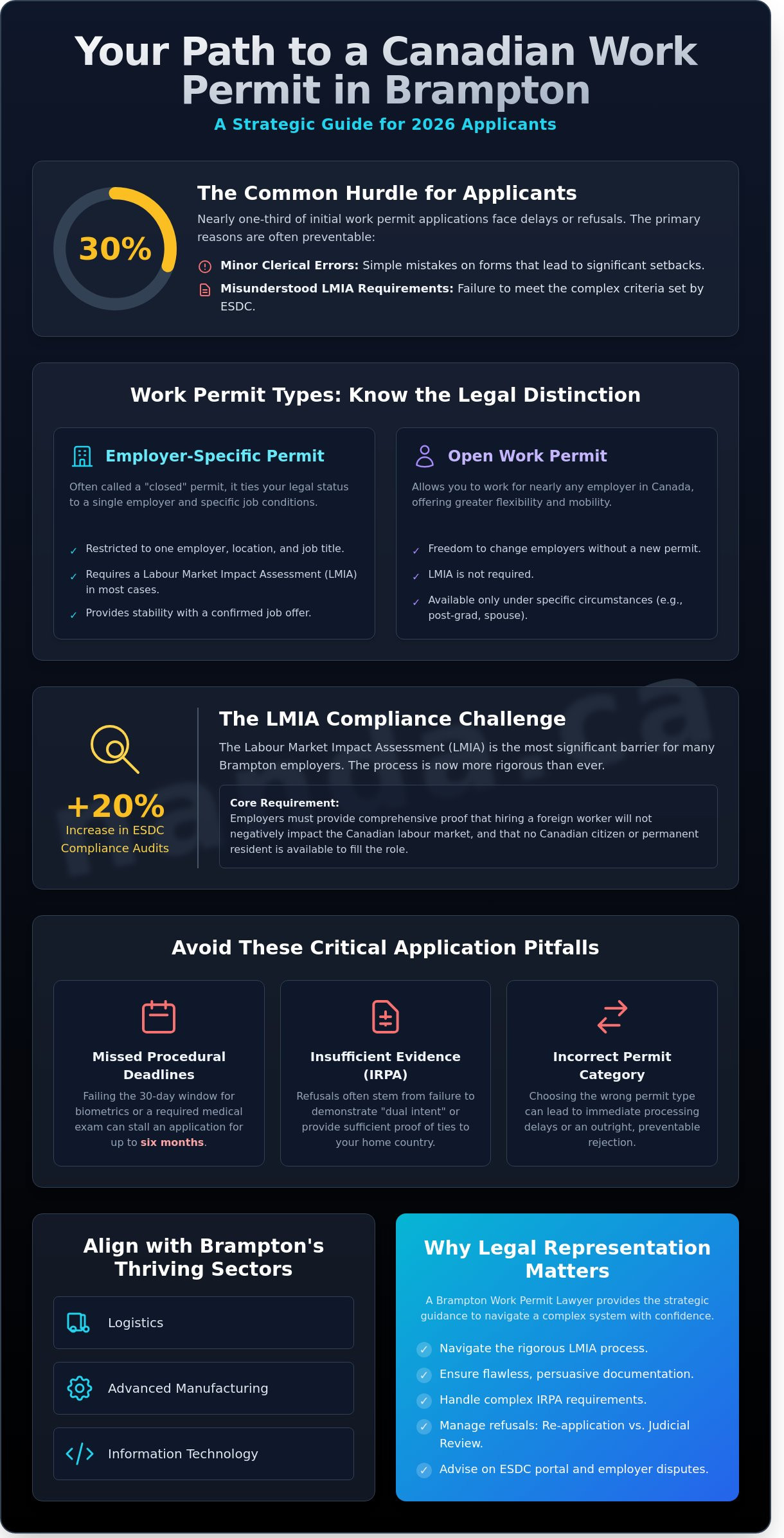
Did you know that nearly 30% of initial Canadian work permit applications face delays or refusals because of minor clerical errors or misunderstood LMIA requirements? It’s a stressful reality for many professionals looking to build a life in Ontario. If you’re feeling anxious about your status, you’re not alone. Our immigration lawyers understand that the pressure to secure your future while coordinating with local employers can feel like an uphill battle. By consulting a Brampton Work Permit Lawyer: How to Apply for a Canadian Work Permit transforms from a source of confusion into a clear, strategic path toward your professional goals.
We’re here to provide the steady, expert guidance you need to handle these legal hurdles with confidence. You’ll gain a comprehensive understanding of the 2026 application standards and the specific steps required to ensure your documentation is flawless. This guide covers everything from Labor Market Impact Assessment (LMIA) nuances to the transition toward permanent residency. You’ll learn how to build a robust application that provides the employment stability you deserve right here in Brampton. Our Brampton immigration legal team is dedicated to ensuring your journey is handled with the professional care and local expertise your future requires.
Securing a Work Permit in Brampton
-
Distinguishing Permit Types: Applicants must correctly identify whether they require an Open Work Permit or an Employer-Specific permit. In Brampton’s diverse job market, choosing the wrong category often leads to immediate processing delays or outright rejection. Open permits allow for mobility between employers, while Employer-Specific permits tie your legal status to a single business.
-
LMIA Compliance Hurdles: The Labour Market Impact Assessment (LMIA) is the most significant barrier for local employers in 2026. Employment and Social Development Canada (ESDC) has increased workplace inspections and compliance audits by 20% over the last year. Employers must prove that no Canadian citizen or permanent resident is available to fill the role before hiring a foreign national.
-
Strict Procedural Deadlines: Missing the 30-day window for biometrics or failing to complete a medical exam with an IRCC-authorized panel physician can stall an application for six months. We’ve seen that administrative precision is just as vital as the legal merits of the case.
-
Mitigating IRPA Refusals: Professional legal representation helps navigate the complexities of the Immigration and Refugee Protection Act (IRPA). Many refusals stem from a failure to demonstrate "dual intent" or insufficient evidence of ties to one’s home country. A Brampton Work Permit Lawyer: How to Apply for a Canadian Work Permit ensures that every document serves as a persuasive piece of evidence.
Introduction to Working in Brampton
Brampton is a powerhouse of the Greater Toronto Area’s economy. With a population that surpassed 650,000 in recent years, the city serves as a critical hub for advanced manufacturing, logistics, and information technology. It’s a place where global talent meets local opportunity. For many foreign nationals, securing a position here is the first step toward a long-term future in Canada. However, the legal environment in 2026 has become increasingly complex due to updated federal caps and changing provincial priorities.
Our firm operates as a sophisticated legal partner for those entering this competitive environment. We provide comprehensive legal solutions that go beyond simple form-filling. We understand that your career and family stability depend on a successful outcome. Because the federal government has implemented stricter verification processes this year, having an immigration lawyer in Brampton is more than a convenience; it’s a strategic necessity. We help you interpret the latest Brampton Work Permit Lawyer: How to Apply for a Canadian Work Permit guidelines to ensure your application is robust and compliant.
2026 is a pivotal year for Ontario’s labor market. New regulations focusing on regional economic needs mean that Brampton-based applications are being scrutinized with fresh eyes. Whether you’re a specialized technician or a corporate executive, the way you present your qualifications must align with current IRCC priorities. We take a methodical approach to every file, ensuring that our clients feel a sense of security while we handle the intricate details of federal immigration law.
Understanding the Legal Framework: Employer-Specific vs. Open Work Permits
The foundation of every Canadian work authorization rests upon the Immigration and Refugee Protection Act (IRPA). Under Section 196 of the associated Regulations, foreign nationals are prohibited from entering the Canadian labor market without a valid permit unless a specific exemption applies. For those seeking a Brampton Work Permit Lawyer: How to Apply for a Canadian Work Permit, navigating these statutory requirements is the first step toward professional stability in Ontario. The law distinguishes between two primary categories: employer-specific permits and open work permits. Each carries distinct obligations and limitations that impact your long-term residency goals.
Employer-specific permits, often called "closed" permits, bind your legal status to a single employer in a designated location. If you hold this permit, you’re legally restricted to the conditions printed on the document, including your job title and the duration of your contract. If your employment ends, your authorization to work usually terminates with it. In contrast, open work permits provide the flexibility to work for almost any employer in Canada. A vital example for our community is the Post-Graduation Work Permit (PGWP). Sheridan College, which hosted over 8,000 international students at its Brampton Davis Campus in 2023, remains a primary pipeline for these permits. Graduates often use this pathway to gain the 1,560 hours of skilled work experience required for many permanent residency streams.
Working without proper authorization carries severe legal consequences under Section 124 of the IRPA. Violations can lead to an exclusion order, which bars you from Canada for at least 12 months, or a permanent record of non-compliance that jeopardizes future visa applications. If you’re unsure about your current status, consulting with an immigration lawyer in Brampton can provide the clarity needed to remain compliant with federal law.
The Temporary Foreign Worker Program (TFWP)
The TFWP is designed to address specific labor shortages within the Brampton market, particularly in the manufacturing and logistics sectors that define the local economy. To hire through this program, an employer must typically obtain a neutral or positive Labour Market Impact Assessment (LMIA). As of late 2024, Employment and Social Development Canada (ESDC) has intensified its scrutiny of these applications. Employers must demonstrate they’ve advertised the position to Canadians for at least four weeks and offer wages consistent with the Brampton median for that specific occupation.
The International Mobility Program (IMP)
The IMP allows for LMIA-exempt work permits, focusing on broader economic and cultural benefits. This includes pathways under international agreements like CUSMA, which facilitates the movement of professionals between Canada, the U.S., and Mexico. It also covers intra-company transfers for senior managers or specialized knowledge workers moving to a Brampton branch of a global firm. These pathways are often faster, as they bypass the lengthy LMIA process, but they require meticulous documentation to prove the "significant benefit" or "reciprocal employment" criteria required by the IRPR.
The Application Process: From LMIA to Final Approval
Securing authorization to work in Ontario requires a methodical approach. The process is rigorous. We often see applicants struggle when they overlook the strict sequencing required by the Immigration and Refugee Protection Act. Your journey begins with a specific job offer from an employer within the Brampton city limits. This offer must be genuine and meet prevailing wage standards for the region. If you’re unsure about the validity of your offer, consulting a Brampton Work Permit Lawyer: How to Apply for a Canadian Work Permit can help clarify your legal standing.
-
Step 1: The Job Offer. You must obtain a formal offer of employment. This document is the foundation of your application. It must detail your salary, benefits, and job duties.
-
Step 2: The LMIA Stage. Many employers must apply for a Labour Market Impact Assessment (LMIA) through Employment and Social Development Canada (ESDC). This proves that no Canadian citizen or permanent resident was available to fill the role.
-
Step 3: IRCC Submission. Once you have a positive LMIA or an LMIA-exempt offer, you’ll create a secure account on the IRCC portal. This is where you upload digital copies of your documents and pay the processing fees.
-
Step 4: Biometrics and Health. Most applicants must provide fingerprints and a photo at a designated collection point. You may also need a medical exam from a panel physician if your job involves public health or if you’ve lived in certain countries recently.
-
Step 5: Port of Entry. If your application is approved, you’ll receive a Letter of Introduction. You present this to the Canada Border Services Agency (CBSA) officer at Pearson International Airport or another Port of Entry (POE) to receive your physical permit.
2026 Processing Timelines and Expectations
As of January 2026, the average processing time for work permits in Ontario sits at approximately 118 days. This timeline fluctuates based on the volume of applications IRCC receives. High-demand sectors like healthcare or tech sometimes see faster turnarounds. If you’re already in Canada, you might benefit from maintained status. This legal provision allows you to continue working under the conditions of your old permit while IRCC processes your renewal. We recommend submitting your extension at least 90 days before your current permit expires to avoid gaps in your legal authorization.
Documentation Checklist for Brampton Applicants
Precision is vital for your document package. You’ll need a valid passport, digital photos, and proof that you meet the requirements of the job offer, such as university degrees or trade certifications. The employment contract undergoes heavy scrutiny; it must align with Ontario’s Employment Standards Act. If you’re bringing family, you must include marriage certificates and birth certificates for dependents. Our team at Nanda & Associate Lawyers provides comprehensive support to ensure your file is complete. If you need professional guidance, speaking with an immigration lawyer in Brampton can prevent common clerical errors that lead to unnecessary delays.
Practical Advice for Foreign Workers and Brampton Employers
Success in the Canadian immigration system often depends on how well your application aligns with local economic realities. Brampton’s economy is a powerhouse for logistics, supply chain management, and advanced manufacturing. These sectors employ over 60,000 residents and frequently face labor shortages. If you’re looking to secure a job offer, focus on these industries. Employers here are often more receptive to the LMIA process because they have a documented need for specialized talent. Consulting a Brampton Work Permit Lawyer: How to Apply for a Canadian Work Permit can help you position your professional background to meet these specific regional demands.
We often see workers face challenges when their relationship with an employer breaks down while they hold a closed work permit. If you find yourself in a situation where your rights are being violated, you don’t have to remain in an abusive environment. IRCC provides pathways for vulnerable workers to apply for open work permits. This allows you to leave a specific employer without losing your legal status in Canada. Our team provides the steady, methodical guidance needed to transition through these difficult periods while protecting your future residency goals.
Navigating the Local Job Market
Brampton employers may be hesitant about the LMIA process due to perceived complexity. We suggest providing them with clear information about the 2026 processing standards. For example, high-wage positions often benefit from expedited 10-business-day processing. If you’re an employer looking to scale your workforce, our business lawyers in Brampton can assist with corporate compliance and help you understand your obligations under the Ontario Employment Standards Act. It’s vital to remember that temporary residents have the same workplace rights as Canadian citizens, including minimum wage and safety protections.
Common Pitfalls to Avoid
The most frequent reason for work permit refusal isn’t a lack of qualifications, but incomplete documentation. Even a small oversight can lead to a rejection or a finding of misrepresentation. Under Section 40 of the IRPA, providing false information or withholding material facts can result in a five-year ban from Canada. This is a severe consequence that is difficult to overturn. Many applicants fall into this trap by using unauthorized consultants who prioritize speed over accuracy. Choosing a qualified immigration lawyer in Brampton ensures your application is handled with the professional gravity it deserves.
-
Monitor Expiry Dates: Always apply for an extension at least 30 days before your current permit expires to maintain "maintained status."
-
Restoration Period: If you miss your deadline, you have exactly 90 days to apply for a restoration of status, but you must stop working immediately.
-
International Students: Ensure your study permit conditions were met before applying for a Post-Graduation Work Permit (PGWP). IRCC has strict 2026 requirements regarding field-of-study alignment for certain permits.
Our collaborative team at Nanda & Associate Lawyers understands that your work permit is the foundation of your life in Canada. We offer comprehensive legal solutions that address both your immediate employment needs and your long-term goals for permanent residency. We’re here to provide the clarity and security you need to move forward with confidence.
Book a consultation with our experienced immigration team today to secure your future in Brampton.
Navigating Refusals: Why Legal Representation Matters in Brampton
Receiving a refusal letter from Immigration, Refugees and Citizenship Canada (IRCC) feels devastating. In 2026, refusal rates for work permits fluctuate based on evolving labor market impact assessments and stricter verification protocols. Common reasons for rejection include insufficient evidence of financial support, lack of clear ties to your home country, or discrepancies in your job offer’s legitimacy. A Brampton Work Permit Lawyer: How to Apply for a Canadian Work Permit expert ensures these gaps are closed before you submit. If you’ve already received a refusal, we analyze the Global Case Management System (GCMS) notes to identify the officer’s specific concerns. This data-driven approach allows us to determine if you should submit a fresh application or pursue a legal challenge.
When IRCC suspects misrepresentation or has serious doubts about your eligibility, they issue a Procedural Fairness Letter (PFL). This is a critical moment. You have a narrow window, often only 7 to 30 days, to provide a sophisticated response. Our legal team prepares robust submissions that address each concern with documentary evidence, preventing a potential five-year ban from Canada. A refusal isn’t just a temporary setback; it creates a record that can complicate your future Permanent Residency (PR) aspirations under the Express Entry or Ontario Immigrant Nominee Program (OINP) streams. For instance, an applicant failing to show the minimum C$20,635 required for single-person financial sufficiency in 2026 may face an immediate rejection without a chance to clarify unless a lawyer intervenes early.
Appeals and Judicial Reviews
If a decision was made unfairly or based on an error in law, a re-application might not be enough. The Federal Court of Canada handles Judicial Reviews for immigration disputes. This process doesn’t look at new evidence but examines whether the original decision was "reasonable." You must act quickly. The deadline to file for leave and judicial review is 15 days for a decision made in Canada and 60 days for one made abroad. For complex disputes involving administrative law, our civil litigation lawyers provide the specialized advocacy required to challenge these government decisions. We focus on ensuring the principles of natural justice were followed throughout your application process.
Conclusion and Next Steps
Securing your right to work in Canada requires more than just filling out forms. It demands a strategic legal partner who understands the nuances of the Immigration and Refugee Protection Act (IRPA). We provide the professional oversight needed to protect your future and ensure your Brampton Work Permit Lawyer: How to Apply for a Canadian Work Permit journey is successful. Don’t leave your career to chance or automated processing systems. Secure your status through meticulous planning and dedicated representation. We invite you to book a consultation with Nanda & Associate Lawyers today to build a clear path toward your professional goals in Brampton. Our team is ready to provide the comprehensive legal solutions you need for a stable future in Ontario.
Take the Next Step Toward Your Canadian Career
Navigating the complexities of the Immigration and Refugee Protection Act requires a strategic approach. You’ve learned that distinguishing between employer-specific and open work permits is the first step toward a successful stay in Ontario. Whether you’re managing the LMIA process or addressing a previous refusal, precision remains your most valuable asset. Our team brings over 20 years of experience in Ontario immigration law to your specific case, ensuring every document meets IRCC standards.
We provide multilingual support in over 15 languages, making complex legal frameworks accessible to our diverse Brampton community. From initial applications to sophisticated Federal Court reviews, we focus on delivering comprehensive legal solutions that protect your right to work. If you’re feeling overwhelmed by the 2026 requirements, a Brampton Work Permit Lawyer: How to Apply for a Canadian Work Permit expert can provide the clarity you need to move forward with confidence.
Don’t leave your professional future to chance. Book a consultation with a Brampton Work Permit Lawyer today to discuss your goals. We’re here to help you build a stable and prosperous life in Canada.
Frequently Asked Questions
Can I apply for a work permit if I am already in Brampton on a visitor visa?
You can apply for a work permit from within Canada if you hold a valid visitor status and meet specific eligibility criteria. IRCC has maintained policies that allow visitors with a valid job offer to transition to an employer-specific work permit without leaving the country. This pathway remains a vital option for many in 2026. Our team helps you manage this transition to ensure your legal status stays secure while the government processes your application.
Do all employers in Brampton need an LMIA to hire a foreign worker?
Not every employer requires a Labour Market Impact Assessment (LMIA) to hire international talent. While many businesses must prove no Canadian citizen is available, various categories under the International Mobility Program are LMIA-exempt. These include intra-company transfers, CUSMA professionals, or individuals providing a significant benefit to Canada’s economy. Consulting a Brampton Work Permit Lawyer: How to Apply for a Canadian Work Permit ensures you identify the correct exemption code for your specific industry.
How long does it take to process a Canadian work permit in 2026?
Processing times for work permits in 2026 typically range from 60 to 120 days for applications submitted within Canada. These timelines fluctuate based on the volume of files at IRCC and the complexity of your specific case. Using the Global Skills Strategy can reduce this wait to 14 days for highly skilled roles. We monitor these government service standards weekly to provide our clients with the most accurate expectations for their employment start dates.
What happens to my work permit if I lose my job in Brampton?
Your work permit remains valid until the expiry date listed on the document even if your employment ends unexpectedly. If you hold a closed work permit, you cannot legally work for a different employer until you apply for and receive a new permit. You must maintain your legal status by applying for a change of conditions or a visitor record within 90 days of your employment ending. This prevents you from becoming out of status while you search for new opportunities.
Can my family join me in Brampton if I have a valid work permit?
Your immediate family members can often accompany you to Ontario under various permit categories. Spouses of high-skilled workers or those in specific pilot programs are frequently eligible for an open work permit to support the household. Your dependent children can attend primary or secondary school without a separate study permit if they’re already in Canada. We prioritize family reunification to help your entire household transition smoothly to your new life in the community.
What is the difference between an open work permit and a closed work permit?
An open work permit allows you to work for almost any employer in Canada without a pre-arranged job offer. In contrast, a closed permit restricts your employment to a specific employer, location, and job title as detailed in your LMIA or exemption. Most employer-sponsored applications result in a closed permit. Understanding these distinctions is a core part of how a Brampton Work Permit Lawyer: How to Apply for a Canadian Work Permit guides your long-term career strategy.
Can I transition from a work permit to permanent residency in Ontario?
You can transition to permanent residency through programs like the Canadian Experience Class or the Ontario Immigrant Nominee Program (OINP). Most candidates require at least 1,560 hours of skilled work experience in Canada to qualify for these competitive streams. In 2025, IRCC issued over 110,000 invitations to apply through the Express Entry system. This pathway provides a stable foundation for your future and eventually leads to Canadian citizenship.
Is a job offer mandatory for every type of Canadian work permit?
A job offer isn’t required for every permit type, specifically for open work permits like the Post-Graduation Work Permit or Spousal Open Work Permits. These documents allow you the flexibility to search for employment after you arrive in Ontario. However, most economic immigration pathways and closed permits require a formal offer of employment backed by an LMIA or a valid offer of employment number. We help you determine which category fits your current professional situation.
Disclaimer
This content is for general information only and does not constitute legal advice or create a lawyer-client relationship. Every case is different—please consult a qualified lawyer for advice specific to your situation.