


Buying a franchise in Mississauga can feel like a shortcut to entrepreneurship. You get a recognized brand, a proven business model, and a support system from day one. But behind the excitement of the grand opening lies a stack of legal documents that can either secure your future or put your entire investment at risk. The franchisor’s success does not automatically guarantee yours. The only thing that does is a meticulous, professional review of the contract with the help of an experienced business lawyer that will govern your business for years to come.
Many aspiring business owners believe the franchise agreement is a standard, non-negotiable document. This is a costly assumption. In reality, it is a complex contract drafted entirely in the franchisor’s favour. Without expert legal guidance, you could unknowingly agree to terms that limit your territory, expose your personal assets, and make it nearly impossible to exit the business profitably. This guide will walk you through the critical legal checkpoints of buying a franchise in Mississauga, explaining Ontario’s unique protections and highlighting the red flags that only a seasoned Mississauga business lawyer can spot.
Understanding the Legal Framework: The Arthur Wishart Act in Mississauga
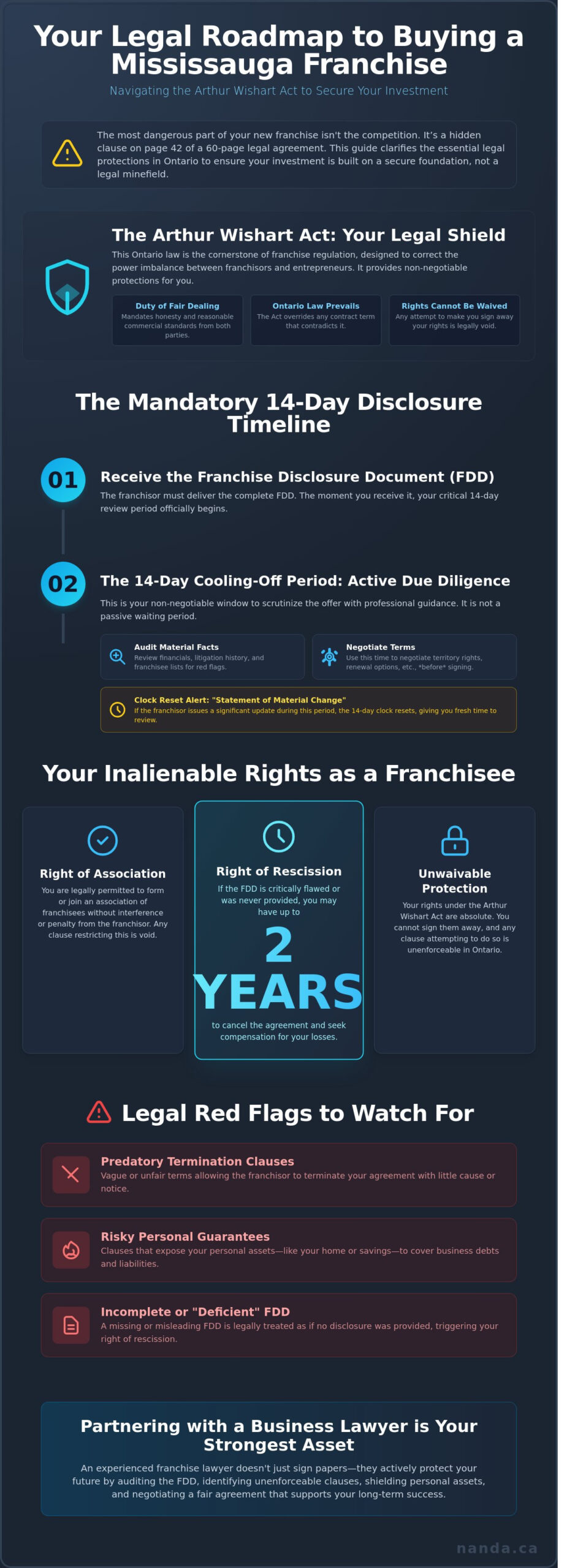
In Ontario, the franchise relationship isn’t just a private contract; it’s governed by a powerful piece of legislation: the Arthur Wishart Act (Franchise Disclosure), 2000. Think of this Act as the fundamental rulebook designed to level the playing field between large, sophisticated franchisors and local entrepreneurs. It imposes a non-negotiable ‘Duty of Fair Dealing’ on both parties, meaning neither the franchisor nor the franchisee can act in bad faith in the performance and enforcement of the agreement.
The cornerstone of this Act is the requirement for comprehensive disclosure. Before you ever sign a contract or pay a single dollar, the franchisor must provide you with a Franchise Disclosure Document (FDD). This is not a marketing brochure; it is a detailed legal document meant to give you a clear, unvarnished look at the business you are about to buy into. Crucially, Ontario law is paramount. If a term in your franchise agreement contradicts a right granted to you under the Act, that term is often void and unenforceable.
The Mandatory Franchise Disclosure Document (FDD)
The FDD is your primary tool for due diligence. Under the Arthur Wishart Act, this document must contain all "material facts" about the franchise system. This includes the franchisor’s audited financial statements, a history of any litigation involving the company, a full list of initial and ongoing fees, and contact information for current and former franchisees in the system. Speaking to these other owners is often the most insightful part of the process.
It’s important to understand that an incomplete or misleading FDD is legally considered the same as receiving no disclosure at all. This can give you powerful rights to cancel the deal, but you first need to know what to look for. This is where experienced business lawyers in Mississauga play a critical role. We scrutinize every page of the FDD, cross-referencing statements and ensuring all required certificates and documents are present and properly executed. This verification process is your first line of defence against a poor investment.
Rights of Association for Mississauga Entrepreneurs
The Act provides another vital protection: the right to associate. As a franchisee, you have a legal right to form or join an organization of other franchisees without any negative consequences or interference from the franchisor. Any clause in the agreement that tries to restrict this right is automatically void.
Why does this matter for a business owner in a bustling commercial hub like Heartland Town Centre or Erin Mills? Because collective bargaining power is significant. If a group of franchisees faces a systemic issue—perhaps a problem with a supplier or an unfair change in marketing fees—addressing it as a unified association is far more effective than going it alone. This right ensures you can collaborate with your peers to protect your shared interests.
The Franchise Buying Process and Disclosure Timeline
Timing is everything in franchise law. The Arthur Wishart Act sets out a strict timeline to ensure you have adequate time to review the information provided and seek professional advice. The most critical rule is the "14-Day Rule." A franchisor must give you the FDD at least 14 days before you sign any binding agreement or pay any money related to the franchise.
This "cooling-off" period is mandatory. If anything significant changes in the information provided in the FDD before you sign (for example, the CEO resigns or the company is hit with a major lawsuit), the franchisor must provide you with a ‘Statement of Material Change.’ This notice details the new information and gives you time to reassess your decision. Finally, should you discover that the disclosure you received was fundamentally flawed, the Act grants you a powerful remedy known as ‘Rescission’—the legal right to unwind the deal and recover your money.
Research published by Arthur Wishart Act shows that this is a well-documented area of ongoing research and practical application.
The Critical 14-Day Disclosure Window
The moment you receive the FDD, a 14-day clock starts ticking. This is not a time to be passive. Your goal is to use this period strategically to conduct your due diligence.
-
Receipt and Initial Review: The first step is to confirm you have received the complete FDD, including all attachments and financial statements. You should immediately provide a copy to your franchise lawyer.
-
Identifying Material Facts: With your lawyer, you will comb through the document to identify key information and potential red flags. A "material fact" is any piece of information that could reasonably be expected to influence your decision to buy the franchise.
-
Legal Review and Negotiation: While many franchisors claim their agreements are "standard," certain clauses may be open to negotiation. This could include aspects of your territory, specific default conditions, or renewal terms. This 14-day window is the ideal time to have your lawyer propose these changes.
Rescission: The Franchisee’s ‘Nuclear Option’
Rescission is the strongest protection a franchisee has under Ontario law. It allows you to effectively cancel the franchise agreement and get your money back if the franchisor failed in its disclosure obligations. The law provides two distinct windows for this remedy:
-
The 60-Day Window: If you receive the FDD late—meaning less than 14 days before signing—but it is otherwise complete, you have 60 days from the date you signed the agreement to rescind.
-
The 2-Year Window: If the franchisor provides no disclosure at all, or if the FDD is so deficient that it amounts to no disclosure (e.g., it’s missing financial statements or key certificates), you have up to two years to rescind the agreement.
If you exercise this right, the franchisor is legally obligated to refund all fees you paid, buy back your inventory and supplies at cost, and compensate you for any losses incurred in establishing the business. It is a powerful tool, but one that requires careful legal navigation to execute correctly.
Key Legal Red Flags When Buying a Mississauga Franchise
A franchise agreement can be over 100 pages long, filled with dense legal language. Within those pages, certain clauses can pose a significant threat to your financial well-being. A thorough legal review is designed to identify these hidden dangers before you commit.
Watch for one-sided termination clauses that give the franchisor broad power to end your agreement for minor infractions, potentially allowing them to take over your location without fair compensation. Another major area of concern is the non-compete covenant, which could prevent you from working in your own industry in the Mississauga area if the franchise relationship ends. Similarly, an unclear or poorly defined "exclusive territory" can leave you vulnerable to the franchisor opening another location right on your doorstep, diluting your market and crippling your sales.
Research published by guide to buying a franchise shows that this is a well-documented area of ongoing research and practical application.
Personal Liability and Asset Protection
Perhaps the single greatest risk for a new franchisee is the personal guarantee. Franchisors almost always require the business owner (and often their spouse) to personally guarantee the obligations of the franchise. This means if your incorporated business defaults on its payments to the franchisor, the franchisor can legally pursue your personal assets—your home, your savings, your car—to cover the debt.
This clause effectively pierces the corporate veil that would normally protect your personal wealth. While it can be difficult to remove this requirement entirely, a skilled lawyer can often negotiate to limit its scope or duration. Understanding how this business obligation impacts your personal financial planning is crucial, as it can have a lasting effect on your family’s legacy and intertwine with your overall wills and estates law strategy.
Territorial Protections in the GTA
In a densely populated and competitive market like Mississauga, your territory is your lifeblood. The franchise agreement must clearly define your rights. ‘Encroachment’ happens when the franchisor allows another franchisee or a corporate-owned store to operate in a way that draws customers from your protected area. This can also happen through online sales channels.
You need to understand the difference between a true ‘exclusive territory’—where no other units under the same brand can operate—and a more limited ‘site license,’ which only protects the specific address of your location. Your lawyer will analyze the contract to ensure your market is adequately protected, especially in high-traffic commercial zones like Square One, and clarify the franchisor’s rights to sell products through their website or alternative channels within your area.
The Strategic Role of a Mississauga Business Lawyer
Why not just have any lawyer look over the agreement? Because franchise law is a highly specialized field. A generalist may not be familiar with the nuances of the Arthur Wishart Act or the common pitfalls hidden in standard franchise agreements. A lawyer with specific experience in franchising understands the industry norms and knows which clauses are truly non-negotiable and which have room for amendment.
Furthermore, buying a franchise is rarely just about the franchise agreement. It almost always involves a commercial lease. This requires a lawyer who can integrate their review with commercial real estate law expertise. Finally, deep local knowledge is invaluable. An understanding of Mississauga’s specific business licensing rules, zoning bylaws, and signage regulations ensures your business is compliant from day one.
Lease Review and Franchise Integration
The franchise agreement and the commercial lease must work in harmony. If your franchise term is for 10 years but your lease is only for five with no option to renew, you have a serious problem. A franchise lawyer ensures these two critical documents are aligned.
Often, you will encounter a ‘Tri-Party Agreement’ between you, your landlord, and the franchisor. This document gives the franchisor certain rights over your lease, such as the right to take it over if you default. In mall settings, you might be offered a sublease from the franchisor, who holds the primary ‘head lease’ with the mall owner. Each structure carries different risks and obligations that must be carefully explained and negotiated.
Local Mississauga Compliance
Your legal obligations don’t end with the franchisor. You must also comply with municipal regulations. A Mississauga-based lawyer can guide you through the City of Mississauga’s requirements for business licenses, which can vary depending on your industry. If you are opening a food service franchise, you will need to navigate health inspections and specific zoning laws that might affect things like drive-thrus or outdoor patios.
Having a legal partner with on-the-ground experience in the local business environment can prevent costly delays and compliance issues, ensuring a smoother path to your grand opening. We have extensive experience helping local entrepreneurs navigate the specific legal landscape of business law in Mississauga.
Finalizing the Purchase: Closing and Beyond
The closing is the final step where all documents are signed, initial fees are paid, and the franchise relationship officially begins. However, your need for legal counsel doesn’t end here. The relationship with your franchisor is an ongoing one, governed by the contract you signed. It’s wise to keep a complete ‘Disclosure File’ containing the FDD, the final signed agreement, and any related correspondence. This file will be invaluable if a dispute arises or when you eventually decide to sell or renew the business.
The Closing Checklist
On the day of signing, your lawyer will perform a final check to protect your interests. This includes:
-
Verifying that no ‘Material Changes’ have occurred since you received the FDD that have not been disclosed.
-
Confirming that your business is structured correctly—whether you are buying personally or through a corporation.
-
Ensuring any amendments, side letters, or verbal promises made during negotiations have been incorporated directly into the final written agreement. If it’s not in writing, it is not enforceable.
Planning for the Future: Renewal and Exit
A good franchise lawyer helps you plan for the entire lifecycle of your business. The agreement will outline the specific conditions you must meet to renew your franchise term. It will also detail your options if you decide to sell. Many agreements contain a ‘Right of First Refusal,’ which gives the franchisor the option to buy your business at the same price offered by a third party before you can sell it to them.
Building a long-term relationship with a business lawyer who understands your franchise is a strategic asset. From navigating operational disputes to planning a profitable exit, having a trusted advisor on your side ensures your hard work and investment are protected for years to come.
If you are considering buying a franchise in Mississauga, do not navigate the complex legal process alone. Contact our experienced team to ensure your investment is built on a solid legal foundation. Book a consultation with a Mississauga franchise lawyer today.
Disclaimer
This content is for general information only and does not constitute legal advice or create a lawyer-client relationship. Every case is different—please consult a qualified lawyer for advice specific to your situation.