


Facing a legal dispute in Mississauga can feel overwhelming. The path forward often seems shrouded in complexity, with valid concerns about costs, timelines, and the intimidating nature of the court system. It is a common and understandable experience to question whether your issue warrants formal legal action. Understanding the process of civil litigation is the first critical step toward regaining control and protecting your interests.
This practical guide for 2026 is designed to demystify the legal landscape in Mississauga. We will walk you through the essential stages of a lawsuit, explore alternatives like negotiation and mediation, and provide clear insights into potential costs. Our goal is to empower you with the knowledge needed to make informed decisions, transforming uncertainty into a strategic plan. By the end, you will have a clearer understanding of your options and feel more confident about how to select the right civil litigation lawyer Mississauga to champion your case and secure your peace of mind.
Key Takeaways
-
A successful legal claim depends on more than just being wronged; learn the three key factors legal professionals use to evaluate a case’s strength before you proceed.
-
The civil litigation process is a structured journey, not an unpredictable battle; understanding the key stages provides the clarity needed to navigate your dispute with confidence.
-
Gain a transparent understanding of how legal fees are structured, empowering you to plan your finances and engage legal support without the fear of unexpected costs.
-
Selecting the right legal partner is a critical strategic decision. Discover why local experience with the Mississauga and Brampton court system is essential for protecting your interests effectively.
Table of Contents
-
What is Civil Litigation and When Does it Apply in Mississauga?
-
Before the Courtroom: Assessing Your Case and Exploring Alternatives
-
The Civil Litigation Process in Ontario: A Step-by-Step Overview
-
Understanding the Costs: How Legal Fees Work in Civil Litigation
-
How to Choose the Right Civil Litigation Lawyer in Mississauga
What is Civil Litigation and When Does it Apply in Mississauga?
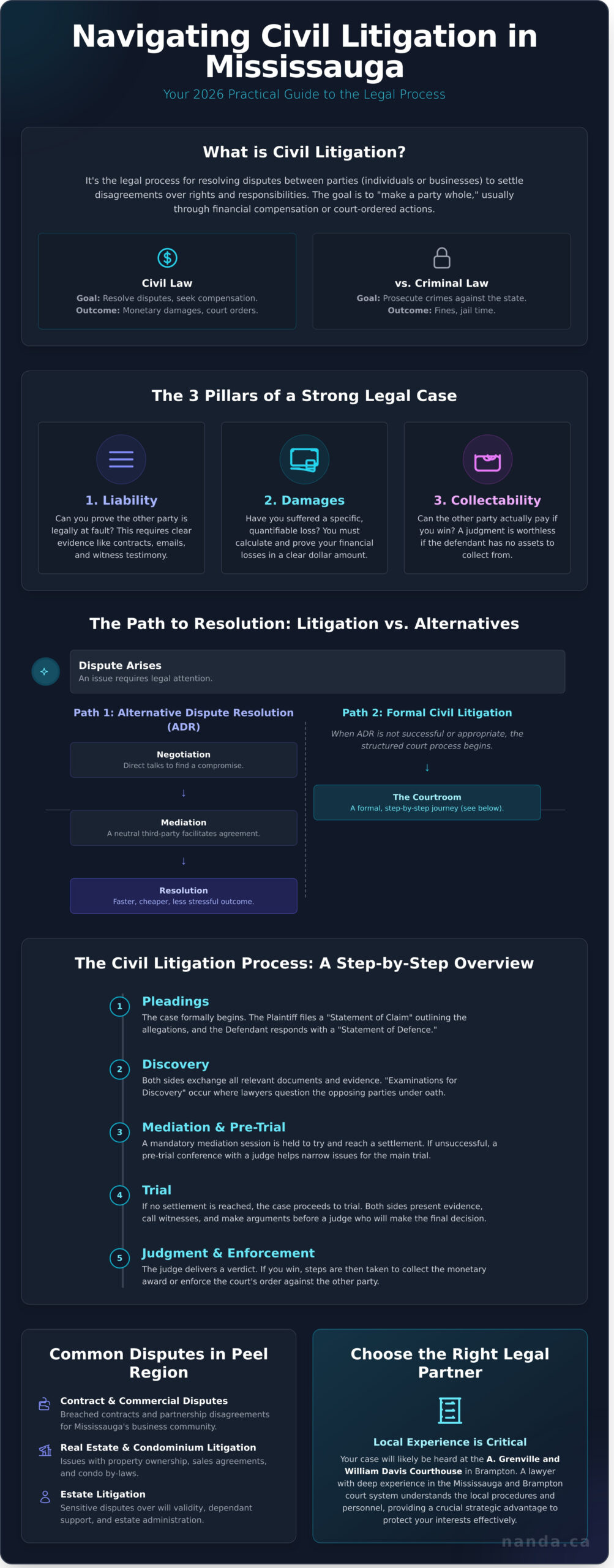
In simple terms, civil litigation is the legal process used to resolve disputes between two or more parties-which can be individuals, businesses, or other organizations. Unlike criminal law, where the state prosecutes an individual for a crime, a civil case does not result in jail time. Instead, its primary purpose is to settle a disagreement over rights and responsibilities, often seeking a resolution through financial compensation or a court-ordered action.
The fundamental goal of civil litigation is to "make a party whole" again after they have suffered a loss or harm due to another party’s actions or negligence. This is achieved either through a monetary award, known as damages, or through a court order that requires a party to perform a specific act (like honouring a contract) or refrain from doing something (an injunction). The entire framework for these legal actions is guided by a comprehensive set of regulations, as outlined in the rules for Civil procedure in Canada, which ensures a structured and fair process for all parties involved.
Common Types of Civil Disputes We See in Peel Region
As a firm deeply rooted in the community, our Mississauga civil litigation law team regularly provides representation for a wide range of civil matters affecting residents and businesses in Mississauga and the surrounding Peel Region. These frequently include:
-
Contract and Commercial Disputes: Representing Mississauga’s thriving business community in matters of breached contracts, partnership disagreements, and other commercial conflicts.
-
Real Estate and Condominium Litigation: Addressing complex issues related to property ownership, purchase and sale agreements, title disputes, and condominium by-law enforcement.
-
Estate Litigation: Providing compassionate yet firm guidance in sensitive disputes over the validity of wills, dependant support claims, and the administration of estates.
The Role of the Superior Court of Justice in Brampton
For residents of Mississauga, understanding the local legal landscape is a crucial first step. Significant civil matters fall under the jurisdiction of the Ontario Superior Court of Justice. The primary venue for these cases is the A. Grenville and William Davis Courthouse, located in Brampton. This court is equipped to hear the complex disputes we handle, from high-stakes commercial disagreements to intricate estate challenges, providing the formal setting where your rights can be asserted and protected.
Before the Courtroom: Assessing Your Case and Exploring Alternatives
Embarking on the path of civil litigation can feel daunting. Before a statement of claim is ever filed, the most critical work involves a clear-eyed assessment of your position and a strategic exploration of all available options. A successful outcome depends on much more than simply being "in the right." It requires a strong legal foundation and a practical understanding that the courtroom is not always the most efficient or effective forum for resolution.
At its core, a strong case in Ontario rests on three essential pillars: liability (proving the other party is at fault), damages (demonstrating a quantifiable loss), and collectability (the other party’s ability to pay a judgment). A weakness in any one of these areas can jeopardize your entire claim. This is why we begin by helping clients answer the tough questions before committing to a lengthy and expensive court battle.
Key Questions to Ask Before You Sue
A rigorous preliminary analysis is the cornerstone of a sound legal strategy. Before proceeding, we work with our clients to establish clear answers to these fundamental questions:
-
What clear evidence do I have to support my claim? This includes documents, contracts, emails, photographs, and witness testimony. A court relies on proven facts, not just assertions.
-
What is the specific financial loss I have suffered? You must be able to calculate and prove your damages in a clear dollar amount, from lost income to repair costs.
-
Can the other party pay if I win? A court judgment is only a piece of paper if the defendant has no assets. Investigating their financial standing is a crucial, practical step.
Alternatives to Litigation: Mediation and Negotiation
The court system should be viewed as a last resort. Alternative Dispute Resolution (ADR) methods offer powerful, cost-effective tools for achieving a favourable outcome with less time and stress. For many disputes, even those eligible for Ontario’s simplified procedure for civil claims, resolving the matter outside of court is preferable. The two most common methods are:
-
Negotiation: A direct or lawyer-assisted discussion between parties to arrive at a mutually acceptable settlement agreement.
-
Mediation: A structured process where a neutral third-party mediator facilitates communication and helps the parties negotiate their own resolution.
The benefits are significant: lower legal costs, faster resolutions, confidentiality, and greater control over the final outcome compared to leaving the decision in a judge’s hands.
The Importance of Ontario’s Limitation Periods
In Ontario, the law sets strict deadlines for initiating a lawsuit. This is known as a limitation period. For most civil claims, the Limitations Act, 2002 imposes a general two-year deadline from the date the claim was discovered. "Discovery" is the day you knew, or ought to have known, that you suffered a loss caused by the other party. Failing to file your claim within this timeframe will almost certainly extinguish your right to sue, no matter how strong your case may be. It is absolutely critical to seek legal advice from an experienced civil litigation lawyer promptly to ensure your rights are protected.
The Civil Litigation Process in Ontario: A Step-by-Step Overview
When alternative dispute resolution methods like negotiation are unsuccessful, the formal court system provides a structured path toward a resolution. Embarking on the civil litigation journey in Ontario means following a clear, methodical process governed by the Rules of Civil Procedure. It is crucial to understand that this path is deliberate and can be lengthy, often spanning many months or even years. The complexity of these stages underscores the importance of securing experienced legal counsel. Resources like the Law Society of Ontario’s Law Society Referral Service can provide a starting point for finding a qualified professional to guide you.
Stage 1: Pleadings – Starting the Lawsuit
This initial stage involves formally defining the dispute on paper. The plaintiff (the person starting the lawsuit) files a Statement of Claim, which outlines the allegations, the facts of the case, and the specific legal remedy sought. This document is then officially delivered, or "served," to the defendant, who must then provide a formal Statement of Defence, responding to the claims and presenting their side of the story.
Stage 2: Discovery – Gathering Evidence
The discovery phase is designed to ensure both parties have access to all relevant information before a trial. There are no surprises in court. This involves two key steps: an Affidavit of Documents, where each side discloses all relevant documents, and Examinations for Discovery, where lawyers question the opposing parties under oath. This crucial process allows each side to assess the strengths and weaknesses of their case and often encourages settlement.
Stage 3: Pre-Trial and Trial
Before a matter proceeds to trial, the system strongly encourages resolution. In many jurisdictions in Ontario, Mediation is a mandatory step where a neutral third party helps facilitate a settlement. If mediation is unsuccessful, a Pre-Trial Conference is held with a judge to discuss the issues and explore settlement possibilities one last time. If no agreement is reached, the case proceeds to Trial, where evidence is presented, and a judge makes a final, binding decision.
Understanding the Costs: How Legal Fees Work in Civil Litigation
One of the most significant concerns for individuals and businesses contemplating legal action is the potential cost. At Nanda & Associate Lawyers, our civil litigation lawyers Mississauga understand that financial uncertainty can be a major barrier. We are committed to providing complete transparency, ensuring you have a clear and comprehensive understanding of all potential expenses before we proceed. The foundation of our relationship is a detailed retainer agreement, which outlines the scope of our services and the associated fee structure, providing you with peace of mind.
Common Fee Structures Explained
In Mississauga and across Ontario, law firms typically use several models to bill for services. The structure chosen often depends on the nature and complexity of your case:
-
Hourly Rates: This is the most common arrangement in civil litigation. You are billed for the time your legal team spends working on your file, including meetings, research, and court appearances. We provide detailed invoices so you can see exactly how time is being allocated.
-
Contingency Fees: Primarily used in personal injury cases, this "no-win, no-fee" structure means our legal fees are a percentage of the final settlement or award. You do not pay legal fees if your case is unsuccessful, making justice more accessible.
-
Flat Fees: For specific, predictable tasks such as drafting a contract or filing a standard motion, a flat fee may be offered. This provides cost certainty for a defined scope of work.
Beyond Legal Fees: Disbursements and Cost Awards
It is crucial to understand that the total cost of litigation extends beyond your lawyer’s fees. Two other key components are disbursements and potential cost awards.
-
Disbursements: These are the out-of-pocket expenses required to advance your case. They include costs such as court filing fees (e.g., C$229 to file a Statement of Claim in the Ontario Superior Court of Justice), fees for process servers, expert witness reports, and transcription services.
-
Cost Awards: Ontario operates on a "loser pays" principle. This means the successful party in a lawsuit is often entitled to have a portion of their legal fees and disbursements paid by the unsuccessful party. While this can be beneficial if you win, it also represents a significant financial risk if you lose.
Navigating the financial aspects of a legal dispute requires a strategic and informed approach. At Nanda & Associate Lawyers Professional Corporation, our team is dedicated to developing a legal strategy that is not only effective but also mindful of your financial realities. To gain a clearer picture of the potential costs for your specific situation, we invite you to schedule a consultation with our experienced litigation team.
How to Choose the Right Civil Litigation Lawyer in Mississauga
Understanding the stages of a lawsuit is the first step; the next is taking decisive action by selecting the right legal advocate to guide you. When facing a legal dispute in Mississauga, your choice of lawyer is one of the most critical decisions you will make. Success often depends not just on legal knowledge, but on local expertise and a deep familiarity with the procedures and personnel at the A. Grenville and William Davis Courthouse in Brampton, which serves the Peel Region. The right firm will not only represent you but will partner with you to navigate the complexities of the system with confidence and strategic foresight.
Key Qualities of an Effective Litigation Team
As you evaluate your options, look for a law firm that demonstrates a clear commitment to your success. A strong legal partner should possess a combination of skill, strategy, and client-focused service. We recommend you seek a team with:
-
Demonstrable Experience: A proven track record in your specific type of dispute, whether it involves a contract breach, a real estate conflict, or a personal injury claim.
-
A Strategic Approach: A commitment to exploring all avenues for resolution, including cost-effective alternatives to court such as mediation and arbitration, to secure the best possible outcome.
-
Clear Communication: A policy of keeping you informed and empowered throughout the legal process, ensuring your questions are answered promptly and clearly.
-
A Reassuring Demeanor: A professional and composed team that builds your confidence and provides peace of mind during a stressful time.
Beyond legal support, it’s also important to manage the personal stress that comes with a dispute by looking after your health.
Why Choose Nanda & Associate Lawyers for Your Case
At Nanda & Associate Lawyers, we have built our reputation on embodying these essential qualities. Our approach to civil litigation is designed to provide comprehensive, client-centred legal solutions. We leverage the collective knowledge of our multidisciplinary team to address every angle of your case, offering a level of insight that standalone practitioners cannot match. We prioritize strategic, cost-effective resolutions that protect your financial and personal well-being.
Reflecting the vibrant diversity of our community, our professionals proudly serve clients in over 15 languages. We believe that clear communication is the foundation of trust, and we are committed to ensuring you feel understood and respected. If you are ready to move forward with a dedicated and experienced legal team, we are here to help.
Schedule a consultation to discuss your case with our experienced team.
Navigating Your Civil Dispute with a Trusted Partner
Navigating a legal dispute in Mississauga requires a clear understanding of the process, a careful assessment of your options, and the right legal partner. While the path of civil litigation can seem daunting, being well-informed is the first step toward protecting your interests and achieving a favourable resolution. You do not have to face this challenge alone.
At Nanda & Associate Lawyers, we have been providing comprehensive legal solutions to the Mississauga community since 2003. Our team’s extensive experience with the Brampton Superior Court of Justice ensures your case is managed with seasoned expertise. To serve our diverse community, we proudly offer our services in over 15 languages, ensuring clear communication and tailored representation every step of the way.
If you are ready to discuss your case and explore your legal options, we invite you to contact our Mississauga office for a confidential consultation. Let us provide the clarity and dedicated support you need to move forward with confidence.
Frequently Asked Questions About Civil Litigation
How long does a civil lawsuit typically take in Ontario?
The timeline for a civil lawsuit in Ontario varies significantly based on the complexity of the case and the court in which it is filed. A straightforward Small Claims Court matter may resolve within a year. However, a more complex case in the Superior Court of Justice can take several years to proceed through pleadings, discovery, motions, and potentially a trial. Our team works to navigate this process efficiently, always protecting your interests.
What is the first step I should take if I think I have a civil case?
The most critical first step is to seek a professional legal consultation. An experienced lawyer can assess the merits of your potential claim, explain your legal options, and advise you on crucial deadlines, known as limitation periods. Acting promptly is essential to preserve your rights. We encourage you to contact our firm to gain a clear understanding of your position and the strategic path forward before taking any action.
Can I sue someone without a lawyer in Small Claims Court?
Yes, you are permitted to represent yourself in Ontario’s Small Claims Court. However, the legal system has specific procedures and rules of evidence that can be challenging to navigate alone. Retaining legal representation ensures your case is presented effectively and professionally, which can significantly improve your chances of achieving a favourable outcome. A lawyer ensures all procedural requirements are met, protecting you from potential missteps.
How much does it cost to start a civil litigation case in Mississauga?
The cost to initiate a civil litigation case involves court-mandated filing fees and legal fees. In Ontario, the government sets the court fees; for example, filing a claim in Small Claims Court can cost between C$108 and C$408, while Superior Court fees are higher. Legal fees will vary depending on the complexity of your case. We provide transparent information on all potential costs during your initial consultation to ensure complete clarity.
What happens if I receive a Statement of Claim?
Receiving a Statement of Claim is a serious matter that requires your immediate attention, as it formally begins a lawsuit against you. In Ontario, you have a strict deadline-typically 20 days-to file a Statement of Defence. Failing to respond in time can lead to a default judgment against you. It is imperative that you contact a lawyer immediately to understand the allegations and prepare a strategic response to protect your rights.
What is the difference between a settlement and a judgment?
A settlement is a voluntary, negotiated agreement between the parties that resolves the dispute, usually before a trial concludes. It is a private contract that can be kept confidential. Conversely, a judgment is a formal and final decision made by a judge after hearing the evidence at trial. A judgment is legally binding, enforceable by the court, and becomes part of the public record. Both provide a resolution, but through very different processes.
Will my civil litigation case definitely go to trial?
It is a common misconception that every lawsuit ends in a courtroom trial. In fact, the vast majority of civil cases in Ontario are resolved before reaching that stage. Many disputes are settled through skilled negotiation, mediation, or pre-trial conferences. Our legal team is dedicated to finding the most efficient and cost-effective resolution, and we prioritize achieving a favourable settlement for you whenever possible, reserving trial as a final resort.