




What if the most dangerous part of your business expansion isn’t the competition, but the hidden “additional rent” clauses buried in your 2026 lease renewal? You’ve likely felt the pressure of rising operational costs, especially with the City of Mississauga’s 1.15% commercial tax increase for 2026. It’s natural to feel anxious about signing a long-term commitment when the lines between your repair duties and your landlord’s maintenance obligations seem intentionally blurred. Using a robust commercial lease agreement ontario checklist is the first step toward securing your company’s future.
We understand that a lease is more than just a monthly payment; it’s a strategic asset that can either support your growth or drain your resources. This guide provides a comprehensive, legally-grounded framework to help you navigate negotiations and protect your bottom line from unexpected pitfalls. We’ll examine critical red flags, explain how Mississauga’s current 1.516977 tax ratio affects your overhead, and outline strategies to secure a flexible exit plan that gives you peace of mind.
Key Takeaways
- Learn how to verify the “Permitted Use” clause against Mississauga zoning bylaws to ensure your business operations are fully compliant with local regulations.
- Understand the financial implications of Gross, Net, and Triple Net (TMI) lease structures to accurately forecast your total occupancy costs.
- Discover why the written contract is the “supreme law” under the Commercial Tenancies Act, as it provides fewer default protections than residential law.
- Use our commercial lease agreement ontario checklist to identify and negotiate critical terms, including exclusivity clauses and specific repair responsibilities.
- Gain a strategic advantage by mastering the due diligence process, from reviewing the initial Offer to Lease to conducting a necessary title search.
Key Takeaways: Essential Commercial Lease Checklist
Entering a commercial tenancy in Ontario is a significant legal undertaking that binds your business to financial and operational obligations for years. Unlike residential rentals, which are governed by the tenant-friendly Residential Tenancies Act, commercial agreements are primarily controlled by the specific contract you sign. To understand the foundational legal framework of what is a lease, you must recognize that the document itself creates the “law” between you and the landlord. A commercial lease agreement ontario checklist acts as your primary defense against lopsided terms that could jeopardize your company’s solvency.
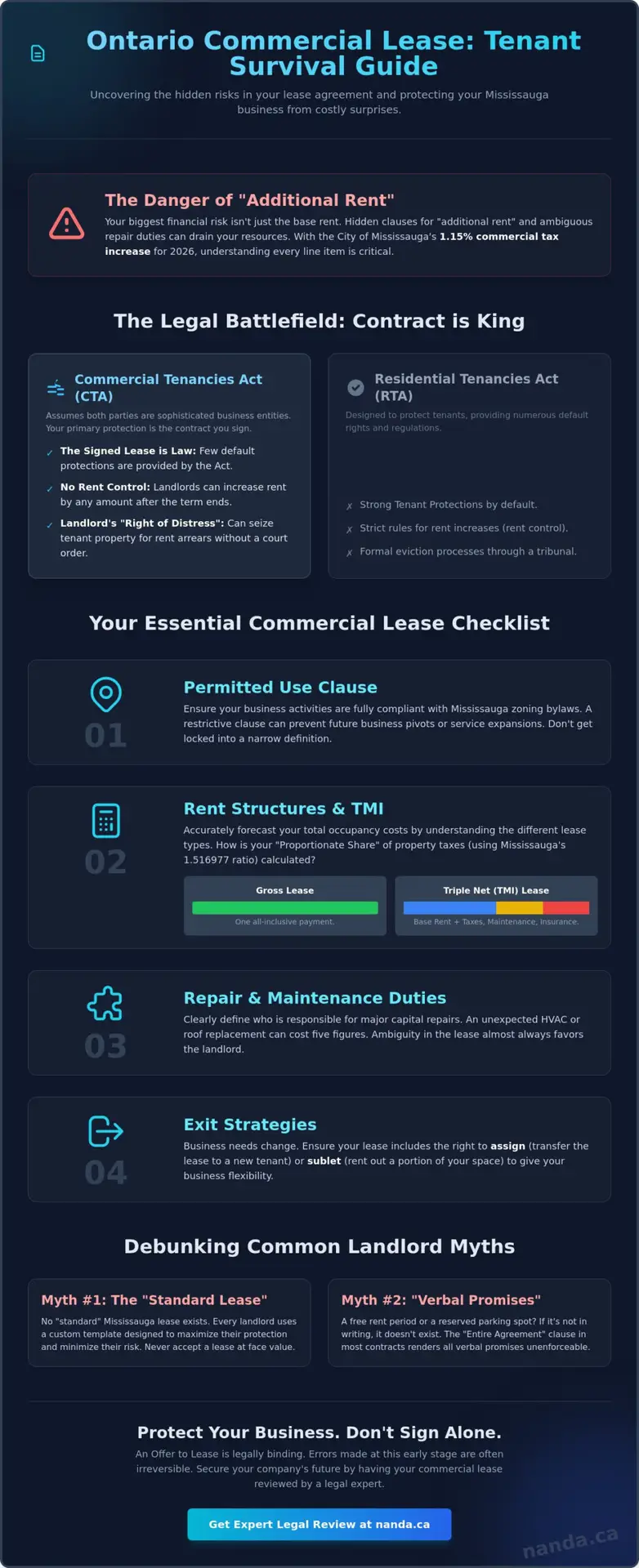
Your checklist should prioritize these four pillars:
- Permitted Use: Confirm that Mississauga zoning bylaws allow your specific business activities. If the lease language is too restrictive, you won’t be able to pivot your business model or add new services later.
- Rent Structures: Distinguish between Gross leases and Triple Net (TMI) leases. In 2026, Mississauga businesses face a 1.15% increase in the city’s portion of commercial taxes, so knowing how your “Proportionate Share” is calculated is vital for your budget.
- Repair Duties: Determine who pays for expensive HVAC systems or structural roof repairs. These costs can reach five figures unexpectedly if the lease isn’t clear.
- Exit Strategies: Ensure you have the right to assign the lease or sublet the space if you sell the business or need to downsize.
Why a Commercial Lease Checklist is Mandatory
Errors made during the initial “Offer to Lease” stage are often irreversible. Once you sign the offer, you’re usually legally committed to the core terms, even before the formal lease is drafted. Because commercial law assumes both parties are sophisticated business entities, courts rarely intervene to “fix” a bad deal. Our business lawyers in Mississauga frequently see entrepreneurs struggle with “additional rent” costs that weren’t clearly defined. A checklist forces you to quantify these liabilities before they become a permanent part of your balance sheet.
The ‘Standard Lease’ Myth in Mississauga
Don’t be misled by a landlord claiming they use a “standard” Mississauga lease. No such document exists. Every landlord uses a template designed to maximize their own protection and minimize their risks. Verbal promises regarding free rent periods or reserved parking stalls are effectively worthless because of the “Entire Agreement” clause found in most Ontario contracts. This clause states that only what’s written in the document matters. If it isn’t on your commercial lease agreement ontario checklist and subsequently written into the contract, it doesn’t exist in the eyes of the law.
Understanding the Commercial Tenancies Act in Ontario
While most people are familiar with the tenant protections found in residential law, commercial relationships operate under a completely different legal philosophy. The Commercial Tenancies Act (CTA) serves as the primary legislation for business rentals in Mississauga. However, it provides surprisingly few default rights. In the commercial world, the law assumes that both parties are sophisticated and capable of protecting their own interests. This means that your signed contract is effectively the “supreme law” of your tenancy. If a specific protection isn’t on your commercial lease agreement ontario checklist and explicitly written into the document, the CTA will not step in to save you.
One of the most powerful tools a landlord possesses under the CTA is the right of “distress.” This allows a landlord to seize and sell a tenant’s property located on the premises to recover rent arrears without first obtaining a court order. Additionally, the Statute of Frauds dictates that any lease intended to last longer than three years must be in writing to be legally enforceable. Relying on a handshake for a long-term Mississauga storefront is a recipe for disaster. We recommend involving civil litigation lawyers early if a landlord attempts to exercise these broad powers unfairly.
CTA vs. Residential Tenancies Act (RTA)
The differences between commercial and residential rules are stark. There is no rent control for commercial properties in Mississauga. A landlord can legally increase the rent by any amount once the initial term expires, provided the lease doesn’t state otherwise. Furthermore, if you fall behind on rent, a commercial landlord can often change the locks after only 16 days of non-payment. You don’t get a hearing at a specialized tribunal; instead, disputes must be resolved through the formal Superior Court of Justice, which is both time-consuming and expensive.
Defining the Premises and Term
Precision is your best friend when defining what you’re actually paying for. Ensure your lease uses BOMA (Building Owners and Managers Association) standards to calculate the “Rentable Area.” Landlords often include a portion of common hallways or lobbies in your square footage, which can inflate your costs. You must also distinguish between the “Commencement Date,” when you get the keys, and the “Rent Commencement Date,” which is when your first payment is due. Always verify that your commercial lease agreement ontario checklist includes “Options to Renew.” Without a clearly defined renewal clause, you have no legal right to stay in the space once your initial term ends, regardless of how much you’ve invested in improvements.
Financial Checklist: Decoding Rent and Additional Costs
Financial clarity is the cornerstone of any sustainable business operation. As you review your commercial lease agreement ontario checklist, you must distinguish between base rent and additional rent. Base rent represents your predictable monthly fee, but “Additional Rent”—often referred to as TMI (Taxes, Maintenance, and Insurance)—is where many Mississauga business owners encounter unexpected expenses. Under the Commercial Tenancies Act, landlords have significant leeway in how they pass these costs to tenants. You need to ensure your “Proportionate Share” is calculated fairly, typically based on the ratio of your square footage to the total rentable area of the building.
Audit rights are a critical, yet often overlooked, part of the negotiation process. You should have the right to inspect the landlord’s financial records once a year to verify that the operating costs you’re paying are accurate. Without this clause, you’re essentially writing a blank check for the building’s management. Annual escalations must also be clearly defined. In 2026, Mississauga’s commercial market is seeing stabilized industrial rents around $17 per square foot, but your lease should specify exactly how much your base rent will increase each year to avoid future disputes.
TMI and Operating Costs in Mississauga
Common Area Maintenance (CAM) fees can include everything from snow removal to parking lot lighting. It’s vital to exclude “Capital Expenditures” from these costs. For example, if the landlord replaces the entire roof, that should be their investment, not an operating expense charged to you. With Mississauga’s 1.15% commercial tax increase in 2026 and a tax ratio of 1.516977, your TMI will likely fluctuate. Utilizing a detailed commercial lease agreement ontario checklist helps you flag items that should remain the landlord’s responsibility. We recommend consulting with our real estate lawyers in Mississauga to ensure your lease protects you from tax reassessment shocks.
Security Deposits and Personal Guarantees
Signing a personal guarantee for your corporation puts your personal assets, including your home, at risk. If your business is established, try to negotiate a larger security deposit or a letter of credit instead. If a guarantee is mandatory, we often suggest a “cap” or a “burn-down” clause. This allows the guarantee to expire after a set number of years of consistent rent payments, providing you with long-term security.
Utilities and Metering
Check if your unit is “separately metered” for hydro and gas. Bulk-metered buildings often divide utility costs by square footage, which means you could end up paying for a neighbor’s high energy usage. In Mississauga, water and hydro accounts must be clearly assigned to either the landlord or the tenant to prevent service interruptions or billing disputes later in your term.
Operational Checklist: Use, Repairs, and Local Zoning
The operational details of your lease dictate how you’ll interact with your physical space every day. A critical item on your commercial lease agreement ontario checklist is the “Permitted Use” clause. Landlords often prefer a narrow definition to maintain control over the tenant mix, but this can stifle your ability to evolve. If you’re a cafe that wants to start selling branded merchandise, a restrictive use clause could technically put you in default. You should also advocate for an exclusivity clause. This prevents the landlord from leasing an adjacent unit to a direct competitor, protecting your market share in a busy Mississauga plaza.
Zoning Verification with the City of Mississauga
Never assume a space is legally ready for your business just because it’s vacant. It’s your responsibility to verify that your intended operations align with Mississauga’s specific zoning bylaws. A “non-conforming use” can lead to immediate lease termination or heavy municipal fines. For instance, certain manufacturing processes or high-traffic retail outlets may have specific parking requirements that the property doesn’t meet. A comprehensive commercial lease agreement ontario checklist must include a step for zoning verification before the “Rent Commencement Date” to avoid paying for a space you can’t actually use.
Maintenance and Repair Obligations
Confusion between “repair” and “maintenance” is a primary source of legal friction. Maintenance generally refers to preventative care, like annual HVAC inspections, while repairs involve fixing major components that have failed. Many Mississauga leases include a “Restoration Clause,” which requires you to return the unit to its original “base building” shell at the end of the term. This means you might have to spend significant capital to gut the very improvements you paid to install. Clarifying these duties now prevents a massive bill when you eventually exit the space.
Signage and Alterations
Your brand’s visibility depends on exterior signage, but most landlords require prior written consent for any changes to the building’s facade. This process must also comply with Mississauga’s sign bylaws. If you’ve negotiated a Tenant Improvement Allowance, ensure the approval process for contractors and materials is streamlined. For expert guidance on these operational hurdles, consult our team for business law in Mississauga to ensure your contract supports your daily operations.
The Legal Review Process: Securing Your Investment
The final stage of securing your business location is often the most critical. Many entrepreneurs mistakenly believe that the “Offer to Lease” is just a preliminary document, but in Ontario, it frequently contains binding language that dictates the core terms of the final contract. Reviewing this document against your commercial lease agreement ontario checklist before signing is essential. Once the offer is executed, your leverage to negotiate major items like repair duties or personal guarantees diminishes significantly. We ensure that the transition from the letter of intent to the formal lease agreement doesn’t introduce hidden liabilities that could threaten your company’s stability.
Due diligence also requires a formal “Title Search.” This process confirms that the landlord actually owns the property and has the legal authority to grant the lease. It also reveals any existing mortgages or liens that could affect your “Quiet Enjoyment” of the space. As part of this review, you’ll encounter Estoppel Certificates and Subordination Agreements. These documents are typically required by the landlord’s lenders and confirm the status of your lease. They’re not just “standard forms”; they’re legal statements that can impact your rights if the building is ever sold or refinanced in the Mississauga market.
Steps to a Professional Lease Audit
A methodical approach prevents costly oversights. First, we conduct an initial review of the Offer to Lease or Letter of Intent to ensure it aligns with your operational goals. Next, we identify high-risk clauses such as Indemnity, which can shift massive liability onto your shoulders, and Force Majeure, which has become increasingly complex since 2020. Our team then enters direct negotiations with the landlord’s counsel to refine the language. The process concludes with the final execution and, in some cases, the registration of the lease on title to protect your interest against future third-party claims.
Why Consult a Mississauga Real Estate Lawyer?
Local expertise is invaluable when navigating the specific nuances of the 2026 Mississauga commercial landscape. Our real estate lawyers in Mississauga provide tailored advice based on current market standards and municipal requirements. We focus on protecting your personal assets from corporate lease liabilities, ensuring that your business’s growth doesn’t put your home or personal savings at risk. By involving our business lawyers in Mississauga early in the process, you gain a strategic partner dedicated to your long-term success. Using a commercial lease agreement ontario checklist is a great start, but having a professional legal audit provides the ultimate peace of mind for your investment.
Secure Your Business Future in Mississauga
Your business deserves a foundation built on clarity rather than assumptions. By diligently following a commercial lease agreement ontario checklist, you protect your venture from the volatility of unmanaged TMI costs and restrictive zoning bylaws. We’ve seen how precise definitions of repair obligations and well-negotiated renewal options can save a company’s balance sheet during unexpected market shifts. Transitioning from a signed Offer to Lease to a fully executed contract requires a strategic eye that understands both the fine print and the local Mississauga landscape.
Since 2003, Nanda & Associate Lawyers has provided comprehensive legal solutions to Mississauga entrepreneurs in over 15 languages. Our team brings deep experience in Ontario Superior Court litigation to every negotiation, ensuring your interests are shielded from day one. Don’t leave your long-term stability to a template contract. Book a Commercial Lease Consultation with our Mississauga Team today to review your agreement with confidence. We’re here to help you turn a complex legal document into a powerful tool for your business growth.
Frequently Asked Questions
Is there a standard commercial lease agreement in Ontario?
No, there’s no standard form for commercial leases in Ontario, unlike the mandatory standard lease used for residential tenancies. Every landlord uses a custom template tailored to their specific property and risk profile. This makes using a commercial lease agreement ontario checklist essential to ensure you aren’t missing critical protections that the law doesn’t automatically provide. Because the contract is the final word on your rights, you must negotiate every term before signing.
What is the difference between a ‘Net’ lease and a ‘Gross’ lease in Mississauga?
A Gross lease involves paying a single flat fee that covers base rent and all operating costs. In contrast, a Net lease requires you to pay a lower base rent plus “additional rent” for your share of taxes, maintenance, and insurance. Most industrial spaces in Mississauga currently favor Net structures. This allows landlords to pass through fluctuating costs, such as the 1.15% city tax increase implemented in the 2026 budget.
Can a landlord lock me out if I am late with my rent in Ontario?
Yes, commercial landlords have broad powers that residential landlords do not possess. Under the Commercial Tenancies Act, a landlord can legally change the locks and prevent you from entering your premises if your rent is at least 16 days overdue. They don’t need a court order to take this action. This is why maintaining open communication and understanding your “grace period” in the contract is vital for business continuity.
Who is responsible for property taxes in a commercial lease?
The tenant is typically responsible for their proportionate share of property taxes in most Mississauga commercial agreements. This is usually billed as part of your TMI (Taxes, Maintenance, Insurance) payments. With Mississauga’s commercial tax ratio sitting at 1.516977 in 2026, these costs can be substantial. You should always verify that your lease defines “proportionate share” based on your actual square footage relative to the entire building’s rentable area.
What happens to my lease if I sell my Mississauga business?
Your ability to transfer the lease depends entirely on the “Assignment and Subletting” clause. If your lease is silent or restrictive, you might remain personally liable for the rent even after selling your company assets. A well-drafted commercial lease agreement ontario checklist includes a requirement for the landlord to not unreasonably withhold consent for an assignment. This ensures you have a clear exit strategy when it’s time to move on or retire.
Do I need a lawyer to review a commercial lease before I sign?
Yes, because a commercial lease is a complex financial liability that can span five to ten years. A lawyer identifies “red flag” clauses that an untrained eye might miss, such as lopsided indemnity or restoration requirements. We help you verify that your business complies with Mississauga zoning bylaws and protect your personal assets from corporate defaults. Investing in a professional review prevents costly litigation that often arises from vague or unfair contract language.
Can I negotiate the ‘Additional Rent’ or TMI costs?
While you can’t negotiate the actual property tax rate or insurance premiums, you can negotiate what the landlord includes in the “Maintenance” portion. You should insist on excluding capital expenditures, such as structural roof replacements or parking lot repaving, from your annual operating costs. Negotiating a “cap” on management fees is another effective way to keep your monthly overhead predictable. These details should be addressed during the initial Offer to Lease stage.
What is an ‘Option to Renew’ and why is it critical?
An Option to Renew gives you the legal right to extend your stay in the premises after the initial term expires. Without this clause, your landlord can force you to vacate or demand an unreasonable rent increase once your term ends. This is critical for Mississauga businesses that have spent significant capital on leasehold improvements. You must follow the specific notice timelines in your lease, usually six to nine months in advance, to validly exercise this option.
Disclaimer
This content is for general information only and does not constitute legal advice or create a lawyer-client relationship. Every case is different—please consult a qualified lawyer for advice specific to your situation.