


Imagine it’s 2026. Your Mississauga business is thriving, but your landlord suddenly invokes a little-known demolition clause, giving you just 180 days to vacate. The dream you’ve built is now at risk because of a single sentence on page 37 of your lease. It’s a terrifying thought, and for many business owners, the anxiety surrounding complex lease agreements is all too real. You understand that unlike residential tenancies, Ontario’s Commercial Tenancies Act offers minimal protection, leaving you vulnerable to clauses concerning unexpected TMI costs, rigid personal guarantees, and restrictive assignment rights.
This guide is designed to demystify the process and provide peace of mind. We will show you how a professional commercial lease review in Mississauga can transform a standard landlord-favoured document into a strategic asset that protects your investment and supports your long-term growth. We’ll break down the critical clauses to watch for, explain your rights and obligations, and provide actionable steps to negotiate a lease that secures your business’s future.
Key Takeaways
-
Understand that there is no such thing as a "standard" commercial lease in Ontario; every term is negotiable and requires careful scrutiny to protect your business.
-
Learn to differentiate between Gross, Net, and Triple Net (TMI) lease structures to accurately forecast your total financial obligations and avoid hidden costs.
-
A professional commercial lease review in Mississauga is a critical step that identifies high-risk clauses and ensures your rights are protected under the Commercial Tenancies Act.
-
Discover how to recognize and negotiate common "tenant traps," such as restrictive assignment clauses or demolition terms, that can limit your future operational flexibility and exit strategies.
Table of Contents
-
Why Commercial Lease Review in Mississauga is Critical in 2026
-
Legal Explanation: Understanding Lease Structures and Ontario Statutes
-
The Commercial Lease Review Process: A Step-by-Step Timeline
-
Strategic Representation: Why Choose Nanda & Associate Lawyers
Why Commercial Lease Review in Mississauga is Critical in 2026
As Mississauga’s economy continues its robust growth into 2026, securing a commercial space is a significant milestone for any business. Whether you are eyeing a prime retail location near Square One Shopping Centre or an industrial unit in the Airport Corporate Centre, the lease you sign is one of the most important contracts you will ever enter. A commercial lease review is not a simple proofread; it is a comprehensive legal audit of your rights, obligations, and potential financial liabilities hidden within dozens of pages. A professional **commercial lease lawyer Mississauga ** businesses can trust dissects this complex document to shield your enterprise from future disputes and financial distress.
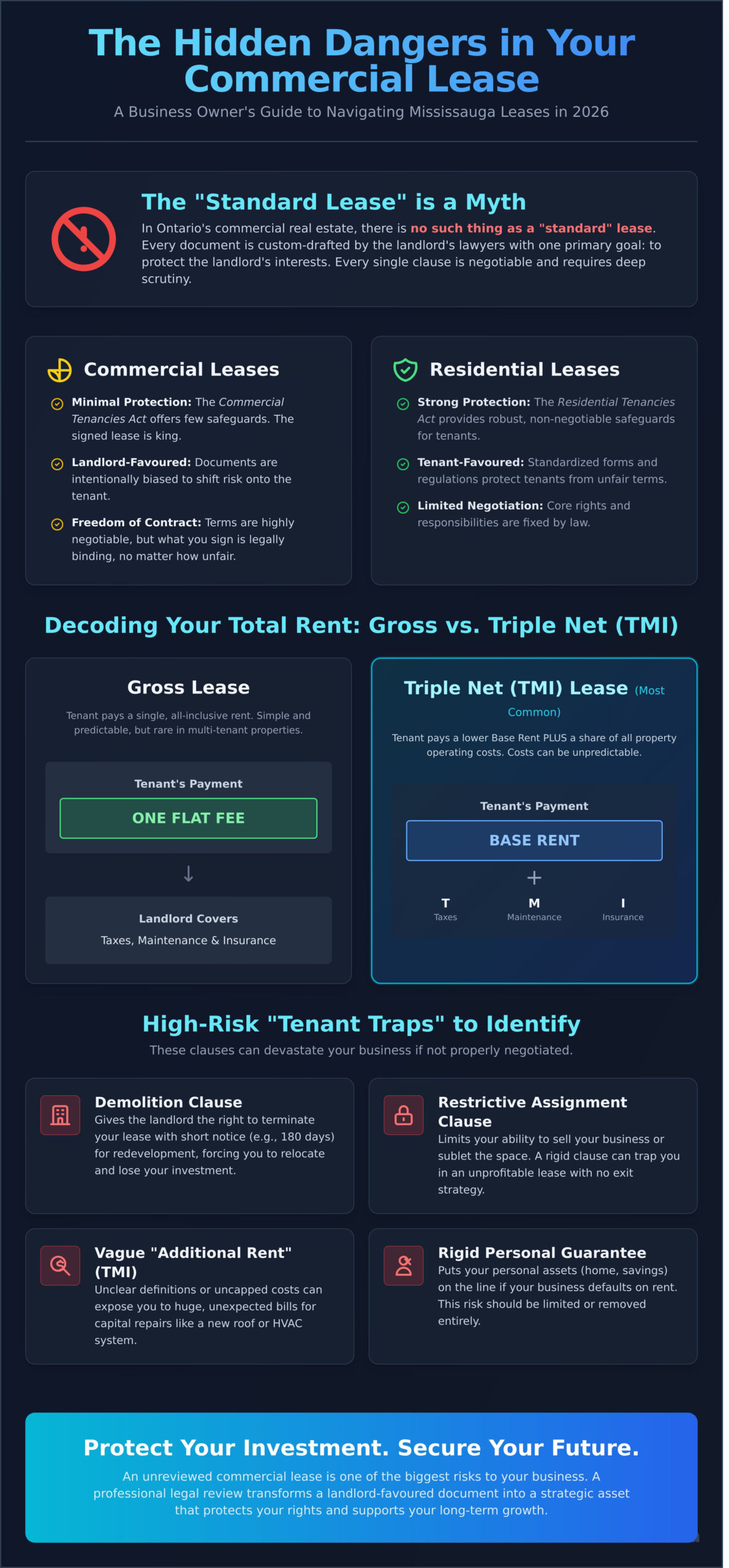
Many business owners fall into the trap of believing in the "standard lease" myth. Let’s be clear: in Ontario’s commercial real estate sector, there is no such thing. Unlike residential agreements, commercial leases are custom documents drafted by the landlord’s legal team with one primary objective: to protect the landlord’s asset. These contracts are intentionally biased. Without a meticulous review, you could unknowingly agree to clauses that permit exorbitant rent increases, assign you responsibility for major structural repairs, or even put your personal assets at risk. The stakes are simply too high to sign without fully understanding every term.
Mississauga Zoning and Permitted Use Clauses
A landlord’s approval for your business activity does not automatically mean the City of Mississauga agrees. Your lease might permit you to operate a specific type of clinic, but if the property’s zoning under Bylaw 0225-2007 prohibits it, your lease is useless. It’s also critical to negotiate a "use" clause that allows for natural business evolution. A clause that is too narrow can prevent you from expanding your services or product lines in the future, effectively stifling growth.
Commercial vs. Residential: The Absence of "Standard" Protections
The consumer protections you may be familiar with from residential renting do not apply here. The Residential Tenancies Act offers zero safeguards to commercial tenants. Instead, the sector operates on the principle of "freedom of contract," meaning the terms you agree to in the lease are legally binding, regardless of how one-sided they may be. While the Commercial Tenancies Act exists, it provides minimal default rules that are almost always superseded by the specific terms written into your lease agreement.
Ultimately, the lease is the foundational document that will govern your business operations, financial commitments, and exit strategy for the next five, ten, or even twenty years. The complexity of modern commercial lease agreements, with their detailed clauses on additional rent, maintenance obligations, and landlord remedies, requires a strategic and defensive legal analysis. Failing to invest in this crucial due diligence upfront is a gamble that can lead to devastating financial consequences down the road. Protecting your investment begins long before you open your doors; it begins with a thorough legal review.
Legal Explanation: Understanding Lease Structures and Ontario Statutes
A commercial lease is not a standard-form document; it is a complex, negotiated contract that dictates your business’s financial and operational future. Unlike residential tenancies, the commercial sphere offers far fewer statutory protections. The terms you agree to in the lease document will govern your relationship with the landlord, making a detailed review essential. Understanding the fundamental structures and the governing laws in Ontario is the first step toward protecting your interests.
The financial obligations in a commercial lease extend far beyond a simple monthly payment. This is where a detailed commercial lease review mississauga becomes critical. Disputes often arise not from the base rent, but from the ambiguous and often escalating costs bundled into "Additional Rent." These costs are governed by the lease type, and in Peel Region, net leases are the prevailing standard.
Net vs. Gross Leases: The Financial Impact
In a Gross Lease, the tenant pays a single, all-inclusive rent, and the landlord covers all property expenses. While simple, this is increasingly rare in multi-tenant Mississauga properties. More common are Net Leases, where the tenant pays a lower "Base Rent" plus a share of the property’s operating costs, known as "Additional Rent" or TMI.
-
TMI Breakdown: This acronym stands for Taxes (municipal property taxes), Maintenance (also called Common Area Maintenance or CAM), and Insurance (the landlord’s property insurance).
-
Calculating Rent: Your total rent is the sum of your Base Rent (a fixed cost per square foot) and the Additional Rent (your proportionate share of the TMI). TMI is estimated annually and you pay a monthly installment, with a reconciliation at year-end that could result in you owing more.
-
Audit Rights: It is crucial that your lease includes a clause giving you "Audit Rights." This allows you to inspect the landlord’s records to verify the CAM charges you are paying. Without this, you have no way to dispute potentially inflated or improper costs.
While the lease itself is paramount, certain disputes over issues like termination or distress (seizing a tenant’s goods for non-payment) are informed by Ontario’s Commercial Tenancies Act. This legislation provides a baseline framework, but it does not override the specific terms you negotiate in your lease agreement. This is why the initial review is so vital.
The Legal Reality of Personal Guarantees
For new corporations or businesses without a long financial history, Mississauga landlords almost universally require a personal guarantee. This is a separate agreement where you, the business owner, personally promise to cover the lease obligations if your corporation defaults. It effectively bypasses the liability protection of your corporation, putting your personal assets—like your home and savings—at risk.
However, a personal guarantee does not have to be an absolute, lifelong commitment. We advise clients to negotiate limitations to mitigate this significant personal risk. Strategies include:
-
A "Burn-Off" Clause: The guarantee can be structured to fall away after a set period of good standing, for instance, after the first 3 or 5 years of a 10-year lease term without any defaults.
-
Capping the Amount: You can limit the guarantee to a specific dollar amount, such as the equivalent of 6 or 12 months of gross rent, rather than the entire value of the lease term.
Successfully negotiating these limitations requires a strategic approach and a clear understanding of the landlord’s risk profile. An experienced commercial lawyer can be instrumental in securing these crucial protections for your personal finances.
The Commercial Lease Review Process: A Step-by-Step Timeline
Signing a commercial lease is a multi-stage commitment that defines your business’s physical and financial future for years. A rushed process can lead to costly oversights and long-term liabilities. At Nanda & Associate Lawyers, we guide our clients through a methodical, four-phase process designed to secure favourable terms and protect their interests. This structured approach transforms a potentially overwhelming document into a clear and strategic business asset.
From LOI to Formal Lease Agreement
The journey begins long before you see the final lease. The Letter of Intent (LOI) or Offer to Lease is the foundational document, yet many business owners treat it as a casual preliminary step. This is a critical error. Many LOIs are drafted to be legally binding. Involving a real estate lawyer at this initial stage is not a luxury; it’s a necessity to prevent common mistakes that haunt tenants later, such as:
-
Vague Use Clauses: Failing to clearly define your permitted business activities can restrict future growth or adaptation.
-
Ambiguous Renewal Terms: An "option to renew" without a defined process for setting the future rent rate is an agreement to disagree later.
-
Unspecified Landlord Contributions: Not itemizing the landlord’s financial contribution to your fit-up (Tenant Improvement Allowance) can leave you with unexpected costs.
Your lawyer ensures the key commercial terms-rent, term length, renewal options, and permitted uses-are precisely defined in the LOI. We then meticulously cross-reference the formal lease agreement against the signed LOI to guarantee no details have been altered or omitted by the landlord.
Coordinating with Professionals
A comprehensive commercial lease review in Mississauga is a collaborative effort. Your legal counsel acts as the central coordinator for a team of essential professionals. We work in synergy with your commercial realtor, who provides market intelligence on comparable rents and property conditions, and your insurance broker, who confirms you can meet the lease’s often-stringent insurance and indemnity requirements. This integrated approach ensures every clause is examined from legal, financial, and operational perspectives.
A primary focus is scrutinizing the "Landlord’s Work" and "Tenant’s Work" schedules. We clarify ambiguities to prevent disputes over who is responsible for HVAC systems, structural repairs, or bringing the premises up to code. Clear definitions here can save you tens of thousands of dollars. We also fortify your lease with robust dispute resolution clauses, outlining steps for mediation or arbitration to avoid costly civil litigation. These provisions must operate within the legal framework established by Ontario’s Commercial Tenancies Act to be enforceable.
The final phases involve strategic negotiation and formal execution. After our initial audit identifies risks, we help you trade minor concessions for critical protections, such as securing an exclusivity clause. Once all terms are finalized and agreed upon, we oversee the formal signing. For leases longer than five years, we strongly advise registering the lease on title to protect your tenancy rights against any future sale of the property or claims from the landlord’s creditors, securing your peace of mind.
Practical Advice: Identifying High-Risk "Tenant Traps"
A standard commercial lease is drafted to protect the landlord’s interests, not yours. Buried within its pages are clauses that can cripple your business operations, limit your future options, or lead to unexpected financial ruin. These "tenant traps" are particularly prevalent in a rapidly developing area like Mississauga. A proactive and detailed commercial lease review mississauga is not an expense; it’s a critical investment in your business’s long-term stability.
The Danger of Demolition Clauses
With major urban intensification projects like the Hurontario LRT transforming Mississauga’s landscape, demolition and redevelopment clauses are now common. A landlord can terminate your lease with notice if they decide to demolish or substantially renovate the property. We work to negotiate crucial protections for our clients, such as extending a standard 180-day notice period to 12 or even 24 months. More importantly, we fight for compensation for the unamortized value of your leasehold improvements. If you invested C$200,000 in a custom build-out on a 10-year term and are forced out after year five, you should recover the remaining C$100,000 value you’ve lost. Beware the "relocation" clause often offered as a substitute; we ensure the language guarantees a truly comparable space, not just any vacant unit the landlord has available.
Assignment Rights for Business Continuity
What happens when you decide to sell your successful business? The value of your enterprise is intrinsically tied to its location and the lease agreement. An assignment clause dictates your ability to transfer the lease to a new owner. If the lease states the landlord has "sole discretion" to approve an assignment, they can refuse for any reason, effectively vetoing the sale of your business. We advocate strongly for language that requires the landlord’s consent "not to be unreasonably withheld." This provides an objective standard and protects your exit strategy. Equally vital is securing a clause that fully releases you, the original tenant, from all liability once the assignment is complete.
Beyond these major clauses, scrutinize the section on "Operating Costs" or Additional Rent. Without a negotiated cap, your share of the building’s expenses can escalate uncontrollably. We recommend negotiating a cap tied to a fixed percentage (e.g., 3-5% annually) or the Ontario Consumer Price Index, whichever is lower. This introduces predictability to one of your largest overheads. Finally, understand your rights regarding default. Under Ontario’s Commercial Tenancies Act, a landlord can change the locks just 16 days after rent is due. A properly negotiated lease includes a "notice and cure" period, giving you a written warning and a chance to remedy a default before facing eviction.
Identifying these complex risks requires a trained legal eye. Before you sign, let our team conduct a thorough commercial lease review to safeguard your investment and secure your peace of mind.
Strategic Representation: Why Choose Nanda & Associate Lawyers
Choosing the right legal partner for your commercial lease is a foundational business decision. It’s not just about reviewing a document; it’s about securing your company’s future physical home and financial stability. At Nanda & Associate Lawyers Professional Corporation, we provide more than just a legal opinion. We deliver a strategic advantage rooted in comprehensive expertise and a deep commitment to the success of Mississauga’s business community.
Our strength lies in our collaborative, multidisciplinary approach. A commercial lease is where property law and corporate strategy intersect. That’s why our team combines the focused expertise of our real estate law division with the strategic oversight of our Business Law team. This integrated perspective ensures no detail is missed, from zoning compliance and property-specific covenants to how termination clauses could impact your long-term corporate growth.
Mississauga is one of Canada’s most diverse cities, and your legal team should reflect that. Our professionals proudly serve clients in over 15 languages, including Punjabi, Hindi, Mandarin, and Tagalog, ensuring clear communication and a nuanced understanding of your needs. We pair this global perspective with transparent fee structures, providing either flat-rate reviews or clear hourly estimates so you can budget with confidence and achieve peace of mind.
A Comprehensive Legal Solution
A thorough commercial lease review in Mississauga goes far beyond the initial signature. Our role is to act as your dedicated mentor through the negotiation process, translating complex legalese into actionable business intelligence. We work to protect your long-term interests by scrutinizing clauses related to renewals, assignments, landlord obligations, and default provisions, safeguarding your operations against future disputes and unforeseen costs.
Next Steps: Booking Your Consultation
Taking the first step toward protecting your business is simple. When you schedule your initial consultation with our team, we recommend you bring a few key documents to ensure a productive and efficient review:
-
The draft Lease Agreement or Agreement to Lease
-
Any written Offer to Lease that has been exchanged
-
All correspondence with the landlord or their agent
-
Basic information about your business entity (e.g., incorporation documents)
We are committed to providing responsive, authoritative, and empathetic legal service tailored to your specific objectives. Your business is a significant investment. Let us help you secure its foundation with a meticulous and strategic legal review. Contact us today to protect your investment and build your future with confidence.
Secure Your Business’s Future with a Strategic Lease Review
Your commercial lease is more than a rental agreement; it’s a foundational document that dictates your business’s financial health and operational freedom for years to come. Understanding complex clauses and identifying high-risk tenant traps under Ontario’s legal framework isn’t just wise, it’s essential for your long-term success. A proactive legal advice from our **Mississauga commercial lawyers **provides the critical leverage you need to negotiate favourable terms and protect your investment from costly future disputes. It’s a strategic decision that secures your position in a competitive market.
Since 2003, Nanda & Associate Lawyers has provided comprehensive legal solutions for businesses, acting as a strategic, one-stop resource for both real estate and corporate matters. Our multilingual team, serving clients in over 15 languages, has deep roots in the community and is committed to your protection. Don’t sign a lease without complete confidence. Contact our Mississauga Commercial Lease Lawyers for a Comprehensive Review and let’s build a secure foundation for your success.
Frequently Asked Questions About Commercial Leases
Is a commercial lease review legally required in Ontario?
No, a commercial lease review is not legally mandatory in Ontario. However, it is a critical step for due diligence. The Commercial Tenancies Act provides a basic framework, but most rights and obligations are defined by the lease agreement itself. Forgoing a professional review means you are accepting complex, landlord-drafted terms that could severely impact your business’s finances and operational flexibility. It is a highly recommended protective measure.
How much does a commercial lease review cost in Mississauga?
The cost for a commercial lease review in Mississauga typically ranges from C$1,000 to C$3,500. This price depends on the complexity and length of the document. A review of a standard 15-page lease for a small retail space will be at the lower end of this range. A comprehensive review and negotiation for a large, customized 50-page industrial lease will cost more. Our firm provides a clear fee structure after an initial assessment of your document.
What happens if I sign a lease without a lawyer and find a mistake later?
Once signed, a commercial lease is a legally binding contract, and you are generally obligated to follow its terms, even if you find a mistake later. Correcting an error post-signing is exceptionally difficult and depends on proving it was a mutual mistake or misrepresentation, which is a high legal bar. More often, tenants are stuck with unfavourable terms like unexpected costs or restrictive use clauses. A proactive review prevents these costly future disputes.
Can a landlord really terminate my lease with only 5 days’ notice for unpaid rent?
Yes, under Ontario’s Commercial Tenancies Act, if rent is unpaid for 15 days, a landlord has the right to change the locks and terminate the tenancy without any formal notice period. The "5 days’ notice" often refers to the landlord’s separate right to seize and sell your assets to cover arrears, which requires five days’ notice after seizure. This powerful landlord remedy underscores the importance of understanding every clause in your lease.
How long does the typical commercial lease review and negotiation take?
A standard commercial lease review in Mississauga, including negotiation, typically takes between one to three weeks. The initial legal review can often be completed within 3-5 business days. The overall timeline then depends on the responsiveness of the landlord during negotiations. Simple clarifications may be resolved quickly, while negotiating significant changes to clauses like renewal options or demolition rights can extend the process. We work efficiently to meet your business timelines.
What is TMI, and why is it so high in Mississauga commercial properties?
TMI stands for Taxes, Maintenance, and Insurance, which are additional rent components that tenants pay to cover the property’s operating costs. These costs are passed through from the landlord to the tenants. In Mississauga, TMI can seem high due to factors like rising municipal property taxes, the costs of maintaining modern commercial buildings with extensive amenities, and increasing insurance premiums. A thorough review ensures these clauses are fair and transparent.
Can I negotiate a lease that has already been signed?
Renegotiating a signed and active lease is very difficult, as both parties are legally bound by the existing terms. A landlord has no obligation to consider changes unless the lease itself contains a clause allowing for it. Negotiation is only possible if the landlord voluntarily agrees, which might happen if they want to secure a longer-term commitment from a good tenant. It is far more effective to negotiate all terms before signing the agreement.
What is the difference between a "Gross Lease" and a "Triple Net Lease"?
The primary difference lies in how operating expenses are paid. In a Gross Lease, the tenant pays a single, all-inclusive flat rent, and the landlord covers all property expenses like taxes and insurance. Conversely, in a Triple Net (NNN) Lease, the tenant pays a lower base rent plus their proportionate share of all three major operating expenses: property taxes, insurance, and common area maintenance (TMI). NNN leases are common and shift more financial risk onto the tenant.