


Your biggest risk when buying commercial property in Ontario isn’t market volatility; it’s the unseen legal liabilities lurking just beneath the surface. From hidden environmental contamination to complex Peel Region zoning restrictions, a single oversight can quickly transform a promising investment into a significant financial drain. It’s understandable to feel overwhelmed by the legal details when you’re focused on a property’s potential and its bottom line.
That is precisely why the guidance of an experienced professional is your most valuable asset. As a leading Commercial Real Estate Lawyer in Mississauga, our expertise in buying commercial property in Ontario provides our clients with a critical strategic advantage. We created this comprehensive guide to give you the clarity and confidence needed to navigate the entire transaction, ensuring your investment is secure and your interests are protected from start to finish.
In the sections that follow, we will walk you through essential steps like conducting thorough due diligence, structuring your corporation for optimal asset protection, and achieving a smooth, risk-free closing that complies with all provincial regulations.
Key Takeaways
-
With guidance from a Commercial Real Estate Lawyer in Mississauga: Buying Commercial Property in Ontario, understand why the province’s ‘Caveat Emptor’ (Buyer Beware) principle makes comprehensive due diligence, including critical off-title searches, essential to protect your investment.
-
Learn how to strategically structure your purchase-using a holding company versus an operating company-to optimize tax benefits and shield your personal assets from liability.
-
Discover why a specialized Commercial Real Estate Lawyer in Mississauga: Buying Commercial Property in Ontario is your essential partner for navigating complexities and avoiding costly pitfalls like zoning violations and tenants’ ‘Right of First Refusal’.
-
Gain clarity on the closing process, from the final review of the Statement of Adjustments to the secure electronic registration of your property title via Ontario’s Teraview system.
Table of Contents
-
The Role of a Commercial Real Estate Lawyer in Mississauga’s 2026 Market
-
Structuring the Deal: Agreements, Financing, and Corporate Protection
-
Common Pitfalls and Regulatory Hurdles in Mississauga Acquisitions
The Role of a Commercial Real Estate Lawyer in Mississauga’s 2026 Market
As Mississauga continues its transformation into a major economic hub, driven by projects like the Hurontario LRT and the expansion of its industrial core, the landscape for commercial real-estate investment is becoming increasingly complex. By 2026, investors will face a market defined by sophisticated zoning regulations, evolving development charges, and intense competition. Successfully acquiring a property here isn’t just a transaction; it’s a strategic business decision that demands specialized legal oversight. Understanding the nuances of Commercial property-which includes everything from retail storefronts and industrial warehouses to office buildings-is the first step. The next is securing a legal partner who can protect your investment from start to finish.
This is where the expertise of a dedicated legal team becomes indispensable. The process of Commercial Real Estate Lawyer in Mississauga: Buying Commercial Property in Ontario involves a level of scrutiny far beyond a residential purchase. It requires an integrated approach that merges real estate law with corporate strategy, ensuring your acquisition aligns with your long-term business objectives and mitigates potential liabilities. At Nanda & Associate Lawyers Professional Corporation, we provide this comprehensive legal framework, tailored specifically to Mississauga’s unique economic and regulatory environment.
Why Local Mississauga Expertise Matters
A lawyer based in Toronto or another municipality simply won’t have the granular, on-the-ground knowledge required to navigate Mississauga’s distinct regulatory framework. Our firm’s local presence provides a decisive advantage. We have direct experience with Peel Region’s development charges, which were significantly updated in 2022 and can represent a major cost factor. We also possess a deep understanding of the Mississauga Official Plan (2023 Consolidation), which dictates land use along key intensification corridors and directly impacts future property values. If your potential property requires a minor variance for things like parking or setbacks, our familiarity with the City of Mississauga’s Committee of Adjustment processes can streamline what is often a contentious and lengthy approval procedure.
Commercial vs. Residential: The Legal Complexity Gap
The legal documents and due diligence required for a commercial transaction are vastly more demanding than for a home purchase. Standard OREA forms, while useful, often fail to address the specific risks of a commercial deal, such as existing tenancies, environmental contamination, or equipment liens. The burden of due diligence is placed almost entirely on the buyer. This process includes critical steps you don’t encounter in residential deals:
-
Reviewing tenant estoppel certificates to confirm lease terms.
-
Conducting Phase I Environmental Site Assessments to check for contamination.
-
Obtaining zoning and building compliance letters from the municipality.
More importantly, a commercial property is an asset of your business. Our integrated approach ensures our business lawyers in Mississauga work alongside our real estate team. We protect your corporate interests by verifying the purchasing entity is structured for optimal liability protection and tax efficiency, ensuring the acquisition is not just a sound real estate investment, but a smart corporate move.
Due Diligence and the Ontario Legal Framework
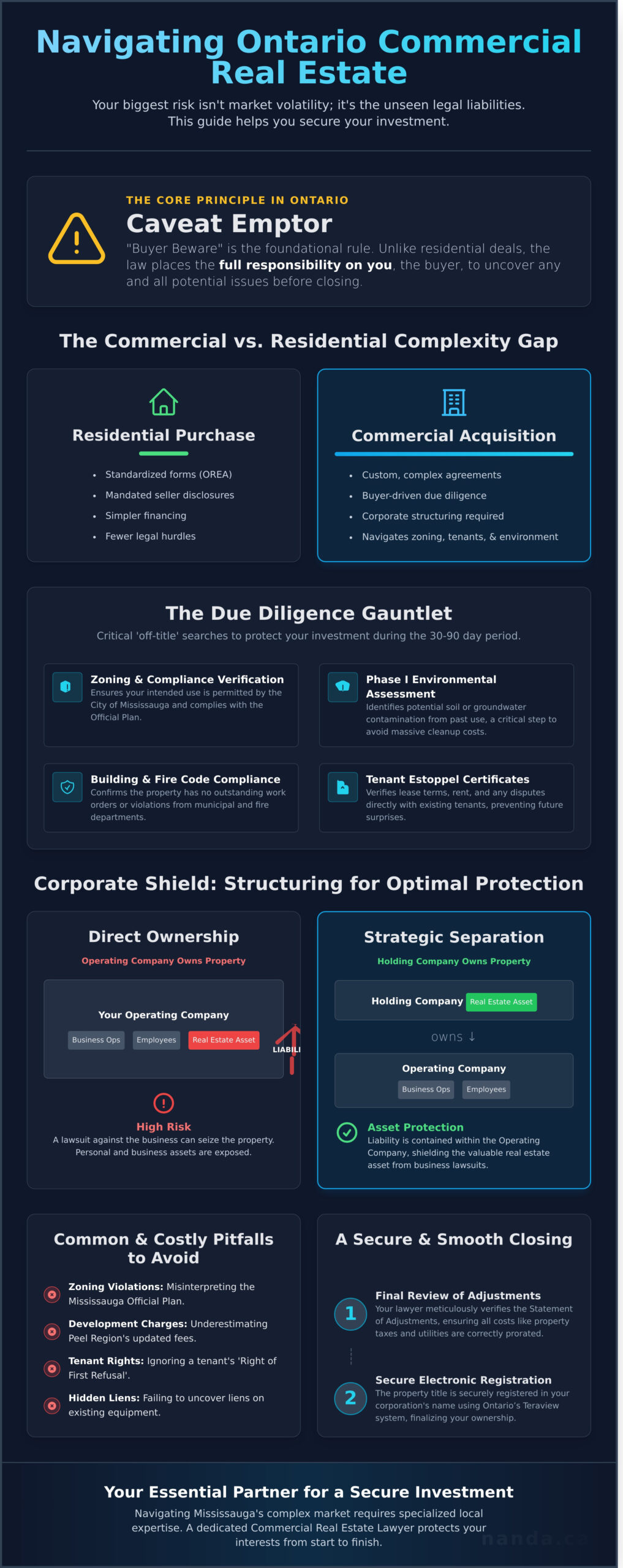
In Ontario’s commercial real estate market, the principle of caveat emptor, or ‘buyer beware’, is the foundational rule. Unlike residential transactions, there are fewer mandated disclosures, placing the full responsibility on you, the buyer, to uncover any and all potential issues with a property before the deal closes. A failure to conduct meticulous due diligence can lead to significant financial loss and legal complications years down the line. This investigative phase is where a purchase is either validated as a sound investment or revealed as an unacceptable risk.
The due diligence period, typically lasting 30 to 90 days, involves a series of critical investigations that go far beyond a simple property inspection. Your legal counsel will coordinate a range of ‘off-title’ searches, which examine issues not registered on the property’s title. A comprehensive checklist includes:
-
Zoning and Compliance: We verify the property’s zoning with the City of Mississauga to ensure it permits your intended use, a requirement under the Ontario Planning Act. A property zoned for ‘light industrial’ use, for example, cannot legally house a retail showroom without a variance or rezoning.
-
Work Orders and Permits: A search of municipal records reveals any outstanding work orders, open building permits, or code violations that you would inherit upon closing.
-
Utility Accounts: We confirm that hydro, water, and gas accounts are in good standing to prevent you from assuming the previous owner’s debts.
-
Fire and Electrical Safety: Inquiries with the Mississauga Fire and Emergency Services and the Electrical Safety Authority (ESA) are made to check for any outstanding orders or known deficiencies.
Environmental Due Diligence: Phase I and II ESAs
Under Ontario’s Environmental Protection Act, a property owner can be held liable for ‘legacy’ contamination, even if they didn’t cause it. A Phase I Environmental Site Assessment (ESA) is a non-intrusive historical review of the property to identify potential contamination risks. If this report raises concerns, such as the site’s previous use as a gas station or dry cleaner, a Phase II ESA is triggered. This involves physical soil and water sampling, which is particularly critical in Mississauga’s established industrial zones near Pearson International Airport. For brownfield sites, navigating the Record of Site Condition (RSC) process is legally required to permit redevelopment.
Off-Title Searches and Municipal Compliance
A crucial step is verifying the property tax status directly with the City of Mississauga or the City of Brampton to confirm there are no arrears or local improvement charges that could become your liability. We also investigate compliance with the Ontario Building Code and the Accessibility for Ontarians with Disabilities Act (AODA), as non-compliance can mandate costly retrofits. Verifying compliance also means reviewing any existing tenant leases, which must adhere to standards set by Ontario’s Commercial Tenancies Act, to understand your future obligations as a landlord. Our firm provides thorough due diligence support to uncover these potential liabilities before they impact your investment.
Finally, Title Insurance has become a non-negotiable safeguard in commercial transactions. By 2026, with the increasing sophistication of title fraud, a robust policy is your best protection. It covers risks that even the most thorough due diligence might miss, including survey errors, unregistered easements, and fraud. This complex web of regulations underscores why a dedicated commercial real estate lawyer in Mississauga, when buying commercial property in Ontario, is not a luxury but a necessity for risk mitigation.
Structuring the Deal: Agreements, Financing, and Corporate Protection
Once you’ve identified a promising commercial property in Mississauga, the next phase is arguably the most critical: structuring the transaction. This goes far beyond agreeing on a price. It involves creating a legal and financial framework that protects your investment, shields your personal assets, and positions you for long-term success. A meticulously structured deal anticipates risks and builds in safeguards, transforming a simple purchase into a strategic acquisition. At Nanda & Associate Lawyers, we focus on three core pillars of this process: the purchase agreement, the corporate structure, and the financing arrangements.
The Agreement of Purchase and Sale (APS)
The APS is the foundational legal document of your transaction. While standard forms exist, a generic agreement rarely provides the robust protection needed for a commercial investment. We customize the APS with specific clauses tailored to your needs. Essential conditions we insist on for our clients include:
-
Financing Condition: A clause giving you a set period, often 15-30 business days, to secure satisfactory mortgage financing.
-
Due Diligence Condition: This allows time for physical inspections (structural, electrical, HVAC) and a thorough review of all documents related to the property.
-
Environmental Condition: A critical clause permitting you to conduct a Phase I Environmental Site Assessment (ESA) to uncover any potential contamination, a significant liability in commercial deals.
Beyond conditions, we negotiate strong representations and warranties from the seller, compelling them to disclose known issues about the property’s condition and legal status under Ontario law. In the fast-paced GTA market, we also provide strategic advice on negotiating the irrevocable period, which is often a tight 24-48 hours, and structuring deposits, typically around 5% of the purchase price, to make your offer competitive yet secure.
Corporate Structuring for Commercial Assets
How you take title to the property is a decision with profound tax and liability implications. Purchasing a commercial asset under your personal name exposes all your personal wealth to risks associated with the property. This is a risk we strongly advise against. Instead, our real estate lawyers in Mississauga collaborate with your accountants and business advisors to create a corporate shield. The most effective strategy is often to set up a Single Purpose Entity (SPE), typically a new corporation, solely to own and manage the property. This isolates the asset, ensuring that any liability, such as a slip-and-fall lawsuit, is contained within that single corporation and cannot threaten your other businesses or personal holdings. This is a core service provided by a meticulous Commercial Real Estate Lawyer in Mississauga: Buying Commercial Property in Ontario. Proper structuring also addresses GST/HST, potentially allowing for exemptions that prevent you from having to pay the full tax amount out-of-pocket at closing.
Successfully navigating commercial financing and tenanted properties requires an equal level of legal diligence. We review commitment letters and mortgage documents from both institutional lenders and private financiers to ensure the terms are favourable and all conditions for funding are met. If the property has existing tenants, the review of estoppel certificates becomes paramount. These are legally binding documents where tenants confirm critical details of their lease, such as rent payments, term length, and any existing defaults. Verifying these details is essential for confirming the property’s income stream and ensuring you don’t inherit disputes. It’s a vital step in complying with the regulations set out in Ontario’s Commercial Tenancies Act and protecting your investment from day one.
Common Pitfalls and Regulatory Hurdles in Mississauga Acquisitions
Purchasing commercial property in Mississauga involves more than just negotiating a price. The landscape is filled with complex regulations and hidden liabilities that can transform a promising investment into a significant financial burden. Overlooking a single detail in the due diligence process can lead to costly disputes, operational shutdowns, or the complete collapse of a transaction. The expertise of a dedicated Commercial Real Estate Lawyer in Mississauga is crucial when Buying Commercial Property in Ontario, as they are trained to identify and mitigate these precise risks before you commit.
Beyond the physical inspection, your legal team must scrutinize every document. A common oversight is the ‘Right of First Refusal’ (ROFR) embedded in an existing tenant’s lease. This clause gives the tenant the right to purchase the property under the same terms you’ve offered, effectively hijacking your deal after you’ve already invested time and money in due diligence. Similarly, industrial lands often hide easements or encroachments not immediately visible. A utility easement might prevent a planned expansion, or a neighbouring structure might be encroaching on your land, reducing its usable area and value. High-value transactions also face the growing threat of title and wire fraud, where criminals impersonate parties to divert closing funds. The Canadian Anti-Fraud Centre reported that wire fraud in real estate transactions cost Canadians over C$9.8 million in 2022 alone, underscoring the need for stringent verification protocols.
Zoning and Land Use Restrictions
Your business plan must align perfectly with Mississauga’s Comprehensive Zoning By-law. It’s critical to verify if your intended operations fall under the correct category, such as E1 (Employment) for warehousing and manufacturing or C1 (Commercial) for retail and service-based businesses. A mismatch can halt your operations indefinitely. If the property isn’t zoned for your needs, you may need to apply for a ‘Re-Zoning’ or an ‘Official Plan Amendment’, a complex and lengthy process in Ontario that can take 12-18 months with no guarantee of success. As Mississauga’s official plan evolves, securing a ‘Letter of Compliance’ from the city is the only definitive way for 2026 buyers to confirm their intended use is legally permitted before closing.
Title Issues and Easements
A clean title is the foundation of a secure real estate investment. We meticulously review the property’s ‘Survey’ or ‘Reference Plan’ to identify any registered encumbrances, such as utility easements that grant companies like Alectra Utilities or Enbridge the right to access parts of your land. The Land Registration Reform Act has modernized Ontario’s title transfers to an electronic system, which increases efficiency but also demands absolute accuracy in registered documents. Should a boundary dispute or an undisclosed encroachment surface after closing, a skilled civil litigation lawyer may be required to defend your property rights and seek a resolution.
Navigating these regulatory and title-related challenges requires a proactive and detailed legal strategy. Our team at Nanda & Associate Lawyers specializes in uncovering these potential issues during the due diligence phase, ensuring your acquisition is both compliant and secure. To protect your investment from hidden risks, schedule a consultation with our experienced commercial real estate lawyers.
The Closing Process and Post-Acquisition Compliance
The culmination of your commercial property acquisition journey is the closing day. This is where legal ownership is formally transferred, and it demands meticulous attention to detail. A misstep here can lead to future liabilities and financial complications. Our role as your legal counsel is to ensure this final stage is executed flawlessly, protecting your investment and facilitating a smooth transition into ownership. We manage every document, calculation, and registration, providing you with the peace of mind that comes from knowing your transaction is secure.
The final steps involve a precise sequence of legal and financial actions. From the final review of financial adjustments to the electronic registration of your title, every action is critical. As your dedicated Commercial Real Estate Lawyer in Mississauga, buying commercial property in Ontario is a process we have perfected through years of dedicated practice, ensuring nothing is left to chance.
The Closing Day Workflow
On the closing day, several key events happen in a coordinated manner, managed entirely through your lawyer’s office. This process is designed for efficiency and security.
-
Step 1: Finalizing the Statement of Adjustments. We prepare and finalize this critical document, which acts as a balance sheet for the transaction. It reconciles costs like prepaid property taxes, collected rent from existing tenants, security deposits, and utilities. Our team scrutinizes every line item to ensure you only pay for what you are responsible for, right down to the day of closing.
-
Step 2: Transfer of Funds and Exchange of Keys. Once all documents are signed and funds are secured in our trust account, we facilitate the electronic transfer of funds to the seller’s lawyer. Upon confirmation of receipt, the seller releases the keys, access codes, and any relevant property documentation.
-
Step 3: Registration of the Deed and Charge (Mortgage). In Ontario, property transfers are registered electronically through a secure system called Teraview. We register the Transfer/Deed of Land to formally put the property title in your name and register any mortgage (Charge) against the property simultaneously. This provides immediate, legally binding proof of your ownership.
A significant part of the closing costs is the Ontario Land Transfer Tax (LTT). For a commercial property valued at C$1,500,000, the provincial LTT would be calculated at C$26,475. This is based on a marginal tax rate system that escalates with the property’s value. We calculate the precise amount payable and ensure it is submitted to the government as part of the closing process.
After the Keys are Delivered
Your responsibilities as a commercial property owner begin the moment the deal closes. Our support extends beyond the transaction to help you navigate these post-acquisition obligations. You must immediately arrange for property insurance, transfer utility accounts into your name, and update your corporate minute book to reflect the new asset acquisition.
Depending on your business operations, you will need to register for the appropriate business licenses with the City of Mississauga or Brampton. Furthermore, ensuring your property meets all health and safety standards, including ongoing compliance with Ontario’s Fire Code and building regulations, is a non-negotiable legal duty. As your commercial portfolio grows, it becomes a major component of your net worth. Our team at Nanda & Associate provides long-term support, helping you integrate these assets into your comprehensive wills and estate planning to protect your legacy and ensure a secure future.
Secure Your Next Commercial Asset with Strategic Legal Guidance
Acquiring commercial property in Ontario is a complex but rewarding process. Your success hinges on navigating critical stages with precision, from conducting exhaustive due diligence under the province’s legal framework to strategically structuring your purchase agreement and financing. Overlooking common regulatory hurdles or post-acquisition compliance can turn a promising investment into a significant liability. The right legal partner ensures every detail is managed, protecting your interests from the initial offer to the final closing.
For investors seeking a Commercial Real Estate Lawyer in Mississauga: Buying Commercial Property in Ontario, Nanda & Associate Lawyers offers the authoritative guidance you need. Since 2003, our firm has been a cornerstone of the legal community, serving Mississauga and the GTA with integrated expertise across Real Estate, Business, and Litigation. Our multilingual team, proficient in over 15 languages, is uniquely equipped to handle the nuances of our diverse market. Don’t leave your investment to chance. Contact Nanda & Associate Lawyers for a Strategic Commercial Consultation and let’s secure your commercial future together.
Frequently Asked Questions
Is a commercial real estate lawyer required by law in Ontario?
Yes, a lawyer is legally required to complete a commercial real estate transaction in Ontario. Only a licensed lawyer can register the electronic transfer of title into your name with the Land Registry Office. Beyond this requirement, your lawyer’s role is essential for conducting due diligence, performing title searches, reviewing contracts, and identifying potential liabilities. This legal oversight is crucial for protecting your investment and ensuring a smooth, legally sound purchase process.
How much is the Land Transfer Tax for commercial property in Mississauga?
The Land Transfer Tax (LTT) for a commercial property in Mississauga is calculated using Ontario’s provincial rates, as Mississauga does not have a municipal LTT. As of 2024, the tax is calculated on a graduating scale: 0.5% on the first C$55,000, 1.0% up to C$250,000, 1.5% up to C$400,000, and 2.0% on the value above C$400,000. For a C$1,000,000 property, the LTT would be C$16,475.
What is an Estoppel Certificate and why do I need one for a commercial purchase?
An Estoppel Certificate is a legal document signed by a tenant that confirms the current terms of their lease agreement are accurate. You need one because it prevents tenants from later disputing key facts, such as their rent amount, security deposit, or lease term, after you take ownership. It’s a critical due diligence tool that provides certainty and protects you from inheriting unforeseen liabilities or disagreements with existing tenants in the property.
How long does a typical commercial real estate closing take in Ontario?
A typical commercial real estate closing in Ontario takes between 60 and 90 days from the date of a firm agreement. However, complex transactions can easily extend to 120 days or longer. The timeline depends on factors like the depth of due diligence required, securing financing, completing environmental site assessments, and negotiating specific terms. This is significantly longer than a standard residential closing, which averages 30 to 60 days.
Can I use a residential real estate lawyer for a commercial property purchase?
It’s strongly advised that you don’t use a residential lawyer for a commercial transaction. Commercial real estate law involves complexities not present in residential deals, including zoning bylaws, environmental regulations, tenant leases, and corporate ownership structures. Retaining a dedicated commercial real estate lawyer in Mississauga ensures you have an expert who understands these specific risks and can provide the specialized guidance needed to protect your significant financial interests.
What happens if the seller breaches the Agreement of Purchase and Sale?
If a seller breaches the agreement, you have legal remedies available to you. You can choose to sue for damages to recover any financial losses you incurred as a result of the breach. Alternatively, you may seek a court order for "specific performance," which compels the seller to complete the sale as originally agreed. Your lawyer will help you assess the situation and determine the most strategic legal path forward to protect your rights.
Are environmental inspections mandatory for commercial property in Ontario?
No, environmental inspections are not legally mandatory for every purchase, but they are an essential part of due diligence and are often required by lenders. A Phase I Environmental Site Assessment (ESA) identifies potential contamination risks from past or present activities. Skipping this step is risky, as a new owner can be held liable for costly cleanup under Ontario’s Environmental Protection Act, even for contamination they did not cause.
How do I protect myself from title fraud during a commercial transaction?
You can protect your investment from title fraud primarily through two key measures: purchasing title insurance and retaining a diligent lawyer. Title insurance is a policy that protects your ownership against losses from fraud, forgery, and other title-related defects. Your lawyer provides another layer of security by conducting rigorous identity verifications of all parties and meticulously reviewing all documents to detect any irregularities before the transaction closes.