

You’ve built a life together in Mississauga-sharing a home, combining finances, and planning a future. Yet, when it comes to the legal definition of common law Ontario, many couples are navigating a landscape of uncertainty. This confusion regarding family law often leads to valid concerns: Are my assets protected if we separate? What are my financial obligations? Without the formal structure of marriage, it’s natural to question how to secure the future you’ve worked so hard to build.
At Nanda & Associate Lawyers Professional Corporation, our Mississauga family lawyers believe knowledge provides peace of mind. This comprehensive 2026 guide is designed to provide clear, actionable answers. We will demystify your legal status, explain the crucial differences in property division for common-law partners, and clarify the nuances of spousal support. Most importantly, you will learn about proactive solutions, like cohabitation agreements, that empower you to protect your interests and move forward together with confidence and security.
Key Takeaways
-
Discover that ‘common law’ is not a single status; its legal definition changes depending on the context, which directly impacts your rights and obligations.
-
Learn the critical distinction between spousal support and property division for common law Ontario couples, as there is no automatic right to an equal share of property upon separation.
-
A proactive cohabitation agreement is the most effective tool for defining financial terms and protecting your assets, providing clarity and peace of mind for your future.
-
Understand the key moments when professional legal advice is essential to safeguard your interests, from drafting an agreement to navigating a separation in Mississauga.
Table of Contents
-
What ‘Common Law’ Really Means in Ontario: It’s Not One Single Rule
-
Your Rights & Obligations: Spousal Support vs. Property Division
-
Common Law vs. Marriage in Ontario: The Critical Differences
-
Proactive Protection: Crafting a Cohabitation Agreement in Mississauga
-
Navigating Common-Law Issues with a Mississauga Family Lawyer
What ‘Common Law’ Really Means in Ontario: It’s Not One Single Rule
One of the most significant sources of confusion in family law is the term ‘common law.’ Many individuals believe it represents a single, uniform status akin to marriage, but this is a critical misunderstanding. The reality of common law Ontario is that your rights and obligations depend entirely on the specific legal context-be it family law, tax law, or estate law. While there are foundational principles for common-law relationships in Canada, the rules that affect your daily life are often dictated by provincial statutes.
To provide clarity, it is essential to remember this key distinction: In Ontario, your common-law status for tax purposes is different from your status under family law. Understanding this difference is the first step toward protecting your rights. This guide will focus primarily on the family law implications for separating common-law couples in Mississauga and the Greater Toronto Area, offering the clear, authoritative guidance you need.
For Family Law (Support & Property): The 3-Year Rule
Under Ontario’s Family Law Act, you are considered a "spouse" for support purposes if you and your partner are not married and meet one of two conditions:
-
You have cohabited continuously in a conjugal (marriage-like) relationship for a period of not less than three years; OR
-
You are in a relationship of some permanence and are the natural or adoptive parents of a child.
Meeting this definition is crucial, as it grants you the right to seek spousal support upon separation. However, it does not automatically entitle you to an equal division of property acquired during the relationship-a right reserved for married spouses.
For Tax Purposes (CRA): The 1-Year Rule
The Canada Revenue Agency (CRA) uses a much shorter timeline to define a common-law partnership. For federal tax purposes, you are considered common-law partners if you have been living together in a conjugal relationship for at least 12 continuous months. This status primarily affects how you must file your income tax returns and determines your eligibility for certain government benefits, such as the GST/HST credit. It is vital to recognize that meeting this one-year CRA rule does not grant you any rights to spousal support or property claims under Ontario’s family law.
Your Rights & Obligations: Spousal Support vs. Property Division
When a relationship ends, financial matters become a primary concern. For partners in a common law ontario relationship, it is crucial to understand that your rights and obligations are fundamentally different from those of a married couple. A pervasive misconception is that you are automatically entitled to half of your partner’s assets. This is not the case, and the law draws a sharp distinction between financial support and the division of property.
Spousal Support: An Obligation Can Arise
Under Ontario’s Family Law Act, common-law partners may have a legal obligation to provide financial support to one another after a separation, much like married spouses. This obligation, known as spousal support, can arise if you have cohabited for at least three years or are in a relationship of some permanence and have a child together. Courts will consider several factors to determine entitlement, amount, and duration, including:
-
The length of the relationship.
-
The financial needs and means of each partner.
-
The roles each person played during the relationship.
Determining spousal support is a nuanced process, not an automatic right. Securing experienced legal representation is essential to protect your interests, whether you are seeking support or have been asked to provide it.
Property Division: No Automatic Right to Half
This is where the legal framework for common law ontario partners diverges most significantly from married couples. There is no automatic right to an equal division of property acquired during the relationship. The concept of "equalization of net family property" does not apply. Instead, property generally remains with the person who legally owns it-whose name is on the title or deed.
If you contributed significantly to the value of an asset owned by your partner, you are not without recourse, but the path is complex. You may be able to make a claim for "unjust enrichment" or a "constructive trust." These legal arguments assert that your partner was unfairly enriched by your contributions and that you should be compensated. These are intricate claims that require detailed evidence and sophisticated legal arguments, a distinction further clarified through resources like Ontario’s official family law services. At Nanda & Associate Lawyers, our divorce lawyers Mississuaga can help you navigate these challenging claims to seek a fair outcome.
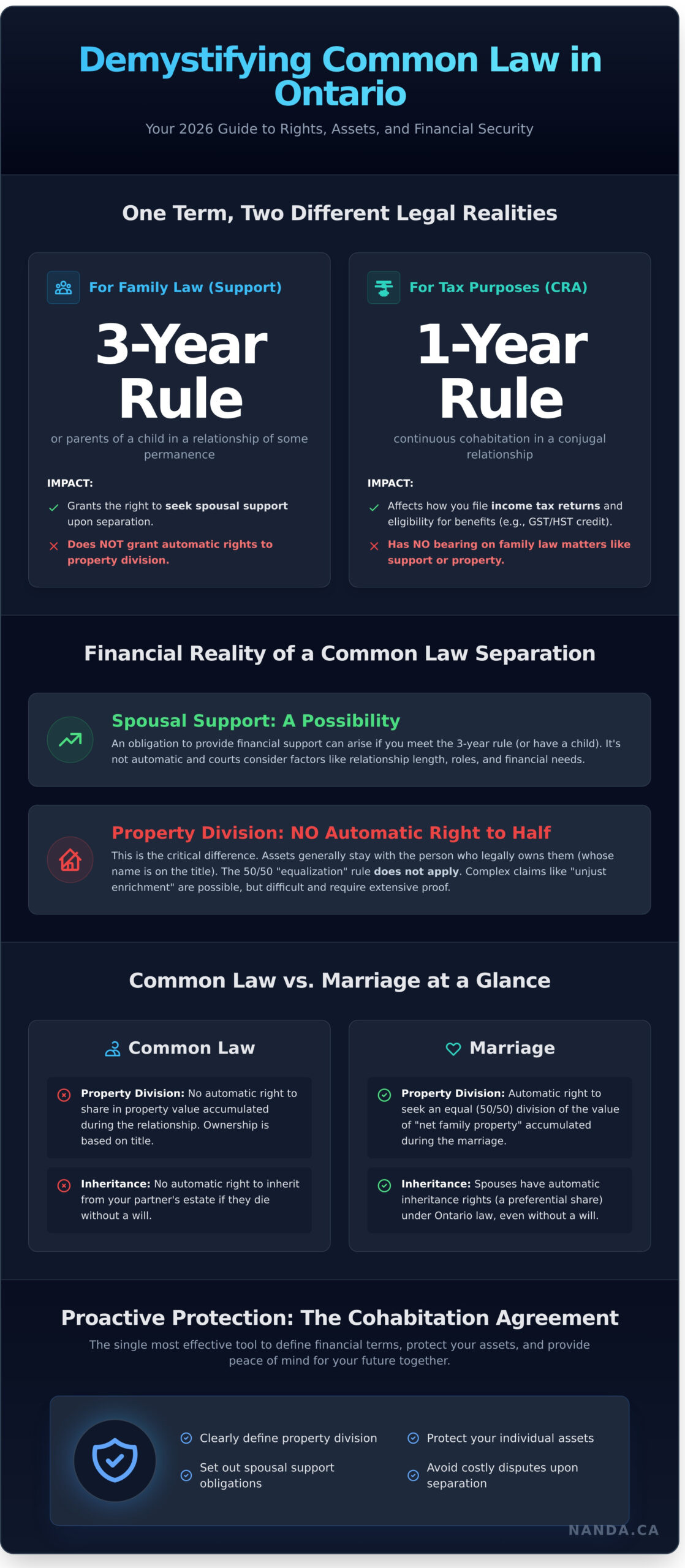
Common Law vs. Marriage in Ontario: The Critical Differences
A prevalent and costly myth is that after a certain period, common-law relationships automatically grant the same rights as marriage. This is fundamentally incorrect. While the law recognizes your relationship for purposes like spousal support, the legal frameworks governing property and inheritance are vastly different. Understanding these distinctions is the first step toward protecting your assets and securing your future. For couples in a common law ontario relationship, failing to grasp these differences can lead to unintended and severe financial consequences.
| Legal Area | Married Spouses | Common-Law Partners |
|---|---|---|
| Property Division (Separation) | Equalization of Net Family Property. The value of most assets acquired during the marriage is divided equally. | No automatic right to property division. Each partner keeps what is in their own name. Claims can be made through complex legal arguments like resulting or constructive trusts. |
| The Family Home | The "matrimonial home" has special status. Both spouses have an equal right to possess it, and its value is shared upon separation, regardless of who is on title. | The home is owned by the person(s) on title. A non-titled partner has no automatic right to its value or to remain in the home. |
| Inheritance (No Will) | The surviving spouse has automatic inheritance rights under the Succession Law Reform Act. | The surviving partner has no automatic right to inherit anything from their deceased partner’s estate. |
The Matrimonial Home: A Key Distinction
For married couples, Ontario’s Family Law Act provides special protection for the matrimonial home. Its value is always shared upon separation. In a common-law relationship, this protection does not exist. The property belongs to whoever is on the legal title. For example, if a couple lives in a Mississauga home valued at C$1.2 million, owned solely by one partner, that partner could potentially keep the entire value of the home upon separation, leaving the other with no share in its equity, even after years of shared life and contributions.
Inheritance Rights: What Happens if a Partner Dies
The distinction is equally stark when a partner passes away without a will. A married spouse is automatically recognized as a beneficiary under Ontario’s intestacy laws. A common-law partner is not. If your common-law partner dies without a will specifically naming you as a beneficiary, you are not legally entitled to any part of their estate. The estate would instead pass to their children, parents, or other relatives. This makes having an updated and legally valid will absolutely essential for anyone in a common-law relationship to ensure their partner is protected.
Proactive Protection: Crafting a Cohabitation Agreement in Mississauga
While understanding your rights is crucial, the most effective strategy is to proactively define them. For couples living together, this means moving beyond the uncertainties of common law and creating a clear, mutually agreed-upon plan. A cohabitation agreement is not a sign of mistrust; it is a hallmark of a mature, practical partnership. It is a powerful tool for communication that allows you and your partner to establish a solid foundation for your future together, especially in a high-value property market like Mississauga.
This legally binding contract empowers you to take control of your financial future, providing clarity and security that the default legal rules for common law Ontario do not automatically offer. By addressing key issues upfront, you can prevent potential conflict and expense down the road, ensuring any future transition is handled with dignity and respect.
What Is a Cohabitation Agreement?
A cohabitation agreement is a private contract for unmarried couples who are living together or intend to live together. It allows you to set your own rules for how financial matters will be handled during your relationship and in the event of a separation. This document lets you opt out of certain default provisions of provincial law, creating a framework tailored to your unique circumstances. Should you decide to marry in the future, your cohabitation agreement can automatically become a legally binding marriage contract.
Key Items to Include for Mississauga Couples
A comprehensive agreement should be tailored to your specific situation. At Nanda & Associate Lawyers, our Mississauga divorce lawyers ensure our clients consider the most critical elements to protect their interests:
-
Property Division: Clearly outline how assets will be divided upon separation. This is particularly vital for significant assets like a shared Mississauga condo or family home, specifying whether it will be sold or if one partner has the option to buy out the other.
-
Spousal Support: You can decide in advance whether spousal support will be paid, how it will be calculated, and for how long. Alternatively, both partners can agree to waive any future claims for support entirely.
-
Debt Responsibility: The agreement should specify who is responsible for debts brought into the relationship and any debts accumulated jointly, such as mortgages, lines of credit, or credit card balances.
-
Financial Arrangements: Define how day-to-day finances, such as joint bank accounts, investments, and household bills, will be managed. This can also include arrangements for other assets, like vehicles or pensions.
Drafting a robust cohabitation agreement is a critical step in protecting your assets and securing peace of mind. For tailored legal advice that reflects your specific needs, we invite you to explore our comprehensive family law services.
Navigating Common-Law Issues with a Mississauga Family Lawyer
Understanding your rights is the first step; the next is securing them. While the information in this guide provides a strong foundation, the unique details of your relationship require tailored legal advice. The complexities of common law ontario mean that proactive legal counsel is not a luxury, but a vital tool for achieving clarity and security. At Nanda & Associate Lawyers, our dedicated family law team provides the professional, reassuring guidance you need to protect your interests, whether you are entering a cohabitation or navigating its end.
During the Relationship: Drafting Your Agreement
A cohabitation agreement is one of the most powerful tools available to common-law partners. A lawyer’s role extends beyond simply drafting a document; we facilitate a structured, productive conversation about your future. Our team ensures the agreement is fair and legally sound by:
-
Providing independent legal advice to each partner, a crucial step for enforceability.
-
Ensuring all essential matters, from property division to support, are clearly addressed.
-
Helping you navigate difficult conversations to build a consensus that protects both of you.
At Separation: Protecting Your Rights
The end of a relationship is an emotionally and financially challenging time. Professional legal representation is essential to ensure a fair and equitable outcome. If you have a cohabitation agreement, our lawyers will help negotiate a separation agreement that honours its terms. If no agreement exists, we will vigorously advocate for your rights concerning complex claims like spousal support or unjust enrichment.
Our firm’s extensive experience at the Brampton courthouse, which serves Mississauga and the entire Peel Region, gives our clients a distinct local advantage. We understand the system and how to navigate it effectively on your behalf. Seeking our counsel is a decisive step toward resolving disputes and building a stable future. For a confidential consultation to discuss your specific situation, we invite you to contact our family law team.
Protecting Your Future: A Clear Path for Common-Law Couples in Mississauga
As we have explored, the legal landscape of common law ontario is nuanced and carries significant distinctions from marriage, especially regarding property division. The most crucial takeaway is that proactive planning is essential for protecting your rights and assets. Understanding that spousal support obligations can arise while property rights are not automatic is the first step toward securing your financial future, and a well-drafted cohabitation agreement provides the ultimate clarity and protection for both partners.
Navigating these complexities requires dedicated and experienced guidance. At Nanda & Associate Lawyers, our family law team has been delivering personalized legal solutions to the Mississauga community since 2003. We believe in empowering our clients with knowledge and strategic advice tailored to their unique situations. With services available in over 15 languages, our diverse team is here to ensure you feel understood and confident in your decisions.
Don’t leave your future to chance. Secure your future. Speak with a Nanda family lawyer in Mississauga today.
Frequently Asked Questions About Common Law in Ontario
How long do you have to live together to be common law in Ontario?
The definition of common law Ontario varies by context. For family law matters like spousal support, you must cohabit in a conjugal relationship for at least three years, or have a child together in a relationship of some permanence. For federal income tax purposes, the Canada Revenue Agency (CRA) considers you common-law after just one year of living together. It is crucial to understand which definition applies to your specific legal situation to protect your rights.
Does my common-law partner get half of my house if we break up in Mississauga?
No, a common-law partner does not automatically get half of your house upon separation in Ontario. Unlike married couples, common-law partners do not have an automatic right to equalize property. Ownership is determined by who is on the legal title. However, a non-titled partner can make a claim for a share of the value based on contributions through legal principles like a trust claim or unjust enrichment. We recommend seeking legal advice to clarify your position.
Can I receive spousal support if I was never married?
Yes, you can be entitled to spousal support without ever being legally married. If you meet the definition of a "spouse" under Ontario’s Family Law Act-by cohabiting for three or more years or having a child together in a permanent relationship-you may have a right to claim support. The court assesses factors like the length of the relationship, financial needs, and roles during cohabitation to determine entitlement and the amount of support payable upon separation.
Is a cohabitation agreement legally binding in Ontario?
Yes, a cohabitation agreement is a legally binding contract in Ontario when properly prepared and executed. For the agreement to be enforceable, it must be in writing, signed by both partners, and witnessed. It is also vital that both parties provide full financial disclosure and have the opportunity to receive independent legal advice before signing. This agreement is a powerful tool to protect your assets and define your mutual obligations, providing clarity and peace of mind.
What happens to our children if my common-law relationship ends?
When a common-law relationship ends, the law treats matters concerning children exactly the same as for a married couple. The court’s primary focus is always the best interests of the child when determining decision-making responsibility (formerly custody) and parenting time (formerly access). Both parents have a legal obligation to financially support their children, and child support is calculated based on the Federal Child Support Guidelines, regardless of the parents’ marital status.
Do I have to change my tax status to common law after one year?
Yes, you are legally required to update your marital status with the Canada Revenue Agency (CRA) after one year of cohabitation. The CRA considers a couple to be in a common-law relationship after they have lived together in a conjugal relationship for 12 consecutive months. You must declare this on your annual tax return. Failing to do so can lead to a reassessment of your taxes and potential repayment of benefits like the GST/HST credit.
How much does a cohabitation agreement cost?
The cost to draft a cohabitation agreement in Ontario typically ranges from C$1,500 to C$3,500, but this can vary. The final price depends on the complexity of your financial assets, the level of negotiation required between you and your partner, and the time spent with your lawyer. While there is an upfront cost, a well-drafted agreement is a valuable investment that can prevent significantly more expensive legal disputes in the event of a future separation.
What happens if my common-law partner dies without a will?
If your common-law partner dies without a will in Ontario, you do not have an automatic right to inherit their property. Under the province’s intestacy laws, only married spouses and blood relatives are recognized as automatic heirs. As the surviving partner, you would have to make a dependant’s support claim against the estate, which can be a complex, costly, and uncertain process. This highlights why having valid wills is essential for every common law Ontario couple.