


Last Tuesday, a Mississauga resident sat in our office, staring at a refusal letter that threatened to keep their spouse on the other side of the world for another year. You likely recognize that cold knot of anxiety. It’s the fear that a minor oversight might trigger a five year ban for misrepresentation or the sting of losing significant C$ application fees to a faceless process. We believe you deserve better than confusion over “dual intent” rules or the heartbreak of a rejected sponsorship.
This guide explores the common reasons for Canadian visa refusal 2026 and provides the legal clarity you need to move forward under the Immigration and Refugee Protection Act. We will examine the specific IRCC criteria for the coming year, explain when to choose an appeal over a re-application, and show you how a dedicated immigration lawyer in Mississauga can help secure your family’s future in Ontario. By understanding the nuances of current policy, you can replace uncertainty with a strategic path toward a successful outcome.
Key Takeaways
- Learn how to navigate the updated 2026 LICO standards and demonstrate financial sustainability to satisfy the IRCC’s increased scrutiny on genuine intent.
- Identify the common reasons for Canadian visa refusal 2026, such as weak ties to your home country and Section 179(b) concerns.
- Understand the severe legal consequences of misrepresentation under Section 40 and the critical steps required to avoid a devastating five-year ban from Canada.
- Determine whether to fix and re-submit your application or pursue a Federal Court Judicial Review based on the specific legal grounds of your refusal.
- Discover how a tailored, collaborative legal strategy in Mississauga can address complex officer concerns and provide a clear path toward a successful outcome.
Table of Contents
- Understanding the 2026 Canadian Visa Refusal Landscape in Mississauga
- Core Reasons Why Canada Visa Applications Get Refused in 2026
- Misrepresentation and Section 40: The Most Serious Refusal
- Legal Avenues After a Refusal: Re-application vs. Appeal
- How Nanda & Associate Lawyers Overcomes Complex Refusals
Understanding the 2026 Canadian Visa Refusal Landscape in Mississauga
A visa refusal occurs when an Immigration, Refugees and Citizenship Canada (IRCC) officer isn’t satisfied that an applicant meets the strict requirements of the Immigration and Refugee Protection Act (IRPA). In 2026, the threshold for approval has shifted significantly. Officers now place unprecedented scrutiny on genuine intent and financial sustainability, reflecting Canada’s focus on economic stability. For residents in Mississauga, these changes are deeply felt. Stricter quotas on family sponsorships and work permits, introduced in late 2025, have made the process more rigorous for our local community. Identifying the common reasons for Canadian visa refusal 2026 is the first step in building a successful appeal or re-application. A refusal letter often feels like a final door closing; however, our immigration lawyers view it as the starting point for a more robust legal strategy.
The Role of IRCC Officers in 2026
Officers exercise broad discretionary power under the Immigration and Refugee Protection Regulations. By 2026, the reliance on the Global Case Management System (GCMS) has intensified. These internal notes provide the actual reasoning behind a decision, which is often hidden behind the generic checkboxes found in standard refusal letters. Understanding the common reasons for Canadian visa refusal 2026 requires an expert to pull and interpret these GCMS notes. Our immigration lawyers Mississauga specialize in decoding this technical data to identify where an application failed to meet the officer’s subjective expectations.
Key Takeaways for Mississauga Applicants
Local applicants must recognize that 2026 policies prioritize high-human-capital individuals. This means those with specialized skill sets and proven financial independence have a clear advantage. Success in this environment requires a proactive approach.
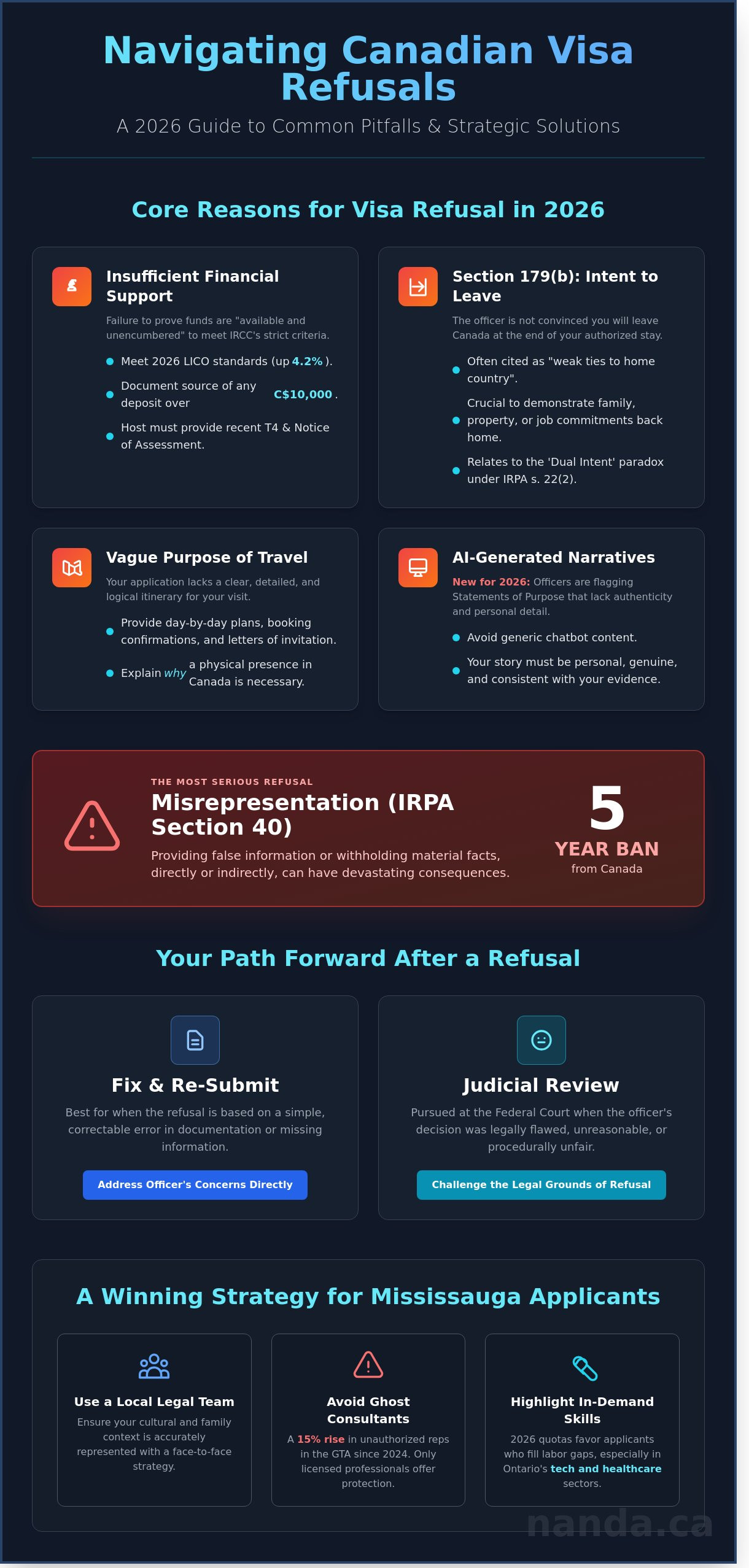
- Face-to-Face Strategy: Meeting with a local legal team ensures your specific cultural and family context is accurately represented in your file.
- Avoid Ghost Consultants: The GTA has seen a 15% rise in unauthorized representatives since 2024. Only licensed professionals provide the protection and accountability you need.
- Skill-Based Focus: 2026 quotas favor applicants who fill specific labor gaps in Ontario’s tech and healthcare sectors.
Managing these complexities alone often leads to avoidable errors. We provide the clarity and professional advocacy required to move past a refusal toward a successful outcome. Our team approaches every case with the calm confidence and empathy your family deserves during these transitions.
Core Reasons Why Canada Visa Applications Get Refused in 2026
The landscape of Canadian immigration has shifted significantly as we enter 2026. IRCC officers now utilize more advanced screening tools to identify inconsistencies in applications. Understanding the common reasons for Canadian visa refusal 2026 is the first step toward building a resilient file. Most rejections today stem from a failure to adapt to heightened documentation standards or a lack of personal authenticity in the narrative components of the application.
- Insufficient Financial Support: Failing to meet the updated 2026 LICO (Low Income Cut-Off) standards which rose by 4.2% this year.
- Section 179(b) Refusals: The officer isn’t convinced you’ll leave Canada at the end of your authorized stay.
- Vague Purpose of Travel: Itineraries that lack detail or fail to explain why a physical presence in Canada is necessary.
- AI-Generated Narratives: A new 2026 refusal trigger where “lack of authenticity” is cited because a Statement of Purpose was clearly generated by a chatbot.
Financial Inadequacy and the LICO Standards
Proving you have enough money isn’t just about showing a high bank balance. IRCC requires funds to be “available and unencumbered.” This means the money must be yours to spend, not borrowed or “parked” in your account just for the application. For those visiting family in Mississauga, host support is a major factor. You must document the source of any deposit over C$10,000 made in the last six months to satisfy 2026 anti-money laundering checks. If a host is providing accommodation, they should provide their most recent T4 and Notice of Assessment to prove they meet the 2026 LICO thresholds. Our immigration lawyers in Mississauga frequently see cases where a lack of “source of funds” documentation led to an immediate rejection.
The ‘Dual Intent’ Paradox
Section 22(2) of the Immigration and Refugee Protection Act (IRPA) acknowledges that an applicant can have “dual intent.” This means you can intend to stay temporarily as a visitor while also having a long-term goal of permanent residency. Despite this legal provision, IRCC officers often confuse dual intent with a lack of ties to your home country. They use Section 179(b) to claim you’re a flight risk. To overcome this, you’ve got to provide a “plan to leave” that exists alongside your PR aspirations. We recommend documenting active employment contracts, property management responsibilities, or specific family obligations in your home country that require your return by a certain date. This demonstrates that you respect the conditions of your temporary status even if you hope to call Canada home one day.
Authenticity and Purpose of Travel
In 2026, generic itineraries are no longer sufficient. If your plan simply lists “visiting Niagara Falls and Toronto,” the officer may find the purpose of travel unclear. You need to link your visit to specific dates, events, or people. Furthermore, the 2026 integrity units now flag Statements of Purpose that lack a human voice. If your personal narrative sounds like a template, it triggers a “lack of authenticity” refusal. Your story needs to feel real, personal, and grounded in your actual life experiences. We’ve found that including specific local references and a clear, logical progression of your travel goals helps satisfy these new scrutiny levels.
Misrepresentation and Section 40: The Most Serious Refusal
Misrepresentation is the most severe hurdle an applicant can face. Under Section 40 of the Immigration and Refugee Protection Act (IRPA), misrepresentation occurs when someone provides false information or withholds facts that could induce an error in the administration of the law. It’s often described as the “death penalty” for immigration prospects because it carries a mandatory five-year ban from entering Canada. In 2026, IRCC uses highly integrated digital tracking systems, so inconsistencies are caught faster than ever before. Many people try to argue they didn’t know their agent made a mistake, but Canadian courts have consistently ruled that “I didn’t know” isn’t a valid defense. You’re legally responsible for every detail on your forms. Working with a civil litigation lawyer can be vital if you need to challenge a fraud finding, as they understand the high burden of proof required to label someone as intentionally deceptive.
Common Triggers for Misrepresentation Findings
- Previous Refusals: Failing to declare a 2023 visa refusal from the USA, UK, or Australia is a primary trigger. IRCC shares biometric data with these nations almost instantly.
- Employment Discrepancies: If your 2026 application lists a job title that contradicts your 2024 tax filings or previous study permit applications, officers will flag it as a material inconsistency.
- Document Integrity: Submitting educational credentials or bank statements that IRCC’s Verification Unit determines are not authentic.
The Procedural Fairness Letter (PFL)
Before an officer issues a final refusal under Section 40, they’ll usually send a Procedural Fairness Letter (PFL). This letter is your one chance to explain the discrepancy before the five-year ban is imposed. You’ll typically have a strict window of 7 to 30 days to respond. Ignoring the legal nuances of this letter is one of the common reasons for Canadian visa refusal 2026. Experienced immigration lawyers in Mississauga are essential at this stage. We help you gather the necessary evidence to prove that any error wasn’t material or was a genuine misunderstanding, potentially saving your future in Canada. Don’t treat a PFL as a simple request for information; it’s a legal challenge that requires a strategic, evidence-based rebuttal.
Legal Avenues After a Refusal: Re-application vs. Appeal
Receiving a refusal letter feels like a dead end, but it’s often just a pivot point in your immigration journey. In 2026, IRCC continues to apply high standards of scrutiny, making common reasons for Canadian visa refusal 2026 a frequent hurdle for applicants in Mississauga. Our team helps you determine if you should “fix and re-submit” or take the matter to court. The choice depends entirely on the specific flaws in the officer’s logic and the nature of the evidence already provided.
We start by requesting Global Case Management System (GCMS) notes. These internal records provide the officer’s raw notes, which are far more revealing than the standard checklist you received. We then assess the decision under the Vavilov framework. This legal standard, established by the Supreme Court of Canada in 2019, requires that every administrative decision be transparent, intelligible, and justified. If an officer ignored your property valuations in Mississauga or misinterpreted your local employment history, their decision may be legally “unreasonable.”
- Re-application: This is often the fastest route if the refusal was due to a simple administrative error or a minor document gap that’s easily corrected.
- Legal Challenge: This is necessary when the officer made a factual error, ignored provided evidence, or relied on “templated” reasoning that doesn’t fit your specific facts.
- GCMS Analysis: We use these notes to build a bulletproof second application that preemptively answers every concern the first officer raised.
Judicial Review at the Federal Court
If your temporary resident visa or study permit is refused, Judicial Review is often the only legal remedy available. This process begins with the “leave” stage, where a judge decides if your case has enough merit to proceed to a full hearing. We focus on identifying a breach of procedural fairness or a clear error of law. It’s vital to remember that only a licensed lawyer can represent you in Federal Court; consultants aren’t permitted to argue these cases. Our immigration lawyers in Mississauga have the litigation experience to hold officers accountable for unfair or illogical decisions.
Immigration Appeal Division (IAD) for Sponsored Families
Family sponsorship refusals offer a different path through the IAD. Unlike Judicial Review, an IAD appeal allows us to present new evidence that wasn’t in your original application. For families in Brampton and Mississauga, this is a chance to provide oral testimony and demonstrate the genuine nature of a relationship. We often lean on Humanitarian and Compassionate (H&C) factors, such as the emotional impact on children or the hardship of family separation. Success here requires meticulous witness preparation to ensure your story is told with clarity and conviction during the hearing.
If you’ve received a refusal, don’t wait for the strict legal deadlines to pass. Contact us today to book a professional consultation and review your options for a second application or appeal.
How Nanda & Associate Lawyers Overcomes Complex Refusals
Receiving a negative decision from IRCC feels like a dead end, but it’s often just a hurdle that requires a more sophisticated legal approach. Our Mississauga team operates as a collaborative powerhouse, merging deep immigration knowledge with aggressive litigation expertise. We don’t just resubmit the same documents. We dissect the Global Case Management System (GCMS) notes to understand exactly why an officer doubted your application. By addressing the specific officer concerns that lead to the common reasons for Canadian visa refusal 2026, we build a factual and persuasive case for reconsideration or judicial review.
Mississauga is home to a vibrant, global population where over 53% of residents identify as immigrants. We reflect this community. Our Drew Road headquarters provides multilingual support to ensure no nuance of your personal history is lost in translation. We provide transparent, professional representation that keeps you informed at every stage of the process. It’s about more than paperwork; it’s about your future in Canada. We provide the calm confidence you need when your plans are on the line.
The Nanda Advantage in Mississauga and Brampton
Our firm brings more than 20 years of experience navigating the complexities of the Immigration and Refugee Protection Act (IRPA). We’ve seen the law evolve through multiple government shifts since our founding in 2003. This longevity allows us to handle high-stakes refusals, including those involving criminal inadmissibility or misrepresentation allegations. For those seeking local expertise, consulting with an immigration lawyer provides the convenience of a nearby office with the resources of a major firm. We’ve successfully challenged thousands of refusals by identifying procedural fairness letters and errors in law that an unrepresented applicant might miss.
Comprehensive Legal Solutions for Your Future
We view your legal needs through a holistic lens. Beyond securing your visa, we focus on your long-term stability. This includes protecting your Canadian assets and legacy through wills and estates planning. If your move involves complex domestic situations or sponsorship challenges, our family law team ensures your rights and the rights of your children are fully protected. Your path to residency should be seamless. The first step is a professional review of your refusal letter to identify the common reasons for Canadian visa refusal 2026 and map out a solution. Contact us today to book a consultation and regain control of your immigration journey.
Take Decisive Steps Toward Your Canadian Residency
Receiving a refusal letter doesn’t mean your journey to Canada has reached its end. The 2026 immigration landscape requires a meticulous understanding of the Immigration and Refugee Protection Act to navigate evolving evidentiary standards. Whether your application was flagged for insufficient ties to your home country or serious concerns under Section 40 regarding misrepresentation, you have viable legal paths forward. Identifying the common reasons for Canadian visa refusal 2026 allows you to address specific gaps with precision. Success often depends on choosing the right strategy; this might involve a robust re-application or a formal appeal through litigation.
Since 2003, Nanda & Associate Lawyers has served the Mississauga and Brampton communities with tailored legal support. Our multilingual team speaks more than 15 languages, ensuring your story is told accurately and professionally. We provide comprehensive solutions across immigration and civil litigation to help you achieve the stability you deserve. You don’t have to face the complexities of the federal court or IRCC alone. Our firm is dedicated to providing the calm confidence and strategic advocacy needed to protect your future. Let’s work together to turn a temporary setback into a successful arrival.
Book a Consultation with an Immigration Lawyer in Mississauga
Frequently Asked Questions
Can I apply for a Canada visa again immediately after a refusal in 2026?
You can apply for a Canada visa again immediately after a refusal, provided your decision letter doesn’t explicitly ban you for misrepresentation. There’s no mandatory waiting period under the Immigration and Refugee Protection Act. However, submitting an identical application without addressing the previous officer’s concerns usually leads to a second rejection. It’s often best to obtain your Global Case Management System (GCMS) notes first to understand the specific reasons for the initial denial.
What is the most common reason for a Canadian student visa refusal in 2026?
The most common reasons for Canadian visa refusal 2026 regarding study permits involve a lack of “dual intent” or insufficient ties to your home country. Under Section 216(1)(b) of the IRPR, officers must be satisfied you’ll depart at the end of your authorized stay. In 2024 and 2025, over 40% of student rejections cited a lack of clear career progression or weak socio-economic connections to the applicant’s residence. We help you build a stronger narrative for your study plan.
How much money should I show for a Canadian visitor visa to avoid refusal?
You should typically show at least C$1,000 for every week of your intended stay in Canada, plus the cost of round trip airfare. While IRCC doesn’t set a rigid minimum, providing six months of bank statements showing stable balances is standard practice. If a host in Mississauga provides accommodation, your liquid asset requirement might decrease slightly. You must still demonstrate personal financial independence to satisfy the officer’s concerns about your economic stability and intentions.
Does a previous US visa refusal affect my Canadian visa application?
A previous US visa refusal affects your Canadian application because Canada and the United States share biometric data through the High Value Data Sharing Protocol. You must disclose all prior visa denials from any country on your application forms. Failing to mention a US refusal constitutes misrepresentation under Section 40 of the IRPA. This can result in a 5 year ban from entering Canada, so honesty is essential for a successful outcome.
What is a Procedural Fairness Letter and should I be worried?
A Procedural Fairness Letter is a formal notification from IRCC stating that an officer has concerns about your eligibility or the genuineness of your documents. You should take this seriously because it’s the final opportunity to respond before a refusal or a finding of misrepresentation. You typically have 7 to 30 days to provide a detailed response. Our team helps you gather evidence to address these specific doubts and protect your long term immigration goals.
Can an immigration lawyer in Mississauga help if my visa was refused for misrepresentation?
An immigration lawyer in Mississauga can provide critical assistance if your visa was refused for misrepresentation. This charge carries a 5 year ban under the Immigration and Refugee Protection Act, which is a severe penalty. We analyze the alleged material fact and determine if it was an innocent mistake or a clerical error. Our firm crafts legal submissions to argue for the removal of the ban based on established case law and procedural fairness principles.
How long does the Judicial Review process take for a refused visa?
The Judicial Review process at the Federal Court of Canada typically takes between 6 and 12 months from the initial filing to a final hearing. This timeline includes the leave stage, where a judge decides if the case has enough merit to proceed. Since approximately 35% of cases are settled or resolved before the final hearing, some applicants see results sooner. We manage every procedural step to ensure your case meets all strict court deadlines and requirements.
Is it better to re-apply or appeal a Canadian visa refusal?
Deciding whether to re-apply or appeal depends on whether the refusal was based on missing information or a legal error by the officer. If you simply forgot a document, re-applying with a stronger file is faster and more cost effective. If the officer ignored evidence or misinterpreted the law, an appeal or Judicial Review is often the better path. We evaluate your specific refusal letter to determine which strategy offers the highest probability of a positive result.