


What if the dream condo you’re about to buy comes with a hidden $20,000 special assessment due next year? It’s a scenario that keeps many prospective buyers in Peel Region awake at night. You’ve found the perfect location and layout, but the mountain of documents, from the status certificate to complex bylaws about pets and rentals, can feel overwhelming and hide significant financial risks that threaten your investment.
This is where the guidance of a skilled condo lawyer Mississauga becomes invaluable. We are here to provide the clarity you need to master the complexities of Ontario’s Condominium Act, ensuring your rights are protected. In this guide, we will break down the critical elements of the Act as we look toward 2026, explaining how to achieve a “clean” status certificate and secure a seamless closing with complete peace of mind.
Key Takeaways
- Understand the critical 2026 amendments to Ontario’s Condominium Act and how they will impact your rights and obligations as a unit owner or board member.
- Learn why the Status Certificate is the most vital document in any condo purchase and the strategic importance of its 10-day review period.
- Discover effective strategies for resolving common disputes, from noise complaints to common expense liens, with guidance from an experienced condo lawyer in Mississauga.
- Grasp the hierarchy of your condominium’s governing documents-the Declaration, Bylaws, and Rules-to better understand your property rights and the corporation’s authority.
Understanding Condominium Law in Mississauga: The 2026 Landscape
Purchasing a condominium in Mississauga involves more than just acquiring property; it means entering a complex legal framework governed by Ontario’s Condominium Act, 1998. This legislation dictates everything from the corporation’s governance to your rights as a unit owner. As we approach 2026, the legal landscape continues to evolve, with ongoing discussions around amendments aimed at increasing transparency and owner protections. A seasoned condo lawyer Mississauga provides the critical guidance needed to navigate these rules, ensuring your investment is secure from day one.
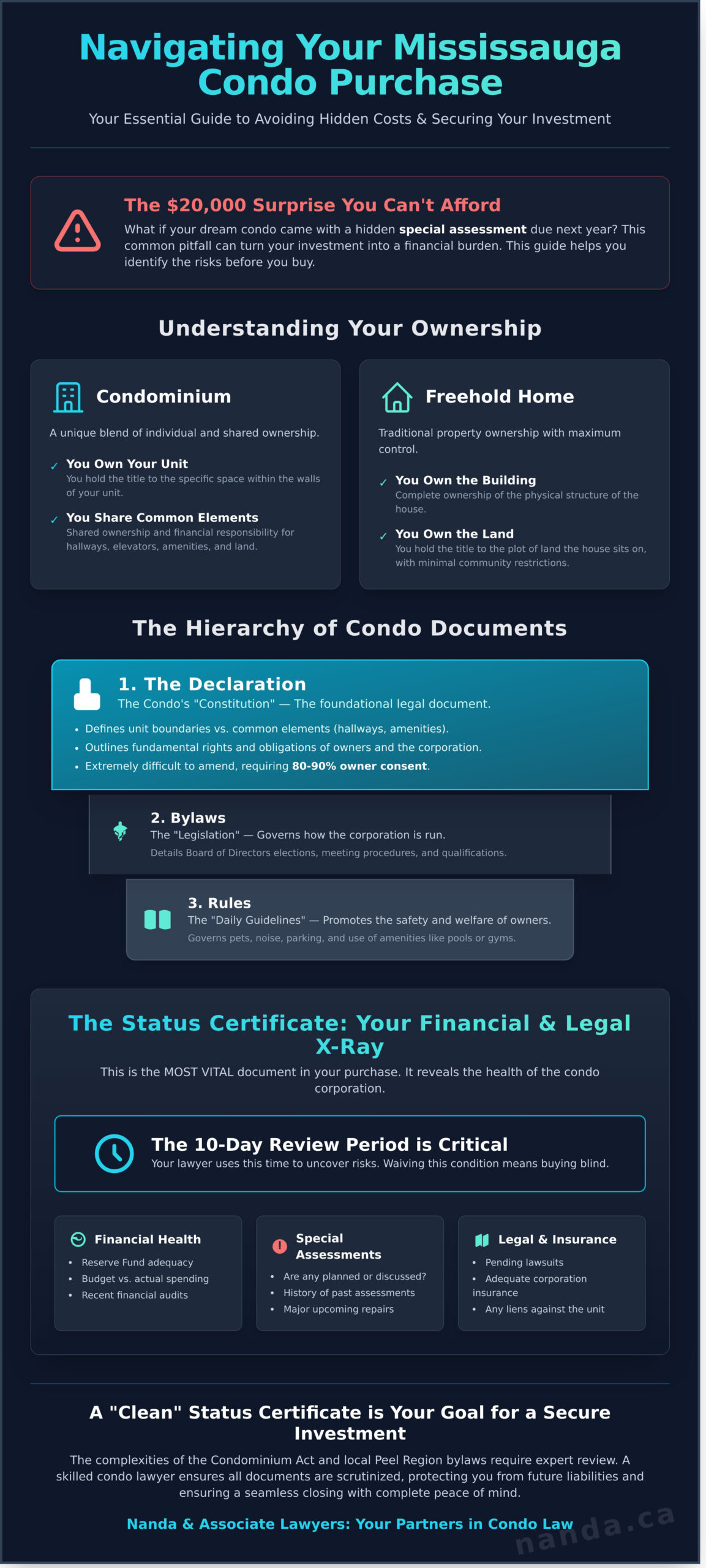
Unlike a traditional freehold home where you own the building and the land, condominium ownership is a unique blend of individual and shared possession. You hold the title to your specific unit, but you also share ownership and financial responsibility for the common elements-hallways, elevators, recreational facilities, and the land itself. This shared model introduces the “Community Standard,” a set of rules and by-laws designed to balance individual freedoms with the collective goals of the corporation. Your ability to renovate, rent your unit, or even have pets is subject to the corporation’s governing documents, a key distinction from freehold ownership.
When disagreements arise, the Condominium Authority of Ontario (CAO) serves as a vital resource for Mississauga owners. Established to provide information and resolve disputes, the CAO’s online tribunal, the Condominium Authority Tribunal (CAT), handles specific issues related to records access, pets, parking, and other common conflicts. Understanding this dispute resolution process is fundamental to protecting your rights within the community.
The Legal Definition of a Condominium in Ontario
It’s a common misconception that “condo” refers only to a high-rise apartment. Legally, a condominium is a method of property ownership, not an architectural style. For a foundational understanding of what is a condominium on a global scale, it’s recognized as a unique legal entity. In Ontario, this can take several forms, including standard condominiums (the most common), phased developments, vacant land, and common element condominiums. As Mississauga implements its ambitious “Downtown 21” Master Plan, we are seeing a surge in complex, mixed-use developments that require meticulous legal review to understand their unique structures.
Why Local Expertise Matters in Mississauga and Brampton
Navigating condominium law requires more than just a general understanding of the Act; it demands localized expertise. Property tax assessments in the Peel Region, for instance, have specific nuances for condominium corporations. Furthermore, our team of real estate lawyers in Mississauga consistently navigates city-specific zoning by-laws that impact everything from short-term rental permissions to commercial use provisions. A lawyer who understands the distinct market dynamics between the high-density towers near Square One and the waterfront properties in Port Credit provides an undeniable strategic advantage, ensuring your deal aligns with both provincial law and local regulations.
The Hierarchy of Condo Documents: Declaration, Bylaws, and Rules
When you purchase a condominium, you aren’t just buying real estate; you’re entering into a binding legal agreement with a community. This agreement is governed by a strict hierarchy of documents that dictates everything from corporate governance to what colour you can paint your front door. Understanding this structure is the first step in protecting your investment and avoiding future disputes. The most common and costly mistake we see is the assumption: “It’s my unit, I can do what I want.” In a condominium, this is rarely the case.
The Declaration: The Master Document
Think of the Declaration as the condominium’s constitution. It’s the foundational legal document registered on title that creates the corporation and outlines the fundamental rights and obligations of both the owners and the corporation itself. Because of its paramount importance, amending a Declaration is exceptionally difficult, requiring the consent of 80% or even 90% of all unit owners. It defines what you own versus what you share. The Declaration precisely outlines the boundaries of your unit versus the common elements (hallways, elevators, amenities) and exclusive-use common elements (your balcony or parking spot). For a typical Mississauga high-rise, Schedule A of the Declaration often defines a unit’s boundary as the physical space enclosed by the undecorated interior surfaces of the perimeter walls, floors, and ceilings.
Bylaws and Rules: The Daily Guidelines
If the Declaration is the constitution, Bylaws and Rules are the legislation that governs daily life. Bylaws focus on the administration of the condo corporation. They detail how the Board of Directors is elected, how meetings are conducted, and the qualifications for board members. Rules, on the other hand, are created by the Board to promote the safety, security, and welfare of the owners and to prevent unreasonable interference. These are the regulations you’ll encounter most often.
Common examples in Mississauga condos include:
- Pet Restrictions: Many buildings have rules limiting the number, type, or size of pets. If a corporation introduces a new pet rule, existing pets are often protected by a “grandfathering” clause, but this protection doesn’t transfer to new pets you may acquire.
- Short-Term Rentals: A growing number of corporations have passed rules or bylaws outright banning short-term rentals like Airbnb. This is separate from the City of Mississauga’s own licensing requirements under By-law 273-20, which you must also comply with.
While the Board has the authority to create rules, they must be reasonable and consistent with Ontario’s Condominium Act, 1998, the Declaration, and the Bylaws. If you believe a rule is unreasonable or enforced unfairly, it can be challenged. This process often requires detailed legal arguments and is best navigated with a civil litigation lawyer who understands condominium law. A comprehensive review by a condo lawyer in Mississauga before you even finalize your purchase can identify potentially problematic rules, saving you significant stress and expense. Our team’s meticulous review process is designed to provide you with this essential peace of mind.
The Status Certificate Review: Your Essential Process for 2026
In any Mississauga condominium transaction, the Status Certificate is the single most important document. Think of it as a comprehensive financial and legal health report for the entire condominium corporation. Once your offer is accepted, the seller requests this package from the property management company, which, under Ontario’s Condominium Act, 1998, has a statutory 10-day period to provide it. This document, along with its attachments, reveals the vital information that determines whether your investment is sound or a potential financial liability.
A meticulous review by an experienced condo lawyer in Mississauga is not just a formality; it is your primary shield against future risks. We scrutinize this package for critical red flags that could impact your finances for years to come. These include:
- Special Assessments: Is the corporation planning a large, unfunded repair that will require a one-time levy of thousands of dollars from each owner?
- Pending Litigation: Lawsuits against the corporation can drain its finances and signal underlying governance problems. For comprehensive information on condominium governance, the Condominium Authority of Ontario provides essential resources for owners and boards.
- Reserve Fund Deficits: A healthy reserve fund is crucial. A significant shortfall between the funds on hand and the projected future repair costs is a clear warning of impending fee hikes or special assessments.
The outcome of this review determines the legal standing of the certificate. A “clean” certificate confirms the corporation is not aware of any circumstances that could lead to an increase in common expenses or a special assessment. A “qualified” certificate, however, indicates potential issues, shifting significant risk onto you, the buyer. Our role is to identify these qualifications and advise you on the legal consequences before your purchase becomes firm.
Step-by-Step: The Professional Review Process
Our team at Nanda & Associate Lawyers Professional Corporation conducts a systematic analysis of the entire Status Certificate package. We meticulously review the corporation’s financial statements and the proposed budget for 2026 to assess its fiscal discipline. We also check for any registered “Section 98” agreements, which disclose alterations made by previous owners, like a renovated kitchen or removed wall, ensuring you don’t inherit liability for unapproved work. Finally, we verify that the current owner’s common expenses are fully paid, protecting you from assuming their debt.
Reserve Fund Studies and Special Assessments
Ontario law mandates that condo corporations conduct a reserve fund study at least every three years. This engineering report forecasts the lifespan and replacement cost of major common elements like the roof, windows, and elevators. A skilled lawyer doesn’t just see if the study exists; we calculate the risk of a special assessment hitting your wallet. We compare the projected expenses in the study against the actual funds saved. A large gap means trouble.
Case Study: Consider a 25-year-old Mississauga condo tower facing C$5 million in necessary parking garage repairs over the next two years. If its reserve fund only holds C$2 million and has a slow contribution plan, the C$3 million shortfall must be covered. For a 200-unit building, that could translate into a sudden, non-negotiable C$15,000 special assessment for each owner. This is the exact scenario a professional Status Certificate review is designed to uncover and prevent.
Resolving Condominium Disputes: Liens, Noise, and Board Conflicts
Living in a condominium community offers many benefits, but the shared environment can also lead to complex disputes. From financial disagreements to interpersonal conflicts, these issues can disrupt your peace and threaten your investment. Understanding the legal mechanisms for resolution is the first step toward protecting your rights as a unit owner. A knowledgeable condo lawyer Mississauga can provide the strategic guidance needed to navigate these challenges effectively, whether you’re dealing with a lien, a difficult neighbour, or an overreaching board.
Disputes often escalate quickly, but Ontario’s legal framework provides clear pathways for resolution. The key is to act promptly and follow the correct procedures, from leveraging the Condominium Authority Tribunal (CAT) for common issues to understanding the severe implications of a common expense lien.
The Power of the Common Expense Lien
A condominium corporation’s most powerful tool for collecting unpaid common expenses is the lien. If you fall behind on your monthly fees, the corporation can register a lien against your unit. This process begins with a formal notice, and if the arrears are not paid within 90 days of the lien’s registration, the corporation can initiate power of sale proceedings. In Ontario, a condo lien takes priority over nearly all other financial claims, including your mortgage. This means the bank’s interest comes second to the corporation’s. An experienced real estate lawyer can be critical in negotiating a manageable payment plan or disputing improper charges before the situation escalates to a forced sale.
Navigating Nuisance and Board Issues
Living in close quarters means conflicts over noise, odours, and even second-hand smoke are common. The Condominium Act, 1998, sets the standard as “unreasonable interference” with the use and enjoyment of a unit or the common elements. For many of these disputes, the Condominium Authority Tribunal (CAT) offers a more accessible and cost-effective online resolution process than the traditional courts. It is the mandatory first step for resolving disagreements over pets, parking, storage, and nuisances.
Conflicts can also arise with the Board of Directors itself. If you believe you are a target of harassment or selective enforcement of the rules, meticulous documentation is your best defence. Keep a detailed log of all incidents, communications, and evidence. The Board has a duty to enforce its by-laws fairly and consistently for all residents. When they fail to do so, legal intervention may be necessary to hold them accountable.
For new builds in Mississauga, construction deficiencies are another frequent source of conflict. Your rights are protected under the Tarion warranty program, but strict deadlines apply for reporting issues. A lawyer can help ensure your claims are properly filed and pursued, protecting the value of your new home.
When Disputes Overlap with Family Matters
Sometimes, a condo dispute is a symptom of a larger domestic issue. Persistent noise or disturbances from a neighbouring unit might be linked to family conflict. While the condominium corporation’s responsibility is to enforce its rules, the root cause may require a different legal approach. In such sensitive cases, consulting a family lawyer can provide clarity on options that address the underlying domestic situation, offering a more comprehensive and lasting solution for everyone involved.
If you are facing a lien, a persistent nuisance, or unfair treatment from your condo board, don’t wait for the problem to worsen. Contact Nanda & Associate Lawyers for a consultation to protect your property and peace of mind.
Comprehensive Legal Solutions: Why Nanda & Associate Lawyers?
Choosing the right legal partner for your condominium transaction in Mississauga goes beyond a simple document review. Condo ownership involves a complex intersection of real estate law, corporate governance, and potential civil litigation. At Nanda & Associate Lawyers, we provide a decisive advantage: a multidisciplinary team equipped to handle every facet of your condo purchase or sale from a single, unified source. Our collaborative structure means your file benefits from the collective knowledge of our entire firm, ensuring no detail is overlooked.
The strength of our approach lies in the seamless integration of our real estate and litigation departments. Imagine your status certificate review uncovers a vague reference to a pending lawsuit against the condo corporation. A standard real estate lawyer might flag it, but our team does more. Our real estate experts can immediately consult with our in-house civil litigation lawyers to assess the real-world financial risk and potential for a special assessment. This proactive risk analysis provides you with a complete picture, empowering you to negotiate from a position of strength or walk away from a problematic investment.
We believe clear communication is the bedrock of effective legal representation. Recognizing Mississauga’s vibrant cultural diversity, we proudly offer our services in over 15 languages, including Punjabi, Hindi, Urdu, and Mandarin. This commitment ensures you can discuss the intricate details of your agreement of purchase and sale or condo by-laws in the language you are most comfortable with, eliminating ambiguity and fostering complete confidence in your decisions.
Tailored Support for Unit Owners and Boards
Our expertise is not one-size-fits-all. For first-time condo buyers, we provide a personalized strategy, demystifying the complexities of condo declarations and financial statements. For Condo Boards, we offer strategic advisory on governance, ensuring full compliance with Ontario’s Condominium Act, 1998. Should disputes arise, our Mississauga head office’s proximity to the A. Grenville and William Davis Courthouse provides a distinct advantage for efficient and effective litigation.
Conclusion: Securing Your Peace of Mind
As Mississauga’s condo market continues to grow in complexity toward 2026, a professional legal review is non-negotiable. An experienced condo lawyer in Mississauga doesn’t just process paperwork; we protect your financial future. The most critical step in safeguarding your investment happens long before you receive the keys. It begins with a thorough, expert-led review of your legal documents. Contact our Mississauga condo lawyers today to secure the comprehensive protection you deserve.
Secure Your Condominium Investment for 2026 and Beyond
The Mississauga condominium landscape requires proactive and informed navigation. Understanding the hierarchy of your governing documents and insisting on a meticulous status certificate review are your first lines of defense against future complications and financial risks. When disputes inevitably arise, having a clear legal strategy is paramount to protecting your rights and preserving your peace of mind.
You don’t have to face these challenges alone. For comprehensive guidance, you need a trusted condo lawyer mississauga. Since 2003, Nanda & Associate Lawyers has provided sophisticated real estate and litigation expertise to clients across the GTA. Our dedicated team offers support in over 15 languages, ensuring clear communication and tailored solutions for your unique situation. Let our experience be your advantage.
Take the next step toward securing your property investment. Book a consultation with a Mississauga condo lawyer and gain the confidence that comes with having an expert advocate on your side.
Frequently Asked Questions
How much does a condo lawyer in Mississauga charge for a status certificate review?
A status certificate review by a condo lawyer in Mississauga typically costs between C$500 and C$800 plus HST. This fee is often part of the overall legal services package for a condo purchase. The review is a critical step where your lawyer analyzes the condo corporation’s financial health, legal status, and rules to identify potential risks like special assessments, pending lawsuits, or a poorly funded reserve fund before your purchase agreement becomes firm.
Can a condo board in Ontario ban pets even if they were allowed when I bought the unit?
Yes, a condo board can introduce new rules banning pets, but your existing pet is typically protected. Under Ontario’s Condominium Act, 1998, such new rules usually include a “grandfather clause.” This means the new prohibition would not apply to pets that were already living in the building before the rule was passed. However, it would prevent you from getting a new pet after your current one is no longer with you.
What happens if I find construction defects in my new Mississauga condo?
If you discover construction defects, you must report them to your builder and the Tarion Warranty Corporation within specific deadlines. Your new condo is covered by Tarion’s warranty, which includes one, two, and seven-year protections for different types of issues. It’s crucial to document all defects with photos and submit them using the official Tarion forms, such as the 30-Day or Year-End Form, to protect your rights and ensure repairs are completed.
Is a status certificate required for every condo sale in Ontario?
While not a legal requirement for the title transfer itself, obtaining and reviewing a status certificate is a standard and non-negotiable condition in nearly 100% of resale condo purchase agreements. Lenders will not provide financing without a clear certificate, and it’s the only way for a buyer to verify the unit’s common expense status and the corporation’s financial stability. Proceeding without one is an exceptionally high-risk decision that is strongly discouraged.
How do I stop a condo lien from being registered against my property?
The most direct way to stop a condo lien is to immediately pay the outstanding common expenses in full. If you disagree with the charges, you should pay the disputed amount “under protest” to prevent the lien and its associated legal costs from being registered. You can then pursue a legal challenge to recover the funds. Ignoring the notice will allow the corporation to proceed with the lien and potentially sell your unit to recover the debt.
What is the difference between a condo bylaw and a condo rule?
The key difference lies in their scope and creation process. Bylaws govern the corporation’s corporate structure, such as board elections, meeting procedures, and financial matters; they must be approved by a vote of a majority of unit owners. Rules, on the other hand, govern the day-to-day use of common elements and units, like noise levels or amenity use. Rules are created by the board and only require notice to owners, not a vote, unless owners requisition one.
Can I sue my condo board for selective enforcement of rules?
Yes, you can take legal action against a condo board for selective enforcement. Condo corporations in Ontario have a legal duty to enforce rules consistently and fairly among all residents. If you can provide evidence that the board is penalizing you for an infraction while ignoring identical infractions by other owners, you may have a case for oppressive conduct. Consulting a condo lawyer in Mississauga is a crucial first step to evaluate your evidence and determine the best legal strategy.
Do I need a lawyer if I am buying a condo parking spot or locker separately?
Yes, you absolutely need a lawyer. The purchase of a parking spot or locker is a formal real estate transaction, just like buying the condo unit itself. It involves either a deed transfer for a titled unit or the complex assignment of an exclusive-use right. A lawyer ensures the seller has the legal right to transfer it, that the title is clear of liens, and that your ownership or usage rights are properly and legally registered, protecting your investment.