


Key Takeaways
- Understand the high stakes of the IRCC “Completeness Check” and how minor clerical errors can lead to immediate application returns or five-year bans for misrepresentation.
- Master the technical requirements for digital forms, including the specific software versions and validation protocols needed to generate mandatory 2D barcodes.
- Learn the strategic “History Audit” method for ensuring my immigration paperwork is error-free by cross-referencing current details with all your previously submitted Canadian visas and permits.
- Follow a disciplined self-audit process that utilizes “Fresh Eyes” reviews and reverse chronology checks to catch inconsistencies that often lead to processing delays.
- Discover how professional immigration lawyers provide a sophisticated “Lawyer’s Audit” and tailored submission letters to address complex background issues and secure your future in Ontario.
Table of Contents
- Why Error-Free Paperwork is Non-Negotiable for Ontario Applicants
- The Essential Technical Checklist for IRCC Forms
- Beyond the Forms: Ensuring Legal Consistency and Credibility
- Step-by-Step: The Self-Audit Process Before Submission
- Professional Representation: How Nanda & Associate Lawyers Secure Your Future
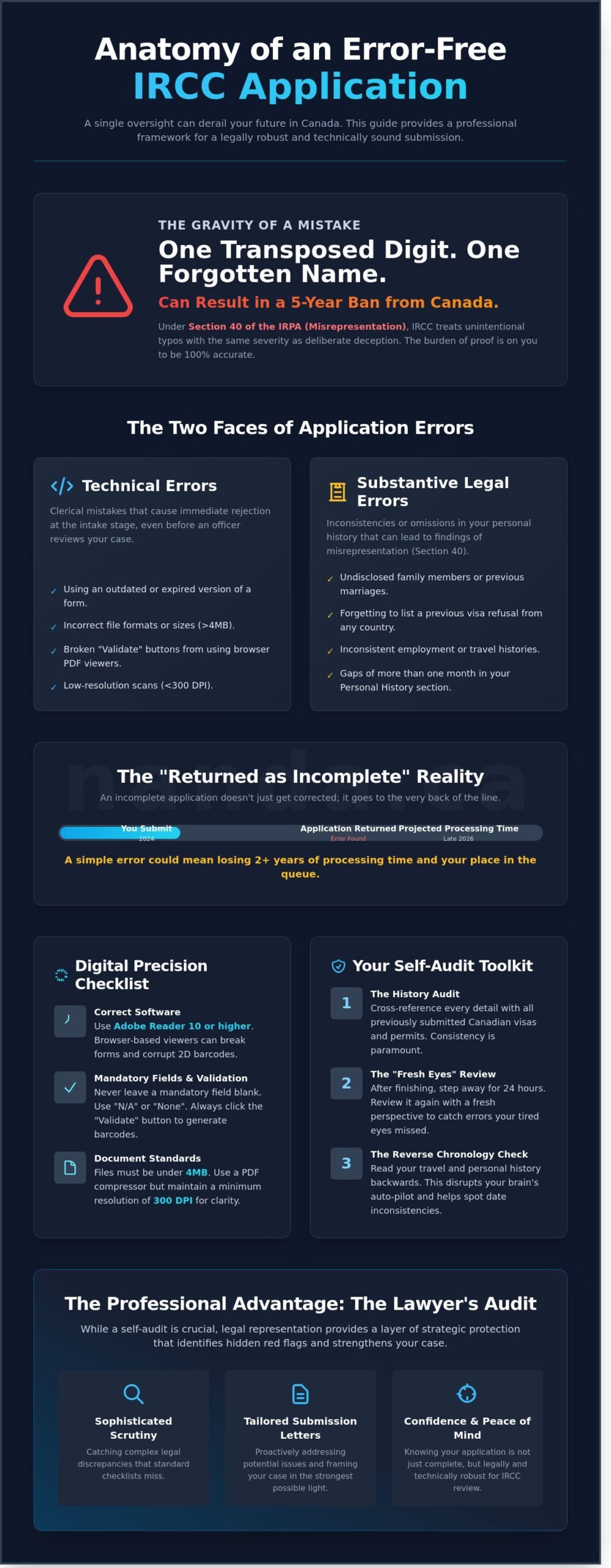
A single transposed digit in a passport number or a forgotten middle name can lead to a five-year ban from Canada under Section 40 of the Immigration and Refugee Protection Act. While it sounds extreme, the law often treats a simple typo with the same gravity as a deliberate attempt to mislead. You’ve likely spent over 60 hours gathering records and feel the heavy weight of every checkbox on those IRCC forms. The anxiety that a tiny oversight could derail your future in Mississauga is both common and completely valid. Our immigration lawyers understand that behind every application is a family’s dream or a professional’s career path.
This guide provides a professional framework for ensuring my immigration paperwork is error-free, offering you the same level of scrutiny our team uses to catch discrepancies before they reach an officer’s desk. You’ll gain the peace of mind that comes from knowing your submission is technically sound and legally robust. We’ll walk through a definitive final-review checklist, explain the legal consequences of clerical errors, and outline the strategic steps to take to protect your status. By the end of this guide, you’ll have the tools to submit your application with absolute confidence.
Why Error-Free Paperwork is Non-Negotiable for Ontario Applicants
A single typo on a permanent residency application isn’t just a minor inconvenience; it’s a potential legal catastrophe. For many applicants in the Greater Toronto Area, the process of ensuring my immigration paperwork is error-free feels like a bureaucratic hurdle, but the reality is much more serious. Immigration, Refugees and Citizenship Canada (IRCC) operates with strict protocols where even a small oversight can lead to a five-year ban from Canada for misrepresentation. This isn’t an exaggeration. If an officer determines that you provided false or misleading information, the consequences are immediate and long-lasting.
The IRCC performs a “Completeness Check” before an officer even looks at the merits of your case. If a form is missing a signature or you’ve used an outdated version of a document, the entire package is returned. This is why consulting an immigration lawyer Mississauga is a strategic step. We help identify hidden red flags that software or simple checklists often miss. Errors generally fall into two categories. Technical errors include things like broken “Validate” buttons on Adobe forms or incorrect file formats. Substantive legal errors involve inconsistent employment histories or undisclosed family members, which carry far heavier weight.
Understanding Section 40 of the IRPA
The Immigration and Refugee Protection Act (IRPA) governs every aspect of your application. Section 40 specifically addresses misrepresentation. It’s vital to understand that the law doesn’t care if your mistake was unintentional. If you forget to list a previous visa refusal from another country, the IRCC views this as a material fact that was withheld. Once a finding of misrepresentation is made, it stays on your record forever. This affects every future travel visa, work permit, or residency application you submit to Canada and often impacts your ability to travel to other Five Eyes nations.
The “Returned as Incomplete” Reality
Mississauga is a high-volume hub for immigration, particularly in categories like Spousal Sponsorship and Express Entry. Because of the sheer volume of files, IRCC staff are trained to look for reasons to reject a file at the intake stage. Common triggers for immediate returns include:
- Using a version of a form that expired just days before submission.
- Leaving a single “Personal History” gap of more than one month.
- Failing to provide a clear, high-resolution scan of a birth certificate.
With processing times for certain programs already projected to extend into late 2026, having a file returned in 2024 or 2025 means you lose your place in line. You don’t just fix the error; you start the entire process over from the beginning. For many, this delay is the difference between maintaining legal status and being forced to leave the country. Ensuring my immigration paperwork is error-free is the only way to protect your timeline and your future in Ontario.
The Essential Technical Checklist for IRCC Forms
Technical precision is the backbone of a successful application. Many applicants focus heavily on their personal narrative while overlooking the rigid digital requirements set by Immigration, Refugees and Citizenship Canada (IRCC). Using the correct software is your first hurdle. You must use Adobe Reader 10 or higher to open and complete most interactive PDF forms. Opening these files in a web browser or a generic PDF viewer often breaks the interactive features; this prevents the generation of critical 2D barcodes that the IRCC system relies on for data entry.
When you’re ensuring my immigration paperwork is error-free, pay close attention to mandatory fields. Leaving a box blank is a common reason for an application to be returned as incomplete. If a question doesn’t apply to your specific situation, enter “N/A” or “None” according to the form’s instructions. This signals to the IRCC officer that you haven’t simply missed the question. If you find the technical side overwhelming, consulting an immigration lawyer in Mississauga can provide the oversight needed to avoid these clerical pitfalls.
Digital Document Standards
The IRCC portal has strict constraints on file uploads. Most individual files must be under 4MB in size. If your scanned police certificate or passport exceeds this limit, use PDF compression tools that maintain a resolution of at least 300 DPI. High-resolution scans are mandatory; every word must be legible, and all four corners of the original document must be visible in the digital frame. While PDF is the standard for forms, JPG and TIFF formats are often accepted for photos or supporting evidence. You can verify specific requirements for your program through the IRCC Help Centre to ensure your files meet current standards.
The Validation and Barcode Process
The “Validate” button is your most vital tool for ensuring my immigration paperwork is error-free. It checks for missing data and generates a page of barcodes that the IRCC system scans to instantly upload your information. If the button fails to trigger, it usually means a mandatory field is empty or formatted incorrectly. You must re-validate and re-print the entire form after every single edit. Even a tiny typo correction requires a fresh validation to ensure the barcodes reflect the updated data. Always place the barcode page at the very top of your document package to streamline the officer’s review process.
Proper naming conventions are also a factor in a smooth upload. Avoid using special characters like slashes, brackets, or periods in your file names. Instead, use a clear format like “Lastname-Firstname-Passport.pdf” to help the processing officer identify your documents quickly. Our team at Nanda & Associate Lawyers often sees applications delayed simply because the digital file structure was disorganized or the barcode page was missing. Taking the time to organize your digital files can save months of waiting time later in the process.
Beyond the Forms: Ensuring Legal Consistency and Credibility
Filing an application is only half the battle. The real challenge lies in maintaining a flawless narrative across years of interactions with Immigration, Refugees and Citizenship Canada (IRCC). When you’re committed to ensuring my immigration paperwork is error-free, you must look backward as much as you look forward. This involves a rigorous “History Audit” where we cross-reference your current data with every visitor visa, study permit, or work extension you’ve ever submitted. IRCC maintains digital records of every entry; if you listed a different home address in 2019 than what you’re claiming now for that same period, it creates a credibility gap that’s hard to close.
Consistency must extend to your family members too. We’ve seen many delays caused by simple discrepancies in a spouse’s birthdate or a child’s middle name spelling across different forms. Your professional life requires the same scrutiny. Your CV or Resume must match your IRCC entries exactly. Discrepancies between your stated job duties and your NOC code descriptions can lead to a refusal. For those with complex personal history or multiple previous applications, consulting an immigration lawyer is a vital step to ensure your narrative remains cohesive and truthful.
Cross-Referencing Your Travel History
IRCC officers use your passport stamps to verify your “History of Travel” entries with surgical precision. They look for “gap years” or even “gap months,” as you must account for every 30 day period over the last 10 years. If you were backpacking through Europe for 60 days, that needs to be documented. We also warn clients that officers frequently check public digital footprints. If your LinkedIn profile shows you were working in Toronto in 2022 while your application says you were in Delhi, you risk a finding of misrepresentation. You can refer to the Official Express Entry document checklist to understand the high standard of proof required for travel and work history.
Document Translation and Notarization
Every document not in English or French must meet strict Ontario translation standards. Using a family member for “self-translation” is a guaranteed path to immediate rejection, regardless of their fluency. In Mississauga, you need a translator certified by the Association of Translators and Interpreters of Ontario (ATIO). Ensuring my immigration paperwork is error-free also means getting the right legal seals. Certain documents, such as statutory declarations of common-law union, require a notary public in Mississauga to verify your identity and witness your signature. We ensure every translated document is accompanied by the required affidavit to prevent technical refusals at the intake stage.
Step-by-Step: The Self-Audit Process Before Submission
A self-audit is the final line of defense against an IRCC rejection. When you’ve spent weeks gathering documents, your brain naturally begins to fill in gaps, causing you to overlook obvious mistakes. This stage is where ensuring my immigration paperwork is error-free becomes a tactical exercise rather than a general goal. We recommend a methodical, slow-paced review to catch the small details that automated validation tools often miss.
The 24-Hour Cooling Period
Fatigue causes approximately 15% of clerical errors in Mississauga applications. You should step away from your file for at least 24 hours before your final check. When you return, use a physical printout rather than a digital copy. Errors that are invisible on a high-resolution screen often stand out clearly on paper. Read every answer aloud. If an explanation of your work history or a travel entry sounds confusing to your ears, it’ll definitely confuse an immigration officer. This auditory check helps you identify logical gaps that your eyes might skip over.
Final Fee and Receipt Verification
Payment errors are a leading cause of application returns in Ontario. You must verify that the name on the C$ receipt matches the primary applicant exactly. If you’re applying with a spouse and children, confirm the number of dependents aligns with the total C$ amount paid. Don’t forget the C$85 biometrics fee. Excluding this fee often leads to a “Request for Evidence” (RFE), which can add 60 to 90 days to your processing time. Always include the official receipt as a separate PDF in your upload package to avoid any ambiguity.
- The Reverse Chronology Check: IRCC forms require history for the last 10 years. Check these dates in reverse, starting with the current month and working backward. A single missing month in your address history can trigger a return.
- The Signature Audit: Distinguish between digital and “wet” signatures. Some portals require a digital attestation, while others, like certain provincial nominee forms, mandate a physical ink signature.
- Consistency Check: Ensure your date of birth and passport number are identical across every single form in the package.
When ensuring my immigration paperwork is error-free, it’s vital to remember that IRCC officers look for reasons to return incomplete files to reduce their backlogs. A missing signature or a mismatched fee isn’t just a small mistake; it’s a reason for your file to be sent back to the start of the queue. Taking an extra 48 hours to conduct this audit can save you six months of waiting later.
If you’re feeling overwhelmed by the technicalities of the submission process, our immigration lawyers in Mississauga can provide a professional review to secure your peace of mind.
Professional Representation: How Nanda & Associate Lawyers Secure Your Future
While a government checklist provides a basic roadmap, it doesn’t account for the nuanced legal interpretations that IRCC officers apply to every file. Our team provides a rigorous “Lawyer’s Audit” that goes beyond surface-level typos. We scrutinize your application through the lens of the Immigration and Refugee Protection Act (IRPA) to identify legal weaknesses that could lead to a refusal. This process involves cross-referencing your employment history, travel records, and family details to ensure absolute consistency. Ensuring my immigration paperwork is error-free isn’t just about filling boxes; it’s about building a bulletproof legal narrative that stands up to intense scrutiny.
One of the most significant advantages we provide is the drafting of formal submission letters. These legal cover letters serve as a persuasive brief, explaining complex personal histories or gaps in documentation that might otherwise trigger a request for more information (PFL). We act as your primary point of contact with both the IRCC and the CBSA, managing all correspondence from our Mississauga office so you never have to face a federal agency alone. If you’ve already prepared your documents, you can contact us for a fixed-fee immigration application review to gain peace of mind before you hit submit.
Strategic Advocacy for Mississauga Residents
Our firm specializes in “Problematic Files,” including cases involving previous refusals or complex H14 concerns. We don’t just resubmit the same documents; we analyze the previous officer’s notes to address the specific grounds for rejection. For entrepreneurs and investors, our status as a multi-disciplinary firm allows us to provide specialized support for business-related immigration, ensuring your corporate structure aligns with Canadian work permit requirements. This comprehensive approach significantly increases the likelihood of a “First-Time Right” approval, saving you the 6 to 12 months of delay often caused by preventable errors.
Next Steps for Your Application
Taking the final step toward your Canadian future requires precision and patience. We invite you to book a consultation at our Drew Road office in Mississauga for a final document review. During this initial meeting, please bring your current draft application, your passport, and any previous correspondence from the IRCC. Our associates will review your timeline and provide a clear strategy for submission. We encourage every applicant to prioritize accuracy over speed. A delay of a few days for a professional review is always preferable to the years of litigation that can follow a finding of misrepresentation. When you’re ready to move forward with confidence, book your consultation with Nanda & Associate Lawyers today.
Take the Next Step Toward Your Mississauga Residency
Success in the Canadian immigration system depends on meticulous attention to detail. Small mistakes on IRCC forms often lead to processing delays or permanent refusals. By prioritizing a rigorous self-audit and aligning documents with the Immigration and Refugee Protection Act, you protect your path to a new life in Ontario. Ensuring my immigration paperwork is error-free isn’t just a goal; it’s a necessity for your future security. Our team has operated from our Mississauga headquarters since 2003, providing the steady guidance needed to navigate federal mandates and the Ontario Rules of Civil Procedure.
We understand these processes feel overwhelming. That’s why we offer multilingual services in 15+ languages to ensure you feel heard and understood. You don’t have to face these technical hurdles alone. Our collaborative approach combines decades of experience with a deep commitment to your peace of mind. We’re here to help you submit a package that stands up to the highest levels of scrutiny.
Ensure your future is secure; Book a Consultation with our Mississauga Immigration Team
Your journey deserves the certainty that comes with professional legal oversight. We’re ready to help you build a stable foundation in Canada.
Frequently Asked Questions
Can I fix a mistake in my Canadian immigration application after it has been submitted?
You can correct a mistake by submitting a notification through the IRCC Web Form as soon as you identify the error. This online tool allows you to upload a detailed letter of explanation and the corrected version of the specific document. If the error is substantial or changes your eligibility, we often recommend seeking legal counsel to determine if a full withdrawal and resubmission is necessary to protect your status.
What happens if I accidentally leave a section blank on an IRCC form?
IRCC will likely return your entire application package as “incomplete” if you leave any mandatory section blank. To prevent this, you should type “N/A” or “Not Applicable” in every field that doesn’t apply to your specific situation. In 2023, incomplete data fields were responsible for the immediate return of approximately 25 percent of all economic class applications, causing significant delays for applicants.
How do I know if I need an immigration lawyer or if I can do it myself?
You should consider hiring an immigration lawyer in Mississauga if your case involves previous visa refusals, medical inadmissibility, or complex family structures. While the government allows self-representation, ensuring my immigration paperwork is error-free is much more certain with a legal professional’s oversight. We provide a meticulous review process that identifies subtle inconsistencies that an untrained eye might miss during the 2025 application cycle.
What is the difference between a minor error and misrepresentation?
A minor error is typically an unintentional typo, such as a transposed digit in a house number, while misrepresentation involves providing false or misleading information that could influence a decision. Under Section 40 of the Immigration and Refugee Protection Act, misrepresentation carries a mandatory 5 year ban from entering Canada. It’s critical to verify every date and fact because IRCC officers have the discretion to interpret omissions as intentional deceit.
Do I need to hire a translator for my documents if I am fluent in English?
You must hire a certified translator for any document that isn’t originally in English or French, regardless of your own language proficiency. IRCC requires a literal translation and an affidavit from the translator to verify the accuracy of the work. In Ontario, we recommend using a member of the Association of Translators and Interpreters of Ontario to ensure the credentials meet the strict 2024 regulatory standards.
How long does it take for IRCC to return an incomplete application?
IRCC usually takes between 4 and 12 weeks to identify and return an incomplete application package to the sender. This timeline depends on the specific processing center and the volume of mail they’re handling at that time. Ensuring my immigration paperwork is error-free before the initial mailing is the only way to avoid losing your place in the processing queue and facing several months of unnecessary waiting.
Is a digital signature acceptable for all Canadian immigration forms in 2026?
Digital signatures are now the standard for most applications submitted through the IRCC secure portal or the Permanent Residence Portal in 2026. You simply type your name exactly as it appears on your passport to sign these electronic forms. However, certain documents like the Use of a Representative form (IMM 5476) still occasionally require a traditional pen and ink signature depending on the specific program’s current technical instructions.
What should I do if my Adobe Reader won’t generate the barcodes?
You must download the latest version of Adobe Acrobat Reader DC to ensure the “Validate” button functions correctly on 2D barcode forms. If the barcodes don’t appear, check that you’ve completed all mandatory fields highlighted in red and avoid filling the form within a web browser. Our Mississauga team frequently assists clients with these 2025 technical glitches to ensure their forms are scannable by IRCC’s automated data entry systems.
Disclaimer
This content is for general information only and does not constitute legal advice or create a lawyer-client relationship. Every case is different—please consult a qualified lawyer for advice specific to your situation.