




Key Takeaways
- Understand the transition from traditional “custody” to modern “decision-making responsibility” under the Children’s Law Reform Act to ensure your legal rights are clearly defined.
- Learn how to use a comprehensive audit checklist to identify potential gaps in your parenting plan, ensuring you are feeling confident in my child custody arrangement before it is finalized.
- Discover the specific procedural steps required to formalize your agreement within the Peel Region, including the vital legal distinctions between a separation agreement and a court order.
- Gain professional insights into Ontario’s “Best Interests of the Child” standard and how it serves as the foundational benchmark for all Mississauga parenting schedules.
- Explore practical strategies for managing transitions and addressing “material changes in circumstances” to maintain long-term stability and minimize future conflict with the help of experienced family lawyers.
Table of Contents
What if the most successful child custody arrangement isn’t the one where you "win" more time, but the one where you never have to argue about a schedule again? For many Mississauga parents, the process of separating is clouded by a deep fear of future conflict and confusion over how Ontario courts apply the "Best Interests of the Child" test. It’s completely natural to feel anxious about whether your children will have the stability they deserve while you grapple with complex legal terminology. Our experienced family lawyers understand that feeling confident in my child custody arrangement is about more than just paperwork; it’s about securing your family’s long-term peace of mind.
In this comprehensive guide, you’ll gain total clarity as we break down Ontario child custody standards and the practical steps required for a legally binding agreement. We’ll explore the critical differences between decision-making responsibility and parenting time to ensure no detail is overlooked. This checklist provides a clear roadmap to help you build a predictable, stable future for your children while meeting every legal requirement under the Children’s Law Reform Act.
Introduction: Why Confidence Matters in Parenting Plans
Separation often brings a period of intense uncertainty for families in Mississauga. The emotional weight of restructuring a household can feel overwhelming, especially when the future of your children is the primary concern. Transitioning from a vague concept of custody to a structured, modern parenting plan is the most effective way to regain control. This shift allows parents to move past an adversarial mindset and focus on long-term stability. Our team at Nanda & Associate Lawyers understands that clarity is the most effective tool for reducing the stress that follows a domestic breakdown.
Clarity is your most valuable asset during this transition. When roles and schedules are clearly defined, the potential for high-conflict litigation drops significantly. This lack of ambiguity also protects children from the toxic stress of parental disputes. By working with a family lawyer in Mississauga, you can build a framework that prioritizes your child’s well-being while protecting your parental rights.
Ultimately, feeling confident in my child custody arrangement means knowing that your plan is resilient, enforceable, and designed to evolve as your children grow. A well-constructed plan doesn’t just settle the present; it anticipates future challenges, such as changes in school schedules or extracurricular commitments. This proactive approach minimizes the need for future legal interventions and allows you to focus on rebuilding your life with peace of mind. Our collaborative approach ensures that every detail of your family’s unique situation is reflected in a plan that stands up to legal scrutiny.
The Ontario Legal Framework: Understanding Parenting Rights
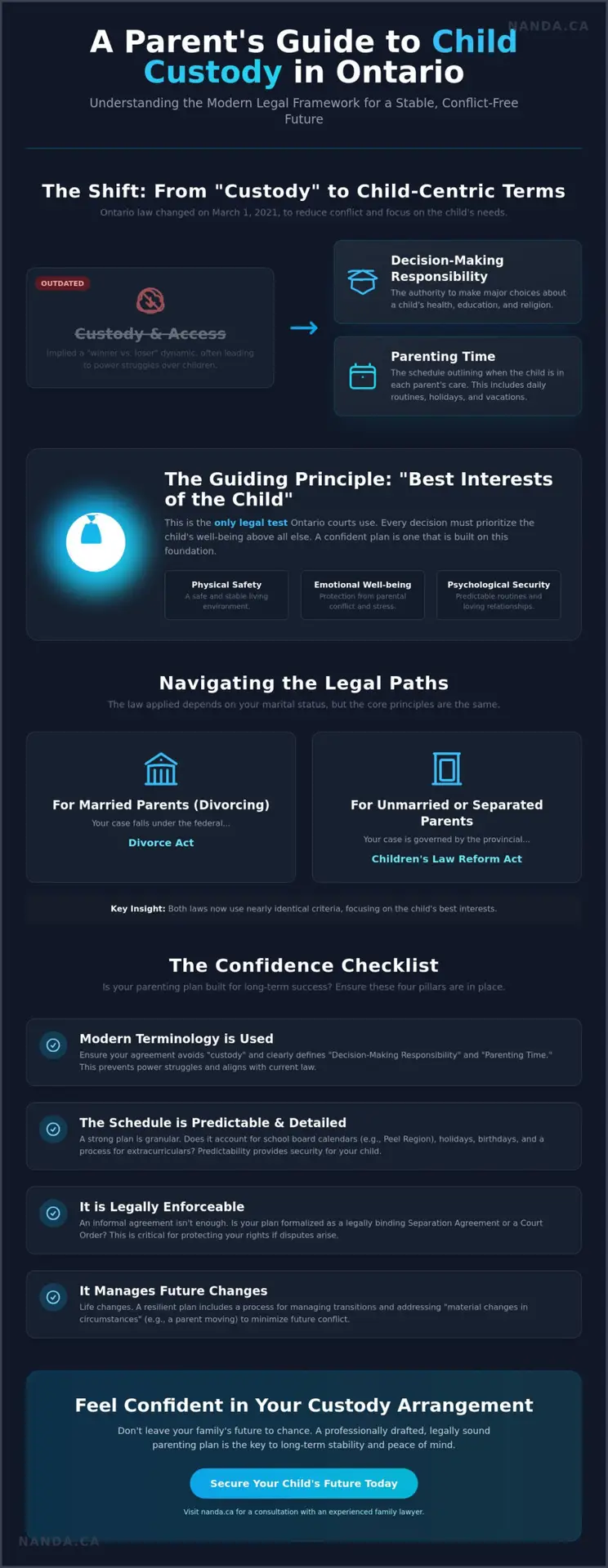
Ontario law underwent significant changes in March 2021 to prioritize the child’s well-being over parental "rights." If you are feeling confident in my child custody arrangement, it is likely because your plan aligns with these modern standards. The law replaced the old terms "custody" and "access" with "decision-making responsibility" and "parenting time." This shift isn’t just about labels; it reflects a move toward a child-centric approach that reduces conflict between parents.
The legal path you take depends on your marital status. Married parents seeking a divorce fall under the federal Divorce Act. Unmarried parents or those who are separated but not yet divorcing rely on the provincial Children’s Law Reform Act. Both pieces of legislation now use nearly identical criteria to determine how a child should be raised. Understanding these nuances is the first step toward family lawyers in Mississauga helping you secure a stable future for your household.
The Best Interests of the Child Test
The "Best Interests of the Child" is the only test Ontario judges use to make parenting orders. As we look toward 2026 standards, courts increasingly focus on the child’s physical, emotional, and psychological safety. Judges examine several specific factors:
-
The child’s needs, given their age and stage of development.
-
The history of care and the stability of the proposed home environment.
-
The child’s own views and preferences, which carry more weight as they gain maturity.
-
The ability of each parent to support the child’s relationship with the other parent.
In a diverse community like Mississauga, the court also places high value on maintaining a child’s cultural, linguistic, and religious heritage. The Confidence Checklist: Is Your Arrangement Built for Success? involves ensuring these identity-based needs are protected within your legal documents.
Decision-Making vs. Parenting Time
Decision-making responsibility refers to the right to make major choices about a child’s life. This includes their education, non-emergency medical care, and religious upbringing. It doesn’t necessarily mean the child lives with that parent full-time. You might have joint decision-making responsibility even if the child spends 70% of their time with one parent.
Parenting time is the actual schedule. In Mississauga, common rotations include the 2-2-3 split or a week-on, week-off arrangement. These schedules are designed to provide the child with consistent, meaningful interaction with both parents. When these schedules are clear and enforceable, you can start feeling confident in my child custody arrangement because there is no room for ambiguity or last-minute disputes. If you’re unsure how these provincial laws apply to your specific family dynamic, you can book a consultation.
The Confidence Checklist: Is Your Arrangement Built for Success?
A parenting plan acts as a roadmap for your family’s new structure. You’ll find that feeling confident in my child custody arrangement requires moving beyond generalities to address specific, day-to-day scenarios. If your agreement is too rigid, it may break under the pressure of life’s changes; if it’s too loose, it invites constant negotiation. At Nanda & Associate Lawyers, we believe a successful plan balances clear rules with a practical framework for cooperation.
Logistical and Financial Essentials
The transition between homes is often where friction occurs. To minimize stress for your children, your agreement should be as geographically specific as possible. Our family lawyers in Mississauga recommend auditing your plan against these points:
-
Drop-off and Pick-up Locations: Does the plan name specific sites in Mississauga? Using neutral, public spaces like the Mississauga Central Library or the Living Arts Centre can help maintain boundaries during high-conflict periods.
-
Multi-Year Holiday Calendars: Vague phrases like "holidays shall be shared" lead to December disputes. Your plan should define schedules for the next 3 to 5 years, explicitly stating where the child spends March Break, winter holidays, and statutory long weekends.
-
Section 7 Expenses: Under Ontario law, "extraordinary expenses" include items like private school tuition, competitive sports, or orthodontic work. Ensure your plan defines how these C$ costs are approved and shared, typically based on a ratio of each parent’s income.
Communication and Dispute Resolution
Communication is the cornerstone of a functional co-parenting relationship. Even if you don’t get along with your former partner, a structured communication clause keeps the focus on the child. This Ontario government page on parenting arrangements provides a foundation for understanding decision-making roles, but your checklist should go further:
-
Designated Platforms: Specify a communication method. Using email or dedicated co-parenting apps like OurFamilyWizard creates a searchable, professional record of all interactions, which discourages aggressive language.
-
Mandatory Mediation: Court should be a last resort. Your agreement should require both parties to attend at least two mediation sessions before filing any new court applications. This saves time, money, and emotional energy.
-
Right of First Refusal: This clause states that if one parent is unable to care for the child for a set period, such as 4 or 8 hours, they must offer that time to the other parent before hiring a babysitter. It’s a simple way to prioritize family time.
Achieving that sense of feeling confident in my child custody arrangement means knowing exactly what happens if a parent is late for a pick-up or if an unexpected school expense arises. By checking these boxes now, you’re protecting your child’s stability and your own peace of mind for years to come.
Navigating the Process: From Agreement to Court Order
Securing your child’s future involves more than just a verbal promise. You’ll achieve true peace of mind by formalizing your plans through the appropriate legal channels in the Peel Region. While a separation agreement is a legally binding contract under the Family Law Act, a court order provides an extra layer of judicial oversight. Both paths are valid ways of feeling confident in my child custody arrangement, but they function differently when it comes to long-term enforcement. An agreement relies on contract law, while an order is a direct mandate from the Mississauga Superior Court of Justice.
If your situation is high-conflict, the court may involve the Office of the Children’s Lawyer (OCL). This provincial office represents the interests of children under the age of 18. An OCL clinician or lawyer might be appointed to meet with the family and provide a report to the court. This report carries significant weight in Mississauga courtrooms, as it provides an objective view of the child’s needs and preferences. Understanding these procedural steps helps reduce the anxiety often associated with the legal system.
The Path to a Binding Order
-
Step 1: Negotiation and Drafting: We work with you to create a detailed Parenting Plan that covers holidays, education, and medical decisions. This document serves as the foundation for your legal filing.
-
Step 2: Independent Legal Advice (ILA): For an agreement to hold up in court, both parents should receive advice from separate lawyers. This ensures everyone understands their rights and that no one was pressured into signing.
-
Step 3: Filing the Agreement: Once signed, we file the agreement with the court at 7755 Hurontario Street. This step makes the support and custody provisions enforceable by the court, just like a judge’s order.
When Mediation is Necessary
Not every dispute needs a trial. Mediation allows parents to resolve stalemates through a neutral third party. In Mississauga, parents often utilize Peel Family Mediation Services to find common ground on scheduling or decision-making issues. This process is generally faster and less adversarial than litigation. If you’re struggling to reach an consensus, our divorce lawyers in Mississauga can represent you during mediation to ensure your rights are protected while you work toward a solution.
Timelines at the Mississauga Superior Court of Justice can vary based on the complexity of the case. A simple, uncontested filing might be processed in a few months. However, if the OCL is involved or if the case goes to a full trial, the process can extend beyond 12 months. Staying organized and following your lawyer’s checklist is the best way to keep your case moving forward. This proactive approach is essential for feeling confident in my child custody arrangement as you transition into your new family dynamic.
If you’re ready to formalize your parenting plan and protect your child’s best interests, our team is here to guide you through every filing and court appearance. Book a consultation with our Mississauga family law team to start building a stable future for your family.
Practical Advice: Maintaining Stability for Your Child
Stability doesn’t happen by accident. It’s the result of a meticulously drafted agreement that anticipates the friction of daily life while prioritizing your child’s emotional well-being. When the logistics of a schedule become second nature, you’ll find yourself feeling confident in my child custody arrangement because the "what-ifs" have already been answered.
Coping with Changeovers and Logistics
Transitions are often the most visible part of a custody schedule for a child. To keep these moments low-conflict, treat them as a professional exchange. In Mississauga, utilizing neutral ground like a local community centre or the school gate can reduce tension. If your schedule involves the Peel District School Board, ensure both parents are listed on contact forms to stay informed about events and emergencies.
-
Be Punctual: Lateness creates anxiety for the child and resentment for the other parent.
-
Keep it Brief: Changeovers aren’t the time for deep discussions about legal issues or finances.
-
Focus on the Child: Make the hand-off about their excitement for the next activity, whether it’s soccer practice at the Paramount Fine Foods Centre or a quiet evening at home.
"A child’s confidence in their world is built on the foundation of their parents’ cooperation."
Finalizing Your Peace of Mind
Life in Ontario is rarely static, and your agreement must reflect that reality. Under the Children’s Law Reform Act, a "material change in circumstances" allows for the modification of an existing order. This might include a parent relocating for work or a child’s changing educational needs as they enter high school. Relying on "handshake deals" to manage these changes is a common mistake that often leads to unenforceable disputes in court.
Many parents fall into the trap of using "boilerplate" templates found online. These generic documents don’t account for the unique nuances of your family’s lifestyle or the specific requirements of Ontario family law. By working with our family law firm in Mississauga, you ensure your agreement is tailored to your specific needs.
Our team at Nanda & Associate Lawyers acts as your empathetic guide through these transitions. We focus on providing comprehensive legal solutions that protect your rights while fostering a healthy environment for your children. When your legal framework is solid, feeling confident in my child custody arrangement becomes your new daily reality. We’re here to help you move forward with the calm confidence you deserve.
Securing a Stable Future for Your Children
Building a parenting plan that works isn’t just about signing legal paperwork; it’s about creating a foundation where your child can truly thrive. By understanding the Ontario legal framework and following a comprehensive success checklist, you move beyond uncertainty into a space of clarity. You’ve learned that a well-structured court order provides the necessary stability to prevent future disputes and protect your family’s routine. Achieving the goal of feeling confident in my child custody arrangement starts with choosing a strategy that prioritizes your child’s best interests while safeguarding your parental rights under provincial law.
Our team brings decades of experience in the Ontario Superior Court of Justice to your side. We provide multilingual legal support in over 15 languages, ensuring you’re heard and understood throughout the process. We utilize a strategic, child-centred approach to resolve family law disputes with empathy and precision. If you’re seeking clarity and confidence in your parenting plan, book a consultation with our Mississauga family law team today.
You don’t have to navigate these complex transitions alone; we’re here to help you find a peaceful and secure path forward for your entire family. Book your consultation today.
Frequently Asked Questions
How is "the best interests of the child" determined in Mississauga courts?
Courts in Mississauga follow the Children’s Law Reform Act to make these critical decisions. They evaluate the child’s physical, emotional, and psychological safety alongside their cultural and linguistic heritage. Judges prioritize stability and the child’s existing relationships. We help parents present a clear case that highlights how their proposed plan meets these specific legal criteria, ensuring the child’s well being remains the primary focus of every legal proceeding.
Can I change my child custody arrangement if my ex-spouse moves out of Mississauga?
You can seek a modification if the move represents a material change in circumstances that affects the child’s daily life. A move outside of Mississauga often necessitates a new schedule to accommodate travel times and school locations. Feeling confident in my child custody arrangement requires a plan that evolves with your family’s reality. We guide parents through the process of varying an order to reflect these new geographic challenges effectively.
What happens if my child refuses to go to the other parent’s house?
You must take all reasonable steps to ensure the child follows the court ordered schedule. Ontario judges expect parents to exercise their parental authority rather than leaving the decision to the child. If a child consistently resists, it may signal a need for counseling or a review of the parenting plan. Failing to facilitate access can lead to findings of contempt; it’s vital to address the root cause immediately.
Do I need a court order if we already have a signed separation agreement?
You don’t strictly need a court order if your agreement is properly drafted and signed, but filing it with the Ontario Court of Justice provides better protection. An agreement filed under the Family Law Act is enforceable just like a court order. This step is a practical way to ensure you have access to enforcement mechanisms if the other parent stops following the agreed upon terms regarding support or parenting time.
How much say does a teenager have in their custody arrangement in Ontario?
While a child doesn’t have an absolute right to choose, their views are given more weight as they gain maturity, typically starting around age 12. Courts may use a Voice of the Child report to understand the teenager’s preferences without forcing them to testify. Judges look for independent thought rather than parental coaching. The older the child, the more likely a judge will respect their desire for a specific living arrangement.
What is the difference between joint custody and shared custody?
Joint custody involves both parents sharing major decisions about the child’s health, education, and religion. Shared custody is a residential term used when a child spends at least 40 percent of their time with each parent. This distinction is important because shared custody can change how child support is calculated under the Federal Child Support Guidelines. Understanding these technicalities helps you reach a fair and sustainable agreement for your family.
What should I do if the other parent is not following the parenting schedule?
You should keep a detailed log of every instance where the schedule is ignored and contact a lawyer to discuss an enforcement motion. You might need to return to court to clarify the order or request police enforcement clauses in extreme cases. Feeling confident in my child custody arrangement depends on both parties respecting the boundaries set by the law. Our team assists in holding the other parent accountable to ensure your child’s routine stays predictable.
Disclaimer
This content is for general information only and does not constitute legal advice or create a lawyer-client relationship. Every case is different—please consult a qualified lawyer for advice specific to your situation.