


When their marriage ended last autumn, the biggest fear for one Mississauga couple wasn’t just the emotional toll; it was the overwhelming uncertainty. They worried about protecting their share of the family home, ensuring a fair parenting plan for their children, and avoiding a financially draining court battle that could last for years.
It’s a familiar anxiety for many facing separation in Ontario. The legal system can feel complex and intimidating, and the fear of making a costly mistake is very real. You want finality and a clear path forward, but the process itself can seem hopelessly confusing, leaving you unsure of where to even begin.
That’s why we’ve created this definitive 2026 guide. We will provide a clear, step-by-step roadmap explaining exactly how to get a separation agreement in Mississauga that protects your assets and your family’s future. This article will walk you through every essential stage, from full financial disclosure to securing independent legal advice, ensuring you can achieve a legally binding resolution with confidence and peace of mind.
Key Takeaways
-
Learn the legal definition of being ‘separate and apart’ in Ontario, which can apply even if you still reside in the same Mississauga home.
-
Uncover the non-negotiable requirement for ‘Full Financial Disclosure’ and understand how failing to comply can void your agreement entirely.
-
Our guide provides a clear roadmap for how to get a separation agreement in Mississauga, outlining the key stages from disclosure to final negotiations.
-
Identify costly mistakes that can jeopardize your future, including the complex but crucial step of accurately valuing corporate pensions.
Table of Contents
-
Introduction & Key Takeaways: Starting Your Separation in Mississauga
-
Legal Explanation: The Pillars of an Enforceable Ontario Agreement
-
The Timelines or Process: Finalizing Your Agreement in Peel Region
-
Practical Advice: Avoiding Common Pitfalls for Mississauga Families
-
Conclusion: Securing Your Future with Nanda & Associate Lawyers
Introduction & Key Takeaways: Starting Your Separation in Mississauga
Beginning the process of separation can feel overwhelming, but clarity is your greatest asset. A separation agreement is a legally binding contract under Ontario’s Family Law Act that provides a clear and enforceable roadmap for your future. It meticulously outlines how you and your former partner will handle critical matters like property division, debt responsibility, child custody, and financial support. Creating this document is the single most important step you can take to protect your interests and establish stability during a period of significant change.
Many people are surprised to learn that "separate and apart" doesn’t necessarily mean living in different homes. Ontario law recognizes that for financial or co-parenting reasons, a couple may live separately under the same roof. Understanding what a legal separation is in this context is crucial, as the date of separation triggers important legal timelines. As we look at the 2026 economic landscape in the GTA, the need for this formal clarity is more pressing than ever. A properly executed agreement is essential for securing financing for a new home, and it’s a non-negotiable requirement for the Canada Revenue Agency (CRA) to recognize your new status for tax credits and benefits.
Key Takeaway: While a do-it-yourself template may seem like a cost-saving measure, it is a significant risk. Agreements drafted without professional legal oversight often contain fatal flaws, such as inadequate financial disclosure or unenforceable clauses, that cause them to fail when challenged in court. Securing professional guidance on how to get a separation agreement in Mississauga isn’t an expense; it’s an investment in your long-term financial and emotional security.
Why You Need a Formal Agreement Now
A formal agreement provides immediate and actionable protection. In Mississauga’s volatile real estate market, where the market value of a matrimonial home can be very high, a separation agreement secures your equity and defines rights to possession or a buyout. It also establishes a clear baseline for child and spousal support according to the 2026 Federal Guidelines, ensuring payments are fair and legally compliant from day one. Finally, the mandatory financial disclosure process prevents future disputes over "hidden assets," providing a transparent foundation for dividing property.
The Difference Between Separation and Divorce
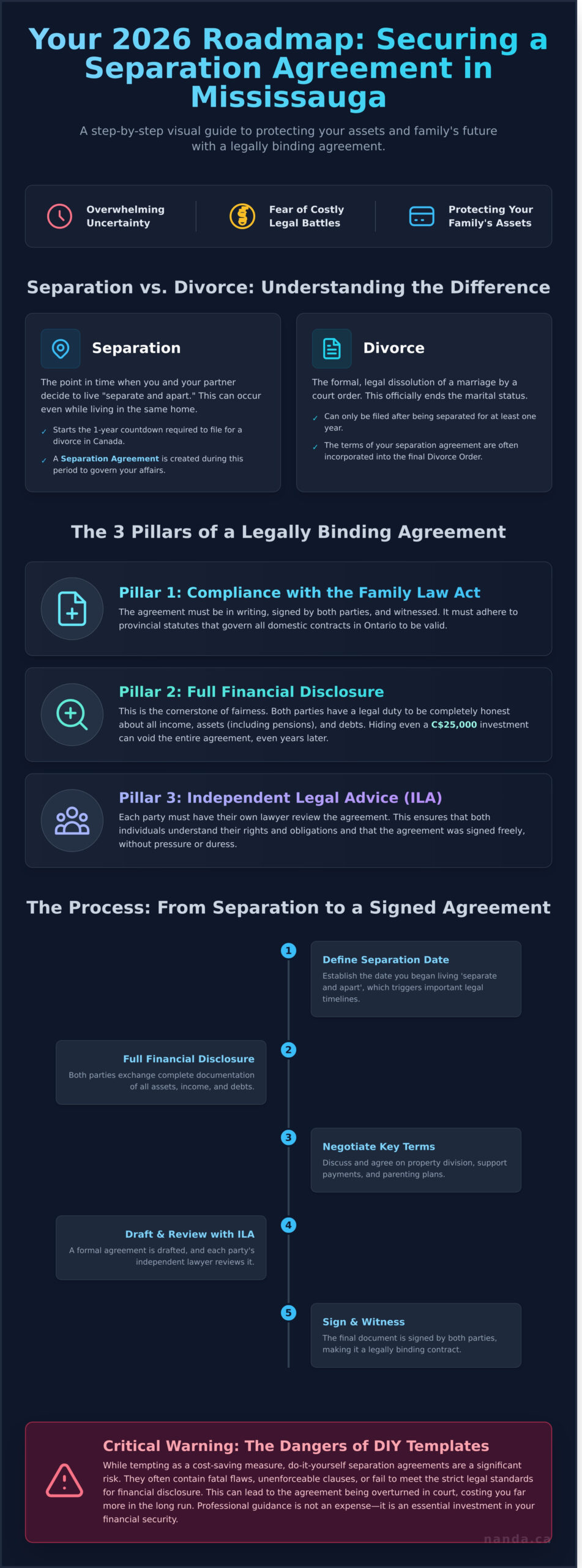
It’s vital to distinguish between these two terms. Separation begins the moment you and your spouse decide to live separate lives, which starts the one-year clock required to file for a divorce in Canada. A divorce is the formal court order that legally ends your marriage. You do not need to be divorced to have a fully enforceable separation agreement. In fact, most couples rely on this agreement to govern their affairs for months or even years before a divorce is finalized. Understanding these distinctions is fundamental, and our team is here to guide you through every step. For a detailed consultation on your specific circumstances, explore our comprehensive family law services.
Legal Explanation: The Pillars of an Enforceable Ontario Agreement
A separation agreement is far more than a simple document outlining who gets what. In Ontario, it is a formal domestic contract that must adhere to a strict set of legal standards to be considered valid and binding. Without a solid legal foundation, the agreement you spend weeks or months negotiating could be challenged and set aside by a court, undoing all your work and creating significant future instability. Understanding these pillars is the first critical step in learning how to get a separation agreement in Mississauga that protects your interests.
At the core of every enforceable agreement are three non-negotiable principles mandated by Ontario’s Family Law Act:
-
Compliance with the Family Law Act: This provincial statute sets the ground rules for all domestic contracts in Ontario. It dictates the formal requirements for a valid agreement, such as that it must be in writing, signed by both parties, and witnessed. It also provides the legal tests a court will use if the agreement is ever challenged.
-
The ‘Full Financial Disclosure’ Mandate: This is the cornerstone of fairness. Both spouses have a legal duty to provide complete and honest information about their income, assets, and debts. Hiding an investment account or undervaluing a business interest isn’t a clever strategy; it’s grounds for a judge to void the entire agreement, potentially years down the line. Transparency is not optional.
-
The Role of Independent Legal Advice (ILA): The court must be satisfied that both parties understood the nature and consequences of the agreement they signed. The most effective way to ensure this is for each spouse to receive advice from their own dedicated family lawyer in Mississauga. This process confirms that no one was pressured and that both individuals understood their rights and obligations before signing.
It’s also essential to recognize that a separation agreement is a specific type of domestic contract. Unlike a prenuptial agreement (signed before marriage) or a cohabitation agreement (for unmarried partners), a separation agreement is created at the end of a relationship to formally resolve the legal issues arising from the breakdown.
The Essential Elements of the Contract
A comprehensive separation agreement must address all the significant issues resulting from your separation. While every family’s situation is unique, a legally sound agreement will methodically resolve the division of property, arrangements for children, and any support payments. This includes a detailed plan for:
-
Division of Property: This involves identifying and valuing all family property and calculating each spouse’s Net Family Property to determine an equalization payment. Key assets typically include the matrimonial home, investment properties, RRSPs, pensions, and business interests.
-
Parenting Arrangements: The agreement must set out a clear parenting plan that serves the best interests of the children. This includes defining decision-making responsibility (formerly custody) for major issues like health and education, as well as a specific schedule for parenting time (formerly access). These terms are guided by principles found in both provincial and federal family law.
-
Support Obligations: Using specialized software that applies the Child Support Guidelines, the agreement will calculate the precise amount of child support. It will also address whether spousal support is payable, for how long, and in what amount, providing financial clarity for both parties.
Why Fairness Matters to the Court
A court retains the power to set aside a separation agreement if it is fundamentally unfair. This isn’t about ensuring a perfect 50/50 split of every last asset; it’s about preventing exploitation. A judge will apply the ‘unconscionability’ test, asking if the deal is so overwhelmingly one-sided that it would "shock the conscience of the court." This can happen if one party was under duress, was misled, or failed to understand the significant legal rights they were signing away. Properly navigating the complexities of how to get a separation agreement in Mississauga means creating a document that is not only legally compliant but also resilient to future challenges. Independent Legal Advice is the primary safeguard each party has to demonstrate they understood the agreement and signed it freely, protecting the contract from future claims of unfairness. Our team can help ensure your agreement is built on a foundation of fairness and legal precision, providing you with lasting peace of mind.
The Timelines or Process: Finalizing Your Agreement in Peel Region
Understanding the path forward can provide immense clarity during a difficult time. While every separation is unique, the process of finalizing a separation agreement in Peel Region generally follows a structured, four-step timeline. This framework, typically spanning four to five months, is designed to ensure all issues are addressed methodically, leading to a fair and legally sound resolution. Knowing how to get a separation agreement in Mississauga is about understanding these deliberate stages.
Here is a realistic look at the journey from initial consultation to a signed, enforceable document.
- Step 1: Information Gathering & Financial Disclosure (Weeks 1-4)
The foundation of any fair agreement is transparency. This initial phase is dedicated to collecting and exchanging all relevant financial information. Both parties have a legal duty to provide full and frank disclosure. This involves compiling documents such as income tax returns from the last three years, property valuations, bank and investment account statements, and pension plan details. A comprehensive understanding of the family’s net worth is essential to properly address equalization, which is governed by the Ontario government rules on dividing property. This step prevents future disputes and ensures the agreement is built on accurate facts.
- Step 2: Negotiation and Mediation in Mississauga (Weeks 5-12)
Once all financial information is on the table, negotiations can begin in earnest. The goal is to reach a consensus on key issues like property division, spousal support, child support, and parenting arrangements. This phase is where you decide the tone of your separation.
The Negotiation Phase: Collaborative vs. Adversarial
Many couples in Mississauga successfully use mediation with a neutral third party to resolve disagreements, particularly around sensitive parenting schedules. Another effective strategy is the four-way meeting, where both spouses and their respective divorce lawyers in Mississauga meet to negotiate terms directly. This collaborative approach often saves time and reduces emotional strain. Should discussions reach a stalemate after several weeks, the next step may involve shifting from negotiation to the court process (litigation).
- Step 3: Drafting the First Version of the Agreement (Weeks 13-16)
After the major points are agreed upon, one party’s lawyer will draft the formal separation agreement. This detailed legal document translates your verbal agreements into precise, unambiguous language. It will cover every aspect of your separation, creating a clear roadmap for your family’s future.
- Step 4: Independent Legal Review and Signing (Weeks 17-20)
This final step is non-negotiable for creating a binding agreement. Each party must have the draft agreement reviewed by their own lawyer. This is called Independent Legal Advice (ILA). It ensures you fully understand your rights, obligations, and the long-term implications of the document you are signing. Once both parties have received ILA and any final revisions are made, the agreement is signed and witnessed, making it legally binding.
Filing and Enforcement in Brampton Courts
For added security, you can file your signed separation agreement with the Ontario Court of Justice, located at 7755 Hurontario Street in Brampton. Filing allows for easier enforcement of its terms. Specifically, any support obligations can be enforced through the Family Responsibility Office (FRO), which can collect payments on your behalf. A properly drafted, signed, and witnessed agreement provides lasting peace of mind, as it is a final resolution that is very difficult to overturn in court.
Practical Advice: Avoiding Common Pitfalls for Mississauga Families
The path to a legally sound separation agreement is often filled with emotional and financial complexities. For families in Peel Region, understanding these challenges is the first step toward a fair resolution. A misstep in the process can lead to significant financial loss and prolonged legal disputes. We’ve identified the most common pitfalls and provide clear, strategic advice to help you protect your future.
A critical part of knowing how to get a separation agreement in Mississauga involves avoiding these four major errors:
-
Signing Under Duress: Never sign any document during a moment of high conflict or emotional pressure. An agreement signed under such conditions may be set aside by a court later, invalidating the entire contract and forcing you to restart the process. It’s vital to review any proposed agreement with your own lawyer when you are calm and clear-headed.
-
Ignoring Pension Complexity: Many GTA-based corporate pensions, particularly defined benefit plans, are exceptionally complex assets. A simple statement of value is not enough. An expert actuarial valuation is required to determine the correct family law value for equalization. Failing to do this can result in one party being shortchanged by tens or even hundreds of thousands of dollars.
-
The ‘Matrimonial Home’ Trap: Do not move out of your matrimonial home before speaking with a family lawyer. While it may seem like a good way to de-escalate conflict, leaving the home can unintentionally signal an abandonment of your claim to exclusive possession. It can also create a new status quo for parenting arrangements that may be difficult to change later.
-
Disregarding the 2026 Tax Year: Spousal support payments are currently tax-deductible for the payor and considered taxable income for the recipient. However, tax laws evolve. A well-drafted agreement must consider how potential changes to federal tax rules in the 2026 tax year and beyond could impact these financial arrangements, protecting both parties from future surprises.
Choosing the Right Legal Support
When a separation involves a family business, multiple real estate holdings, or complex investments, you need more than just a family lawyer. A multidisciplinary firm like Nanda & Associate Lawyers provides a seamless, ‘one-stop’ solution. Our family lawyers collaborate directly with our in-house business and real estate teams to provide a comprehensive strategy. In a city where over 52% of residents speak a language other than English at home (Statistics Canada, 2021 Census), our multilingual team ensures nothing is lost in translation.
Local Resources and Support Systems
Beyond legal representation, Peel Region offers several resources to assist families. You can access the court-mandated Mandatory Information Program (MIP) at the Brampton courthouse to understand the legal process. For high-conflict parenting disputes, a local parenting coordinator can be engaged to help manage schedules and decisions without constant court intervention. For property division, we connect our clients with trusted real estate appraisers who have specific expertise in the distinct markets of Mississauga, Brampton, and Milton.
Navigating the intricate details of property, pensions, and support is central to achieving a fair outcome. If your separation involves complex financial assets, schedule a consultation with our experienced Mississauga family lawyers to build a strategy that secures your financial stability.
Conclusion: Securing Your Future with Nanda & Associate Lawyers
Navigating a separation is one of life’s most challenging transitions. Your separation agreement is the essential roadmap to your new life, defining your financial independence, property rights, and parenting arrangements for years to come. It must be built on a solid legal foundation. Understanding how to get a separation agreement in Mississauga is the critical first step, but securing one that is fair, comprehensive, and legally binding is the ultimate goal. A poorly drafted document can lead to costly and emotionally draining disputes down the road, undoing any initial savings in time or expense.
What sets our firm apart is the integration of compassionate family law with the strategic depth of a multi-disciplinary practice. At Nanda & Associate Lawyers, we see the full picture. If your separation involves selling the matrimonial home or dividing a family-owned business, our family lawyers collaborate directly with our in-house real estate and corporate law teams. This seamless approach ensures every detail is aligned, protecting your interests from all angles without the inefficiency of hiring multiple firms. We provide the comprehensive legal solutions you need under one roof.
For over two decades, Nanda & Associate Lawyers has been deeply embedded in the Mississauga and Brampton communities. We are not just your lawyers; we are your neighbours. Our team reflects the vibrant diversity of the Peel Region, speaking over 15 languages to ensure you can communicate your needs with clarity and confidence. We believe that exceptional legal representation should be accessible, responsive, and always results-driven.
How We Can Help You Today
Our dedicated family law team provides end-to-end guidance and support. We are committed to achieving the best possible outcome for you and your family through a process built on strategy and care. Our services include:
-
Tailored Drafting: We craft separation agreements that reflect your unique family goals, meticulously addressing everything from complex parenting schedules and spousal support to the division of registered retirement savings plans (RRSPs) and corporate assets.
-
Strategic Negotiation: Our primary objective is to reach a fair settlement through skilled negotiation or mediation. We work diligently to keep you out of the A. Grenville and William Davis Courthouse in Brampton, saving you the significant time and costs associated with family litigation.
-
Independent Legal Advice (ILA): We provide the critical Independent Legal Advice required by Ontario law. This final review ensures you fully understand your rights and obligations, making your agreement legally enforceable and protecting you from future challenges.
Contact Our Mississauga Family Law Team
You don’t have to navigate this process alone. We invite you to a personalized consultation to review your situation, answer your questions, and identify the best path forward. Visit our office at 2980 Drew Road in Mississauga or schedule a confidential virtual meeting at your convenience. Don’t leave your financial and parental future to chance. Take the first step toward clarity and peace of mind today by contacting our team.
Secure Your Future with a Tailored Separation Agreement
Navigating separation is a significant life transition. As this guide has detailed, a legally enforceable agreement rests on full financial disclosure and independent legal advice, forming the foundation for a stable future. Understanding how to get a separation agreement in Mississauga is about more than just paperwork; it’s about creating a clear and fair path forward for you and your family.
You don’t have to manage this complex process alone. Since 2003, Nanda & Associate Lawyers has provided compassionate and authoritative legal guidance to families across the GTA. With legal services available in over 15 languages and comprehensive solutions that span Family, Real Estate, and Business Law, our team is uniquely equipped to protect your interests from every angle.
Take the decisive first step towards peace of mind. Schedule a Consultation with our Mississauga Family Law Team today. Your new beginning is within reach, and we are here to help you secure it with confidence.
Frequently Asked Questions About Separation Agreements in Mississauga
Can I write my own separation agreement in Mississauga?
Yes, you can write your own separation agreement, but we strongly advise against it. These DIY agreements often fail to meet legal standards and can be set aside by a court. Without professional legal advice, you risk creating an unenforceable document that omits critical issues like pension division or tax implications. Securing a lawyer ensures your agreement is comprehensive, legally sound, and protects your rights for the future, providing you with true peace of mind.
How much does a separation agreement cost in Ontario?
The cost of a separation agreement in Ontario varies based on the complexity of your situation. If your case involves complex assets, business valuations, or significant conflict requiring extensive negotiation, costs can increase substantially. We provide a clear fee structure after understanding the specific details of your case.
What happens if my spouse refuses to sign the agreement?
A separation agreement is a voluntary contract, so you cannot force your spouse to sign it. If they refuse, your first step should be to explore alternative dispute resolution methods like mediation or collaborative family law to reach a consensus. If negotiations fail and an agreement cannot be reached, the only remaining option is to commence a court application. A judge will then make binding orders regarding property division, support, and parenting matters.
Is a separation agreement the same as a divorce?
No, a separation agreement is fundamentally different from a divorce. A separation agreement is a private legal contract that resolves issues like property division, debt, and spousal or child support. A divorce, on the other hand, is a formal court order that legally ends your marriage. You can be legally separated with a signed agreement for years without ever getting a divorce. The agreement often simplifies the divorce process later on.
How do we handle the matrimonial home in a Mississauga separation?
Under Ontario’s Family Law Act, both spouses have an equal right to possess the matrimonial home, regardless of whose name is on the title. Common solutions include one spouse buying out the other’s share, selling the home and dividing the net proceeds, or arranging for one party to reside in it for a specified period. The home’s value is a central part of the equalization of net family property, and its resolution is a critical component of any separation agreement.
Can a separation agreement be changed later?
Yes, a separation agreement can be changed, but only if both former spouses consent to the new terms. Any modifications must be formalized in a written amending agreement, which should be signed and witnessed just like the original document. If one party does not agree to a change, you may need to return to mediation or, if necessary, seek a court order to vary the original terms, particularly for support provisions where a material change in circumstances has occurred.
Do I need to go to court to get a separation agreement?
No, you don’t need to go to court. In fact, a primary advantage of a separation agreement is that it’s a private contract negotiated entirely outside the court system. This approach is typically more collaborative, cost-effective, and faster than litigation. Understanding how to get a separation agreement in Mississauga without court involvement is key to a smoother process. The court only becomes involved if you and your spouse cannot agree on the terms and require a judge to make a decision.
How long do you have to be separated before you can get a divorce in Ontario?
In Ontario, the grounds for divorce require you to be separated from your spouse for at least one full year (365 days). While you can begin the application process before the one-year mark has been reached, the court will not grant the final Divorce Order until that period has officially passed. This one-year separation is the most common basis for divorce in Canada, establishing that there has been a breakdown of the marriage.