



Key Takeaways
- Use only the most recent version of each form—outdated versions are auto-rejected
- Complete every field, even fields that seem optional
- Include all supporting documents listed in the official guide
- Double-check signature fields on IMM 1344 and IMM 0008
- Ensure dates match across all documents
Brampton is more than just a city; it’s a vibrant illustration of immigration on its largest scale. The City of Brampton states that roughly 52.9% of Brampton’s residents were born outside Canada, placing it as the 5th-largest immigrant population in the country. Each of those statistics represents a family grappling with borders, bureaucracy, and the quiet pain of separation.
Spousal sponsorship carries an emotional weight unlike any other immigration pathway. You’re not just filing forms—you’re fighting for the right to share a home with the person you love.
In a city this immigration-dense, the competition for processing resources is real, and the stakes of a misstep are higher. A smart spousal sponsorship lawyer Brampton knows these local pressures, not only the federal rulebook. Small procedural errors can mean months of delay or outright refusal.
Before diving into strategy, the most critical early decision shapes everything that follows: where your spouse currently lives, and that choice defines your entire sponsorship path.
Choosing Your Path: Inland vs. Outland Sponsorship
Understanding Brampton’s immigration landscape is one thing—knowing which sponsorship stream fits your situation is another. The first major strategic decision every couple faces when figuring out how to apply for spousal sponsorship in Canada is straightforward but consequential: is your spouse already in Canada, or are they waiting abroad?
The answer determines everything from processing timelines to your legal options if something goes wrong.
According to IRCC data, outland applications average 9 to 12 months, while inland applications can wait anywhere from 12 to 28 months. That’s a huge gap and one you’ll want to consider carefully before you fill out your first form.
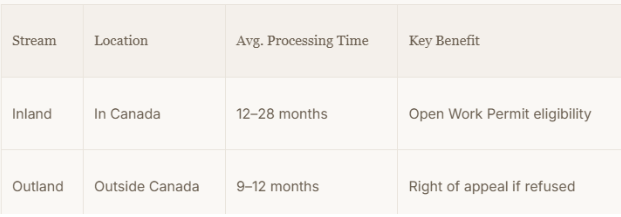
The trade-off, however, is real. Outland applicants who receive a refusal retain the right of appeal through the Immigration Appeal Division—a critical protection that inland applicants generally don’t have access to in the same way. Families navigating a refusal often benefit from consulting a spousal sponsorship appeal lawyer Brampton residents trust for that reason alone.
Choosing wrong doesn’t just cost time—it can reset your entire process. Which brings us to a critical obstacle many applicants never see coming.
The ‘R10’ Hurdle: Why 27% of Applications Fail Before They Start
Once you’ve chosen your sponsorship stream, the next challenge is submitting a package that actually makes it past the front door. IRCC uses what’s known as the R10 completeness check — a preliminary screening step that reviews whether your application meets basic administrative requirements before it ever reaches an officer’s desk. According to CIC News, approximately 27% of inland spousal sponsorship applications were refused at this initial stage in 2025. That’s more than one in four couples, who were stopped before the real review even began.
An incomplete application doesn’t pause your file — it erases your place in line entirely.
The Checklist
Knowing how to apply for spousal sponsorship in Canada means understanding that IRCC won’t fix your mistakes for you. Every required form must be current, complete, and included.
- Use only the most recent version of each form—outdated versions are auto-rejected
- Complete every field, even fields that seem optional
- Include all supporting documents listed in the official guide
The Signature Trap
Missing signatures are one of the most common—and preventable—reasons applications get returned. Both the sponsor and the applicant must sign specific forms independently.
- Double-check signature fields on IMM 1344 and IMM 0008
- Ensure dates match across all documents
- Digital and photocopied signatures are generally not accepted
The Fee Factor
Submitting incorrect fees triggers an immediate return with no exceptions.
- Verify current processing fees on the IRCC website before submission—they do change
- Pay the Right of Permanent Residence Fee (RPRF) upfront to avoid delays
- Keep official payment confirmation as part of your records
With the administrative foundation secured, the next challenge is arguably more personal: convincing an officer that your relationship itself is genuine.
Proving Your Love is Real: The ‘Genuineness’ Test
Getting past the R10 completeness check is a milestone—but it’s only the beginning. The deeper challenge in any Canada spousal sponsorship application is convincing an IRCC officer that your relationship is exactly what you say it is.
So what does “genuine” actually mean to a visa officer? In practice, they’re looking for a relationship that developed organically, has depth over time, and would exist regardless of the immigration benefits it provides. Evidence falls into four broad categories: financial entanglement (joint bank accounts, shared bills), physical documentation (photos across different settings and life events), social corroboration (letters from family and friends who’ve witnessed the relationship), and shared legal ties (co-signed leases and named beneficiaries on insurance).
“A relationship isn’t proved by a wedding album. It’s proved by the grocery receipts, the birthday texts, the lease renewals—the unglamorous details that accumulate over years.” — Common observation among immigration practitioners reviewing refused files
“Family reference letters carry significant weight when they’re specific. Generic ‘they seem happy together’ letters are largely ignored.” — A pattern noted consistently in IRCC officer training guidelines
“Shared finances are often the single most persuasive category of evidence—they’re hard to fabricate and easy to verify.” — Reflected in IRCC’s published assessment criteria
One critical warning: don’t overcurate your photo submissions. Officers are trained to spot collections that look staged or suspiciously polished. Consistency over time matters far more than quality. A candid photo from a Tuesday dinner two years ago can outperform a professionally shot engagement portrait.
The numbers reinforce this: according to IRCC data analysis, appeals based on “insufficient evidence” of a genuine relationship carry a 67% success rate—meaning the relationship was real, but the original application simply failed to tell the story convincingly.
That’s a costly lesson. And if an officer does say no, the path forward depends heavily on which stream you applied through—which is exactly where things get more complicated.
When the Answer is ‘No’: The Spousal Sponsorship Appeal Process
A refusal is not necessarily the end of the road. For Outland applicants, Canadian immigration law preserves a meaningful right: the ability to challenge a negative decision before the Immigration Appeal Division (IAD). Inland applicants generally do not share this right, which makes the stream you choose at the outset a consequential decision. If your Canada spousal sponsorship application has been refused, understanding your appeal options quickly is critical, as IAD filing deadlines are strict. Missing them can permanently close the door on this route.
Procedural Errors: Your Strongest Ground
Not every refusal reflects a fair assessment. When an immigration officer makes a technical mistake—misapplying the law, ignoring relevant evidence, or failing to follow proper procedure—that’s classified as a procedural error. These cases are compelling: appeals based on procedural errors carry a remarkable 78% success rate at the IAD. In practice, a well-documented procedural challenge can overturn a refusal entirely, sometimes allowing your spouse to obtain a spouse open work permit Canada authorizes during processing while the appeal resolves.
Merit-Based Refusals: A Harder Fight
When an officer concludes the relationship isn’t genuine, the appeal becomes a credibility battle. You’ll need to rebuild your evidentiary foundation—stronger documentation, updated photos, communication logs, and potentially sworn testimony. These cases succeed, but the margin for error is far smaller.
A refusal is only permanent if you let it be—understanding which grounds apply to your case is the first strategic decision after receiving a negative decision.
The complexity of navigating IAD timelines, filing deadlines, and evidentiary standards is exactly why having the right legal support in your corner matters so much—which brings us to what a Brampton spousal sponsorship lawyer can realistically do for you.
Final Thoughts: Brampton Spousal Sponsorship Lawyer is Your Best Asset
The journey to sponsor spouse PR Canada is rarely a straight line. Between the 12–28 month processing window, the R10 completeness check, the genuineness standard, and the possibility of an Immigration Appeal Division hearing, the process demands both precision and stamina. A single missed document can reset your timeline. A poorly framed response can trigger a refusal.
A lawyer’s most tangible value is prevention. In practice, applications that clear the R10 check on the first submission avoid weeks—sometimes months—of unnecessary delay. Legal counsel ensures every document is present, every form is consistent, and every supporting narrative is framed strategically before IRCC ever opens the file.
A well-prepared application isn’t just faster—it’s fundamentally safer.
The Nanda Advantage
- Local expertise: Nanda & Associate Lawyers provides specialized legal representation for complex immigration matters across the GTA, including Brampton
- First-submission accuracy: Meticulous R10 preparation minimizes completeness refusals
- Genuineness strategy: Counsel helps couples present their relationship clearly and compellingly
- Appeal representation: Experienced defence if a refusal requires IAD intervention
Ready to protect your application from the start? Book a consultation today and give your spousal sponsorship the strategic foundation it deserves.