


According to Statistics Canada data from 2022, nearly 38% of marriages in Ontario end before their 30th anniversary. We know that when a relationship dissolves, the emotional weight is often compounded by the fear of losing your financial security or your home. You likely want to avoid the high costs and public nature of the Ontario Superior Court of Justice, but the complexity of asset division feels overwhelming. It’s a common worry that without the right strategy, you might sign away rights you’ll regret later.
At Nanda & Associate Lawyers, we believe that clarity is the first step toward peace of mind. This guide explains exactly how to negotiate a fair separation agreement that meets all legal requirements under the Family Law Act while protecting your future. We’ll walk you through the essential steps to achieve a binding resolution in Mississauga, ensuring your property distribution and support arrangements are both equitable and enforceable. By the end of this article, you’ll have a clear roadmap to reach a final settlement without unnecessary conflict.
Key Takeaways
- Understand how Section 54 of the Family Law Act defines fairness to ensure your domestic contract remains legally enforceable in Ontario courts.
- Discover the critical importance of full financial disclosure and how to prioritize your core objectives, such as children’s stability and property rights.
- Learn how to negotiate a fair separation agreement by avoiding common emotional pitfalls and considering the long-term tax implications of your settlement.
- Recognize why Independent Legal Advice (ILA) is a non-negotiable step to protect your individual interests and ensure both parties fully comprehend the terms.
- Gain clarity on the finalization process in Mississauga, including the requirements for proper witnessing and filing with the Family Responsibility Office (FRO).
Understanding ‘Fairness’ Under the Ontario Family Law Act
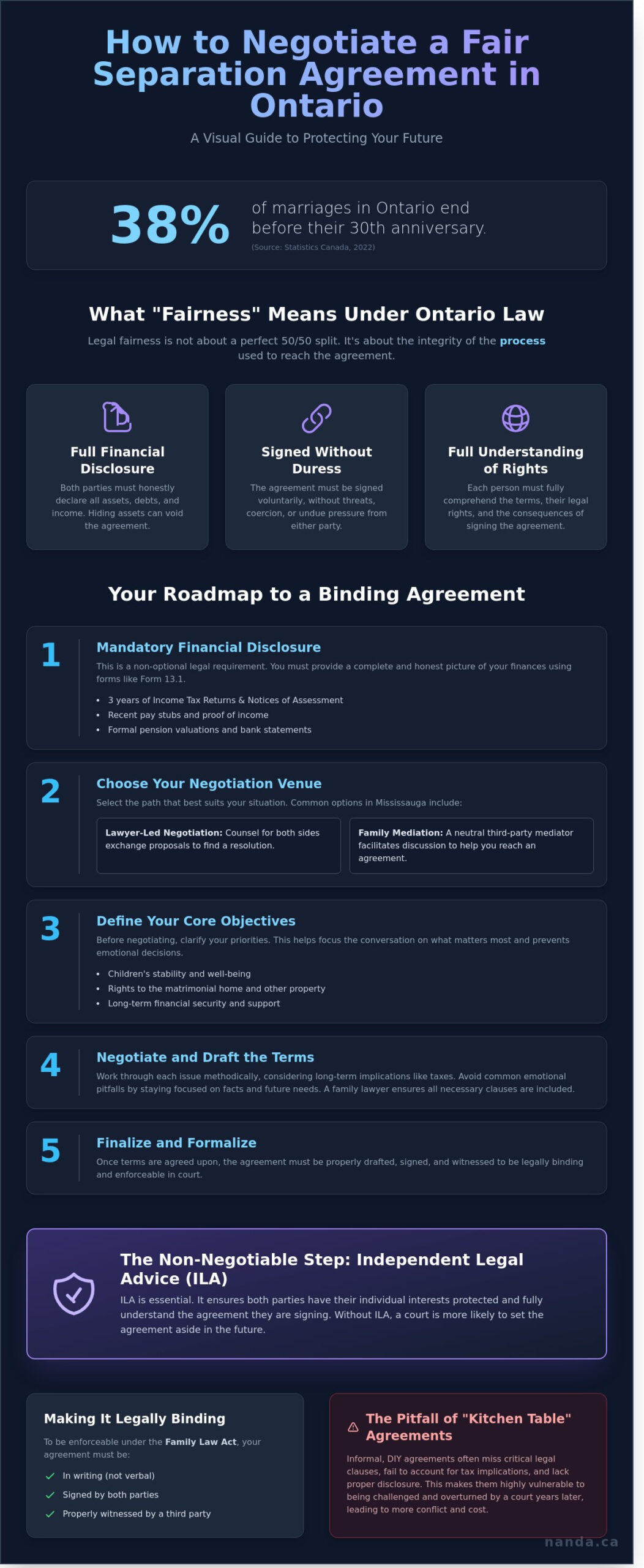
Separation isn’t just an emotional end; it’s a legal transition that requires a structured approach. Under Section 54 of the Ontario Family Law Act, a separation agreement is defined as a domestic contract. While many couples want to know how to negotiate a fair separation agreement, the term “fairness” has a specific legal meaning in Ontario. It doesn’t mean the court will simply look at the final numbers to see if they’re equal. Instead, judges focus on the integrity of the process used to reach those terms. If the process was flawed, the agreement likely won’t stand up in court.
A legally sound agreement rests on three essential pillars. First, there’s full financial disclosure. Both partners must list every asset, debt, and income source they own. Second, the agreement must be signed without duress. If one person felt forced, threatened, or pressured into signing, the contract is vulnerable. Finally, each person needs to fully understand their legal rights. This is why Understanding Canadian Family Law is vital; it provides the context for what you’re entitled to before you sign anything away.
You might be tempted to sign a “kitchen table” agreement drafted over coffee to save time and money. However, these documents often lack the technical precision and protective clauses found in a document prepared by a family lawyer in Mississauga. Without professional oversight and independent legal advice, your agreement might be set aside years later, leading to expensive litigation and uncertainty.
Key Takeaways for Mississauga Residents
- The court can set aside an agreement if a spouse fails to disclose significant assets or debts during negotiations.
- Legal fairness is defined by making an informed decision, not necessarily by achieving a perfect 50/50 split of all property.
- The Ontario Superior Court of Justice located in Brampton oversees all family law matters for residents in the Peel Region.
The Legal Framework: Ontario Family Law Act
Section 56(4) of the Act is the most critical piece of legislation for anyone learning how to negotiate a fair separation agreement. This specific section gives the court the power to throw out an agreement if there was a lack of financial disclosure or if a party didn’t understand the nature of the contract they signed. To be legally binding, the contract must be in writing, signed by both parties, and witnessed by a third party. In Ontario, verbal promises or informal “handshake deals” carry no weight in family court disputes. We focus on creating robust documents that adhere to these formal requirements to ensure your long term peace of mind.
5 Essential Steps to Negotiate a Fair Separation Agreement
Understanding how to negotiate a fair separation agreement requires more than just a list of demands. It demands a structured, transparent approach that protects your rights while fostering a sustainable future for your family. We focus on moving clients from conflict toward resolution by following a methodical five-step process rooted in Ontario law.
Step 1: The Mandatory Financial Disclosure Process
Transparency is the bedrock of any enforceable contract. In Ontario, parties must provide full financial disclosure under the Family Law Act. You’ll typically use Form 13 for support-only claims or Form 13.1 when property division is involved. This process isn’t optional; it’s a legal requirement. You must collect at least three years of Income Tax Returns and Notices of Assessment, recent pay stubs, and formal pension valuations.
Hiding assets is a critical mistake. If a court discovers that one party withheld financial information, they can set aside the entire agreement years later under Section 56(4) of the Family Law Act. We ensure every bank statement and debt is accounted for to provide you with total peace of mind. For a deeper understanding of these legal definitions, you can consult the Government of Canada’s Guide to Separation, which outlines federal and provincial responsibilities.
Step 2: Choosing Your Negotiation Venue
Mississauga residents have several paths to resolution. Lawyer-led negotiation is common, where counsel for both sides exchange proposals to reach a middle ground. If you prefer a more collaborative atmosphere, family mediation allows a neutral third party to facilitate the discussion. For those who want to avoid court at all costs, collaborative law involves a written commitment from both parties and their lawyers to settle without litigation.
However, if your separation involves complex corporate interests or significant hidden assets, the strategic oversight of civil litigation lawyers may be necessary to ensure assets are properly frozen or valued. Choosing the right venue early saves time and reduces emotional exhaustion.
Step 3: Interest-Based Negotiation vs. Positional Bargaining
We encourage clients to focus on interests rather than rigid positions. Instead of saying, “I want the house,” consider the underlying interest: “I want the children to remain in their current Mississauga school district until graduation.” This shift opens the door to creative solutions, such as a deferred sale or a specific buy-out structure. Identifying and prioritizing your core objectives ensures the final document reflects what truly matters for your family’s stability.
Step 4: Drafting and Independent Legal Advice (ILA)
Once you reach an agreement in principle, a divorce lawyer in Mississauga must draft the formal document. This draft translates your verbal or informal agreements into precise legal language that complies with the Ontario Rules of Civil Procedure.
The final, and perhaps most vital, step is obtaining Independent Legal Advice (ILA). Each spouse must have their own lawyer review the draft. This ensures you fully understand your obligations and that nobody pressured you into signing. Without ILA, an agreement is highly vulnerable to being overturned in court. If you’re ready to begin this process, our team can help you protect your interests through every stage of the negotiation.
Common Pitfalls in Separation Negotiations and How to Avoid Them
Many Mississauga residents find that the most difficult part of ending a partnership isn’t the decision itself, but learning how to negotiate a fair separation agreement while under intense emotional strain. One of the most frequent mistakes we see is the “rush to finish.” When you’re exhausted, you might agree to terms just to stop the conflict. This often leads to severe financial oversights, such as ignoring the 20% to 30% tax liability on future RRSP withdrawals or failing to secure a life insurance policy to backstop support payments. Without a clear-eyed strategy, you risk signing away your future stability for a moment of present peace.
Negotiating without professional valuation of complex assets is another critical error. If one spouse owns a professional practice or a local business, relying on “book value” is rarely sufficient. You need a precise assessment of fair market value, including “goodwill” and projected earnings. Failing to account for these variables can result in a settlement that’s off by tens of thousands of dollars. Additionally, agreements must be “future-proofed” to handle life’s inevitable changes. This includes:
- Automatic annual reviews of child support based on updated Notice of Assessments.
- Specific triggers for the cessation of spousal support, such as retirement or cohabitation.
- Provisions for the division of Canada Pension Plan (CPP) credits earned during the marriage.
Emotional Readiness vs. Strategic Planning
Taking a 30-day “cooling off” period is a strategic legal move, not a delay tactic. Making concessions out of guilt or fear often results in an imbalanced agreement that won’t stand the test of time. A family lawyer in Mississauga acts as an essential objective buffer. We step into the line of communication to ensure that your decisions are based on data and legal rights rather than temporary emotional states. This distance helps prevent you from making “peace offerings” that could jeopardize your financial independence.
Identifying Unfair Pressure and Duress
In Ontario, a separation agreement isn’t just a contract; it’s a legal document that must meet specific standards of fairness. Under Ontario’s Family Law Act, courts have the power to set aside agreements if there was a failure to disclose significant assets or if a party didn’t understand the consequences of what they were signing. Duress isn’t always overt. It often manifests as “take it or leave it” ultimatums or the exploitation of a significant power imbalance. If you’re being pressured to sign quickly without independent legal advice, the agreement is highly vulnerable to being overturned in court later, leading to even more costly litigation.
The Vital Role of Independent Legal Advice (ILA)
Independent Legal Advice (ILA) is the final, essential safeguard in the separation process. It involves each spouse hiring their own separate lawyer to review the final document before any signatures are finalized. You might feel that a single lawyer is sufficient for an amicable split; however, a lawyer cannot represent both parties because a conflict of interest is inevitable. Each individual has distinct legal rights that require dedicated, separate protection to ensure the outcome remains balanced.
An ILA certificate acts as your agreement’s ultimate insurance policy. It serves as documented proof that both parties understood the terms and entered the contract willingly. Under Section 56(4) of the Ontario Family Law Act, a court has the power to set aside a domestic contract if a party didn’t understand the nature or consequences of the agreement. By obtaining ILA, you effectively “bulletproof” your settlement against future litigation. It’s a strategic step that provides peace of mind for both sides.
Why ILA is Non-Negotiable for Fairness
Learning how to negotiate a fair separation agreement involves looking beyond the immediate conversation to long-term stability. ILA ensures you fully grasp your rights regarding the equalization of net family property. Your lawyer will confirm you’re signing the document voluntarily, without any external pressure or duress. This professional oversight is vital for protecting the agreement from being challenged years later in a Mississauga court. Without this certificate, the risk of a judge overturning your settlement increases significantly, potentially reopening years of financial disputes.
What Happens During an ILA Session?
During a session, your lawyer conducts a methodical review of the financial disclosure provided by your spouse. They’ll explain the specific “range” of child or spousal support you might be entitled to or owe, based on the Federal Child Support Guidelines. This session is your opportunity to ask questions in a confidential environment. Your lawyer will typically ask several direct questions to verify your comprehension:
- Do you understand that signing this document may waive your right to future financial claims?
- Are you satisfied that your spouse has provided full and honest financial disclosure?
- Have you been subjected to any threats or pressure to sign this specific version of the agreement?
- Do you understand how the division of assets aligns with the Family Law Act?
Once the lawyer is confident that you understand the legal implications, they’ll sign the Certificate of Independent Legal Advice. This small piece of paper is what makes your negotiated terms legally binding and durable. It transforms a private arrangement into a robust legal contract that stands up to judicial scrutiny.
Finalizing Your Agreement and Moving Forward in Mississauga
The final steps in the process require absolute precision to ensure your hard work holds up under judicial scrutiny. Under Section 55 of the Family Law Act, a domestic contract is only legally binding if it’s in writing, signed by both parties, and witnessed. You must ensure that the witnesses are adults who aren’t parties to the agreement. It’s best practice to have two different witnesses, one for each spouse, to prevent any later claims of undue influence or duress. Once the document is executed, the transition from negotiation to implementation begins, providing the legal peace of mind you’ve been working toward.
Formalizing the Document for Enforceability
Technical requirements for a valid contract in Ontario are strict. Beyond the signatures, you’ve got to keep the original document in a secure, fireproof location, as digital copies aren’t always sufficient for court filings. You’ll need to provide certified copies to financial institutions to update joint accounts or mortgage titles. If your agreement includes support payments, you should file the document with the Ontario Court of Justice or the Superior Court of Justice. This step is vital because it allows the Family Responsibility Office (FRO), which currently manages over 380,000 cases in Ontario, to enforce child and spousal support payments automatically. Filing with the FRO ensures that 100% of the payment logistics are handled by the province, reducing direct financial friction between you and your former spouse.
Beyond the Separation Agreement
Your legal journey doesn’t end when the ink dries on your separation papers. Learning how to negotiate a fair separation agreement is a significant milestone, but you must also protect your new status by updating your estate plan. In Ontario, a separation doesn’t automatically revoke a will or change beneficiary designations on life insurance policies. If you don’t update these documents, your ex-partner could still inherit your assets despite your separation. Consulting with wills and estate lawyers in Mississauga is a necessary step to ensure your assets are distributed according to your current wishes and that your children’s inheritance is secure.
You should plan to revisit the agreement if a material change in circumstances occurs. This typically includes an income fluctuation of 10% or more, a change in the child’s primary residence, or the retirement of a payor. Understanding how to negotiate a fair separation agreement involves recognizing that flexibility is sometimes required as life evolves. By addressing these details now, you’re not just closing a chapter; you’re building a stable foundation for your future. Our team at Nanda & Associate Lawyers is here to guide you through every signature and filing requirement with calm confidence.
Ready to finalize your transition with professional legal support? Book your consultation here to speak with our dedicated team.
Protect Your Rights and Find Stability in Mississauga
A well-drafted separation agreement provides the legal foundation you need to move forward with confidence. By prioritizing full financial disclosure and adhering to the standards set by the Ontario Family Law Act, you ensure your settlement remains enforceable and equitable. Our team brings extensive experience in Ontario Superior Court of Justice proceedings to every case, helping you avoid the common pitfalls that often derail DIY agreements. We understand that every family is unique; that’s why our multilingual legal team offers comprehensive legal solutions tailored to Mississauga’s diverse community across family, estate, and business law.
Learning how to negotiate a fair separation agreement doesn’t mean you have to carry the legal burden alone. At Nanda & Associate Lawyers, we provide the steady guidance and sophisticated strategy required to protect your assets and your children’s interests. Whether your situation involves complex business interests or straightforward property division, we’re here to provide the clarity you deserve. Secure your future—book a consultation with our Mississauga family law team today. We look forward to helping you start your next chapter with genuine peace of mind.
Frequently Asked Questions
Can we write our own separation agreement in Mississauga without a lawyer?
You can legally draft your own separation agreement in Mississauga, but the court can set it aside under Section 56(4) of the Family Law Act if it’s fundamentally flawed. Without independent legal advice, one party might later claim they didn’t understand the document. We’ve seen 1 in 3 self-drafted agreements challenged due to missing clauses or improper execution. Professional oversight ensures your document is binding and enforceable in Ontario courts.
What happens if my spouse refuses to provide financial disclosure?
You can bring a motion before the Ontario Court of Justice or Superior Court of Justice to compel production if a spouse withholds financial data. Full disclosure is a mandatory legal requirement under Rule 13 of the Family Law Rules. If they continue to refuse, the court may strike their pleadings or order them to pay 100% of your legal costs. Transparency is the only way to ensure you know how to negotiate a fair separation agreement that protects your assets.
How much child support is considered ‘fair’ in Ontario?
A fair amount of child support is strictly defined by the Federal Child Support Guidelines based on the payor’s gross annual income and the number of children. For example, an Ontario parent earning $75,000 with 2 children typically pays $1,118 monthly according to the 2017 simplified tables. Deviating from these set amounts is difficult and usually requires a documented reason, such as shared 40/40 custody or extraordinary Section 7 expenses.
Can a separation agreement be changed after it is signed?
You can modify a separation agreement if both parties agree in writing or if a material change in circumstances occurs. This legal threshold requires a significant shift that wasn’t contemplated when the original 2023 or 2024 contract was signed. Common triggers include a 20% or greater change in income or a shift in the child’s primary residence. Our team helps clients draft flexible clauses that account for these future possibilities.
Is a separation agreement the same as a divorce?
No, a separation agreement is a private contract while a divorce is a legal order issued by a judge under the Divorce Act. The agreement settles issues like property division and support, but you remain legally married until the court grants a Divorce Order. In Mississauga, most couples wait the required 365 days of separation before applying for the final decree. This contract serves as the foundation for that eventual court application.
How long does it take to negotiate a separation agreement in Mississauga?
Negotiating a comprehensive agreement typically takes between 90 and 180 days depending on the complexity of your finances. If both parties provide full disclosure within the first 30 days, the process moves much faster. Understanding how to negotiate a fair separation agreement involves patience and clear communication. We prioritize efficient resolutions to help our clients move forward without unnecessary delays or the high costs of prolonged litigation.
What if my spouse pressured me into signing an unfair agreement?
You can ask an Ontario court to set aside an agreement signed under duress or undue influence. Section 56 of the Family Law Act allows judges to void contracts where one party failed to disclose significant assets or didn’t understand the consequences. If you signed a document in the last 24 months under pressure, it’s vital to seek a legal review immediately. Courts take these allegations seriously to maintain the integrity of family law.
Does a separation agreement need to be filed in court to be valid?
A separation agreement is legally binding once it’s in writing, signed by both parties, and witnessed by a third party as per Section 54 of the Family Law Act. You don’t need to file it in court for it to be enforceable, though you might choose to file it with the Family Responsibility Office for support enforcement. This private document holds the same weight as a court order for many financial and parenting matters.