


Could your life’s work be reduced to a 50/50 split simply because of the date you said “I do”? Many entrepreneurs in Peel Region believe their professional success is separate from their domestic life, yet statistics show that roughly 38 percent of Canadian marriages reach a breaking point before their 30th anniversary. It’s natural to feel a deep sense of anxiety when you realize that your company might be subject to equalization under the Family Law Act. If you’re currently facing a separation, learning how to protect my business in a divorce Mississauga is the most critical step you can take to ensure your professional legacy remains intact.
We understand that you’ve invested thousands of hours and significant capital into building your enterprise. You shouldn’t have to risk liquidation or hand over voting rights to an ex-spouse just to settle a family law matter. This guide provides the essential legal strategies and Ontario-specific frameworks you need to safeguard your professional livelihood. Our divorce lawyers Mississauga will walk through the equalization process, explain how business valuations are calculated in Ontario, and identify the specific corporate documents that protect your operational control.
Key Takeaways
- Understand how the Ontario Family Law Act governs the equalization of net family property to ensure your business assets are accurately valued and protected.
- Learn how to protect my business in a divorce mississauga by leveraging marriage contracts and shareholder agreements to restrict the transfer of ownership interests.
- Discover the essential role of professional business valuations in high-net-worth cases and the critical difference between fair market value and value to owner.
- Identify immediate strategic actions to separate personal and professional finances, effectively preventing the commingling of assets during a separation.
- Explore how a multidisciplinary legal team provides the comprehensive solutions necessary to safeguard your professional livelihood and ensure long-term stability.
Table of Contents
- Understanding Business Asset Division Under the Ontario Family Law Act
- The Role of Shareholder Agreements and Domestic Contracts
- Business Valuation Methods: How Mississauga Courts Determine Worth
- Strategic Steps to Protect Your Business During a Mississauga Divorce
- Navigating Business Protection with Nanda & Associate Lawyers
Understanding Business Asset Division Under the Ontario Family Law Act
Starting and scaling a business in Mississauga requires immense dedication. Protecting that legacy during a marital breakdown requires a clear understanding of the Ontario Family Law Act. The central pillar of this legislation is the Equalization of Net Family Property (NFP). Ontario law views marriage as an economic partnership where both parties contribute to the household, regardless of who manages the daily operations of a company. When this partnership ends, the law mandates a fair sharing of the wealth accumulated during the years of the union.
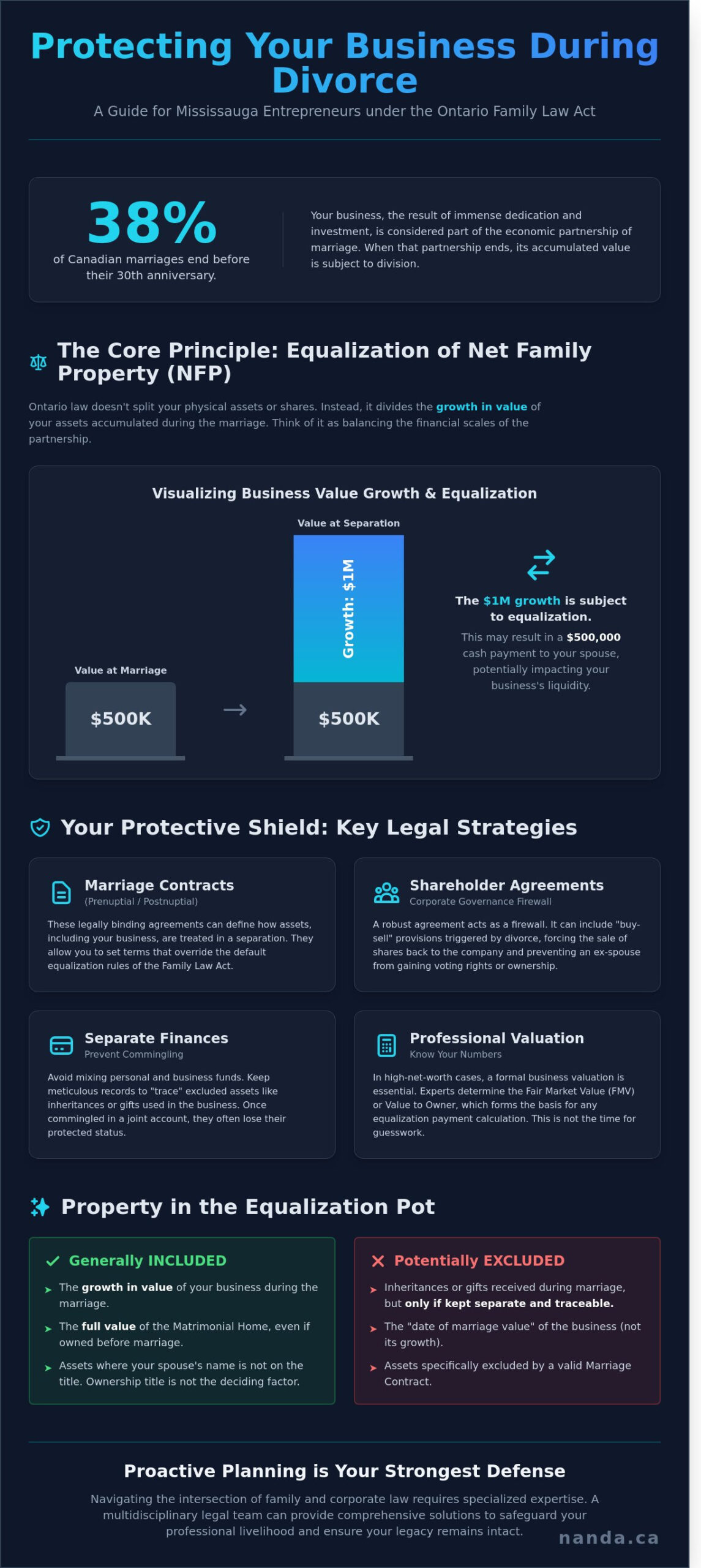
It’s a common misconception that a spouse will automatically walk away with 50% of your physical equipment, office space, or shares. Instead, the law focuses on the monetary value. If your Mississauga based manufacturing firm was worth C$500,000 at the time of your marriage and grew to C$1.5 million by the date of separation, the C$1 million increase is generally subject to equalization. You usually keep the business itself, but you may owe your spouse a cash payment for half of that growth. This financial obligation is a critical factor when considering how to protect my business in a divorce mississauga.
The matrimonial home also plays a unique role in these calculations. Under Section 18 of the Family Law Act, a home owned before the marriage that becomes the family residence doesn’t receive the same “date of marriage” deduction as a business. This often creates a situation where a business owner must tap into corporate equity or take on new debt to settle the equalization of the home’s full value. This interaction between residential and commercial assets can significantly drain a company’s liquidity if not managed through a strategic legal approach.
The Concept of Equalization in Mississauga
The equalization process calculates the growth of your global assets from the wedding date to the date of separation. Many local entrepreneurs assume that keeping their spouse’s name off the business registration or the Articles of Incorporation provides a shield against claims. This isn’t the case. The Ontario Family Law Act prioritizes the economic reality of the marriage over the formal title on a business certificate. For a Mississauga entrepreneur, Net Family Property is the total value of all assets owned on the separation date minus debts and the value of property brought into the marriage.
Excluded vs. Included Business Property
Specific assets are sometimes excluded from the equalization pot. If you used a C$100,000 inheritance received in 2019 to purchase new warehouse equipment, that specific value might be excluded. However, you must be able to “trace” those funds through meticulous financial records. If the inherited money was co-mingled with a joint bank account, it often loses its excluded status. You should consult a divorce lawyer in Mississauga to verify which parts of your commercial holdings qualify for exclusion and to ensure your records meet the court’s strict tracing requirements. This is a vital step in learning how to protect my business in a divorce mississauga.
The Role of Shareholder Agreements and Domestic Contracts
Protecting a company requires a two-pronged approach involving both corporate governance and family law strategy. Under the Ontario Family Law Act, the value of a business is typically considered part of a spouse’s net family property. Without proactive steps, you might find your ex-spouse owning a significant portion of your company’s equity or gaining a seat at the boardroom table. This is why understanding how to protect my business in a divorce mississauga is vital for any entrepreneur. We recommend implementing robust shareholder agreements and domestic contracts long before a relationship breaks down.
The intersection of corporate law and family law can be complex. While a shareholder agreement governs the relationship between owners, it doesn’t automatically override a court order for equalization. However, it can dictate how that value is paid out. Buy-sell provisions are critical here; they ensure that if a transfer of shares is triggered by a life event like divorce, the other shareholders have the right to purchase those shares at a fair market value. This prevents the business from being paralyzed by an unwanted partnership.
Protecting Corporate Governance
A well-structured shareholder agreement acts as a firewall. It ensures that shares stay within the intended group of owners. Our business lawyers in Mississauga often draft provisions that trigger upon a divorce. These clauses require a shareholder to sell their interest back to the company or other partners if a matrimonial court orders a transfer. Right-of-first-refusal and shotgun clauses are also effective. They prevent an ex-spouse from gaining voting rights or operational control, keeping the business’s daily functions stable during personal turmoil. We’ve seen these protections save companies from 40% losses in productivity caused by internal management disputes.
Domestic Contracts as a Shield
Marriage contracts and post-nuptial agreements are the most direct tools for asset protection in Ontario. These documents can explicitly state that the business, including its future growth, is excluded from the equalization process. For a contract to be binding, it’s essential to provide full and frank financial disclosure. Failing to disclose even a small percentage of your assets can lead Mississauga courts to set the entire agreement aside under Section 56(4) of the Family Law Act. We ensure these contracts are drafted with precision to withstand legal challenges, providing you with lasting peace of mind. If you’re concerned about your specific situation, reaching out to a family lawyer in Mississauga can help clarify your options.
- Full Disclosure: Every asset must be listed to ensure the contract is enforceable.
- Independent Legal Advice: Both parties should have their own lawyers to avoid claims of duress.
- Specific Exclusions: Clearly define what constitutes “business assets” to avoid confusion during valuation.
Business Valuation Methods: How Mississauga Courts Determine Worth
Determining the value of a Mississauga enterprise is rarely a simple accounting exercise. In high-net-worth divorces, the court requires a professional valuation to ensure the equalization of net family property is accurate. We typically engage a Chartered Business Valuator (CBV) to provide an independent, expert report. These professionals don’t just look at bank statements; they analyze the difference between “Fair Market Value,” the price a third party would pay, and “Value to Owner,” the specific economic benefit the owner derives from the entity.
A critical factor in these calculations is “Goodwill.” Commercial goodwill, which belongs to the entity itself, is an asset subject to division. Personal goodwill, which is tied directly to your reputation and skills, often isn’t. Understanding this distinction is a primary strategy for how to protect my business in a divorce mississauga. If 80% of your revenue depends on your specific client relationships or specialized expertise, the transferable value of the business may be lower than a spouse’s legal team claims. Our role is to ensure the valuation reflects the reality of your corporate structure.
- Professional Oversight: CBVs provide the litigation support necessary to withstand cross-examination in Ontario courts.
- Asset Analysis: Distinguishing between tangible assets like real estate and intangible assets like brand recognition.
- Evidence-Based Reporting: Using historical data from the last 3 to 5 years to project future earnings.
Valuation Dates and Market Fluctuations
Under Ontario’s Family Law Act, the value of your business is frozen on the “Separation Date.” This is the most critical date in your legal timeline. Mississauga’s market can be volatile. If your business value dropped 15% because of a local market shift three months after you moved out, the court still looks at the value from the day you separated. We also account for corporate debt. A business with C$1,200,000 in assets but C$700,000 in liabilities has a net value of C$500,000 for equalization purposes. Precision in these numbers prevents overpayment.
Double Dipping: Support vs. Property Division
Ontario courts follow a strict rule against “double dipping.” This prevents a spouse from receiving a share of the business as property and then receiving spousal support based on the same income stream used to value that business. If a business is valued based on its future earnings, those same earnings shouldn’t be fully counted again when calculating support. This is a complex area of law. Our team works with civil litigation lawyers when disputes arise regarding shareholder agreements or corporate structures that impact these calculations. Knowing how to protect my business in a divorce mississauga involves ensuring your income isn’t being weaponized twice in the courtroom.
Strategic Steps to Protect Your Business During a Mississauga Divorce
When a separation becomes imminent, your first instinct might be to shield your assets or distance yourself from the company’s value. However, transparency is your best defense in the eyes of the law. Under the Ontario Family Law Act of 1986, the value of your business at the date of marriage and the date of separation determines the growth subject to equalization. If you’re wondering how to protect my business in a divorce mississauga, the answer starts with meticulous documentation and professional guidance. We’ve seen that roughly 40% of marriages in Canada end in divorce, making these proactive steps a necessity for any shareholder or sole proprietor.
- Maintain Status Quo: Don’t change your salary or stop taking new contracts. This looks like “asset dissipation” to a judge. Keep the doors open and the revenue steady to show the business is a stable, ongoing entity.
- Financial Separation: Stop using the corporate credit card for family dinners or personal travel immediately. Ontario courts look unfavourably on commingled funds, which can complicate the valuation process.
- Disclosure Readiness: Prepare for a rigorous financial disclosure process. You’ll need to provide comprehensive records that reflect the true health of the enterprise to avoid court-ordered audits.
Financial Hygiene and Record Keeping
We recommend a full internal audit of your books to ensure every business expense is legitimate and defensible. Paying personal expenses through the corporation is a common practice that backfires during a divorce. It often leads to “income imputation,” where a judge adds those personal benefits back into your gross income for support calculations. You must organize corporate tax returns, balance sheets, and profit and loss statements for at least the last 5 years. This data helps establish a baseline value and prevents the other party from claiming the business is worth more than its fair market value.
Managing Business Cash Flow for Equalization
You don’t always have to sell the company or liquidate equipment to satisfy an equalization payment. A family law firm in Ontario often negotiates creative solutions that protect the “golden goose” while satisfying legal requirements. Options include:
- Structured settlements that allow you to pay the equalization amount over a period of 3 to 10 years.
- Transferring other personal assets, such as equity in the matrimonial home, to offset the business’s value.
- Using life insurance policies or corporate dividends to fund the payout without stripping the company of its operating capital.
Managing your cash flow effectively during this period is vital. Learning how to protect my business in a divorce mississauga involves balancing your legal obligations with the operational needs of your staff and clients. We focus on ensuring the business remains a viable source of income for years to come.
Protect your life’s work with a strategy built on experience and local expertise. Consult with our family lawyers in Mississauga to safeguard your business interests today.
Navigating Business Protection with Nanda & Associate Lawyers
Nanda & Associate Lawyers provides the multidisciplinary expertise required to shield your commercial interests during personal upheaval. While you determine how to protect my business in a divorce mississauga, the intersection of the Family Law Act and corporate governance is where many entrepreneurs feel most vulnerable. Our team bridges this gap. We combine the sharp, pragmatic focus of our business lawyers in Mississauga with the empathetic representation of our family law department. This collaborative model ensures that your corporate structure is analyzed through the lens of equalization and asset protection simultaneously.
Generic legal templates often fail to account for the nuances of private corporations or professional practices. A standard form cannot address the complexities of a 2024 valuation or the specific wording needed in a shareholder agreement to prevent a former spouse from gaining voting rights. We develop personalized strategies that reflect your unique operational reality. We focus on preventing asset depletion and ensuring that your company’s cash flow remains stable throughout the litigation process. Our advocates have handled thousands of cases since our inception, providing the depth of knowledge your assets deserve.
Comprehensive Legal Solutions in Mississauga
Our firm brings extensive experience before the Ontario Superior Court of Justice. This local presence is vital for business owners who need advocates familiar with the specific procedural expectations of the Peel Region judiciary. We recognize that Mississauga is a global hub. Our multilingual support, covering over 15 languages, allows us to serve a diverse community of entrepreneurs in their preferred tongue; this ensures no detail is lost in translation during complex negotiations.
We understand that your business is likely your most significant life’s work. Our commitment is to provide the stability and peace of mind you need to lead your company while we handle the legal intricacies. If you are ready to secure your professional legacy, family law lawyers in Mississauga from our firm can guide you through every stage of the process. We prioritize your long term interests to ensure your business survives the transition intact.
To begin building your defense and protecting your corporate future, visit https://nanda.ca/book-consultation/ to schedule your initial meeting with our dedicated team.
Securing Your Professional Legacy in Mississauga
Navigating the intersection of family law and corporate stability requires a proactive strategy. You’ve learned that the Ontario Family Law Act views business interests as part of net family property, which makes domestic contracts and robust shareholder agreements essential tools for shielding your company. Accurate valuation remains a cornerstone of this process. Mississauga courts rely on specific financial methodologies to determine a business’s worth; therefore, having a clear understanding of these metrics is vital for a fair outcome.
Knowing how to protect my business in a divorce mississauga isn’t just about legal defense. It’s about ensuring the long-term continuity of the enterprise you’ve worked hard to build. Since 2003, Nanda & Associate Lawyers has served the Mississauga community with a multidisciplinary team of family and business law experts. We offer services in over 15 languages, ensuring you feel heard and supported throughout every stage of your case. Our firm provides the comprehensive legal solutions needed to maintain your business’s integrity while you navigate this personal transition.
Protect your business and your future, book a consultation with Nanda & Associate Lawyers today.
You can move forward with the calm confidence that your professional achievements and your future are in capable hands.
Frequently Asked Questions
Is my spouse entitled to half of my business in Ontario if they never worked there?
Your spouse isn’t automatically entitled to 50 percent of the business itself, but they’re entitled to half the growth in value that occurred during your marriage. Under the Ontario Family Law Act, marriage is treated as an economic partnership. Even if your spouse never contributed to daily operations, the law assumes their support at home allowed you to focus on the enterprise. This means the increase in the company’s value is included in your Net Family Property calculation.
Can I be forced to sell my Mississauga business to pay a divorce settlement?
Courts generally avoid ordering the sale of a functional business if other assets can satisfy the equalization payment. However, if the business represents 90 percent of your total wealth and you lack liquid funds, a sale might become a last resort. We often help clients negotiate structured settlements or ten year payment plans to keep the doors open. Preserving the income stream is usually in the best interest of both parties and the children involved.
How does a shareholder agreement protect me if I get a divorce?
A shareholder agreement protects you by restricting who can own or vote on company shares. These documents often include “buy-sell” provisions that trigger if a shareholder faces a matrimonial claim. This is a vital strategy for how to protect my business in a divorce mississauga because it prevents an ex-spouse from becoming an unwanted business partner. It ensures that only the original partners maintain control while the spouse receives a fair cash value instead of equity.
What happens if the value of my business decreased after we separated?
Ontario law typically fixes the value of assets on the “Valuation Date,” which is the day you officially separated. If your business value dropped by 25 percent six months later, you’re usually still stuck with the higher separation date value for your calculations. There are rare exceptions where a court might adjust for a post-separation decline, but 85 percent of cases strictly follow the separation date. Accurate date-of-separation appraisals are essential for a fair outcome.
Can I remove my spouse from the business payroll during the divorce process?
You shouldn’t remove a spouse from the payroll or cut their benefits without a written agreement or court order. Unilateral changes to the “status quo” are often viewed negatively by judges and can lead to claims of bad faith. If your spouse earns a C$60,000 salary from the company, cutting that off could result in an emergency motion for spousal support. We recommend maintaining all financial arrangements until your legal counsel provides a specific exit strategy.
Does a pre-nuptial agreement always protect my business in Mississauga?
A pre-nuptial agreement is a powerful shield, but it’s only valid if it meets strict legal criteria under the Family Law Act. To be enforceable in a Mississauga court, both parties must provide full financial disclosure and obtain independent legal advice. Statistics show that roughly 15 percent of these contracts are challenged if one spouse felt pressured or didn’t understand the financial stakes. A well-drafted agreement clearly excludes the business from equalization, providing long-term peace of mind.
How is “Goodwill” calculated when valuing a professional practice in Ontario?
Valuators divide goodwill into “personal” and “commercial” categories to determine what’s actually transferable. Personal goodwill belongs to the individual practitioner and usually isn’t included in the divisible value because it can’t be sold to a third party. In a 2021 Ontario case, the court emphasized that a professional’s reputation is an attribute, not a marital asset. This distinction can reduce the total valuation of a medical or legal practice by 30 percent or more.
What if I started the business before we got married?
You’re allowed to deduct the marriage-date value of your business from your final equalization payment. You only share the increase in value that happened between your wedding day and your separation date. Understanding how to protect my business in a divorce mississauga involves documenting the exact worth of your company at the start of the marriage. If the business was worth C$200,000 then and C$500,000 now, you only account for the C$300,000 growth in your net family property.