


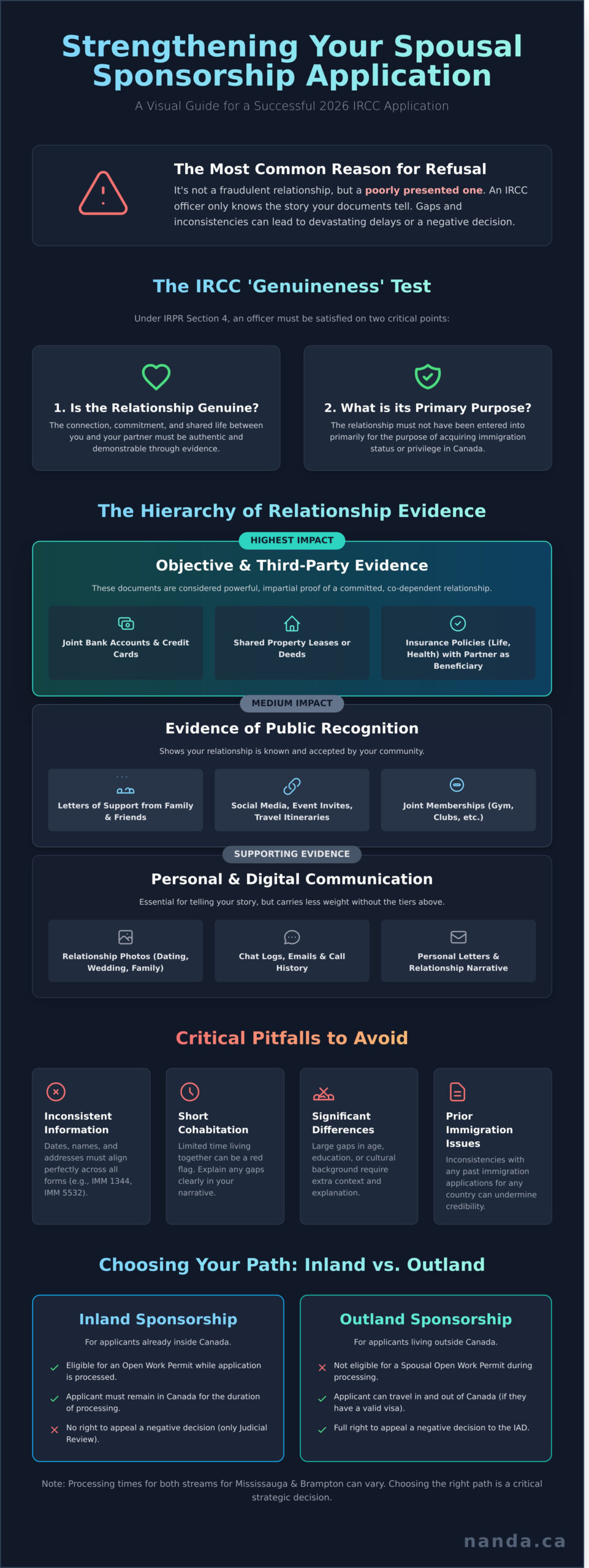
The most common reason for a spousal sponsorship refusal isn’t a fraudulent relationship; it’s a poorly presented one. An officer from Immigration, Refugees and Citizenship Canada (IRCC) doesn’t know you personally. They only know the story your documents tell, and if that story has gaps or inconsistencies, it can lead to devastating delays or a negative decision. We understand the profound anxiety that comes with this process. You aren’t just submitting paperwork; you’re trying to build a life together in Mississauga, and the fear of separation is a heavy weight to carry.
That is precisely why we have developed this guide. We will show you exactly how to strengthen my spousal sponsorship application by moving beyond simple checklists and focusing on the professional strategies and evidentiary standards required under current IRCC guidelines for 2026. You will gain a clear roadmap for collecting compelling proof and building a case that leaves no room for doubt. In the sections that follow, we’ll break down the critical categories of evidence, explain how to craft a convincing narrative, and provide practical tips to help you secure your family’s future in Canada with confidence.
Key Takeaways
-
Learn how IRCC officers apply the crucial ‘genuineness test’ under Canadian immigration regulations to evaluate the authenticity and primary purpose of your relationship.
-
Discover the hierarchy of relationship evidence and why documents proving financial co-dependence, such as joint bank accounts and insurance policies, are critical for a successful application.
-
Find out how to strengthen my spousal sponsorship application by avoiding common inconsistencies and documentation errors that can trigger a Procedural Fairness Letter and significant delays.
-
Understand the key differences between Inland and Outland sponsorship, including current 2026 processing times for Mississauga residents, to select the most strategic path.
Table of Contents
-
Introduction and Key Takeaways: Strengthening Your 2026 Application
-
Avoiding Common Pitfalls: Why Professional Legal Review is Critical
Introduction and Key Takeaways: Strengthening Your 2026 Application
As we look toward 2026, the landscape for spousal sponsorship in Ontario remains both an opportunity and a significant challenge. Immigration, Refugees and Citizenship Canada (IRCC) continues to process a high volume of applications, with family reunification being a stated priority. However, this volume, particularly in densely populated areas like Mississauga, necessitates an exceptionally high standard of proof. If you’re asking, "how to strengthen my spousal sponsorship application," the answer lies in moving beyond simply meeting the minimum requirements. It involves building a case file that is irrefutably genuine and meticulously organized.
A ‘strong’ application is one that proves two critical elements beyond a reasonable doubt: first, the legal eligibility of both the sponsor and the applicant, and second, the authenticity of their relationship. It’s not enough for your relationship to be real; you must present it in a way that an immigration officer, who has never met you, can clearly see its development, public recognition, and shared commitment. The stakes are incredibly high. A refusal can lead to lengthy and costly appeals, not to mention the emotional toll of prolonged separation.
At our firm, we approach every spousal sponsorship case with a strategy we call the ‘Narrative of Commitment.’ This method involves weaving every piece of evidence, from financial statements to personal letters, into a cohesive and compelling story. This narrative pre-emptively addresses an officer’s potential questions and leaves no room for misinterpretation. It transforms a stack of documents into a clear portrait of a shared life.
Key Takeaways for GTA Applicants
-
Consistency is paramount. The volume of your evidence is secondary to its consistency. An officer will place more weight on an application where dates, names, and addresses align perfectly across all forms (like the IMM 1344 and IMM 5532) than one with hundreds of photos but conflicting information.
-
Objective evidence holds more weight. While your personal stories and photos are important, IRCC officers give greater consideration to third-party, objective evidence. Documents like joint bank account statements, shared property leases, or life insurance policies naming your partner as a beneficiary are powerful, impartial proof of a committed relationship.
-
A professional review identifies hidden risks. An experienced legal eye can spot ‘red flags’ you might not recognize. These could be short periods of cohabitation, significant age differences, or inconsistencies in previous immigration applications. Identifying and addressing these issues before submission is critical.
Why Mississauga Couples Face Unique Scrutiny
The Peel Region is a primary destination for newcomers, making the Mississauga IRCC processing centre one of the busiest in the country. The sheer volume of applications means that officers are highly experienced and trained to conduct rigorous reviews efficiently. This environment leaves no margin for error. The broader context of Immigration to Canada shows that high-density urban centres are always under a microscope. Your application must be clear and convincing from the very first glance. This is why localized evidence, such as a joint Ontario lease agreement or shared utility bills from Alectra, is so vital. It grounds your relationship in a tangible, verifiable local context. Our immigration lawyers in Mississauga have built a deep understanding of the specific standards applied at this processing centre. We structure each application to meet these high expectations, ensuring every detail reinforces the central narrative of your genuine partnership.
The Legal Framework: Understanding the ‘Genuineness’ Test
At the heart of every spousal sponsorship application lies a single, critical question: is the relationship genuine? Immigration, Refugees and Citizenship Canada (IRCC) officers are legally mandated to scrutinize each file to ensure the Canadian immigration system is not being misused. This evaluation is governed by Section 4 of the Immigration and Refugee Protection Regulations (IRPR), which establishes a two-pronged test for all spousal and partner sponsorships.
An IRCC officer must be satisfied on two distinct points:
-
The relationship is genuine and was not entered into primarily for the purpose of acquiring any status or privilege under the Act.
-
The sponsored spouse or partner is not inadmissible to Canada for other reasons.
Failing to convince the officer on the first point is the most common reason for refusal. The burden of proof rests entirely on you, the applicant and sponsor. Your file, reviewed by an officer at a Case Processing Centre (CPC) in Mississauga or Sydney, must tell a clear, consistent, and compelling story. This is where a well-crafted Narrative Statement becomes invaluable. It’s your opportunity to connect the documentary evidence-the photos, the text messages, the joint bank statements-into a cohesive story that paints a vivid picture of your life together. This is a fundamental step in learning how to strengthen my spousal sponsorship application from the outset.
IRPA and IRPR Compliance
The terms ‘Spouse,’ ‘Common-law Partner,’ and ‘Conjugal Partner’ have precise legal definitions that must be met. A spouse is a legally married partner. A common-law partner is someone you have cohabited with in a conjugal relationship for at least 12 continuous months. For evidence, we often draw on standards from Ontario’s Family Law Act, using documents like joint leases or statutory declarations to prove cohabitation. A ‘Bad Faith’ finding, where an officer concludes the relationship is not genuine, is the leading cause for refusal and can have serious long-term consequences.
Addressing Relationship ‘Red Flags’ Proactively
Certain relationship characteristics can trigger heightened scrutiny from IRCC. These are not automatic grounds for refusal, but they require proactive and persuasive explanation. Common ‘red flags’ include significant age gaps, different cultural or religious backgrounds, a short courtship before marriage, or the absence of a formal wedding ceremony. Your application must address these issues head-on. For example, if you had a small civil ceremony, explain why and supplement it with letters from family who support your union. When these indicators are present, the complexity of your case increases, and seeking guidance from an experienced immigration lawyer in Mississauga can be the difference between approval and refusal.
Understanding these legal requirements is the first step. The IRCC provides extensive documentation, and we always advise clients to familiarize themselves with the official Complete Guide to Spousal Sponsorship. However, interpreting this guide and applying it to your unique circumstances is where professional expertise provides immense value.
Practical Advice: Building a Robust Evidentiary Package
An approvable spousal sponsorship application is built on a foundation of credible, comprehensive evidence. While photos from your wedding day and trips together are important, immigration officers are trained to look for much more. They seek proof of a relationship that is not only genuine but also publicly recognized and financially intertwined. The key question of how to strengthen my spousal sponsorship application is best answered by moving beyond sentimental items and focusing on a hierarchy of evidence, where documents demonstrating cohabitation and financial interdependence carry the most weight.
To prove you are living together in a marriage-like relationship, especially in a competitive environment like Mississauga, your documentation must be clear and consistent. This includes not just a lease or deed, but a pattern of correspondence and billing that places you both at the same address over time. Think of it as creating a paper trail of your shared life. While these documents are powerful, we always advise clients to cross-reference their evidence with the government’s Official Document Checklist (IMM 5533) to ensure all formal requirements are met.
Documenting Financial Interdependence
One of the most compelling ways to demonstrate a genuine spousal relationship is by proving financial co-dependence. Immigration, Refugees and Citizenship Canada (IRCC) places significant value on evidence that you have merged your financial lives. This goes far beyond simply sending money to one another. We guide our clients to assemble a package that includes:
-
Joint Bank and Credit Card Accounts: Statements showing consistent, shared use for household expenses like groceries, rent, and entertainment are invaluable.
-
Shared Property Documents: A residential lease agreement for a rental in the GTA or a property deed for an owned home with both names listed is considered primary evidence.
-
Utility Bills: Invoices from providers like Alectra Utilities or Enbridge Gas that show both names at a single Mississauga address create a powerful, verifiable link.
-
Insurance and Benefits: Naming your spouse as a beneficiary on an employer-provided benefits plan or a private life insurance policy is a profound statement of long-term commitment.
The Power of Statutory Declarations
Letters of support from friends and family add a crucial layer of social proof to your application. However, a simple letter is not enough. To make these testimonials legally persuasive, they should be formatted as Statutory Declarations. These sworn statements must be detailed, specific, and factual. A strong declaration will describe how the person knows you, how they have witnessed your relationship develop, and provide concrete examples of your life as a couple. Vague praise is unhelpful; dated anecdotes are compelling.
To give these declarations their required legal authority, they must be signed in the presence of a commissioner for taking affidavits. An experienced immigration lawyer in Mississauga can not only help structure these letters for maximum impact but also serve as the commissioner to notarize them. It’s critical that each declaration includes the declarant’s full name, address, and phone number. IRCC may contact them for verification, and if the information is outdated or incorrect, it could trigger a misrepresentation investigation, jeopardizing your entire application.
The Application Process and Timelines for Ontario Residents
Successfully sponsoring your spouse in Mississauga involves more than just proving your relationship; it requires meticulous navigation of Immigration, Refugees and Citizenship Canada’s (IRCC) digital systems and local procedures. The shift to a fully digital platform has streamlined submissions, but it has also introduced new complexities where small errors can lead to significant delays. Understanding this process from start to finish is fundamental to building a resilient application.
As of 2024, nearly all spousal sponsorship applications must be submitted online through the IRCC’s permanent residence portal. This system is expected to be further refined by 2026, demanding even greater precision from applicants. One of the most effective ways for how to strengthen my spousal sponsorship application is to master this digital submission process, ensuring every document is correctly formatted, named, and uploaded to prevent an administrative return that could set you back months.
Navigating the Digital Portal
The most common reason for an application being returned is incompleteness. This can range from a missing signature to a file that exceeds the 4 MB size limit. To avoid this, we advise clients to create a meticulous digital checklist. Use clear document naming conventions, such as LastName_FirstName_Passport.pdf, and verify that every uploaded document is legible. Crucially, ensure digital signatures are typed exactly as they appear on the signatory’s passport or primary identity document, without any variations or nicknames.
A critical component for many couples is the Spousal Open Work Permit (SOWP). If your spouse is in Canada with you, you can submit the SOWP application at the same time as your inland sponsorship package. This allows them to work legally in Canada while the sponsorship application is processed. Generally, the work permit is issued after IRCC has completed its initial eligibility checks and issued the Acknowledgment of Receipt (AOR).
Processing times remain a primary concern for families. While IRCC provides estimates, local Mississauga processing can fluctuate. As a benchmark from late 2023 data, inland applications were averaging approximately 12-15 months, whereas outland applications processed through various visa offices abroad could range from 15-24 months. These timelines begin only after the application is accepted for processing.
Local Logistics in Mississauga
Certain steps require local action within the GTA. Your spouse will need an immigration medical exam from an IRCC-approved panel physician. You can find the official, up-to-date list of designated physicians in the Peel Region on the IRCC website. We recommend booking this appointment well in advance. Similarly, obtaining an RCMP certified criminal record check can be done through accredited local fingerprinting services in Mississauga, a process that typically takes 2-3 weeks to receive the results by mail.
After you submit your complete application and receive your AOR, the next steps typically include a request for biometrics, the start of background checks, and a final decision. Properly sequencing these local requirements is key to how to strengthen my spousal sponsorship application and ensure a seamless journey toward permanent residence. Our team has extensive experience guiding Mississauga families through each stage of this complex process, providing clarity and peace of mind. For a tailored strategy session to ensure your application is positioned for success, we invite you to consult with our immigration law team.
Avoiding Common Pitfalls: Why Professional Legal Review is Critical
After investing months of emotional energy and effort into your spousal sponsorship application, the final submission stage is the most critical. The temptation to rely on unregulated "ghost consultants" or to manage a complex case on your own can lead to devastating setbacks. A single overlooked detail or inconsistency can trigger scrutiny from Immigration, Refugees and Citizenship Canada (IRCC), potentially derailing your family’s future. True strength in an application comes from meticulous, professional oversight that anticipates and mitigates these risks from the very beginning.
Even a minor inconsistency can result in a Procedural Fairness Letter (PFL), a formal notice from IRCC indicating serious concerns about your application. For example, if the date you list for your engagement party on one form differs by a single day from a supporting document, an officer may question the genuineness of your entire relationship. These letters are not simple requests for clarification; they are direct challenges to your credibility, and your response must be a compelling legal argument supported by new, persuasive evidence.
Furthermore, your immigration journey doesn’t exist in a legal vacuum. It intersects directly with Ontario’s family law framework. A professionally drafted cohabitation agreement or marriage contract does more than protect your assets under the province’s Family Law Act. For IRCC, it serves as powerful, legally-binding evidence of your commitment and shared future, significantly bolstering the genuineness of your relationship. This is a strategic step that immigration consultants cannot provide, but a full-service law firm can integrate seamlessly into your planning.
Responding to Procedural Fairness Letters
Receiving a PFL questioning your marriage’s genuineness is a serious development that demands immediate, expert legal intervention. This is your final opportunity to persuade the visa officer. If the response is insufficient and a refusal is issued, the next step is often a formal appeal to the Immigration Appeal Division (IAD). This process is a legal hearing, where the skills of experienced civil litigation lawyers become indispensable for presenting your case effectively.
Final Checklist for a Strong Submission
Our "final eyes" review is a non-negotiable step in understanding how to strengthen my spousal sponsorship application. We meticulously check for correct form versions, consistent dates across all documents, valid signatures, and ensure all supporting evidence is current. We also verify that foreign-language documents meet IRCC’s strict certified translation standards, which require an affidavit from the translator. At Nanda & Associate Lawyers, we provide this comprehensive legal solution, ensuring your file is flawless before it ever reaches an officer’s desk.
Ultimately, achieving a seamless transition to permanent residency is about proactive, strategic preparation. By entrusting your application to a legal team that understands the intricate connections between immigration, family law, and litigation, you are not just submitting forms; you are building a resilient case designed for success and securing your family’s future in Mississauga with confidence and peace of mind.
Chart Your Path to Permanent Residence with Confidence
The journey to sponsoring your spouse is a detailed process, but it’s one you can navigate successfully. Success hinges on two critical factors: clearly demonstrating the genuineness of your relationship and meticulously assembling a robust evidentiary package. Ultimately, the answer to how to strengthen my spousal sponsorship application lies in proactive, thorough preparation that leaves no room for doubt in an immigration officer’s assessment.
Navigating the complexities of IRCC requirements alone can be a significant source of stress. Since 2003, Nanda & Associate Lawyers has proudly served the Mississauga communities, guiding families through this exact process. Our team’s expertise in handling complex sponsorship appeals and refusals, combined with our ability to provide services in over 15 languages, ensures your case receives the dedicated and culturally sensitive representation it deserves. Don’t leave your family’s future to chance. Let our experienced immigration lawyers provide the peace of mind you need to move forward. Secure your spouse’s future in Canada, contact Nanda & Associate Lawyers for a consultation today.
Frequently Asked Questions
How much money do I need to sponsor my spouse in Ontario in 2026?
There is generally no minimum income requirement to sponsor a spouse in Ontario, unless you are sponsoring a spouse who has a dependent child with their own dependent child. Instead, you must sign a three-year undertaking to financially support your spouse and prove you are not receiving social assistance for reasons other than a disability. Government processing fees in 2024 were approximately C$1,205, but this figure is subject to change by 2026.
What happens if our spousal sponsorship application is refused?
If your spousal sponsorship application is refused, you have a right to appeal the decision to the Immigration Appeal Division (IAD) of the Immigration and Refugee Board. You must file this appeal within 30 days of receiving the refusal letter. The appeal provides an opportunity to present new evidence and arguments to challenge the officer’s decision. Alternatively, you could choose to submit a new, more robust application that directly addresses the reasons for the initial refusal.
Can I sponsor my spouse if I am currently receiving social assistance in Mississauga?
No, you generally cannot sponsor your spouse if you are receiving social assistance, such as Ontario Works. This is because the sponsorship agreement requires you to be financially self-sufficient. An important exception exists for individuals receiving social assistance due to a disability. If you are receiving disability benefits from a provincial government, you may still be eligible to sponsor your spouse. It’s vital to confirm your specific situation before proceeding with an application.
How many photos and chat logs should I include in my evidence package?
You should include a curated selection of 10 to 20 high-quality photos and a maximum of 10 pages of chat logs. Quality is far more important than quantity. Select photos that show you together over the course of your relationship, ideally with friends and family in different settings. For chat logs, choose excerpts that demonstrate your ongoing communication and shared future plans. Submitting hundreds of pages can overwhelm an officer and obscure the most important evidence.
Do we need to be living together in Mississauga to apply for sponsorship?
No, you do not need to be living together to apply, particularly for an outland sponsorship application where one partner resides abroad. If you are married but living apart, you must provide a strong explanation for the separation. For common-law partners, you must prove you have previously lived together for at least 12 consecutive months. The key is to provide compelling evidence that your relationship is genuine, regardless of your current living arrangement.
How long does the spousal sponsorship process take from start to finish?
As of early 2024, the average processing time for spousal sponsorship applications is between 12 and 24 months from the time of submission. This timeline can fluctuate based on the specific country the application is from, the complexity of your case, and the current caseload of Immigration, Refugees and Citizenship Canada (IRCC). Submitting a complete and well-organized application is the most effective way to prevent avoidable delays in processing.
Can my spouse work in Canada while the sponsorship application is pending?
Yes, your spouse can work in Canada while the application is pending if you submitted an "inland" sponsorship application. When applying from within Canada, your spouse is eligible to apply for an Open Work Permit (OWP) at the same time as the sponsorship application. This permit allows them to work for nearly any employer in Canada while they await a final decision on their permanent residency status, which is a significant benefit of the inland process.
What is a Procedural Fairness Letter, and why did I receive one?
A Procedural Fairness Letter (PFL) is a formal notice from an immigration officer who has significant concerns about your application that could lead to a refusal. You received one because the officer has identified a potential issue, such as a concern about the genuineness of your relationship or an inadmissibility issue. The letter provides a final chance to respond with new evidence and arguments. Knowing how to strengthen my spousal sponsorship application with a compelling response to a PFL is critical.