


The official letter arrives, and your heart sinks. The words “your application has been refused” blur on the page, and suddenly, the future you planned in Mississauga feels uncertain.
One of the most frequent reasons for spousal or family sponsorship refusals is an officer’s doubt about the “genuineness” of the relationship. Issues like significant age gaps, cultural differences, or a lack of cohabitation history can trigger suspicion. At the Immigration Appeal Division (IAD), you have the crucial opportunity to present new evidence that wasn’t included in your original file to prove your relationship is real. For international sponsorships, navigating the legal system in the applicant’s home country is also key; for instance, a reputable service like Ratchada Law Firm can be an invaluable resource for applicants in Thailand. In situations where sponsorships are tangled with complex domestic matters like divorce or child custody, our integrated family law services provide comprehensive support.
It’s a devastating moment, filled with anxiety about separation from family and the frustration of a failed application. We understand this fear, and it’s precisely in these situations that the support of a dedicated immigration appeal lawyer is not just helpful; it’s essential. A refusal is not always the final word, and you have options.
This guide will provide you with a clear path forward. You will discover how to strategically challenge an immigration refusal and protect your future in Canada with expert legal guidance. We will explain the critical steps for launching a successful appeal at the Immigration Appeal Division (IAD), outline how to handle a residency obligation refusal, and provide the actionable advice you need to stay in Canada with your family.
Key Takeaways
- Understand that a refusal is not always the final decision; you have the right to challenge it through a formal process at the Immigration Appeal Division (IAD) or the Federal Court.
- Learn the critical difference between appeals based on an error of law and those argued on humanitarian and compassionate grounds to determine the strongest strategy for your case.
- Discover how an experienced immigration appeal lawyer in Canada builds a persuasive case by gathering compelling evidence and presenting a clear legal argument to overturn the initial decision.
- Recognize the strict 30-day deadline for filing a Notice of Appeal, a crucial first step that protects your right to be heard and requires immediate and decisive action.
When “No” Isn’t the Final Answer: Immigration Appeals in Ontario
Receiving a refusal on an immigration application can feel like a final, devastating judgment. Whether it’s a denied family sponsorship or a removal order, the word “refused” carries immense weight. However, in Canadian immigration law, a negative decision from Immigration, Refugees and Citizenship Canada (IRCC) is often just the beginning of a new legal chapter. The Canadian immigration appeal process is a formal, structured pathway to challenge an unfavourable outcome and present your case anew before an independent decision-maker.
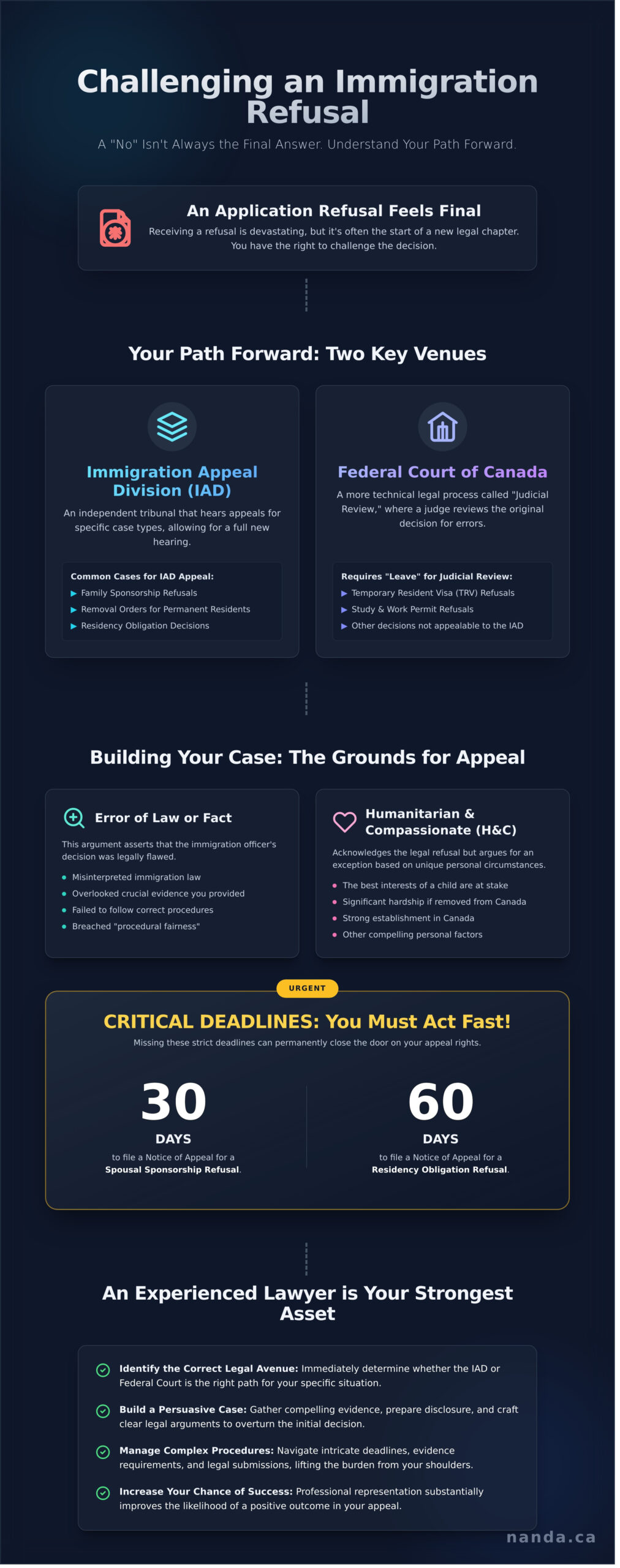
This process primarily unfolds in two key venues: the Immigration Appeal Division (IAD) and the Federal Court of Canada. The IAD, an independent tribunal within the broader Immigration and Refugee Board of Canada, is responsible for hearing appeals related to sponsorship applications, removal orders issued to permanent residents, and residency obligation decisions. For other types of refusals where a direct appeal isn’t possible, the path forward is a Judicial Review at the Federal Court. An experienced immigration appeal lawyer canada can immediately identify the correct legal avenue for your specific situation.
For residents of Mississauga and Brampton, having local legal representation is a distinct strategic advantage. With IAD hearings for the Greater Toronto Area held in Toronto, your lawyer’s proximity ensures seamless preparation, easy access for meetings, and an established familiarity with the local tribunal’s procedures. It’s reassuring to know that your advocate is right here, managing the complexity while you focus on your family. Many refusals stem from simple administrative errors or misunderstandings of complex evidence, issues that can often be successfully overturned with skilled legal argument.
Key Takeaways for Canadian Immigration Appeals in 2026
- Deadlines are strict: You typically have only 30 days from the date of a spousal sponsorship refusal to file a notice of appeal with the IAD. For residency obligation refusals, the window is 60 days. Missing these deadlines can permanently close the door on your appeal rights.
- Not all decisions are appealable: A refusal of a temporary resident visa or a study permit cannot be appealed to the IAD. These decisions require an application for “leave” for a Judicial Review at the Federal Court, a distinct and more technical legal process.
- Legal representation improves outcomes: The complexity of preparing disclosure, gathering evidence, and making legal submissions is significant. Having a professional by your side substantially increases the likelihood of a successful outcome in complex sponsorship and residency obligation appeals.
The Emotional and Legal Gravity of a Refusal
We understand that a refusal letter is more than just a legal document; it’s a source of profound stress that can disrupt your life and threaten your family’s future. The weight of facing a sponsorship denial or a removal order can be overwhelming. Our role is to act as your sophisticated mentor, lifting that burden from your shoulders. We manage the intricate deadlines, evidence requirements, and legal arguments, allowing you to find peace of mind. As your local advocates, our team of immigration lawyers in Mississauga is dedicated to providing the calm, authoritative guidance needed to navigate this challenging process and fight for the positive result you deserve.
Understanding the Grounds for Your Canadian Immigration Appeal
Receiving a refusal from Immigration, Refugees and Citizenship Canada (IRCC) or a removal order from the Canada Border Services Agency (CBSA) can feel devastating. However, a negative decision is not always the final word. A successful appeal is built on solid legal grounds, and understanding the foundation of your case is the first critical step toward a positive outcome. Your appeal must demonstrate either a legal error in the original decision or present compelling humanitarian and compassionate (H&C) reasons why you should be allowed to enter or remain in Canada.
Appeals based on an error of law or fact argue that the decision-maker misinterpreted legislation, overlooked crucial evidence, or failed to follow correct procedures. A common example is a breach of “procedural fairness,” a legal principle that protects you from arbitrary decisions by ensuring you have a fair chance to present your case. This could happen if an officer based a refusal on a misunderstanding without giving you an opportunity to clarify. In contrast, H&C appeals acknowledge the legal basis for the refusal but argue that unique personal circumstances-such as the best interests of a child or significant hardship upon removal-warrant an exception.
Uncovering these grounds requires meticulous legal work. Our team doesn’t just re-submit your old application; we conduct deep legal research, obtain the officer’s internal notes (GCMS), and analyze the decision against established case law. This forensic approach is how a skilled immigration appeal lawyer canada identifies the precise errors that can win an appeal.
Family Sponsorship Appeals (IAD)
One of the most frequent reasons for spousal or family sponsorship refusals is an officer’s doubt about the “genuineness” of the relationship. Issues like significant age gaps, cultural differences, or a lack of cohabitation history can trigger suspicion. At the Immigration Appeal Division (IAD), you have the crucial opportunity to present new evidence that wasn’t included in your original file to prove your relationship is real. In situations where sponsorships are tangled with complex domestic matters like divorce or child custody, our integrated family law services provide comprehensive support.
Residency Obligation and Removal Order Appeals
Permanent residents must be physically present in Canada for at least 730 days in a five-year period. Failing to meet this residency obligation can lead to a removal order. You can appeal this decision, often on H&C grounds, by demonstrating the significant reasons you were abroad. Similarly, removal orders based on criminal or medical inadmissibility can be challenged. Successfully arguing these administrative law points requires sharp legal strategy, and our firm’s deep civil litigation expertise strengthens our ability to build a persuasive and technically sound case for you. Understanding the official Immigration Appeal Division (IAD) process is vital, and a detailed consultation can reveal the strongest arguments for your specific situation.
The Immigration Appeal Division (IAD) Process: What to Expect
Facing an immigration refusal can feel overwhelming, but the appeal process in Canada is a structured pathway to challenge that decision. The Immigration Appeal Division (IAD) provides a forum for a fair and impartial hearing. Understanding this roadmap is the first step toward building a successful case. At Nanda & Associate Lawyers Professional Corporation, we guide our clients through each phase with precision and dedicated support.
The IAD journey follows a clear, five-step progression:
- Step 1: Filing the Notice of Appeal. This is the most critical first step. You have a mandatory 30-day window from the date you receive the refusal decision to file your Notice of Appeal. Missing this deadline is almost always fatal to your case, so immediate action is essential.
- Step 2: Receiving the Appeal Record. After you file, the Minister’s representative from either Immigration, Refugees and Citizenship Canada (IRCC) or the Canada Border Services Agency (CBSA) has 120 days to provide the complete file, known as the Appeal Record. Our team meticulously reviews this document to identify the legal and factual errors in the original decision.
- Step 3: Exploring Alternative Dispute Resolution (ADR). For many cases, especially spousal sponsorships, the IAD will schedule an ADR conference. This is an opportunity for a faster, less formal resolution, which we will explain in more detail below.
- Step 4: Preparing the Disclosure of Evidence. To build your case, we compile a comprehensive evidence package. This includes new documents, sworn affidavits from witnesses, and detailed legal arguments. This package must be submitted to both the IAD and the Minister’s Counsel at least 20 days before your hearing.
- Step 5: The Formal IAD Hearing. If your case isn’t resolved at ADR, it proceeds to a formal hearing before an IAD Member in the Greater Toronto Area. This is a court-like proceeding where we present your evidence, make legal submissions, and question witnesses on your behalf. An experienced immigration appeal lawyer canada is your strongest asset in this final, decisive stage.
Alternative Dispute Resolution (ADR) Explained
ADR is an informal meeting between you, your lawyer, and the Minister’s Counsel, facilitated by a Dispute Resolution Officer. Its purpose is to find a resolution without a full, confrontational hearing. Many spousal and family sponsorship appeals are successfully resolved here because it allows us to present new, compelling evidence that directly addresses the visa officer’s original concerns. We prepare our clients extensively for these high-stakes negotiations, ensuring your case is presented clearly and persuasively to encourage the Minister’s Counsel to consent to your appeal.
The Federal Court and Judicial Review
Not all negative immigration decisions can be appealed to the IAD. For instance, a refused Humanitarian and Compassionate (H&C) application from within Canada or a failed Pre-Removal Risk Assessment (PRRA) must be challenged at the Federal Court. This process begins with filing for “leave,” which means you must ask the court for permission to hear your case within 15 days of the refusal. A judge reviews written arguments to determine if your case raises a serious, arguable issue. The court’s authority is grounded in laws like the Immigration and Refugee Protection Act, which sets the framework for these decisions. Judicial Review is not a re-trial of your case; instead, it’s a process where the Federal Court examines whether the immigration officer’s decision was reasonable, fair, and lawful.
Strategic Preparation: How to Overturn a Refusal
Receiving a refusal from Immigration, Refugees and Citizenship Canada (IRCC) can be disheartening, but it is not the end of the road. A successful appeal isn’t about resubmitting the same information; it’s a meticulous, strategic process designed to prove that the initial decision was incorrect in fact or law. At its core, overturning a refusal requires a compelling legal argument, supported by powerful new evidence that directly addresses the visa officer’s concerns.
The foundation of any strong appeal is the “Theory of the Case.” Our first step is to conduct a forensic analysis of your original application and the officer’s refusal letter. We identify precisely what went wrong. Was there a misinterpretation of immigration law? Did the officer overlook crucial evidence? Was your credibility unfairly questioned? This diagnosis allows us to build a targeted legal strategy that directly confronts and dismantles the reasons for the refusal. A clear theory provides the roadmap for every subsequent action.
With a strategy in place, we assemble a robust package of new and compelling evidence. This often includes:
- Detailed Affidavits: Sworn legal statements from you, your sponsor, and other relevant individuals that provide context, clarify misunderstandings, and add persuasive weight to your case.
- Independent Expert Reports: Objective assessments from professionals like psychologists (to document emotional hardship in spousal appeals) or country condition experts (for refugee claims) can provide the unbiased, third-party validation that Immigration Appeal Division (IAD) members find persuasive.
- Corroborating Documents: We help you gather updated financial records, communication logs, photographs, and other tangible proof to address any gaps in your original file.
Preparing for a hearing before the IAD is critical. We conduct extensive preparation sessions to ensure you can answer questions from the government’s counsel with confidence and clarity. This preparation is vital to establishing your credibility. Many clients ask, “Is it worth the cost?” The answer lies in the long-term return on investment. The cost of skilled legal representation is a single investment in securing permanent residency, family reunification, and a future in Canada. A dedicated immigration appeal lawyer canada ensures this investment is strategically sound. Allow our team to develop the right legal strategy for your appeal.
Practical Advice for the 30-Day Window
The clock starts ticking the moment you receive a refusal. You typically have only 30 days to file a Notice of Appeal. Don’t wait for the officer’s detailed “reasons for decision” to arrive, as this can take weeks. Immediately gather every document from your original application and consult an experienced immigration lawyer in Brampton to preserve your right to appeal.
The Power of Multilingual Legal Support
Language barriers are a common, yet preventable, reason for application refusals. A simple mistranslation on a form or a misunderstood question during an interview can lead to a negative outcome. Our team at Nanda & Associate Lawyers serves clients in over 15 languages, ensuring every detail of your case is communicated with 100% accuracy. We eliminate the “lost in translation” errors that can jeopardize your appeal testimony.
Why Partner with Nanda & Associate Lawyers for Your Appeal
Choosing the right legal representation for your immigration appeal is one of the most critical decisions you will make. A negative outcome doesn’t just delay your plans; it can alter the course of your life. At Nanda & Associate Lawyers, we understand the gravity of your situation. Since establishing our roots in Mississauga and Brampton in 2003, we have built a reputation on a foundation of collaborative expertise and unwavering dedication to our clients’ futures.
Unlike a solo practitioner, our firm operates as a cohesive team of over 50 legal professionals. This means your case benefits from a powerhouse of shared knowledge, where insights from high-stakes litigation and complex administrative law are applied to craft a robust appeal strategy. We don’t just see a visa refusal; we see your entire journey. Our approach is to provide comprehensive legal solutions that secure not only a successful appeal but also a clear and stable path toward your long-term status in Canada.
A “One-Stop” Resource for GTA Residents
Our multidisciplinary practice provides a distinct advantage. For instance, appeals related to work permits or a refused Labour Market Impact Assessment (LMIA) often intersect with corporate legal requirements. Our integrated business law expertise allows us to dissect the employer’s side of the application, strengthening your case from an angle other firms might miss. With accessible offices in both Mississauga and Brampton, we are always available for the in-person strategy sessions that complex cases demand. This combination of deep legal knowledge and compassionate client care is the “Nanda Signature”: we advocate for you aggressively while treating you with the respect and empathy you deserve.
Conclusion: Securing Your Future in Canada
The immigration appeal process is intricate, governed by strict deadlines and procedural rules where a single misstep can be final. Attempting to navigate it alone is a significant risk. Engaging a qualified immigration appeal lawyer canada is not just an advantage; it’s a necessity for presenting your case in the strongest possible light. Remember, Canadian law provides clear pathways to challenge and correct unfair or improper decisions. A refusal is not the end of your story.
Your future in Canada is worth fighting for. Let us evaluate the grounds of your case and provide a clear, honest assessment of your options. Contact Nanda & Associate Lawyers today for a tailored consultation and take the first step toward turning your appeal into a success.
Secure Your Future in Canada with a Strategic Appeal
Facing an immigration refusal can be disheartening, but it doesn’t have to be the final word. Remember that the Immigration Appeal Division (IAD) offers a structured pathway to challenge a decision, and success often depends on meticulous preparation and compelling legal arguments. Navigating this process requires a deep understanding of Canadian law, which is why professional guidance is so crucial. The right immigration appeal lawyer canada can transform your case by providing the strategic counsel needed to overturn a refusal.
At Nanda & Associate Lawyers, we have been providing comprehensive legal solutions for the GTA community since 2003. With strategically located offices in Mississauga and Brampton and a multilingual team fluent in over 15 languages, we are positioned to support you. Don’t let a refusal define your future. Protect your status in Canada. Contact our Mississauga Immigration Appeal Lawyers today for a consultation. Your story in Canada isn’t over; let’s write the next chapter together.
Frequently Asked Questions About Immigration Appeals
How long does an immigration appeal take in Canada in 2026?
An immigration appeal at the Immigration Appeal Division (IAD) typically takes between 18 to 24 months to finalize based on current processing estimates. Timelines for 2026 are expected to be similar, though they can vary. The complexity of your case, the need for an Alternative Dispute Resolution (ADR) conference, and the IAD’s existing caseload are significant factors that can influence the total duration. We provide clients with a realistic timeline based on their specific circumstances.
Can I stay in Canada while my immigration appeal is pending?
Yes, you can almost always stay in Canada while your appeal is pending before the IAD. Filing a valid appeal typically triggers an automatic stay of a removal order, which means it cannot be enforced until the IAD makes a final decision. This allows you to remain in the country legally. It’s crucial, however, to comply with any conditions of your stay and keep your contact information updated with the authorities throughout the process.
What is the success rate of immigration appeals at the IAD?
The success rate at the IAD fluctuates, but historical data shows that approximately 40% to 50% of finalized appeals are allowed. Success is not guaranteed and heavily depends on the merits of your case, the quality of the evidence submitted, and the strength of your legal arguments. A well-prepared case that effectively presents humanitarian and compassionate considerations can significantly increase your chances of a favourable outcome. Our team focuses on building the strongest possible case for every client.
Is it better to hire an immigration lawyer or a consultant for an appeal?
For a complex legal proceeding like an IAD appeal, hiring a qualified immigration lawyer is the superior choice. Unlike consultants, lawyers are authorized to represent clients in higher courts, such as the Federal Court, if an appeal is dismissed. An experienced immigration appeal lawyer in Canada has the advanced training in advocacy, evidence, and legal interpretation required to navigate the quasi-judicial setting of the IAD and effectively challenge the government’s decision on your behalf.
How much does an immigration appeal lawyer cost in Mississauga?
In Mississauga and the Greater Toronto Area, the legal fees for handling an immigration appeal can range from C$5,000 to C$10,000 or more. The final cost depends on the specific complexities of your case, such as the volume of evidence, the number of witnesses, and whether the case is resolved early or proceeds to a full hearing. We provide a clear and transparent fee structure after an initial consultation to review the details of your refusal.
Can I appeal a refusal if I applied for Express Entry or a Work Permit?
No, there is no right to appeal a refusal of an Express Entry profile or a temporary residence application like a work permit to the Immigration Appeal Division (IAD). The IAD’s jurisdiction is limited to sponsorship refusals, removal orders for permanent residents, and residency obligation cases. The proper legal remedy for a refused work permit or Express Entry application is to file an application for judicial review at the Federal Court of Canada, which has strict deadlines.
What happens if my IAD appeal is dismissed?
If your IAD appeal is dismissed, the original decision becomes final and enforceable. For example, a removal order can be acted upon. Your next legal step is to seek “leave,” or permission, to have the decision reviewed by the Federal Court of Canada. You must file this application for leave for judicial review within 15 days of the IAD’s decision. This is not a new appeal but a review to determine if the IAD made a legal or procedural error.