


What if the document you believe protects your Mississauga business is actually a roadmap for a C$50,000 CRA audit penalty? You likely value the flexibility that hiring external talent provides to your operations. Most business owners in Ontario assume that simply labeling someone a contractor is enough to define the relationship, but the Ministry of Labour often thinks otherwise. It’s a common source of anxiety, especially when a single misstep in your independent contractor agreement ontario can lead to significant back-tax liabilities and legal disputes.
We’re here to provide the clarity you need to move forward with confidence. You’ll learn how to draft a legally sound agreement that explicitly addresses the ‘Control Test’ and protects your firm from costly misclassification risks. We’ll outline the essential clauses every Mississauga business owner needs to ensure long-term compliance. This guide covers the strategic steps required to secure your business interests and achieve lasting peace of mind. Through a clear understanding of Ontario’s evolving labour standards, you can build a stable foundation for your professional partnerships.
Key Takeaways
- Understand the critical legal distinction between a “contract for services” and an employment relationship to ensure your Mississauga business remains compliant with provincial standards.
- Learn how to apply the “Fourfold Test” used by Ontario courts to determine worker status and protect your organization from the risks of unintentional reclassification.
- Discover the essential clauses required in a professional independent contractor agreement ontario to clearly define project scopes and establish proper invoicing protocols.
- Identify the significant financial liabilities associated with misclassification, including potential Canada Revenue Agency (CRA) audits and unpaid obligations under the Employment Standards Act.
- Find out how a tailored workforce audit and bespoke legal documentation can provide the long-term security and peace of mind your business needs to grow confidently.
What is an Independent Contractor Agreement in Mississauga?
An independent contractor agreement in Mississauga is a legally binding contract that defines the professional relationship between a service provider and a local business. This document establishes what’s known in legal circles as a “contract for services.” It differs significantly from a “contract of service,” which describes a traditional employer-employee relationship. For the 99,000 businesses currently operating in Mississauga, from high-growth tech startups to massive logistics hubs near Pearson International Airport, this distinction is a financial necessity. Having a formal independent contractor agreement ontario ensures both parties understand their obligations, tax responsibilities, and the scope of work before a single hour is billed. It’s the primary tool for managing expectations and mitigating the risk of future litigation.
The Role of Intent in Ontario Contracts
Ontario courts place significant weight on the mutual intention of the parties at the moment they signed the document. A written agreement provides a clear record of that intent, making it far superior to verbal “handshake” deals that often lead to expensive disputes in Peel Region courts. However, intent isn’t a magic shield. If the actual daily workflow contradicts the written word, regulators will look past the contract. Understanding the Independent Contractor vs. Employee: The Ontario Legal Test is vital because the Ministry of Labour prioritizes the reality of the working relationship over the labels used in a document. If you treat a contractor like an employee by controlling their hours and tools, the “intent” written in your contract may be disregarded during an audit.
Common Industries for Contractors in Peel Region
Mississauga is Canada’s second-largest employment hub, with specific sectors relying heavily on flexible talent to maintain their competitive edge. These industries are currently under high scrutiny for worker misclassification, making precise documentation essential.
- Logistics and Supply Chain: With over 70 Fortune 500 companies maintaining offices here, the movement of goods requires specialized consultants and freight experts.
- Information Technology: Software developers and cybersecurity experts in the Square One tech corridor often prefer the autonomy of contracting.
- Professional Services: Marketing, accounting, and specialized engineering firms frequently scale their teams using independent talent for project-based work.
Businesses that fail to properly draft an independent contractor agreement ontario risk heavy penalties, including retroactive CPP and EI payments. Our team recognizes that a “one-size-fits-all” template doesn’t work for the diverse Mississauga business community. Using a business lawyer in Mississauga helps ensure your contracts are tailored to your specific industry standards while protecting your corporate interests from the start.
Independent Contractor vs. Employee: The Ontario Legal Test
In Ontario, the title on a business card or the heading of an independent contractor agreement ontario doesn’t dictate a worker’s legal status. The Ministry of Labour and Ontario courts look past the “Independent Contractor” label to the actual nature of the relationship. This scrutiny ensures that workers entitled to protections under the Employment Standards Act, 2000 (ESA) aren’t denied benefits like vacation pay, overtime, or notice of termination. If the Ministry determines a worker is actually an employee, the business may face retroactive payments for unpaid benefits and taxes.
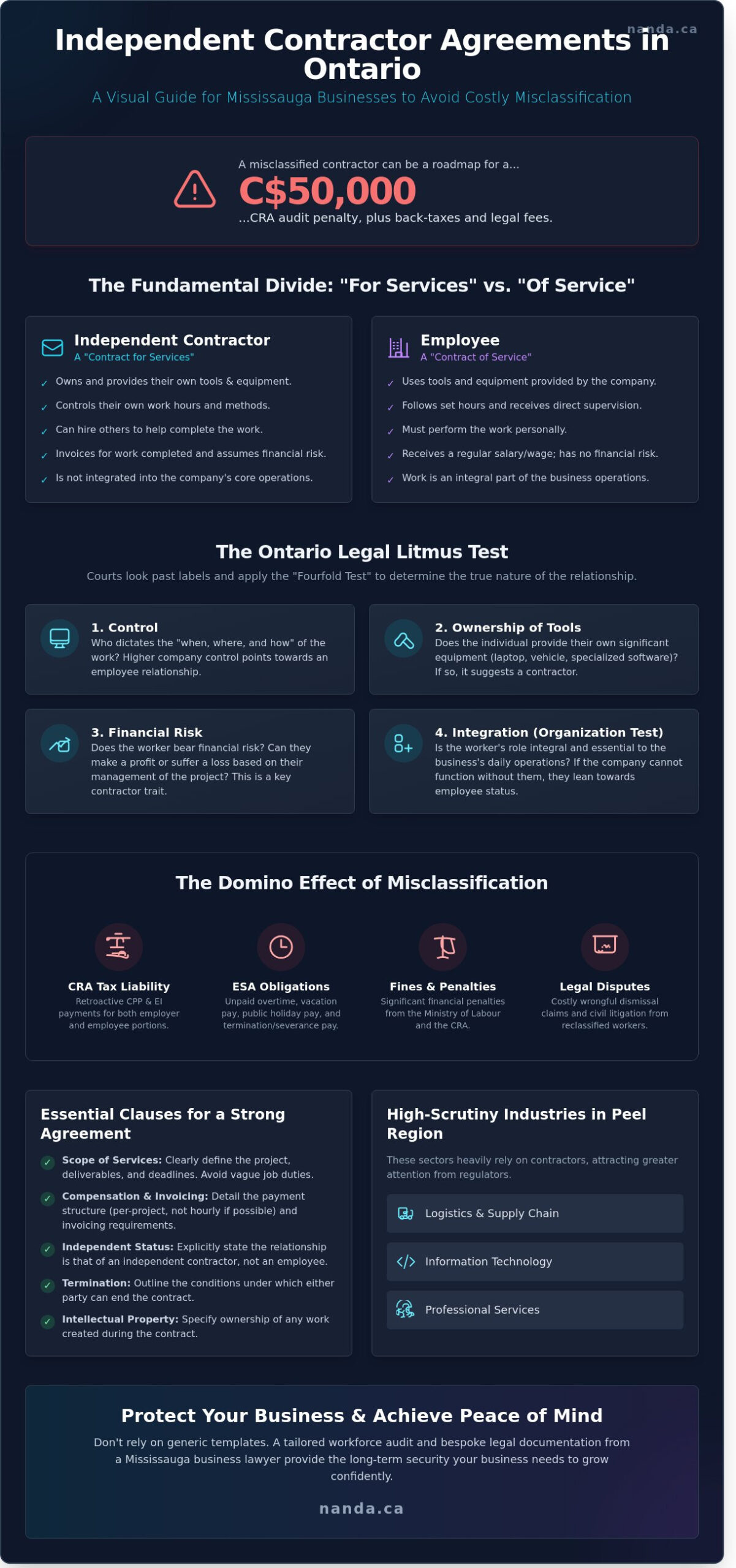
Courts primarily apply the “Fourfold Test” established in cases like Sagaz Industries Canada Inc. v. 671122 Ontario Ltd. (2001). This is often paired with the “Organization Test,” which asks whether the individual’s work is an integral part of the business or merely accessory to it. If a worker performs a core function that the Mississauga firm couldn’t operate without, the law often views them as an employee. Understanding How a Mississauga Business Lawyer Protects Your Interests involves reviewing these specific criteria to avoid the 100% liability of a misclassification ruling.
The Control Test and Financial Risk
The “control test” examines who directs the work. If a Mississauga company dictates the “when, where, and how” of a project, the worker leans toward employee status. Financial risk is equally telling. Contractors typically provide their own equipment and maintain a dedicated office space in Mississauga. They face a real chance of profit or a risk of loss based on their own efficiency. If a worker has no financial skin in the game and is paid a flat hourly rate regardless of expenses, they fail this part of the test.
The Dependency Factor under Ontario Law
Ontario law recognizes a middle ground known as the “dependent contractor.” This category became a vital part of the legal landscape following the 2009 decision in McKee v. Reid’s Heritage Homes Ltd.. If a contractor works exclusively for one Mississauga firm for a long period, they become economically dependent. This dependency can trigger requirements for reasonable notice of termination, mirroring the rights of traditional employees. Businesses must be cautious when a contractor’s income relies 100% on their contract, as this exclusivity often overrides the written terms of an agreement.
Essential Clauses for Every Ontario Contractor Agreement
A well-drafted independent contractor agreement ontario businesses and service providers rely on must clearly delineate the boundaries of the professional relationship. We often see disputes arise when the “Scope of Work” is too vague. You should define specific deliverables, milestones, and deadlines rather than general duties. This project-centric approach reinforces the contractor’s independence. Payment terms must also reflect this structure. Ensure the agreement requires the contractor to submit invoices and provide an HST number if their worldwide taxable supplies exceed the C$30,000 annual threshold. You must avoid anything resembling a recurring “salary,” as this is a primary indicator of employment that can trigger unwanted tax liabilities.
Termination clauses require extreme precision to avoid the “reasonable notice” pitfalls found in Ontario common law. Without a clear, enforceable termination provision, a court might award a contractor a significant notice period similar to those given to employees. Your agreement should specify a fixed notice period or a flat fee for early termination. Additionally, include robust indemnification and insurance requirements. This ensures the contractor carries their own commercial general liability insurance, protecting your Mississauga enterprise from third-party claims resulting from their work or negligence. Shifting this liability back to the contractor is a fundamental step in risk management for any local business owner.
Intellectual Property and Confidentiality
Protecting your company’s proprietary data is vital to maintaining a competitive edge. The agreement must state that all work created for your Mississauga business remains your exclusive property. Since the Working for Workers Act, 2021 effectively banned most non-compete agreements in Ontario as of October 25, 2021, we focus on strong non-solicitation and confidentiality clauses. These protect your client lists and trade secrets without violating current provincial labor standards. It’s about securing your assets while respecting the legal boundaries of restrictive covenants in the GTA.
Compliance with Ontario Legislation
The contract must explicitly state that the Employment Standards Act, 2000 (ESA) does not apply to the relationship. Misclassification can lead to heavy penalties and retroactive payments for vacation pay or overtime. To ensure compliance, it is helpful to review the Canada Revenue Agency guidelines which outline the “control test” and “economic reality test” used to distinguish workers. Contractors are also responsible for their own Workplace Safety and Insurance Board (WSIB) coverage and tax remittances. Our business lawyers in Mississauga recommend verifying a contractor’s WSIB clearance certificate before any work begins. This prevents your business from being held liable for the contractor’s unpaid premiums or workplace injuries.
Risks of Misclassification for Mississauga Businesses
Misclassifying a worker isn’t just a clerical error; it’s a financial landmine. Mississauga businesses often discover this reality during a Canada Revenue Agency (CRA) audit. If the CRA determines your “contractor” is actually an employee, you’re on the hook for both the employer and employee portions of Canada Pension Plan (CPP) and Employment Insurance (EI) contributions. These back-payments, combined with interest and penalties, can quickly exceed C$25,000 per worker for a two-year period. It’s a heavy price for failing to ensure your independent contractor agreement ontario reflects the true nature of the work.
Beyond taxes, the Employment Standards Act (ESA) creates massive liabilities. You could be forced to pay 4% vacation pay and overtime for every hour worked over 44 per week, dating back years. These risks also haunt you during a business sale or merger. In a 2023 merger we observed, a Mississauga firm saw its valuation drop by 12% because the buyer identified several misclassified roles during due diligence. Buyers don’t want to inherit your “hidden” debt of potential worker claims.
Ministry of Labour Investigations
In the Peel Region, a single claim for unpaid wages or an anonymous tip often triggers a Ministry of Labour inspection. The legal landscape shifted significantly with the introduction of Section 5.1 of the ESA, which places the burden of proof squarely on the employer. You must prove the worker is not an employee. If the Ministry finds a violation, administrative penalties start at C$250 but can reach C$1,000 per affected individual. These fines are public and can damage your reputation in the local Mississauga business community.
Civil Litigation and Contract Disputes
A disgruntled individual might seek help from civil litigation lawyers to sue for benefits they feel they were denied. Ontario judges aren’t bound by the label you put on a document. Courts frequently look past the title of an independent contractor agreement ontario to examine the actual working relationship. If a judge finds “dependency,” they may award “reasonable notice” damages. This often results in paying out 3 to 6 months of compensation to a worker who was terminated without notice, even if the contract said no notice was required.
Protect your business from these costly legal liabilities by reviewing your current worker classifications. Consult our Mississauga business lawyers today to ensure your contracts are legally sound.
How a Mississauga Business Lawyer Protects Your Interests
Many Mississauga SMBs rely on generic online templates to save costs during the hiring process. This approach often backfires because a standard form cannot account for the unique operational needs of your specific industry. We move beyond these one-size-fits-all documents to build bespoke protections that shield your assets. A properly drafted independent contractor agreement ontario serves as your first line of defense against costly litigation and regulatory fines.
Our team conducts a comprehensive Workforce Audit for every client. This proactive review identifies potential misclassification risks before they escalate into Ministry of Labour investigations or CRA audits. If your current independent contractor agreement ontario shares too many characteristics with an employment contract, you could be liable for years of unpaid CPP, EI, and vacation pay. We rectify these vulnerabilities early, ensuring your business model remains sustainable and legally sound.
When disputes arise, we provide strategic advice rooted in the Ontario Rules of Civil Procedure. Our lawyers understand how to leverage these rules to seek early resolutions, such as summary judgments, which can save your business thousands in legal fees. We act as a collaborative mentor, helping your enterprise grow while maintaining strict compliance with provincial standards.
Drafting Tailored Legal Solutions
Customizing your termination and intellectual property (IP) clauses is vital for protecting your competitive edge. We ensure these provisions align with your commercial goals while reflecting the most recent 2024 Ontario court decisions regarding contract enforceability. Having a business lawyer in Mississauga review your onboarding process provides the security you need to scale confidently. We focus on:
- Establishing clear ownership rights for all work product and inventions.
- Drafting termination notice periods that comply with current judicial expectations.
- Creating precise non-solicitation clauses to protect your client base.
Dispute Resolution and Representation
Contractual friction shouldn’t derail your operations. We navigate mediation and settlement negotiations to resolve conflicts quietly and efficiently. Our team represents Mississauga businesses before the Ontario Labour Relations Board (OLRB) if a worker challenges their status. This proactive partnership ensures long-term stability. We don’t just react to problems; we build the legal infrastructure that prevents them from occurring in the first place.
Protect your business today. Contact Nanda & Associate Lawyers to ensure your contracts are robust, compliant, and tailored to your needs.
Secure your consultation here: https://nanda.ca/book-consultation/
Securing Your Mississauga Business Interests
Navigating the fine line between an employee and an outside provider requires more than just a handshake. A well-drafted independent contractor agreement ontario businesses can rely on serves as your primary defense against costly misclassification claims and Ministry of Labour audits. By clearly defining the nature of the relationship and outlining specific deliverables, you protect your company’s intellectual property and financial stability. Our team brings deep expertise in the Ontario Employment Standards Act to ensure your contracts reflect the latest judicial precedents from 2024.
At Nanda & Associate Lawyers, we understand that Mississauga’s diverse business community needs sophisticated, strategic risk management. Our multilingual legal team provides comprehensive solutions tailored to your unique corporate goals. We don’t just draft documents; we build foundations for long-term growth. You shouldn’t leave your regulatory compliance to chance when professional protection is accessible. Our collaborative approach ensures your contracts are both legally sound and practically effective for your specific industry.
Secure your business with a professional consultation today.
We’re ready to help you move forward with confidence and complete peace of mind.
Frequently Asked Questions
Is a signed independent contractor agreement enough to prove someone isn’t an employee in Ontario?
A signed document is not definitive proof of a worker’s status in the eyes of the law. Ontario courts and the Ministry of Labour prioritize the actual nature of the daily working relationship over the specific title used in an independent contractor agreement ontario. Under the four part test established in 2001, authorities examine who controls the work, who provides the equipment, the chance of profit, and the risk of loss. If the relationship functions like employment, the written contract won’t prevent a costly reclassification.
Can an independent contractor in Mississauga claim unemployment benefits (EI)?
Independent contractors in Mississauga generally cannot claim regular Employment Insurance (EI) benefits because they don’t pay into the program through standard payroll deductions. However, since 2010, self employed individuals can voluntarily register for special benefits like maternity, parental, or disability leave. To qualify for these specific benefits, you must have earned a minimum of C$8,492 in 2023. Regular unemployment benefits remain unavailable to those outside a traditional employment relationship unless they are later reclassified as employees.
What happens if I don’t have a written agreement with a freelancer in Ontario?
Operating without a written agreement leaves your Mississauga business vulnerable to significant legal risks and ambiguity regarding intellectual property and liability. Without a formal document, the relationship is governed by common law principles, which often favor the worker if a dispute arises. You may find yourself responsible for unexpected notice periods or tax liabilities if the Ministry of Labour deems the worker an employee. We recommend consulting an employment lawyer in Mississauga to draft clear, protective terms.
Are non-compete clauses still legal for contractors in Ontario?
Non compete clauses remain legal for independent contractors in Ontario, despite the 2021 ban that applies to most employees under the Employment Standards Act. While legal, these clauses must be narrowly defined and reasonable to be enforceable in a court of law. A judge will typically strike down a clause that is too broad in geographical scope or duration, such as a three year ban across all of Canada. Most businesses use non solicitation agreements instead, as they are often more defensible during civil litigation in Mississauga.
How much notice do I need to give an independent contractor to end the contract?
The notice period depends entirely on the specific termination provisions outlined in your independent contractor agreement ontario. If the agreement is silent on termination, Ontario common law requires “reasonable notice,” which can vary based on the length of the relationship and the worker’s level of dependency. For a dependent contractor, this notice period can sometimes reach 12 to 24 months, mirroring the requirements for employees. Ensuring your contract includes a clear, specific termination clause is the best way to avoid these high costs.
Does an independent contractor need to have their own WSIB coverage in Ontario?
Many independent contractors must have their own WSIB coverage, particularly if they work in the construction industry under the Workplace Safety and Insurance Act, 1997. Even in non mandatory industries, Mississauga businesses often require contractors to maintain their own accounts to protect the hiring company from potential liability. If a contractor doesn’t provide a valid clearance certificate, your business could be held responsible for their unpaid premiums or the costs associated with a workplace accident.
What is a ‘dependent contractor’ and why does it matter for my Mississauga business?
A dependent contractor is a worker who operates as a separate business but relies on one client for 80 percent or more of their total income. This classification is vital for Mississauga businesses because these workers are entitled to reasonable notice of termination, unlike true independent contractors. The Ontario Court of Appeal solidified this category to protect workers in economically dependent relationships. Misclassifying these individuals can lead to expensive wrongful dismissal lawsuits that could have been avoided with proper legal structuring.
Can the CRA reclassify my contractors even if the Ministry of Labour doesn’t?
The Canada Revenue Agency (CRA) can reclassify your workers even if the Ontario Ministry of Labour has not conducted an audit or issued a ruling. The CRA operates under federal tax laws, while the Ministry of Labour enforces the provincial Employment Standards Act. These two bodies use different criteria and can reach different conclusions about the same worker. If the CRA determines a worker is an employee, your business may be liable for years of unpaid CPP and EI contributions plus interest.
Navigating the complexities of worker classification requires a strategic approach to protect your business interests. Our team provides the authoritative guidance needed to ensure your contracts are robust and compliant with current Ontario legislation. Contact Nanda & Associate Lawyers today to secure your business operations and achieve peace of mind. Book your consultation here.