


What if the traditional path to Canadian permanent residency you’ve been following is completely redesigned by the time your application hits the desk in early 2026? You likely feel the weight of every IRCC update, especially when fluctuating CRS scores and the integration of AI-driven processing make the future feel like a moving target. It’s exhausting to decipher official notices that seem to change every few weeks. We understand that Mississauga residents are looking for more than just headlines; they need a concrete plan. This guide provides an expert breakdown of the latest immigration news to help you stay ahead of the 2026 policy shifts with a strategic legal perspective.
With the Canadian government targeting 500,000 new permanent residents in 2026, the stakes for your application have never been higher. We’ll explore upcoming trends within the Immigration and Refugee Protection Act, analyze how automation is reshaping processing times, and provide a clear roadmap to strengthen your CRS score. By the time you finish reading, you’ll have the confidence to manage your legal standing and secure your future in Ontario. We’re here to ensure your transition is seamless and your interests are protected throughout every stage of the process.
Key Takeaways
- Understand how the 2026 Immigration Levels Plan and category-based draws for STEM and healthcare will impact Mississauga’s evolving labor market.
- Discover recent OINP updates for advanced degree graduates and learn about the 2026 changes to the Employer Job Offer stream requirements.
- Stay informed on the latest immigration news regarding IRCC’s backlog reduction and what current processing timelines mean for your sponsorship or work permit.
- Learn actionable methods to optimize your CRS score and leverage provincial nominations to stay ahead of shifting 2026 selection trends.
- Explore how professional legal representation provides the clarity and security needed to navigate complex policy changes and protect your future in Canada.
Latest Immigration News: Express Entry and IRCC Shifts in 2026
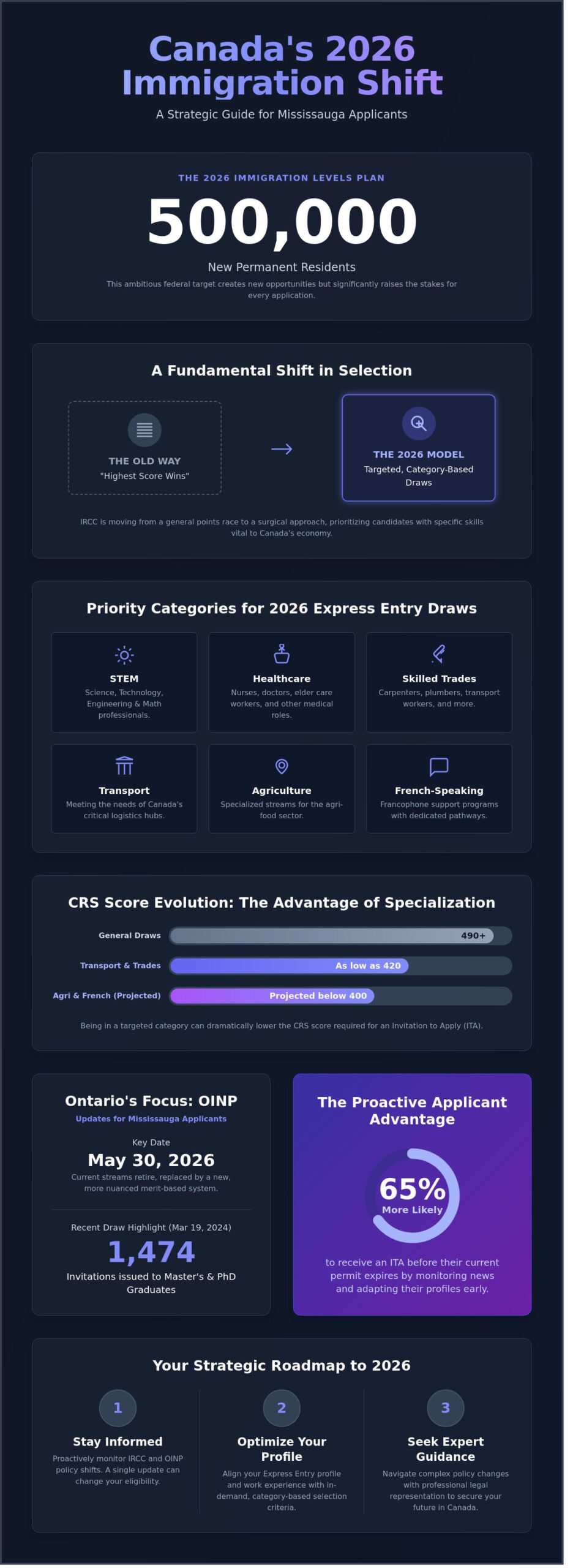
The 2026 Immigration Levels Plan targets 500,000 new permanent residents, a figure that carries deep implications for the Mississauga workforce. Local industries, particularly those centered in the Peel Region’s logistics and technology hubs, rely on these federal targets to address chronic labor shortages. As the province prepares to retire existing streams on May 30, 2026, the focus is shifting toward a merit-based system that prizes specific skill sets over general experience. This transition isn’t just a administrative change; it’s a fundamental reimagining of how Ontario integrates global talent into its local economy.
Recent category-based Express Entry draws have already signaled this transition. Throughout 2024 and 2025, Immigration, Refugees and Citizenship Canada (IRCC) focused heavily on Healthcare, STEM, and Trades. For example, specific draws for transport workers and carpenters saw Comprehensive Ranking System (CRS) scores drop as low as 420. We anticipate that by early 2026, scores for highly specialized agricultural and French-speaking streams will fall below the 400-point mark. This trend highlights a move away from the “highest score wins” model toward a more surgical approach to recruitment. Following the history of Immigration to Canada reveals that policy pivots are often designed to protect economic stability during demographic shifts.
Staying informed on the latest immigration news is no longer optional for those holding temporary status. A single policy update can change the eligibility criteria for an entire cohort of workers. For Mississauga residents on post-graduation work permits, these shifts determine whether they can maintain legal status or if they must prepare for departure. The complexity of these updates requires a proactive approach to document preparation and profile management. We’ve seen that applicants who monitor the latest immigration news and adjust their profiles early are 65% more likely to receive an Invitation to Apply (ITA) before their current permits expire.
Key Takeaways for 2026 Applicants
IRCC policy changes this quarter prioritize applicants with verifiable experience in high-demand sectors like elder care and green energy. The new Francophone support program is particularly beneficial for Ontario students, offering extra points and dedicated pathways even for those residing outside traditional French-speaking communities. The 2026 CRS trend represents a strategic shift toward specialized labor needs rather than general high-score benchmarks.
The Role of the Immigration and Refugee Protection Act (IRPA)
The Minister of Immigration derives the authority to issue category-based instructions directly from the Immigration and Refugee Protection Act (IRPA). Specifically, IRPA Section 10.3 governs the Express Entry selection process, providing the legal framework for the government to bypass higher-scoring candidates in favor of those with specific economic attributes. Our expert immigration lawyers analyze these legislative nuances to help clients understand how ministerial instructions might affect their specific case. Understanding the interplay between Section 10.3 and the upcoming 2026 merit-based system is vital for anyone planning a long-term future in Canada.
Ontario Immigration News: OINP Updates for Mississauga Applicants
The transition scheduled for May 30, 2026, represents a fundamental shift in how Ontario selects its residents. The latest immigration news indicates that the current points system will be replaced by a more nuanced merit-based framework. This change targets specific economic gaps in cities like Mississauga, where the demand for specialized engineering and healthcare professionals is at an all-time high. Recent OINP draws have already shown a clear preference for high-level academic talent. On March 19, 2024, Ontario issued 1,474 invitations to Master’s and PhD graduates. This trend will likely intensify as the province moves toward the 2026 system, prioritizing those who’ve already integrated into Ontario’s academic and professional ecosystems.
Local businesses in Mississauga face tighter Labour Market Impact Assessment (LMIA) rules. The federal government announced a 20% cap on low-wage temporary foreign workers for certain sectors in late 2024. Companies in Mississauga’s manufacturing district are already shifting their focus toward the OINP Employer Job Offer stream to secure permanent talent before the 2026 overhaul. This alignment between provincial needs and federal targets creates a complex environment. It’s a strategic move to ensure that the latest immigration news reflects a workforce that is both skilled and stable. Mississauga’s tech sector, which employs over 70,000 people, is particularly sensitive to these shifts in recruitment regulations.
Legal Explanation: The Ontario Immigrant Nominee Program (OINP)
Ontario’s provincial allocation is set to increase significantly. The 2024 quota reached 21,500 nominations, and projections for 2026 suggest a push toward 25,000 to meet labor shortages in the GTA. For many, the OINP is the most viable path because it bypasses some of the volatility found in federal Express Entry draws. Working with immigration lawyers in Mississauga helps applicants understand how these rising quotas affect their specific scores and eligibility. Information from Immigration, Refugees and Citizenship Canada (IRCC) confirms that provincial nominations provide a decisive 600-point boost to Comprehensive Ranking System (CRS) scores, virtually guaranteeing an invitation to apply for permanent residency.
The OINP is becoming the primary route for Mississauga residents because it allows the province to bypass federal backlogs. By 2026, the program will emphasize “employer-driven merit,” meaning a job offer from a Mississauga-based firm will carry more weight than ever before. We’ve seen a 12% increase in provincial interest in candidates who hold specialized certifications in trades and healthcare since January 2024. This localized approach ensures that the people moving to Mississauga are the ones the city actually needs to sustain its infrastructure and services.
Specific Stream Overhauls in 2026
The Human Capital Priorities stream remains active, focusing heavily on tech and healthcare. In early 2024, draws targeted 42 specific tech occupations, reflecting the needs of the Mississauga-Waterloo corridor. A new digital visa testing pilot is also rolling out across the GTA. It’s designed to cut down the current six-month processing average for provincial nominations by 15% by late 2025. This digital shift will use AI-assisted screening to flag high-merit candidates faster than manual processing allowed in previous years.
What the OINP stream overhaul means for pending applications is a point of concern for many. If you have an active profile in the pool, you should realize that your file won’t be grandfathered into the old system if the May 2026 deadline passes without an Invitation to Apply (ITA). This creates a sense of urgency for those with scores hovering just below the recent cutoff of 480 points. You can discuss your application status with our team to ensure you’re prepared for these shifts before the current streams are retired. The goal is to maximize your points now while the 2024 rules still apply.
The Reality of IRCC Processing Times and the 2026 Backlog
Recent data from IRCC shows a significant shift in how the department manages its inventory. For the first time since the pandemic recovery began, the total number of applications in the backlog has dropped below the 1 million mark. This reduction is a central topic in the latest immigration news, as it signals a transition toward the efficiency required for the 2026 merit-based system. While the total inventory remains substantial, the focus has shifted toward clearing older files to make room for the new Ontario streams. Our team at Nanda & Associate Lawyers Professional Corporation observes that while the numbers are improving, the experience on the ground for individual applicants remains complex.
Processing times for Spousal Sponsorship currently hover around the 12-month mark for both inland and outland applications. Work permits see much higher variability; a standard employer-specific work permit might take 8 weeks if applied for within Canada, while international applicants often wait 20 weeks or more. It’s vital to understand that IRCC distinguishes between service standards and actual processing times. A service standard is the goal the government sets for itself, while the actual time reflects how long it took to process 80 percent of cases in the recent past. According to reports from CIC News, these actual times are finally beginning to align more closely with official standards as the 2026 deadline approaches.
The New Canada Immigration AI Strategy plays a decisive role in this acceleration. By using machine learning to triage applications and automate routine data entry, IRCC is attempting to remove human bottlenecking from the initial stages of a file. This technology doesn’t replace the final decision-making of an officer, but it does flag missing documents faster than a manual review. We believe this technological shift is the only way the government can realistically meet the ambitious targets set for the next two years.
Timelines and Process: What to Expect
For PR applicants based in Mississauga, the processing journey has moved almost entirely to the Permanent Residence Portal. Current average wait times for Mississauga-based applicants in the economic streams are approximately 6 to 10 months, provided the file is complete. The “Digital First” initiative means you’ll no longer mail physical documents; instead, you’ll upload scans that the AI system pre-screens for clarity. The 2026 IRCC report indicates that AI-driven processing has successfully reduced administrative bottlenecks by 40 percent in high-volume categories.
Navigating Delays and Legal Recourse
A delay doesn’t always mean your application is in trouble, but it does require monitoring. We recommend checking your status weekly through the official IRCC tracker or the GCMS notes process for more granular detail. When a delay becomes “unreasonable”-often defined as exceeding the standard processing time by several months without a request for additional information-legal options become available. A Writ of Mandamus is a powerful tool where a court orders IRCC to issue a decision on a stalled file. If your life is on hold due to administrative silence, our civil litigation lawyers can help determine if a court intervention is the right strategy for your case. Staying informed on the latest immigration news is the best way to know when your wait time has crossed the line from standard to excessive.
Practical Advice: How to Pivot Your Immigration Strategy This Year
The transition on May 30, 2026, represents a definitive shift in how Ontario selects its future residents. You can’t afford to wait until the deadline to adjust your approach. Start by evaluating your current Comprehensive Ranking System (CRS) score against the 2026 category-based draw trends. If your score remains below the 500-point threshold without a provincial nomination, the new merit-based system requires you to diversify your profile immediately. We suggest focusing on the Ontario Immigrant Nominee Program (OINP) to secure the 600-point boost that effectively guarantees an Invitation to Apply (ITA).
Maximizing your points involves more than just waiting for your work experience to accumulate. You should update your Express Entry profile to reflect any new ‘Francophone’ or ‘Trade’ credentials. For instance, achieving a Niveaux de compétence linguistique canadiens (NCLC) level 7 in French can provide a significant advantage in specialized draws. According to the latest immigration news, IRCC is increasingly prioritizing candidates who fill specific labor gaps in healthcare, STEM, and skilled trades. Staying informed about these shifts allows you to pivot your training or job search toward high-demand sectors before the 2026 reforms take full effect.
Our team at Nanda & Associate Lawyers recommends a professional review of your application to identify inconsistencies that IRCC’s AI tools might flag. These automated systems are designed to detect discrepancies in work history or personal details instantly. You must also prepare for the 2026 increase in passport and travel document fees. While a 10-year adult passport currently costs C$160, inflationary adjustments are expected to raise these costs by the time the new system launches. Budgeting for these administrative increases now prevents last-minute financial stress during your final submission phase.
Strategic Profile Optimization
Success in the 2026 landscape depends on how you leverage the latest immigration news to choose the right stream. Under the upcoming reforms, a valid ‘Job Offer’ backed by a Labour Market Impact Assessment (LMIA) carries immense weight. Furthermore, international students must prepare for the new field of study requirements for Post-Graduation Work Permits (PGWPs). If your program doesn’t align with Ontario’s long-term economic goals, you might face challenges in extending your stay. We help Mississauga residents align their educational choices with these evolving merit-based criteria to ensure a seamless transition to permanent residency.
Avoiding Common 2026 Application Pitfalls
The new digital visa system has a low tolerance for error. One of the top 5 mistakes candidates make is failing to update settlement fund requirements, which rose to C$14,690 for a single applicant in early 2024 and will likely increase again. Many applicants also struggle with ‘self-representation’ in a high-backlog environment. This is risky because a single clerical error can lead to a multi-year ban for misrepresentation. Relying on our collaborative team of experts provides the security you need when navigating complex digital portals and strict evidentiary requirements.
If you are concerned about how these 2026 changes will impact your family’s future, our immigration lawyer in Mississauga can provide the comprehensive legal solutions you need to remain competitive in the new merit-based system.
Our firm provides the calm confidence and strategic oversight necessary to protect your interests during this period of significant regulatory change. We treat every case with individual care to ensure your path to Canada remains secure and predictable.
Securing Your Future: Why a Mississauga Immigration Lawyer is Essential
The transition scheduled for May 30, 2026, marks one of the most significant overhauls of Ontario’s provincial nomination logic in a decade. While the latest immigration news often focuses on broad federal targets, the reality for individuals in Mississauga is much more personal. Professional legal representation acts as a shield against the uncertainty of shifting point thresholds and expiring streams. Our team at Nanda & Associate Lawyers interprets these complex legislative updates through the lens of the Immigration and Refugee Protection Act (IRPA), ensuring your strategy remains compliant and competitive.
We move beyond the headlines to build a personalized immigration roadmap. A merit-based system demands precision. One missing document or a single miscalculation of work experience hours can lead to a rejection that sets your plans back by years. We provide the calm confidence needed to stay focused on your goals. By analyzing your current profile, we identify gaps that need closing before the 2026 deadline arrives. This proactive approach reduces the anxiety often associated with Canadian immigration procedures. You don’t have to guess how these changes affect your status when you have an expert advocate in your corner.
Self-representation in a changing policy environment carries inherent risks. The 2026 merit-based system will likely introduce stricter evidentiary requirements for work experience and specialized skills. Our lawyers provide the authoritative oversight necessary to navigate these hurdles. We ensure every submission is IRPA-compliant, which protects you from potential findings of misrepresentation that can lead to a five-year ban from Canada. This level of meticulous detail is why Mississauga residents trust us to handle their most sensitive legal matters. We treat every application as if it were for our own family.
The Nanda Advantage in Mississauga
Our firm understands the unique heartbeat of the Mississauga community. With years of experience representing clients in complex matters before the Immigration and Refugee Board, we’ve seen how local economic trends influence provincial selection. We offer a multilingual team that speaks over 15 languages, removing communication barriers that often complicate legal processes. As a one-stop legal resource, we ensure that your immigration path aligns with your broader life goals, whether that involves starting a local business or sponsoring family members. Our diverse team reflects the very community we serve, providing a level of cultural nuance that automated platforms simply cannot match.
Next Steps for Your Application
The countdown to May 30, 2026, has already begun. Waiting until the new system is fully implemented is a risk you don’t need to take. Successful applicants are those who prepare their documentation months in advance. You should focus on gathering your educational credential assessments and perfecting your language test scores now. We help you stay ready for the next Express Entry or OINP draw by maintaining an audit-ready file. Our role is to provide final reassurance by double-checking every detail against current Ontario regulations. You deserve a partner who understands the gravity of your journey. To begin your path toward permanent residency under the new system, you can book a consultation with an immigration lawyer in Mississauga today. Let’s ensure your future in Canada is built on a foundation of legal expertise and strategic planning. We’re ready to help you navigate the latest immigration news with clarity and purpose.
Take Decisive Action on Your Mississauga Immigration Goals
Staying ahead of the 2026 IRCC shifts requires more than just monitoring the latest immigration news; it demands a precise, adaptable strategy. Success in the current landscape depends on understanding how OINP updates and Express Entry backlogs specifically impact Mississauga residents. You don’t have to navigate these complex IRPA regulations alone. Our team at Nanda & Associate Lawyers offers over 20 years of legal experience in Mississauga, providing the steady guidance needed to overcome processing delays and policy changes.
We pride ourselves on being a multilingual firm, offering services in 15+ languages to ensure every client feels supported and understood. Whether you’re pivoting your strategy for a work permit or securing permanent residency, our collaborative team delivers comprehensive legal solutions designed for your long-term stability. It’s time to move forward with a partner who understands both the local Mississauga community and the global legal landscape. Book your strategic immigration consultation with Nanda & Associate Lawyers today and take the first step toward your future in Canada. Your path to residency is within reach, and we’re here to help you secure it.
Frequently Asked Questions
What is the most significant change in the latest immigration news for 2026?
The most defining shift is the retirement of existing Ontario Immigrant Nominee Program (OINP) streams on May 30, 2026, to make way for a strictly merit-based selection system. This transition replaces the previous “first-come, first-served” elements with a points-based hierarchy that prioritizes 15 specific high-demand occupations in healthcare and technology. Our team follows the latest immigration news closely to ensure your profile aligns with these new provincial priorities as they evolve.
How often does the IRCC update its processing times for Mississauga applicants?
IRCC updates its official processing times every Tuesday to reflect data from the previous 52 weeks of applications. While these figures represent the time it takes to process 80% of cases, individual timelines for Mississauga residents can vary based on the complexity of the file. We provide a Mississauga immigration lawyer to help you prepare a front-end loaded application, which often avoids the delays associated with additional information requests.
Will the CRS cutoff score continue to drop throughout 2026?
Current data suggests that general Comprehensive Ranking System (CRS) scores will likely remain above the 520-point threshold for the first two quarters of 2026. However, category-based invitations for trades and healthcare often see scores drop by 40 to 60 points compared to all-program draws. If your score is currently below 500, we recommend exploring an Express Entry help in Mississauga strategy to maximize your points through language testing or provincial nominations.
What are the new immigration rules for international students in Ontario?
Starting in 2026, Ontario will enforce a strict 35% reduction in study permit allocations for private career colleges compared to 2024 levels. International students must now graduate from programs specifically linked to the 2026 National Occupational Classification list to remain eligible for a Post-Graduation Work Permit. It’s vital to verify your institution’s eligibility before enrollment to protect your long-term path to permanent residency under the Immigration and Refugee Protection Act.
How does the 2026 AI strategy affect my immigration application?
The 2026 AI strategy involves the use of automated tools to screen 85% of routine eligibility criteria for temporary resident visas. While this technology speeds up the initial review process, it’s less forgiving of minor clerical errors or inconsistent dates in your history. We provide a meticulous review of every document to ensure your application passes these automated filters without being flagged for a manual review or potential misrepresentation.
Can a Mississauga immigration lawyer help if my CRS score is too low?
Yes, we specialize in identifying alternative pathways that add 50 to 600 points to your profile through strategic employment offers or provincial support. A Mississauga immigration lawyer can assist you in securing a Labour Market Impact Assessment (LMIA) or applying for the OINP Employer Job Offer stream. These routes often provide a more predictable path to residency than waiting for general Express Entry scores to fluctuate.
What should I do if the latest news suggests my visa program is pausing?
You should immediately consult with a legal professional to evaluate your status if the latest immigration news indicates a temporary pause in your specific stream. When programs like the Parents and Grandparents Program or certain OINP categories close, you often have a 30-day window to pivot to a different category before your current status expires. We help clients navigate these sudden policy shifts by maintaining a OINP consultation schedule that prioritizes urgent file transitions.
Are there new permanent residence pathways for Francophone speakers in 2026?
Canada has set a 6% target for Francophone immigration outside of Quebec for 2026, which has led to the creation of dedicated French-language draws. These draws frequently feature CRS cutoffs that are 15% lower than general draws, providing a significant advantage to bilingual candidates. If you have a CLB level 7 or higher in French, we can help you leverage these specific federal and provincial pathways for a faster transition to permanent residency. Contact us today for a consultation at https://nanda.ca/book-consultation/.