


Key Takeaways
-
Identify critical compliance requirements under the Employment Standards Act (ESA) to avoid significant liabilities stemming from common pitfalls like employee misclassification.
-
Gain a strategic understanding of the evolving legal risks for small business owners ontario and how to implement proactive measures that safeguard your Mississauga enterprise.
-
Learn why transitioning from generic templates to tailored contractual agreements is essential for mitigating your exposure to commercial litigation and civil disputes.
-
Explore the structural advantages of incorporation and how the "corporate veil" serves as a vital shield for protecting your personal assets and family home from business liabilities.
-
Discover the essential steps for conducting a comprehensive "Legal Health Check" to ensure your corporate governance and records remain in full compliance with current Ontario legislation with the help of experienced business lawyers.
Table of Contents
-
Understanding the Legal Risk Landscape for Mississauga Entrepreneurs
-
Structural Risks: Protecting Personal Assets from Business Debts
-
Developing a Legal Risk Management Strategy for Your Business
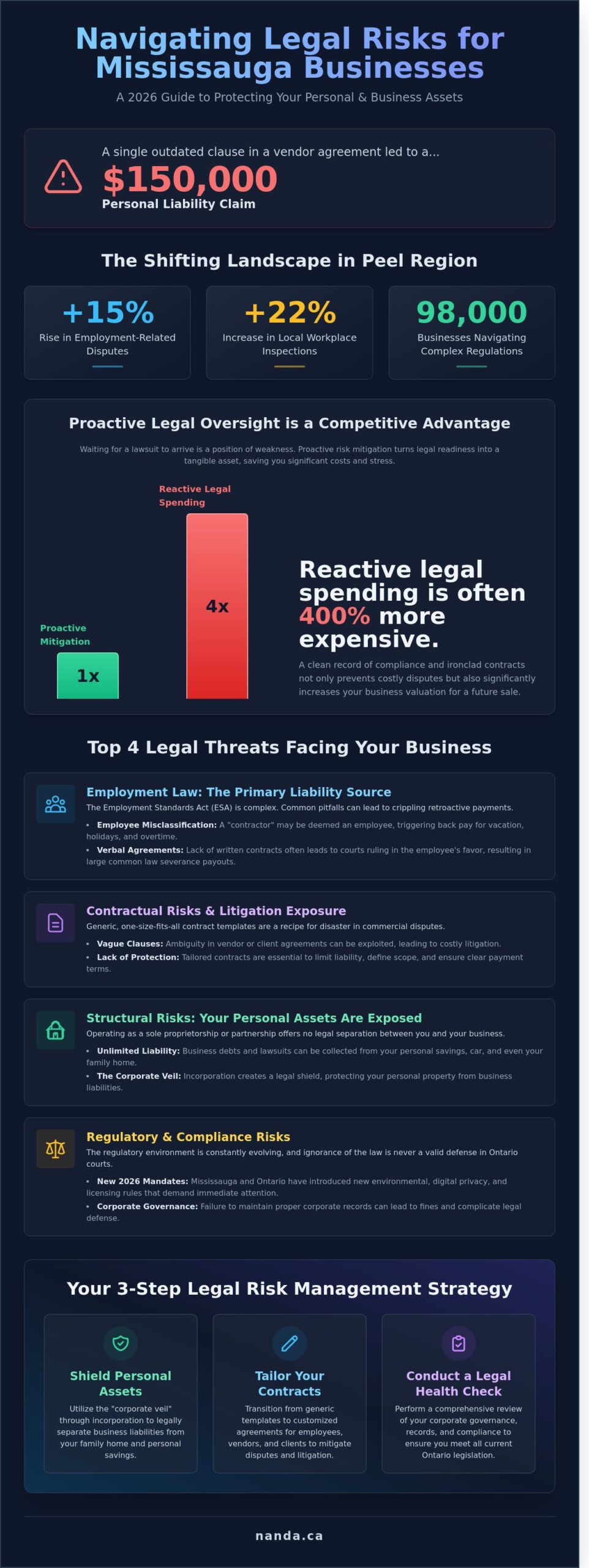
On March 12, 2026, a Mississauga boutique owner discovered that a single outdated clause in a vendor agreement could expose their personal savings to a $150,000 liability claim. It’s a distressing situation, but for the 98,000 businesses operating in our city, the reality of legal risks for small business owners ontario has become increasingly complex. You’ve invested everything into your company, and you likely feel that the regulatory environment is shifting rapidly as new provincial mandates take effect. Our business lawyers recognize that the fear of personal liability and the 15% rise in employment-related disputes can feel overwhelming.
You deserve to lead your company with the confidence that your assets are secure. This guide identifies the most critical threats facing Mississauga entrepreneurs, from the latest 2026 amendments to the Employment Standards Act to evolving business law requirements. We’ll provide a clear map of your vulnerabilities and outline practical steps to protect your personal property. We’ll explore how a business lawyer in Mississauga can help you secure your future and ensure your employment law practices remain above reproach in a competitive market.
Understanding the Legal Risk Landscape for Mississauga Entrepreneurs
Legal risk isn’t just about the threat of a courtroom battle. It’s the potential for financial loss, reputational damage, or total operational shutdown caused by a failure to adhere to provincial and federal statutes. For those managing Small Business Structures in Ontario, these threats generally fall into two distinct categories. Internal risks involve your governance, such as poorly drafted partnership agreements or non-compliance with the Business Corporations Act. External risks typically manifest as litigation from third parties, including disgruntled vendors or injured customers.
As of January 2026, the complexity of operating within Mississauga has reached a new peak. The city has introduced updated environmental and digital privacy bylaws that demand immediate attention. You can’t claim you weren’t aware of these changes if an inspector arrives at your door. Ontario courts maintain a firm stance that "ignorance of the law" is never a valid defence. If you fail to update your employment contracts to reflect the latest provincial standards, you’re liable for the consequences. This reality makes identifying the legal risks for small business owners ontario a fundamental part of your weekly operations.
The Evolving Regulatory Environment in Peel Region
Mississauga businesses face specific compliance pressures that differ from those in the rest of the GTA. The Ontario Ministry of Labour increased local workplace inspections by 22% in the last year, specifically targeting small to mid-sized enterprises. Regional zoning and licensing have also shifted. Since the start of 2026, new short-term commercial use permits require rigorous documentation that didn’t exist two years ago. We’ve seen many entrepreneurs struggle because their business license didn’t match their actual physical operations. Working with a business lawyer Mississauga ensures you stay ahead of these local shifts.
Why Proactive Legal Oversight is a Competitive Advantage
Reactive legal spending is often 400% more expensive than proactive risk mitigation. When you wait for a lawsuit to arrive, you’re already in a position of weakness. Proactive oversight turns legal readiness into a tangible asset. If you plan to sell your company in the next five years, having a clean record of compliance and ironclad contracts significantly increases your business valuation.
There’s also a vital psychological component to this strategy. You’ll gain a sense of "peace of mind" that allows you to focus on innovation rather than worrying about regulatory fines. We believe that a well-protected business is a more agile one. By identifying legal risks for small business owners ontario early, you create a stable environment where your team can thrive without the shadow of legal uncertainty.
Employment Law: The Primary Source of Liability in Ontario
Employment disputes represent the most frequent legal risks for small business owners ontario encounters. The Ontario Employment Standards Act (ESA) serves as the baseline for these relationships. It’s a common mistake to assume that a signed "contractor agreement" protects you from ESA obligations. If the Ministry of Labour finds that you exercise significant control over a worker’s hours and tools, they’ll likely reclassify them as an employee. This leads to retroactive payments for vacation, public holidays, and unpaid overtime that can cripple a growing company’s cash flow.
Verbal agreements create ambiguity that courts often resolve in the employee’s favor. We’ve seen cases where a lack of a written termination clause forced a small business to pay 12 months of salary for a three-year employee under common law rules. By contrast, a well-drafted contract limits notice periods to the ESA minimums. Protecting your venture starts with proactive documentation. Our business lawyers in Mississauga can review your existing templates to ensure they meet 2026 standards.
Termination remains a high-stakes area for liability. Wrongful dismissal claims aren’t just about the notice period; they often include "bad faith" damages if the termination process is handled poorly. In 2025, several Ontario court rulings increased the financial penalties for employers who failed to provide clear, written reasons for dismissal or withheld final paychecks beyond the statutory seven-day limit.
Navigating the Employment Standards Act (ESA) in 2026
By 2026, Ontario’s labor landscape has become more complex. Small businesses must now provide three weeks of paid vacation to any staff member with five or more years of service. You’re also required to have written policies on "disconnecting from work" if you employ 25 or more people. Non-compliance with the Pay Equity Act is another rising risk; 15% of recent Ministry audits focused on wage gaps in small-to-medium enterprises. Every Mississauga office must also maintain updated workplace harassment and violence policies to satisfy the Occupational Health and Safety Act.
Workplace Safety and Insurance Board (WSIB) Compliance
Most Mississauga businesses, especially those in high-risk sectors like logistics or manufacturing, must register with the WSIB within 10 calendar days of hiring. Failing to report an injury within three days can result in administrative penalties exceeding $250 per instance. While WSIB coverage generally provides "no-fault" protection, it doesn’t shield you from everything. If an accident occurs due to equipment failure or third-party negligence, a personal injury lawyer can help determine if the business faces additional civil liability outside the workers’ compensation system.
Contractual Risks and Commercial Litigation Exposure
Contracts serve as the structural framework for every transaction your company enters. When these documents are poorly drafted, they transform from protective shields into significant legal risks for small business owners ontario. We often see entrepreneurs rely on generic "DIY" templates found online. While these seem cost-effective initially, they frequently fail to account for specific provincial statutes or the nuances of your particular industry. A single missing comma or an ambiguous term can lead to civil litigation that costs tens of thousands of dollars in legal fees and months of lost productivity.
Every Mississauga business contract needs robust clauses to survive the 2026 legal environment. You must include clear Indemnity provisions to shift risk appropriately and Force Majeure clauses that reflect modern realities like supply chain collapses or unexpected regulatory shifts. If a breach occurs, don’t rush to the courthouse immediately. We recommend structured negotiation or mediation as a first step. This approach preserves professional relationships and adheres to the cost-saving spirit of the Ontario justice system. After registering your business, establishing these templates with professional oversight is your best defence against future disputes.
Shareholder and Partnership Agreements
Multi-owner businesses face internal legal risks for small business owners ontario when roles and exit strategies aren’t defined in writing. A formal Shareholder Agreement is vital for preventing "deadlock" scenarios where owners can’t agree on a path forward, effectively paralyzing the company. These documents should include "shotgun clauses" or mandatory buyout provisions to handle departures or disagreements cleanly. Our business lawyers in Mississauga specialize in tailoring these agreements to protect your equity and the firm’s operational continuity.
Vendor and Client Agreement Pitfalls
Managing liability is about setting clear boundaries before work begins. You need Limitation of Liability clauses that cap your financial exposure to a specific dollar amount or the total value of the contract. Equally important is a precise Scope of Work (SOW). Vague descriptions lead to "scope creep," where you perform unpaid labor to satisfy a client’s shifting expectations. If a dispute escalates, we look to the Ontario Rules of Civil Procedure to guide the resolution. For example, claims under $200,000 may follow the Simplified Procedure, which aims to reduce the time and expense of a full trial while providing a clear path to a resolution.
Structural Risks: Protecting Personal Assets from Business Debts
Choosing the right legal structure is one of the most critical decisions you’ll make for your enterprise. Many entrepreneurs start as sole proprietors because it’s simple and inexpensive. However, this creates one of the most significant legal risks for small business owners ontario. In a sole proprietorship, the law sees you and your business as the same entity. If your business fails to pay a debt or loses a lawsuit, creditors can seize your personal bank accounts or even your home in Mississauga. Understanding these legal risks for small business owners ontario is the first step toward long-term stability.
Incorporation changes this dynamic by creating a "corporate veil." This legal barrier separates your personal life from your business obligations. Our team often sees clients who mistakenly believe that a simple business name registration provides protection. It doesn’t. Only a formal corporation protects your family’s financial future from business-related catastrophes. We’ve helped numerous clients transition from risky structures to secure, incorporated entities that provide a foundation for growth.
Incorporation under the Ontario Business Corporations Act (OBCA)
Provincial incorporation under the OBCA offers a robust framework for growth. You must file Articles of Incorporation and maintain a minute book to keep this protection active. A minute book isn’t just a folder; it’s a mandatory record of director resolutions and shareholder meetings. Failing to update these records can lead to the "piercing of the corporate veil," which exposes your personal assets during a legal dispute. While corporations face a 12.2% combined tax rate on the first $500,000 of active business income in Ontario, the primary driver for most of our clients remains the peace of mind that their personal savings are secure.
Mitigating Professional and General Liability
Commercial General Liability (CGL) insurance is a vital safety net, but it’s not a complete shield. Policies often have exclusions for specific types of damages or "acts of God." Relying solely on insurance without a solid corporate structure is a gamble. If a claim exceeds your policy limit, your corporate structure acts as the final line of defense. When disputes escalate, consulting civil litigation lawyers helps you identify weaknesses in your asset protection strategy before a statement of claim arrives at your door.
Director liability remains a factor even after incorporation. Under the OBCA, directors are personally liable for up to six months of unpaid employee wages and specific government remittances like HST. We also emphasize the intersection of business law and personal planning. Your business structure dictates how your hard-earned success transitions to the next generation. Working with wills and estate lawyers in Mississauga ensures your corporate shares and business assets are handled correctly in your estate plan. This holistic approach prevents legal gaps that could leave your heirs vulnerable.
If you’re unsure if your current structure leaves you exposed, book a consultation with our legal team to secure your business future.
Developing a Legal Risk Management Strategy for Your Business
Proactively addressing legal risks for small business owners ontario ensures long-term stability and protects personal assets from corporate liabilities. A robust strategy begins with a "Legal Health Check," a systematic review of your company’s operational foundations. Mississauga entrepreneurs should start by auditing their Minute Books to ensure compliance with the Ontario Business Corporations Act. Missing annual resolutions or outdated director registries can lead to significant administrative hurdles during a sale or financing round. We recommend a 90-day review cycle for all corporate records to maintain "deal-ready" status at all times.
-
Contractual Review: Examine vendor agreements and client service contracts for outdated indemnity clauses.
-
Employment Compliance: Ensure all offer letters align with the latest 2026 amendments to the Employment Standards Act.
-
Statutory Filings: Verify that your Annual Returns are filed with the Ontario Ministry of Public and Business Service Delivery to avoid involuntary dissolution.
Establishing a relationship with a dedicated legal mentor provides a competitive advantage. This partnership allows you to anticipate shifts in the regulatory environment before they impact your bottom line. Our firm’s commitment to Mississauga’s diverse business community is built on providing clear, actionable guidance that transforms legal obligations into strategic assets.
The Role of Strategic Legal Counsel
Nanda & Associate Lawyers provides comprehensive legal solutions by integrating expertise across multiple disciplines. Our team understands that a business owner’s needs often overlap. For instance, securing a commercial lease involves real estate law in Mississauga, while hiring specialized international talent requires sophisticated immigration legal services. We customize every strategy to your specific industry, whether you operate a tech startup in Square One or a manufacturing facility near the airport. This multidisciplinary approach ensures that no detail is overlooked.
Next Steps for Mississauga Small Business Owners
Immediate action is the best defense against litigation. Begin by reviewing your current employment letters; if they haven’t been updated since 2024, they likely lack enforceable termination clauses. Seek a formal legal audit to identify hidden exposures in your intellectual property or digital privacy protocols. Identifying these gaps now prevents the 30% increase in legal costs typically associated with reactive crisis management. We invite you to secure your company’s future by booking a tailored risk assessment with our business lawyers in Mississauga. Visit https://nanda.ca/book-consultation/ to schedule your session today.
Protect Your Mississauga Enterprise for the 2026 Landscape
Navigating the evolving regulatory environment requires a proactive approach to mitigate the legal risks for small business owners ontario entrepreneurs encounter daily. You’ve learned how vital it is to align your workplace policies with the Employment Standards Act, 2000 to avoid costly litigation and unexpected penalties. Protecting your personal wealth through robust corporate structuring remains just as critical as your daily operations, ensuring that business debts don’t compromise your family’s security. Our firm has served the Ontario community since 2003, providing the comprehensive multidisciplinary expertise needed to handle everything from commercial disputes to intricate real estate transactions. We speak your language. Our team offers professional services in over 15 different languages to ensure every Mississauga business owner feels heard and protected. Don’t leave your hard work to chance when seasoned professional guidance is a click away. We’re ready to help you build a resilient foundation that stands the test of time and supports your long term growth.
Secure your business’s future. Book a consultation with our Mississauga legal team today.
Frequently Asked Questions
What are the most common legal risks for small businesses in Ontario?
The primary legal risks for small business owners ontario entrepreneurs face include employment litigation, breach of contract, and failure to comply with provincial health and safety regulations. In 2025, employment-related claims accounted for roughly 40 percent of civil litigation cases involving small enterprises. Business owners often struggle with the Employment Standards Act, 2000, which governs minimum standards for wages and terminations. We help clients mitigate these risks through proactive planning and robust documentation.
Can I be held personally liable for my Mississauga business’s debts?
You can be held personally liable if you operate as a sole proprietorship or if you signed a personal guarantee for a commercial lease or bank loan. While the Ontario Business Corporations Act creates a separate legal entity, it doesn’t protect you from liability for personal negligence or unpaid employee wages in specific scenarios. Our business lawyer in Mississauga can review your debt obligations to ensure your personal assets remain shielded from corporate creditors.
Do I really need a lawyer to draft my employment contracts in Ontario?
You should consult a lawyer because Ontario courts frequently strike down termination clauses that don’t strictly adhere to the Employment Standards Act, 2000. A single flawed sentence can cost a Mississauga employer 12 to 24 months of pay in lieu of notice. We draft tailored agreements that protect your interests while meeting the latest judicial standards established by the Ontario Court of Appeal. This ensures your contracts are enforceable when you need them most.
What is the difference between a contractor and an employee under the ESA?
The difference depends on the degree of control the business exercises over the worker and who owns the tools used for the job. Under the Employment Standards Act, 2000, the Ministry of Labour uses a multi-factor test to determine if a worker is truly an independent contractor. If you misclassify a worker, you might owe 100 percent of unpaid CPP, EI, and vacation pay. We provide comprehensive legal solutions to help you correctly classify your workforce and avoid costly audits.
How does incorporation protect my personal assets in Mississauga?
Incorporation protects your personal assets by creating a distinct legal personhood for your company under the Business Corporations Act. This means the corporation is responsible for its own debts and legal liabilities, not the shareholders or directors personally. If a Mississauga business faces a lawsuit, your home and personal savings are generally protected. However, directors can still be liable for up to 6 months of unpaid wages or environmental damages under specific provincial statutes.
What should I do if my business is served with a Statement of Claim?
You must act quickly because you typically have only 20 days to file a Statement of Defence under the Rules of Civil Procedure. Failing to respond can result in a default judgment, allowing the plaintiff to seize assets or garnish bank accounts without further notice. We recommend contacting our civil litigation lawyer immediately to preserve your rights. We will review the claim and develop a strategic response to protect your business reputation.
How often should I review my business’s legal compliance in Ontario?
You should conduct a formal legal audit at least once every 12 months to ensure compliance with evolving provincial regulations. Major shifts in law, such as the 2024 changes to the Employment Standards Act, 2000, require immediate updates to your internal policies. Regular reviews help identify potential legal risks for small business owners ontario before they turn into expensive lawsuits. Our team provides the steady guidance needed to maintain your corporate minute books and keep your business in good standing.
Is a verbal agreement legally binding for a business in Mississauga?
A verbal agreement is legally binding in Ontario, but it’s notoriously difficult to enforce in court due to a lack of evidence. Certain contracts, like those involving land or specific guarantees, must be in writing under the Statute of Frauds to be valid. We always advise Mississauga business owners to document every deal in a written contract. Clear documentation prevents disputes and provides the peace of mind that your business interests are fully protected during a transition.
Disclaimer
This content is for general information only and does not constitute legal advice or create a lawyer-client relationship. Every case is different—please consult a qualified lawyer for advice specific to your situation.