


Imagine standing at the corner of Hurontario and Burnhamthorpe on a rainy afternoon in October 2023, where a single moment of negligence changes your entire career path. For many in our community, this isn’t just a story; it’s a reality that brings them face to face with the intricate web of personal injury law. You’re not just fighting physical pain. You’re battling a system that often prioritizes corporate profits over your individual recovery.
It’s exhausting to field calls from aggressive adjusters while managing rehabilitation costs that can exceed $50,000 for serious orthopedic injuries. We understand that your primary goal is reclaiming your stability and ensuring your family’s needs are met. This article provides a clear roadmap to help you secure the maximum compensation available. By working with a dedicated personal injury lawyer in Mississauga, you gain an advocate who understands the local court system. We’ll examine the specific litigation milestones in Ontario, how legal teams quantify your pain and suffering, and the strategic ways we help you meet strict provincial deadlines.
Key Takeaways
- Understand the critical legal frameworks and strict limitation periods, such as the Limitations Act, 2002, that govern your right to seek compensation in Ontario.
- Learn the essential steps of the litigation process, from the strategic preservation of evidence to the formal issuance of a Statement of Claim.
- Discover how to accurately assess the value of your claim under Ontario personal injury law by distinguishing between pecuniary losses and non-pecuniary damages.
- Identify the benefits of contingency fee arrangements, which allow you to access professional legal representation in Mississauga without the burden of upfront costs.
- Gain the insights necessary to select a dedicated legal team that offers the sophisticated advocacy and empathetic support required for your long-term recovery.
Understanding Personal Injury Law in Mississauga: An Overview
Personal injury law in Ontario functions as a protective shield for individuals who’ve been harmed by the carelessness of others. It’s built upon the principles of tort law, which seeks to provide a remedy for civil wrongs. In Mississauga, this legal field covers a wide array of incidents where negligence leads to physical, emotional, or financial loss. The primary objective is to secure compensation that addresses the victim’s needs, helping them recover and regain stability after a traumatic event.
Whether you’re dealing with a collision on the 403 or a fall in a local commercial space, the goal of a claim is to return the injured party to the position they were in before the accident occurred. We focus on several core areas within this practice:
- Motor Vehicle Accidents: These are governed by the Insurance Act and involve complex “no-fault” benefit systems alongside traditional lawsuits for pain and suffering.
- Slip and Falls: Under the Occupiers’ Liability Act, property owners in Mississauga must maintain safe environments for visitors. Failure to clear ice or repair flooring can lead to significant liability.
- Product Liability: This addresses injuries caused by defective consumer goods, manufacturing errors, or inadequate warning labels on products sold within Ontario.
Local representation is vital because Peel Region courts have specific administrative nuances. Most Mississauga cases proceed through the A. Grenville and William Davis Court House in Brampton. A personal injury lawyer in Mississauga brings familiarity with local experts and medical practitioners, which strengthens the credibility of your file. We understand the specific expectations of regional judges and the tactics often employed by insurance adjusters operating in the Greater Toronto Area.
The Legal Basis of a Claim: Negligence and Duty of Care
Success in a lawsuit hinges on proving four pillars: duty of care, breach of that duty, causation, and actual damages. Ontario courts apply the “but for” test to establish causation, as clarified in the Supreme Court case Clements v. Clements. This means a plaintiff must prove that their injury wouldn’t have happened “but for” the defendant’s specific actions. In complex multi-party accidents, the Negligence Act allows for the apportionment of fault among several defendants based on their degree of responsibility.
Key Takeaways for Mississauga Residents
If an accident occurs, your immediate actions dictate the strength of your future claim. You must report any collision resulting in injuries or property damage exceeding $2,000 to the Peel Regional Police. Obtaining a police report number is a non-negotiable step for personal injury law proceedings. Additionally, seeking medical help at Trillium Health Partners or a local clinic isn’t just for your health; it creates the primary evidence required to document the extent of your injuries for the court.
The Legislative Framework: Ontario Laws You Must Know
Understanding the legal foundation of your claim is the first step toward a successful recovery. In Mississauga, personal injury law is governed by a complex web of provincial statutes that dictate how, when, and why you can seek compensation. These laws aren’t just suggestions; they’re rigid rules that Ontario courts follow strictly. Our team at Nanda & Associate Lawyers prioritizes helping you understand these pillars so you can make informed decisions about your future.
The Two-Year Limitation Period
The Limitations Act, 2002 establishes a standard 24-month window for filing most personal injury claims in Ontario. This clock typically starts ticking the moment your accident occurs. If you fail to initiate legal action within this two-year period, you’ll likely lose your right to sue forever. While the principle of “discoverability” allows for extensions if an injury wasn’t immediately apparent, these exceptions are difficult to prove in court. For claims involving minors, the 24-month countdown usually doesn’t begin until the individual reaches the age of 18. We encourage prompt action because physical evidence at a Mississauga accident site can disappear in hours, and witness memories often begin to blur after only 14 days.
The “Threshold” and Deductibles in Car Accident Claims
Motor vehicle accidents fall under the Ontario Insurance Act, which creates a unique two-part system. First, you have the Statutory Accident Benefits Schedule (SABS), a “no-fault” scheme providing immediate medical and rehabilitation funding regardless of who caused the crash. Second, you may pursue a “tort” claim against the at-fault driver for pain and suffering. However, to win compensation for non-monetary losses, your injury must meet a specific legal “threshold.” This requires proving a “permanent serious impairment of an important physical, mental or psychological function.”
- The Statutory Deductible: For 2024, the deductible for pain and suffering awards is $46,053.20 for any settlement or judgment under $153,509.39.
- Tort vs. No-Fault: SABS covers immediate needs like physiotherapy, while a tort claim seeks long-term damages for lost wages and emotional distress.
- The 60-Day Notice: Under the Occupiers’ Liability Act, if you slip on snow or ice in Mississauga, you must provide written notice to the property owner within 60 days of the incident.
The intersection of these laws means that even a clear-cut case requires strategic handling to ensure you aren’t barred by a technicality. If you’re feeling overwhelmed by these timelines, speaking with a personal injury lawyer can help protect your rights while you focus on healing. Our firm takes a methodical approach to these legislative requirements, ensuring every notice is served and every filing deadline is met with precision. We believe that professional representation provides the peace of mind necessary to navigate the aftermath of a serious trauma.
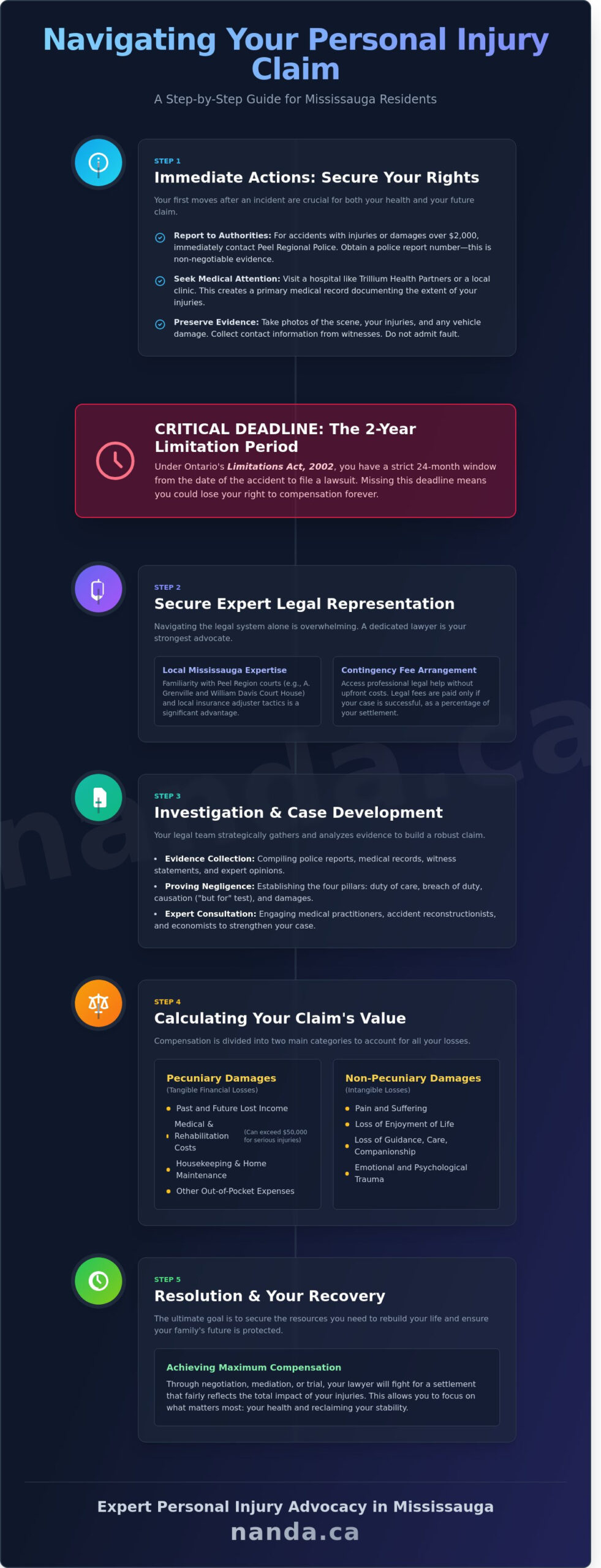
How to Navigate the Personal Injury Claim Process
The litigation process in Ontario follows a methodical sequence designed to ensure fairness and transparency. We guide you through each stage of personal injury law to minimize stress while maximizing your potential recovery. The journey typically follows these five critical steps:
- Step 1: Initial consultation and evidence preservation, including securing witness statements and medical records from local providers like Trillium Health Partners.
- Step 2: Issuing the Statement of Claim and receiving the defense’s response, which usually occurs within 20 days of service.
- Step 3: The Discovery phase, where both parties exchange relevant evidence and conduct oral examinations.
- Step 4: Mandatory mediation, a specific requirement for civil cases filed in the Greater Toronto Area under the Ontario Rules of Civil Procedure.
- Step 5: Pre-trial conferences and the final path to a court judgment if a settlement isn’t reached.
The Discovery Process in Mississauga Litigation
The Discovery phase is often the most intensive part of your lawsuit. During an Examination for Discovery, you’ll provide testimony under oath. It’s a factual inquiry, not an interrogation. Your personal injury lawyer prepares you thoroughly so you understand the types of questions the defense will ask regarding your lifestyle and recovery. We also manage the “Affidavit of Documents.” This is a formal list of every relevant record in your possession, such as employment files and therapy notes. These documents form the evidentiary backbone of your claim.
Mediation and Settlement Negotiations
Statistics from the Ontario Ministry of the Attorney General indicate that 95% of civil cases settle before trial. This happens because mediation is a cornerstone of modern personal injury law, providing a controlled environment to resolve disputes without the unpredictability of a courtroom. A neutral mediator works with both sides to find a fair compromise. We help you evaluate every settlement offer by comparing it to the potential legal costs and the 15% to 30% risk of loss associated with a full trial. This strategic approach ensures you don’t accept an undervalued offer that fails to protect your future financial stability.
Calculating Damages: What is Your Claim Worth?
Determining the value of a claim in personal injury law requires a methodical approach that balances tangible bills with intangible suffering. We categorize these losses into pecuniary and non-pecuniary damages. Pecuniary damages, often called special damages, are the out-of-pocket expenses you’ve already paid or will pay in the future. Non-pecuniary damages, or general damages, compensate for pain, suffering, and the loss of enjoyment of life. It’s vital to understand that Canada imposes a “cap” on non-pecuniary damages. Established by the Supreme Court in 1978 and adjusted for inflation, this limit sits at approximately $450,000 in 2024 for the most severe, catastrophic cases.
To establish a fair valuation, we look beyond your immediate medical bills. We assess your “loss of competitive advantage,” which occurs when an injury makes you less marketable to future employers. If a 38-year-old tradesperson can no longer perform heavy lifting, their career trajectory changes permanently. We utilize a network of medical experts and vocational specialists to quantify these shifts. These professionals provide objective data on your functional limitations, ensuring your claim reflects the 20 or 30 years of earning potential you might lose.
Economic vs. Non-Economic Losses
Calculating income loss involves analyzing your past earnings and projected career growth. We don’t just look at your base salary; we include lost bonuses, pension contributions, and health benefits. Future care costs are another critical component. If your recovery requires a $25,000 home modification or $150 weekly rehabilitation sessions for the next decade, those figures must be secured now. Additionally, the Ontario Family Law Act allows your immediate relatives to seek compensation for the loss of guidance, care, and companionship they’ve suffered due to your accident.
Practical Advice for Maximizing Your Recovery
Your daily habits during the legal process significantly impact your final settlement. We recommend maintaining a detailed “pain journal” to track your physical limitations and emotional state. Consistency is your greatest asset. If you miss 20% of your physiotherapy appointments, insurance adjusters will use that data to argue your injuries aren’t as severe as you claim. Follow every piece of medical advice to maintain your legal credibility. While our team handles your injury matter, our civil litigation lawyers are available to manage any secondary legal disputes that may arise during your recovery.
Every injury case has unique variables that influence its total value. Speak with an experienced personal injury lawyer to receive a personalized assessment of your claim.
Securing the Right Legal Representation in Mississauga
Selecting the right firm is the most critical decision you’ll make after an accident. Most reputable firms practicing personal injury law in Ontario operate on a contingency fee basis. This means you don’t pay any hourly rates or upfront legal fees. We only receive payment if we successfully secure a settlement or court award for you. This arrangement ensures that high-quality legal help is accessible to everyone, regardless of their current financial situation. It aligns our interests with yours, as our success is directly tied to the outcome of your case.
When evaluating a firm, look for a team that prioritizes clear communication and has a proven track record in the Region of Peel. Mississauga is one of Canada’s most diverse cities. According to the 2021 Census, over 53% of residents identify as immigrants. A firm that offers multilingual support in languages like Hindi, Punjabi, or Urdu provides an essential layer of comfort and precision. It ensures nothing is lost in translation during complex legal proceedings and helps us build a stronger, more personal connection with our clients.
Why Choose a Local Mississauga Advocate?
A local representative brings specific advantages that outside firms often lack. We’re intimately familiar with the local legal landscape, including the procedures at the Superior Court of Justice serving the Peel Region. Our team maintains established relationships with local medical experts and rehabilitation centers, such as Trillium Health Partners. This proximity allows for faster evidence gathering and a more synchronized approach to your recovery and your personal injury law claim.
Final Steps to Protect Your Rights
The window to collect evidence and meet statutory notice periods closes quickly. For example, the Municipal Act requires a 10-day notice period for accidents occurring on city-owned property. Professional representation provides the stability you need to focus on healing while we handle the aggressive tactics of insurance adjusters. Taking immediate action protects your long-term financial security and ensures your voice is heard throughout the litigation process. Book your consultation today to begin your journey toward recovery with expert guidance.
Take Control of Your Legal Recovery Today
Navigating the complexities of personal injury law requires a clear understanding of the Ontario Insurance Act and the strict timelines involved in filing a claim. You’ve learned that calculating the true value of your damages involves assessing both immediate medical costs and long term lifestyle impacts. Securing your rights isn’t just about paperwork; it’s about ensuring your future stability through strategic litigation and informed decision making.
At Nanda & Associate Lawyers, we bring over 20 years of experience in Ontario courts to your side. Our team provides multilingual legal services in more than 15 languages, ensuring you feel heard and understood throughout the entire process. We operate on contingency-based fees, which means you only pay if we win your case. This approach removes financial barriers and lets us focus entirely on achieving the best possible outcome for you. You don’t have to face this transition alone.
Secure your future and book a consultation with Nanda & Associate Lawyers. We’re ready to help you move forward with confidence and peace of mind.
Frequently Asked Questions
How much does it cost to hire a personal injury lawyer in Mississauga?
Most personal injury law firms in Mississauga operate on a contingency fee basis. You don’t pay any legal fees upfront because the firm’s payment is a percentage of the final settlement. If the case doesn’t result in a financial recovery, you won’t owe fees for the legal services provided. This arrangement ensures that every resident has access to professional representation regardless of their current financial situation.
What is the average settlement for a car accident in Ontario?
Settlement amounts are calculated based on individual factors and the 2024 statutory deductible for pain and suffering. Under the Ontario Insurance Act, your claim must meet a specific threshold of permanent and serious impairment to qualify for non-pecuniary damages. We assess your unique situation by reviewing medical reports and income loss statements to ensure the insurance company provides a fair offer that covers your long-term needs.
Can I still sue if I was partially at fault for the accident?
You can still seek compensation if you’re partially responsible for an accident under the Negligence Act. The court uses the principle of contributory negligence to adjust your award based on your percentage of fault. If a judge finds you 30 percent liable, your total compensation is reduced by that same 30 percent. This legal framework ensures you receive support even when circumstances aren’t entirely clear.
How long does a personal injury lawsuit typically take to resolve?
Most personal injury law cases in Ontario reach a resolution within 24 to 48 months. This period is necessary to reach maximum medical improvement, which allows us to value your claim accurately. Cases involving complex medical issues or multiple defendants often take longer to navigate the discovery process. We manage every step of this timeline to keep your case moving toward a successful and fair conclusion.
What happens if the insurance company denies my claim?
You can challenge an insurance denial by filing an application with the Licence Appeal Tribunal or starting a civil lawsuit. We analyze the insurer’s specific reasons for the denial and gather new evidence to counter their position. In many cases, providing additional medical documentation or expert opinions can reverse a negative decision. Our team handles these disputes to ensure your benefits are reinstated as promptly as possible.
Do I have to go to court for a personal injury claim?
Only 5 percent of personal injury claims in Ontario end in a courtroom trial. The vast majority of cases resolve through negotiation, mandatory mediation, or a pre-trial conference. We prepare every file with the detail required for a trial, but our primary goal is to reach a settlement that provides the security you need. This approach gives us the leverage required to negotiate from a position of strength.
What should I bring to my first meeting with a lawyer?
Please bring your photo identification, the police accident report, and any medical discharge papers or prescriptions. It’s also helpful to have your insurance policy documents and a list of any witnesses who saw the event. Having these 6 items available during our first meeting allows us to build a strategic plan for your recovery. We use this information to begin protecting your rights and interests immediately.
What is the deadline to file a slip and fall claim against a city?
You must provide written notice to the municipality within 10 days of a slip and fall incident under the Municipal Act, 2001. This is a very short window compared to the standard 2 year limitation period for most other injury claims. If you miss this 10 day deadline, the city may move to dismiss your claim entirely. Contacting us immediately ensures we meet all statutory requirements to preserve your legal rights.