




On October 12, 2023, a Mississauga resident named Sarah discovered how quickly life changes after a sudden collision on the 403. You’re likely feeling that same heavy weight right now, especially as you begin the recovery process for a personal injury. It’s exhausting to manage medical bills while insurance adjusters push for a settlement that feels far too low. You might also worry that the 730 day limitation period in Ontario is slipping away while you’re focused on your health.
We’re here to help you move through the complexities of Ontario law with expert guidance on filing claims and securing the compensation you deserve. This guide provides a clear roadmap for the legal process in the Peel Region. You’ll learn how to push back against insurance pressure and achieve the financial stability your family needs to move forward with confidence.
Key Takeaways
-
Understand how the concepts of negligence and duty of care establish the legal foundation for seeking damages in the high-traffic corridors of Mississauga.
-
Learn about the Ontario statutory threshold and what qualifies as a "permanent serious impairment" when pursuing compensation for your losses.
-
Identify the critical importance of the two-year limitation period and the essential steps involved in the Peel Region litigation and discovery process.
-
Demystify the "no-fault" insurance myth and gain professional insights on communicating with adjusters to safeguard your personal injury claim.
-
Discover the benefits of a personalized, multilingual legal strategy designed to provide comprehensive and culturally aware solutions for the diverse community of the GTA.
Table of Contents
Introduction to Personal Injury Law in Mississauga
An unexpected accident often leaves you feeling physically broken and emotionally drained. Within the framework of Ontario Personal Injury Law, the system provides a clear path for victims to seek "damages" when someone else’s negligence causes harm. These damages aren’t just numbers on a page; they represent the financial recovery needed for medical bills, lost wages, and the pain you’ve endured. At Nanda & Associate Lawyers Professional Corporation, we understand that moving from the role of a victim to a position of legal empowerment requires a steady hand and a strategic mind.
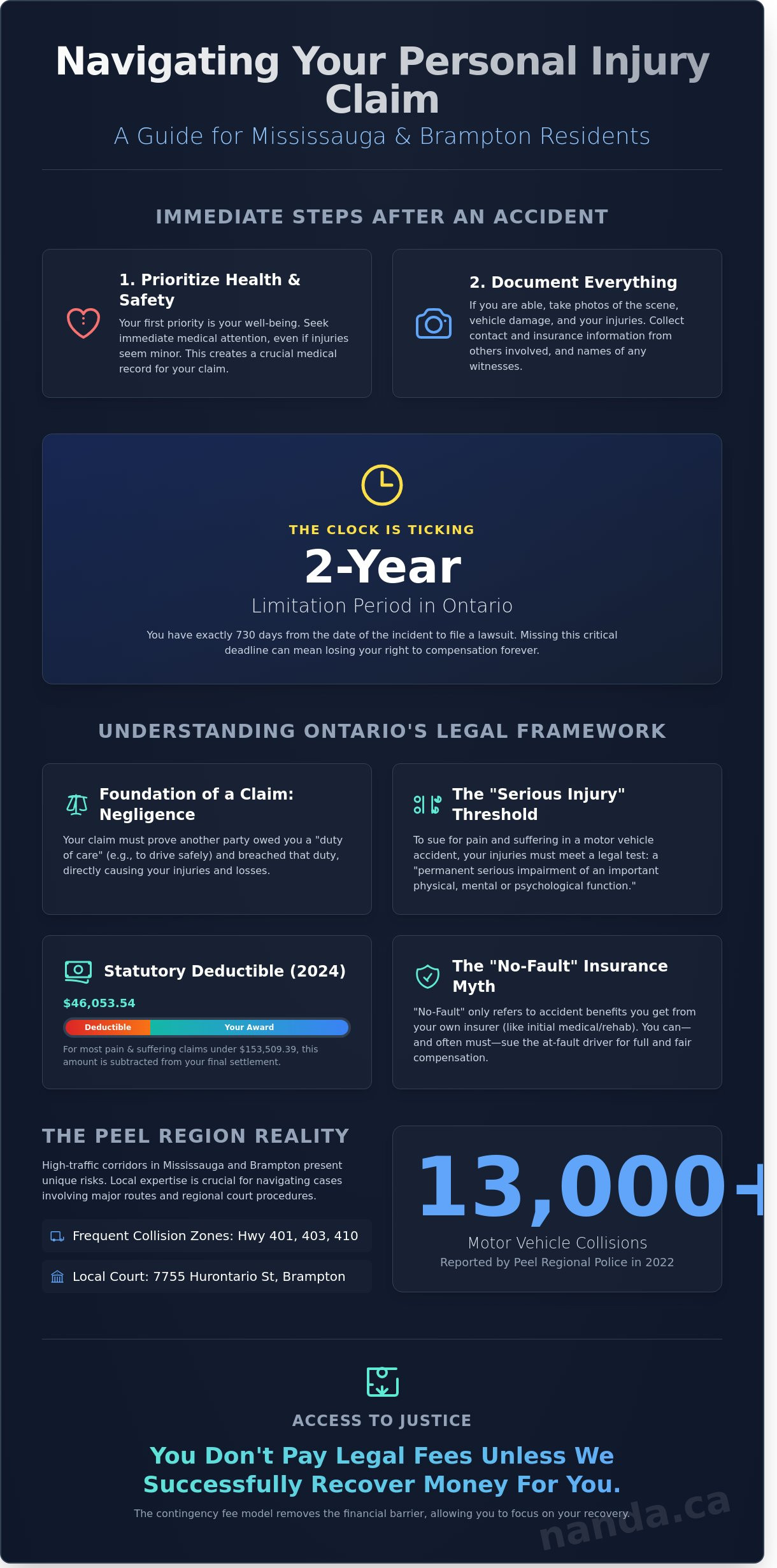
The Greater Toronto Area presents a unique set of risks for commuters and pedestrians alike. In Mississauga, high-traffic corridors like the 401, 403, and the 410 interchange are frequent sites of serious collisions. Peel Regional Police statistics from 2022 highlighted over 13,000 motor vehicle collisions in the region, illustrating the constant danger on our local roads. When these incidents occur, the initial shock can be paralyzing. Our role as a multidisciplinary firm is to provide comprehensive legal solutions that address every facet of your recovery, ensuring you aren’t left to face insurance companies alone.
Key Takeaways for Accident Victims
-
Prioritize Health and Evidence: Your first step must always be seeking medical attention. Once safe, try to capture photos of the scene and collect contact details from witnesses. These pieces of evidence are the foundation of any personal injury claim.
-
The Contingency Fee Model: Many people hesitate to call a lawyer because they worry about costs. We work on a contingency basis, meaning you don’t pay legal fees unless we successfully recover money for you. This removes the financial barrier to justice.
-
Local Representation: Having a team that knows the specific layout of Mississauga courts is a distinct advantage. It ensures your case is handled with an understanding of local judicial expectations.
Why Regional Expertise Matters in Peel
Navigating a personal injury claim in Peel Region involves more than just knowing the law. It requires a deep familiarity with local police reporting procedures at the various divisions in Mississauga. Whether your accident happened near Square One or closer to the Bramalea City Centre, the way evidence is gathered by local authorities impacts your case outcome. Our team understands these nuances and how to efficiently retrieve the documentation necessary to support your story.
The Ontario Superior Court of Justice has its own specific dynamics and procedural rhythms. A local personal injury lawyer understands these regional patterns, from the typical timelines for motions to the preferences of local judges. We also recognize the specific safety challenges of the region, such as the high-density trucking routes that define much of Mississauga’s industrial landscape. This local insight allows us to build a more persuasive argument tailored to the realities of the Peel Region’s roads and legal environment. We focus on providing the stability and peace of mind you need to focus on your physical rehabilitation while we handle the complexities of the litigation process.
Legal Explanation: The Framework of Ontario Personal Injury Law
A successful personal injury claim in Ontario rests on the foundation of negligence. To seek compensation, we must prove the defendant owed you a duty of care and breached that duty, directly causing your injuries. In Mississauga, this duty exists in many forms, such as a driver’s obligation to follow the Highway Traffic Act or a shop owner’s duty to keep their premises safe. The Supreme Court of Canada, in cases like Mustapha v. Culligan (2008), clarified that the harm must be a reasonably foreseeable consequence of the defendant’s actions. We analyze every detail of the incident to establish this link, ensuring the responsible party is held accountable for their lapse in judgment.
The Ontario Insurance Act introduces a complex layer for motor vehicle accidents known as the statutory threshold. You can’t sue for pain and suffering unless your injuries constitute a "permanent serious impairment of an important physical, mental or psychological function." This is a high bar that requires extensive medical evidence. Additionally, most claims for non-pecuniary damages are subject to a statutory deductible. For 2024, this deductible is C$46,053.54 for claims that don’t exceed C$153,509.39. These figures adjust annually for inflation, making it vital to have a clear understanding of how these numbers impact your net recovery.
Compensation is generally divided into special and general damages. Special damages are quantifiable economic losses, such as lost wages or medical bills supported by receipts. General damages cover non-monetary losses like pain, suffering, and loss of amenities. We work to ensure every expense, from immediate hospital parking fees to long-term therapy costs, is included in your claim. If you’re unsure how these rules apply to your specific situation, our team can help you understand the legal options available to you.
Relevant Ontario Legislation
The Occupiers’ Liability Act dictates how property owners in Mississauga must maintain their premises. Whether it’s a slip and fall at a local mall or a trip on a poorly maintained walkway, the owner must ensure the visitor is reasonably safe. Under the Negligence Act, Ontario applies the rule of contributory negligence. If a court finds you were 30% at fault for the accident, your total compensation is reduced by that percentage. Furthermore, the Compulsory Automobile Insurance Act mandates that all GTA drivers carry insurance, providing a framework for how claims are processed through the provincial no-fault system.
Understanding Damages and Compensation
Calculating lost earning capacity is a critical step for professionals working in the Mississauga business hub. If an injury prevents you from returning to a high-level corporate role, we calculate the total projected income lost over your remaining career years. Future care costs are equally significant, as they must cover decades of potential rehabilitation and home modifications. Our civil litigation lawyers are skilled at quantifying these non-pecuniary losses by gathering expert testimony and medical reports. Gaining a clear perspective on the Litigation Process in Peel Region allows you to move forward with the confidence that your long-term financial stability is being prioritized.
Timelines and the Litigation Process in Peel Region
Time is your most valuable asset after an accident. In Mississauga, the countdown starts the moment the incident occurs. Under Ontario’s Limitations Act, you generally have exactly two years from the date of your personal injury to commence legal action. Missing this 730-day window usually results in the total loss of your right to seek compensation. It’s a strict boundary that the courts rarely extend, which is why we emphasize early intervention. When you suffer a personal injury in Ontario, gathering evidence in those first few months can make the difference between a successful claim and a dismissed one.
Once the process begins, we enter the discovery phase. This involves an exhaustive exchange of every relevant document, from medical records to police reports. You’ll also participate in an examination for discovery. This is an oral session where the opposing lawyer asks questions under oath. It’s a methodical process designed to ensure both sides have 100% of the facts before moving forward. In the Peel Region, mediation is a mandatory hurdle before a case can proceed to a courtroom. Statistics from the Ministry of the Attorney General show that roughly 95% of civil cases in Ontario settle before reaching a judge. Mediation provides a structured, private environment to reach those settlements without the stress of a public trial.
If a fair settlement isn’t reached during mediation, the case proceeds to trial. This is a formal hearing where a judge or jury hears evidence and makes a final ruling on liability and damages. Trials in Peel can last anywhere from 5 days to several weeks. While they’re rare, preparing for one from the very first day ensures we’re always in a position of strength during negotiations.
Step-by-Step Claim Timeline
The journey begins with an initial consultation. We conduct a detailed assessment to review the merits of your case. Once we establish a solid foundation, we file the Statement of Claim to formally initiate the lawsuit. After being served, the defendant has a standard 20-day window under the Rules of Civil Procedure to file their response. If the defendant is located elsewhere in Canada or the United States, this window expands to 40 or 60 days respectively. We track these deadlines with rigorous precision to keep your case moving forward.
Local Procedural Nuances
Processing a claim in Peel involves specific local requirements. All formal documents are filed at the Courthouse. Local knowledge is vital because wait times for mediation dates in the Greater Toronto Area currently average 5 to 9 months depending on the complexity of the file and mediator availability. Trial dates can often be set 18 to 24 months into the future. It’s essential to work with a firm that manages lawsuits and litigation with local precision to avoid unnecessary administrative delays. We understand the specific rhythms of the court office, ensuring every filing meets the strict local standards required for a seamless progression of your file.
-
Filing Location: Courthouse.
-
Mandatory Step: Rule 24.1 requires mandatory mediation for all civil actions in Toronto, Ottawa, and Windsor; however, it’s a standard practice in Peel to facilitate faster resolutions.
-
Pre-Trial Conference: A meeting with a judge to discuss settlement possibilities roughly 3 to 6 months before the trial date.
Practical Advice: Navigating Insurance and Liability
Ontario’s "no-fault" insurance system is frequently misunderstood. Drivers often assume they can’t sue if they’re partially at fault. That’s a myth. In reality, the Insurance Act ensures that every person injured in a motor vehicle accident has access to basic benefits through their own provider, regardless of who caused the crash. However, this doesn’t prevent you from pursuing a tort claim against a negligent driver for pain, suffering, and excess economic losses. Under current Ontario regulations, you generally have only 7 days to notify your insurer of the accident and 30 days to complete the initial application for accident benefits. Missing these windows can jeopardize your claim.
When an insurance adjuster calls, remember their primary goal is to minimize the company’s financial exposure. They might ask for a recorded statement within 24 hours of the incident while you’re still in shock or under the influence of pain medication. It’s best to keep your answers brief. Stick to the basic facts of the date, time, and location. Don’t speculate on your recovery or the severity of your injuries. What feels like a minor ache today could evolve into a chronic condition six months from now.
Documenting your recovery journey is one of the most effective ways to support your personal injury claim. We recommend keeping a dedicated "Injury Diary" to track your progress. This should include:
-
Daily pain levels measured on a scale of 1 to 10.
-
Specific examples of activities you can no longer perform, such as lifting a 4-kilogram bag of groceries or playing with your children.
-
Dates of all medical appointments and the names of attending specialists.
-
A log of missed work hours and the specific reasons for your absence.
-
Notes on how the injury affects your mental health, including instances of anxiety or sleep disruption.
Personal injury law often intersects with other legal fields. If your injury happened at work, you might have to choose between Workplace Safety and Insurance Board (WSIB) benefits and a private lawsuit. Similarly, if you’re receiving Long-Term Disability (LTD) payments, your insurance policy might contain "offset" clauses that allow the provider to claw back money from your settlement. Understanding these overlaps is essential to maximizing your total recovery.
Dealing with Insurance Adjusters
You should never sign a final release or any document labeled "Full and Final" without a comprehensive legal review. These documents are permanent. Once signed, you waive your right to seek further compensation, even if your health declines. A personal injury lawyer in Mississauga acts as your shield, handling all correspondence and protecting you from aggressive tactics. We manage the complex balance between Statutory Accident Benefits (SABS) for immediate medical needs and the Tort claim that addresses your long-term losses.
If you’re feeling pressured by an insurance company to settle quickly, contact our legal team today for a professional evaluation of your case.
Long-Term Planning and Protection
A settlement isn’t just a cheque; it’s the foundation of your future stability. It’s vital to consider how these funds integrate with your wills and estate planning to protect your family. Large settlements may require a "structured" format, where you receive tax-free monthly payments for 20 years or more rather than a single lump sum. This protects the capital from being exhausted too quickly and ensures you have a reliable income stream to cover ongoing care costs and household expenses for the rest of your life.
The Nanda Approach: Comprehensive Legal Solutions
Recovering from a personal injury involves more than just physical healing; it requires a total restructuring of your daily life. At Nanda & Associate Lawyers, we don’t apply a one-size-fits-all template to your case. Our team provides personalized and strategic representation that addresses the specific nuances of your accident. We’ve seen how a sudden collision or slip and fall can disrupt a family’s financial foundation. Our role is to act as your shield, managing the aggressive tactics of insurance companies while you focus on rehabilitation. We transition our clients from a state of legal crisis into a future defined by stability and protection.
Mississauga is one of the most diverse cities in Canada, with over 50 percent of the population born outside the country. Communication shouldn’t be a barrier to justice. Our firm bridges this gap through a multilingual team capable of assisting clients in more than 15 languages, including Hindi, Punjabi, Gujarati, and Mandarin. This cultural competence allows us to explain the complexities of the Ontario legal system in the language you’re most comfortable using. By removing the stress of translation, we ensure you’re fully informed and empowered at every stage of your claim.
Our firm operates on a collaborative "Associate" model that distinguishes us from solo practitioners. When you retain our services, you aren’t just hiring one person; you’re gaining access to a powerhouse of collective knowledge. Our lawyers regularly consult with one another to brainstorm strategies and share insights on recent court rulings. This internal synergy means your personal injury case benefits from hundreds of years of combined legal experience. We leverage this shared expertise to build robust arguments that stand up to intense scrutiny in the courtroom.
Why Choose Nanda & Associate Lawyers?
Since 2003, we’ve served the Mississauga communities with a commitment to excellence. Our 21 year history in the Region of Peel has allowed us to build deep roots and a reputation for calm confidence. We offer a unique "One-Stop" benefit that few other firms can match. If your injury impacts your status in Canada, our team can handle related immigration or business issues alongside your primary claim. This holistic approach ensures that every facet of your legal life is protected under one roof. We maintain a steady, methodical rhythm in our work, ensuring no detail is overlooked during negotiations or litigation.
-
Over two decades of experience navigating Ontario’s judicial system.
-
Multidisciplinary support for business, real estate, and family law needs.
-
A track record of securing settlements that reflect the true cost of long-term care.
Your Next Steps Toward Recovery
Taking the first step toward a legal claim can feel daunting, but we’ve streamlined the process to make it as seamless as possible. To prepare for your initial consultation, please bring any police reports, medical records, and photographs of the accident scene. Our promise to you is simple: we don’t get paid unless we secure a settlement or win your case at trial. This contingency fee arrangement ensures that high-quality legal representation is accessible to everyone, regardless of their current financial situation. We take on the financial risk so you can pursue the compensation you deserve without upfront costs.
-
Collect all names and contact information of witnesses from the incident.
-
Keep a detailed log of your symptoms and how they affect your daily routine.
-
Save all receipts for out-of-pocket expenses related to your recovery.
Your rights have a shelf life due to strict limitation periods in Ontario. Waiting too long can permanently bar you from seeking compensation. We invite you to book a consultation today to discuss your case in a confidential, professional environment. Let our experienced team provide the clarity and peace of mind you need to move forward with confidence.
Secure Your Path to Recovery in Mississauga
Navigating the aftermath of an accident is a heavy burden, but you don’t have to face the legal system alone. Success in a personal injury claim depends on a clear understanding of Ontario’s strict litigation timelines and the specific procedural requirements of the Peel Region. By identifying liability early and managing insurance communications with precision, you protect your right to fair compensation and long term stability.
Nanda & Associate Lawyers has been serving Ontario since 2003, bringing a wealth of experience to every case we handle. Our diverse team offers multilingual services in 15+ languages, ensuring that communication is never a barrier to justice. Because we work on a contingency-based fee structure, you can focus on your physical recovery while we manage the legal complexities. It’s our mission to provide the comprehensive solutions and peace of mind you need during this stressful transition. Personal injuries often create ripple effects that extend beyond medical bills and lost wages, sometimes affecting family relationships and requiring the expertise of a family law firm Ontario residents trust to navigate complex custody arrangements or support modifications that arise when a parent’s earning capacity is permanently altered. Take the first step toward securing your future today. Book a Consultation with our Personal Injury Team to explore your legal options. You deserve a dedicated advocate who will fight for the resolution you’ve earned.
Frequently Asked Questions
How long do I have to file a personal injury claim in Mississauga?
You generally have two years from the date of your accident to start a personal injury lawsuit in Ontario. This deadline is established by the Limitations Act, 2002. If your accident involved a slip and fall on municipal property in Mississauga, you must provide written notice to the city within 10 days. Missing these specific windows often results in the permanent loss of your right to seek compensation.
What is the ‘deductible’ for pain and suffering awards in Ontario?
Ontario law applies a statutory deductible to most awards for pain and suffering resulting from motor vehicle accidents. For 2024, if your award for non-pecuniary general damages is C$154,439.33 or less, a deductible of C$46,332.33 is subtracted from your total. This amount increases every year on January 1 based on inflation. It means if a jury awards you C$50,000, you’ll only receive C$3,667.67 after the deduction.
Can I still claim if I was partially at fault for the accident?
You can still pursue a claim even if you’re partially responsible for the incident. Under the Negligence Act of Ontario, the court determines your percentage of fault and reduces your compensation accordingly. If you’re found 25% at fault for a crash and your total damages are C$100,000, you’ll receive C$75,000. We focus on gathering evidence to minimize your fault percentage and protect your settlement.
How much does a personal injury lawyer cost?
Most lawyers in this field work on a contingency fee basis. This means you don’t pay any legal fees upfront or during the litigation process. We only collect a fee if we successfully recover money for you through a settlement or court award. The fee is calculated as a percentage of the total amount recovered, ensuring legal representation is accessible regardless of your current financial situation.
What is the difference between a tort claim and accident benefits?
Accident benefits are "no-fault" payments provided by your own insurance company regardless of who caused the crash. These cover immediate needs like physiotherapy or income replacement. A tort claim is a separate lawsuit filed against the at-fault driver to recover damages not covered by benefits, such as pain and suffering or future loss of income. You must meet a specific threshold of permanent impairment to succeed in a tort claim for non-monetary losses.
How long does a typical personal injury lawsuit take to settle in Ontario?
A typical personal injury case in Ontario takes between 24 and 48 months to reach a resolution. The timeline depends heavily on your medical recovery and when you reach Maximum Medical Improvement (MMI). It’s vital not to settle too early, as you can’t reopen a case if your injuries worsen later. Complex cases involving catastrophic impairments often take longer to ensure all future care costs are accurately calculated. For those dealing with serious personal injuries in Mississauga, having a comprehensive legal checklist becomes essential to navigate the intricate requirements and deadlines that can significantly impact your settlement outcome. Additionally, when significant settlements are involved, it’s crucial to consider how these funds will be protected through proper wills and estates planning in Mississauga to ensure your family’s long-term financial security. When personal injuries result in long-term disabilities that affect family dynamics, working with an experienced family law firm Ontario residents rely on becomes crucial for addressing custody modifications or spousal support adjustments that may be necessary due to changed circumstances.
What if the person who hit me doesn’t have insurance?
You can still seek compensation through the Uninsured Automobile Coverage section of your own Ontario auto insurance policy. Every standard policy includes up to C$200,000 in coverage for accidents involving uninsured or unidentified hit and run drivers. If you don’t have your own insurance, the Motor Vehicle Accident Claims Fund (MVACF) acts as a last resort. This government fund provides a maximum of C$200,000 for all claims arising from a single accident.
Do I have to go to court for a personal injury claim?
It’s unlikely that you’ll need to step into a courtroom, as 95% of cases in Ontario settle before trial. Most claims are resolved through mandatory mediation or direct negotiations with the insurance company. You’ll likely attend an Examination for Discovery, where lawyers ask you questions about the accident under oath in a boardroom setting. Our team prepares you thoroughly for every stage to ensure you feel confident and supported. When dealing with serious personal injuries that require extensive documentation and evidence, proper preparation becomes even more critical to achieving a favorable outcome without the need for a lengthy trial process.
Disclaimer
This content is for general information only and does not constitute legal advice or create a lawyer-client relationship. Every case is different—please consult a qualified lawyer for advice specific to your situation.