


The threat of a power of sale is one of the most stressful situations a homeowner can face. The legal notices, the complex terminology, and the profound fear of losing your family home can be paralyzing. If you are a homeowner in this situation, it is crucial to understand that you are not alone and that there is effective power of sale Mississauga help available to guide you through this challenging period. The feeling of isolation and confusion is common, but it does not have to be your reality.
At Nanda & Associate Lawyers Professional Corporation, we believe that knowledge is the first step toward regaining control. That is why we have created this comprehensive homeowner’s guide. Here, we will demystify the power of sale process in Ontario, providing you with clear, actionable steps to navigate the path ahead. You will learn about critical timelines, your legal rights, and the strategic options that can help you protect your home and your financial future. Our aim is to replace uncertainty with confidence, empowering you to make informed decisions for your family.
Key Takeaways
- A Notice of Sale is the start of a legal process, not an immediate eviction, giving you a critical window to take action and protect your home.
- Discover the four primary strategic options you have to stop the proceedings, including how you may be able to reinstate your mortgage.
- Understand the step-by-step timeline in Ontario and learn the five crucial first steps you must take to safeguard your rights.
- Learn how seeking professional power of sale Mississauga help ensures your lender is acting legally and that your interests are protected at every stage.
Understanding the Power of Sale Notice You Received in Mississauga
Receiving a Notice of Sale Under Mortgage can be a deeply unsettling experience. The first and most important step is to take a breath. This legal document is the beginning of a process, not an immediate eviction order. It signifies your lender is exercising its contractual right to sell your property to recover an outstanding debt. If you are facing this situation and require power of sale Mississauga help, understanding the fundamentals of this process is your first step toward regaining control.
Essentially, a Power of Sale is a clause in your mortgage agreement that allows the lender to sell your home if you default on the loan. The key takeaway is that you have rights and a defined timeline to respond. The goal is to resolve the debt, and our team is here to provide the comprehensive legal solutions you need to navigate this challenge effectively.
Why This Happens and What it Means for You
A lender typically initiates a Power of Sale after a default has occurred. While this is a serious legal matter, knowing the common triggers can help clarify your position. These often include:
- Several missed mortgage payments
- Failure to pay property taxes or condominium fees
- Allowing the property to fall into significant disrepair
- Breaching another major clause (covenant) in your mortgage agreement
The notice you received starts a critical countdown. You have a specific period, known as the redemption period, to pay the outstanding amount and halt the process. It is crucial to act decisively within this timeframe, as your legal options are most effective when exercised early.
Power of Sale vs. Foreclosure in the Peel Region
In Ontario, it is vital to distinguish a Power of Sale from a Foreclosure. In a Power of Sale, you legally retain ownership (title) of the property until the sale is finalized. The lender sells the property on your behalf. Conversely, in a Foreclosure, the lender goes to court to take complete ownership of the property itself. For a detailed overview of this alternative process, you can refer to this resource for Understanding Foreclosure and its implications. Lenders in the GTA, including Mississauga and the Peel Region, overwhelmingly prefer the Power of Sale process because it is generally faster and less costly than a court-supervised foreclosure.
A significant and often overlooked aspect of a Power of Sale is your right to any surplus funds. After the lender sells the property and pays the mortgage debt, legal fees, and any other registered creditors, the remaining money legally belongs to you, the homeowner. This is a critical difference from a foreclosure, where the lender keeps any and all equity in the property.
The Power of Sale Process in Ontario: A Step-by-Step Timeline
Facing a power of sale can be an overwhelming experience, but the process is not immediate. It follows a structured, legal timeline governed by Ontario’s Mortgages Act. Understanding these stages is the first and most critical step toward taking control of the situation. Knowing what to expect empowers you to act decisively and seek the professional power of sale Mississauga help you need before your options become limited.
The process formally begins when your lender, after you have defaulted on your mortgage for at least 15 days, issues a formal notice. This marks the start of a critical period where your actions can determine the outcome.
The Notice and Your Redemption Period
The first document you will receive is a ‘Notice of Sale Under Mortgage’. This legal notice clearly states the total amount required to bring your mortgage back into good standing, which includes the principal in arrears, interest, and any legal costs incurred by the lender. This notice also triggers the ‘redemption period’-your most important window of opportunity. In Ontario, this period is typically between 35 and 45 days. During this time, you have the right to pay the specified amount and stop the power of sale entirely. It is crucial to explore all avenues, including speaking with your lender and reviewing government-sanctioned mortgage relief options, to find a viable solution.
What Happens if the Redemption Period Expires?
If the arrears are not paid by the deadline, the lender can proceed to the next stage. They will typically issue a ‘Statement of Claim’, a legal document filed in court that seeks both possession of your property and payment of the full outstanding mortgage balance. For homeowners in Mississauga, this claim is filed at the Superior Court of Justice in Brampton. Once a judgment for possession is granted, the lender has the legal right to take control of your home, change the locks, and prepare it for sale on the open market, often listing it on MLS.
The lender is obligated to sell the property for a fair market value. After the sale, the proceeds are used to pay off the mortgage, legal fees, and real estate commissions. If any funds remain, they are paid to you. However, if the sale price does not cover the total debt, you may still be personally liable for the shortfall.
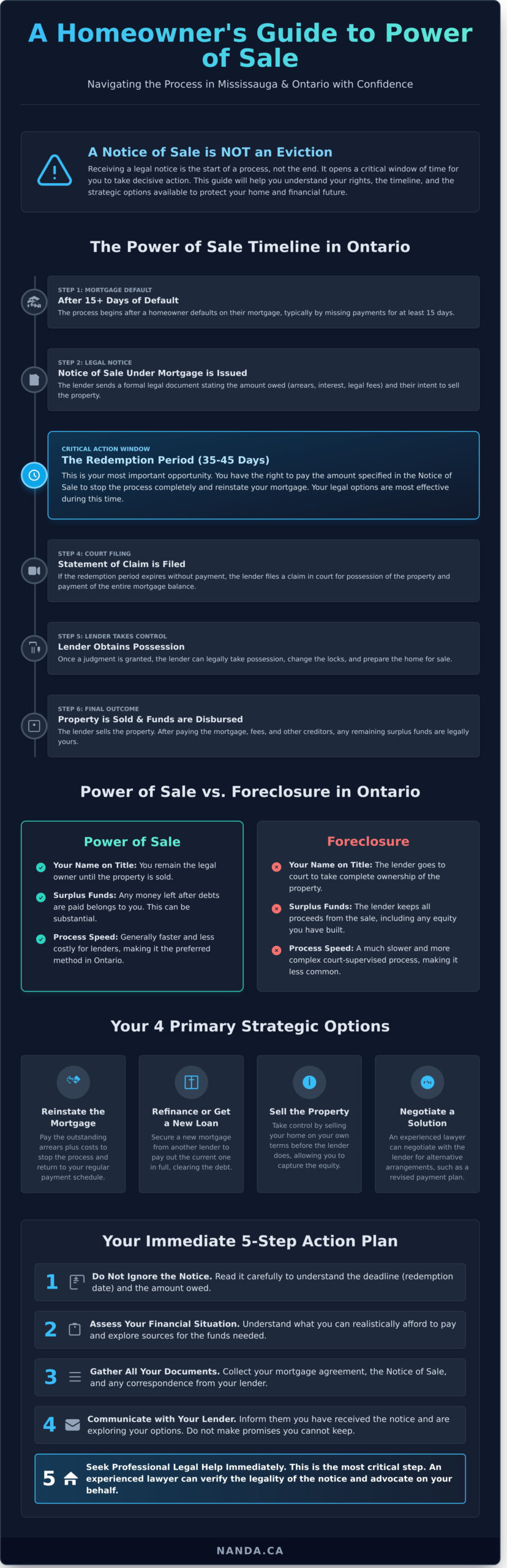
Your Strategic Options to Stop a Power of Sale in Mississauga
Receiving a Notice of Sale can feel overwhelming, but it is crucial to remember that you are not without recourse. The law provides homeowners with several strategic pathways to resolve the situation and protect their property. Understanding these options is the first step toward getting effective power of sale mississauga help and regaining control. At Nanda & Associate Lawyers, we guide our clients through four primary strategies:
- Reinstate the Mortgage: This involves paying the full amount of the arrears-the missed payments plus any legal fees incurred by the lender. Your right to reinstate the mortgage by paying all arrears is a powerful tool protected under specific provisions within Ontario’s Mortgages Act, and it can be exercised up until the property is sold.
- Refinance with a New Lender: You can seek a new mortgage from a different bank, credit union, or private lender. The funds from this new mortgage are used to pay off the entire balance owed to your current lender, effectively stopping the power of sale and giving you a fresh start.
- Sell the Property: By taking control and selling your home on the open market, you can often secure a much higher price than the lender would in a forced sale. This allows you to pay off the mortgage and retain any remaining equity.
- Negotiate a New Payment Plan: You can proactively approach your lender to negotiate a revised payment schedule or a temporary deferral. A well-structured proposal can be a viable solution.
Refinancing or Selling Your Mississauga Property
Taking proactive steps to either refinance or sell your property puts you in the driver’s seat. Selling the home yourself, particularly in the strong and competitive Mississauga real estate market, almost always yields a better financial outcome than a lender-managed sale. This maximizes your equity. Alternatively, refinancing provides the necessary capital to clear the debt with your current lender, stop the legal proceedings, and establish a more manageable mortgage arrangement for your future.
If you are exploring the option of selling your home to resolve the situation, you can learn more about how a real estate professional can assist in maximizing your equity.
Negotiating with Your Lender
Lenders are often more willing to negotiate than homeowners might assume. The power of sale process is costly and time-consuming for them, and they may prefer to find a mutually agreeable solution. However, any verbal agreement is not enough. It is essential to have a lawyer formalize a new payment plan or forbearance agreement to ensure it is legally binding and protects your interests. Our team can help you negotiate from a position of strength. Explore your legal options with a free consultation.
Your Immediate Action Plan: 5 Steps to Take Right Now
Receiving a Notice of Sale is an overwhelming experience. It is normal to feel stressed and uncertain, but inaction is the most significant risk you face. To regain control, focus on these five concrete steps. This structured approach provides the clarity and direction needed to protect your home and your financial future.
- Do Not Ignore the Notice: This is the most critical first step. The Notice of Sale is a legal document with a strict timeline. Read it carefully to identify the redemption date-the deadline by which you must pay the arrears-and the total amount the lender claims is owed. Understanding these details is essential for formulating a strategy.
- Gather Your Documents: Organization is your ally. Collect all relevant paperwork in one place, including your original mortgage agreement, any amending agreements, the Notice of Sale, and recent financial statements such as pay stubs and bank records.
- Assess Your Financial Situation: Conduct an honest and thorough review of your finances. Calculate your total debt, income, and expenses. This clear financial picture will help your legal counsel determine the most viable options, whether that involves negotiating a repayment plan, refinancing, or arranging a private sale.
- Contact a Real Estate Lawyer Immediately: Time is not on your side. The moment you receive a notice, you should seek professional power of sale Mississauga help. An experienced lawyer can immediately assess your situation, verify the lender’s claims, and advise you on all available legal remedies.
- Do Not Sign Anything from Your Lender: Your lender may send you forbearance agreements or other documents. Do not sign anything without having it reviewed by your lawyer. You could unknowingly waive important legal rights or agree to unfavourable terms.
Why Legal Counsel is Not a Cost, But an Investment
Many homeowners hesitate to hire a lawyer due to perceived costs. However, this perspective overlooks the substantial value at stake. Your home equity, often worth hundreds of thousands of dollars, is your primary asset. A lawyer’s fee is a small investment to protect it. Our legal team will meticulously verify the lender’s calculations, ensure the entire process is legally compliant, and act as your dedicated advocate, creating a professional buffer between you and the lender’s representatives.
Preparing for Your Legal Consultation
To make your first meeting as productive as possible, please come prepared. Bring the Notice of Sale, your original mortgage agreement, and any other correspondence from your lender. It is also helpful to write down a list of your questions and concerns ahead of time. Being ready to discuss your financial situation openly will allow us to provide tailored and effective power of sale Mississauga help from the very start. For comprehensive legal solutions, contact our team at Nanda & Associate Lawyers today.
How Nanda & Associate Lawyers Can Help You in Mississauga
Facing a notice of sale is an incredibly stressful experience, but you do not have to navigate it alone. At Nanda & Associate Lawyers, our primary goal is to protect your home, your financial interests, and your peace of mind. When you need professional power of sale Mississauga help, our legal team acts with precision and urgency. We begin with an immediate and thorough review of your case, scrutinizing every document and action taken by the lender to ensure they are operating strictly within the bounds of Ontario law.
From the moment you retain our services, we become your dedicated advocates. We lift the immense burden of dealing with the lender by taking over all communications on your behalf. Our team of skilled negotiators explores every possible strategic option to resolve the situation favourably. This can range from renegotiating the terms of your mortgage to provide you with manageable repayment options, to facilitating a private sale of your property that allows you to retain maximum equity and control over the process.
Our Expertise in Mississauga Real Estate Litigation
Our firm’s strength lies in our profound understanding of property law and our extensive experience within the Mississauga legal landscape. We provide strategic, results-oriented representation grounded in years of successfully helping homeowners. Our approach includes:
- Deep Legal Knowledge: A comprehensive command of the Ontario Mortgages Act and its strict procedural requirements, which we leverage to protect your rights.
- Proven Negotiation Skills: Extensive experience negotiating with all major Canadian banks, credit unions, and private lenders to achieve workable solutions for our clients.
- Clear Strategy: A commitment to providing you with a clear, understandable legal strategy and keeping you fully informed at every stage of the process.
Take the First Step to Regain Control
In a power of sale proceeding, time is of the essence. The sooner you seek qualified legal counsel, the more strategic options are available to protect your property and your future. Our Mississauga office is here to provide immediate, confidential advice to help you understand your rights and the next steps. You have a dedicated team ready to stand with you. To get the expert power of sale Mississauga help you need, we invite you to contact our team at Nanda & Associate Lawyers today.
Secure Your Home and Your Future with Expert Legal Guidance
Receiving a Notice of Sale Under Mortgage can be incredibly stressful, but it is not the final word. The most critical takeaways from this guide are that you have defined legal rights and that swift, strategic action can halt the process. Understanding your options is the first step toward regaining control. You do not have to navigate this complex situation alone; professional power of sale mississauga help is available to protect your interests and your most valuable asset.
At Nanda & Associate Lawyers, we have been providing comprehensive legal solutions to homeowners in the Mississauga community since 2003. Our team possesses deep expertise in Ontario real estate litigation and is committed to finding the best possible outcome for you. With multilingual services available for our diverse community, we ensure clear communication and compassionate representation. Do not delay in securing the support you deserve. Contact our Mississauga Power of Sale lawyers for immediate, confidential help.
Taking this decisive step today can secure your home and provide the peace of mind you need for the future.
Frequently Asked Questions About Power of Sale
How long does a power of sale take in Ontario?
The power of sale process in Ontario follows a legislated timeline. After a mortgage default, the lender issues a Notice of Sale, which provides a redemption period of at least 35 days. During this time, you can pay the outstanding arrears to stop the process. If the debt is not settled, the lender can proceed with selling the property. The entire process, from the initial notice to a final sale, typically takes several months, depending on the specific circumstances of the case.
Can I stop a power of sale after the redemption period ends?
Yes, it is possible to stop the process even after the redemption period expires. You retain the right to redeem your mortgage by paying the full outstanding balance-including principal, interest, and all legal costs-at any point before the lender enters into a binding Agreement of Purchase and Sale with a new buyer. This requires immediate action, and securing professional legal representation is critical to navigating this complex stage and protecting your home from being sold.
What happens to the equity in my home after a power of sale?
After your home is sold, the lender uses the proceeds to pay the outstanding mortgage balance, their legal fees, real estate commissions, and any other associated costs. Any remaining funds, which represent your home’s equity, must be paid to you. The lender is legally required to provide you with a detailed accounting of all transactions. If the sale proceeds are insufficient to cover all debts and costs, you may still be legally responsible for the shortfall.
Will a power of sale ruin my credit score in Canada?
A power of sale has a severe and long-lasting negative impact on your credit score. It is reported to Canadian credit bureaus like Equifax and TransUnion as a serious delinquency, often noted as a repossession. This mark can lower your score significantly and will typically remain on your credit report for up to seven years. This makes it extremely difficult to qualify for future mortgages, loans, or other forms of credit, underscoring the importance of preventing the sale from completing.
What are the costs I will be responsible for in a power of sale?
As the homeowner, you are responsible for all costs the lender incurs to sell the property. These expenses are deducted from the sale proceeds before you receive any equity. Common costs include the lender’s legal fees, property appraisal fees, real estate agent commissions, property management and maintenance fees, and repair costs. Seeking expert power of sale Mississauga help early in the process is vital to minimize these costs and protect your financial interests.
Can my lender lock me out of my house during a power of sale?
A lender cannot simply lock you out without following the proper legal process. Once the redemption period ends, the lender can obtain a court order for vacant possession of the property, which legally obligates you to leave. This is often done to make the home easier to show and sell. If you receive any notice demanding you vacate the property, it is imperative to contact a lawyer immediately to understand your rights and the legal timelines involved.
Is it better to sell my house myself than let the bank sell it?
In nearly all cases, it is far better to sell your house yourself. Selling the property on your own terms gives you control over the listing price and marketing, which often results in a higher sale price and protects more of your equity. It also allows you to avoid paying for the lender’s extensive legal and administrative costs. A proactive sale is less damaging to your credit history and provides a much better financial outcome than a forced power of sale.
How much does a lawyer cost for a power of sale issue in Mississauga?
Legal costs for a power of sale matter in Mississauga vary depending on the complexity of your situation and the services required. A straightforward negotiation may involve a flat fee, while more complex litigation would likely be billed at an hourly rate. At Nanda & Associate Lawyers, we provide a transparent fee structure after an initial consultation. Investing in timely legal advice often proves to be a fraction of the cost of losing your home’s equity.