


Imagine sitting in your Mississauga home three weeks after a funeral, only to realize that a single oversight in calculating the Estate Administration Tax could leave you personally liable for thousands of dollars. It’s a heavy burden to carry, and it’s exactly why many executors seek the guidance of a professional probate lawyer to manage the complexities of the Ontario Superior Court of Justice. You likely feel a deep sense of responsibility to honor your loved one’s legacy, but the constant worry about beneficiary disputes or missed tax deadlines can make the process feel overwhelming.
We understand the pressure you’re under. You deserve to manage this transition with confidence, knowing that your personal assets are protected. In this guide, we’ll walk you through the essential legal steps to obtain your Certificate of Appointment of Estate Trustee without unnecessary delays. You’ll learn how to handle the 1.5 percent tax rate on estates valued over C$50,000 and ensure every debt is paid correctly so you can distribute assets with total peace of mind. We’ll also cover how to mitigate family conflicts before they escalate into litigation.
Key Takeaways
- Understand the essential transition from Executor to Estate Trustee and how the Ontario court system validates a Will to begin the formal administration process.
- Learn how to identify and mitigate the risks of personal liability for estate debts and taxes while fulfilling your fiduciary duties to beneficiaries and creditors.
- Discover when a Certificate of Appointment is mandatory and how an experienced probate lawyer can streamline the complex drafting of your court application.
- Explore effective strategies for resolving estate litigation and identify the common legal grounds for challenging a Will in Ontario to protect a loved one’s legacy.
- Gain peace of mind by leveraging a multilingual and culturally aware legal team dedicated to providing comprehensive estate solutions for Mississauga’s diverse community.
Understanding Probate and Estate Administration in Mississauga
Probate serves as the formal judicial process used to validate a deceased person’s last Will and testament through the provincial court system. For Mississauga families, this procedure ensures that the document presented is indeed the final expression of the deceased’s wishes and that the person applying for authority has the legal right to manage the assets. If you’re looking for a foundational definition of how these proceedings work globally, understanding What is Probate helps clarify how the court supervises the transfer of wealth. We recognize that this period is often marked by grief; our role is to provide the steady, methodical guidance required to navigate these requirements with dignity.
Ontario’s legal vocabulary has evolved to reflect a more precise understanding of fiduciary duties. While many people still use the term “Executor,” the Rules of Civil Procedure now refer to this individual as an “Estate Trustee.” This change emphasizes that the person managing the assets holds them in trust for the beneficiaries rather than owning them outright. Whether named in a Will or appointed by the court, an Estate Trustee carries significant legal liability. A seasoned probate lawyer helps these individuals manage their responsibilities while protecting them from personal exposure or claims of negligence.
Residents in Mississauga fall under the specific jurisdiction of the Ontario Superior Court of Justice located in the Peel Region. Most local applications are processed through the courthouse at 7755 Hurontario Street in Brampton. This court verifies the Will’s authenticity and ensures that all potential heirs have received proper notice of the proceedings. Our firm frequently interacts with this specific court branch, providing us with a practical understanding of local filing preferences and timelines.
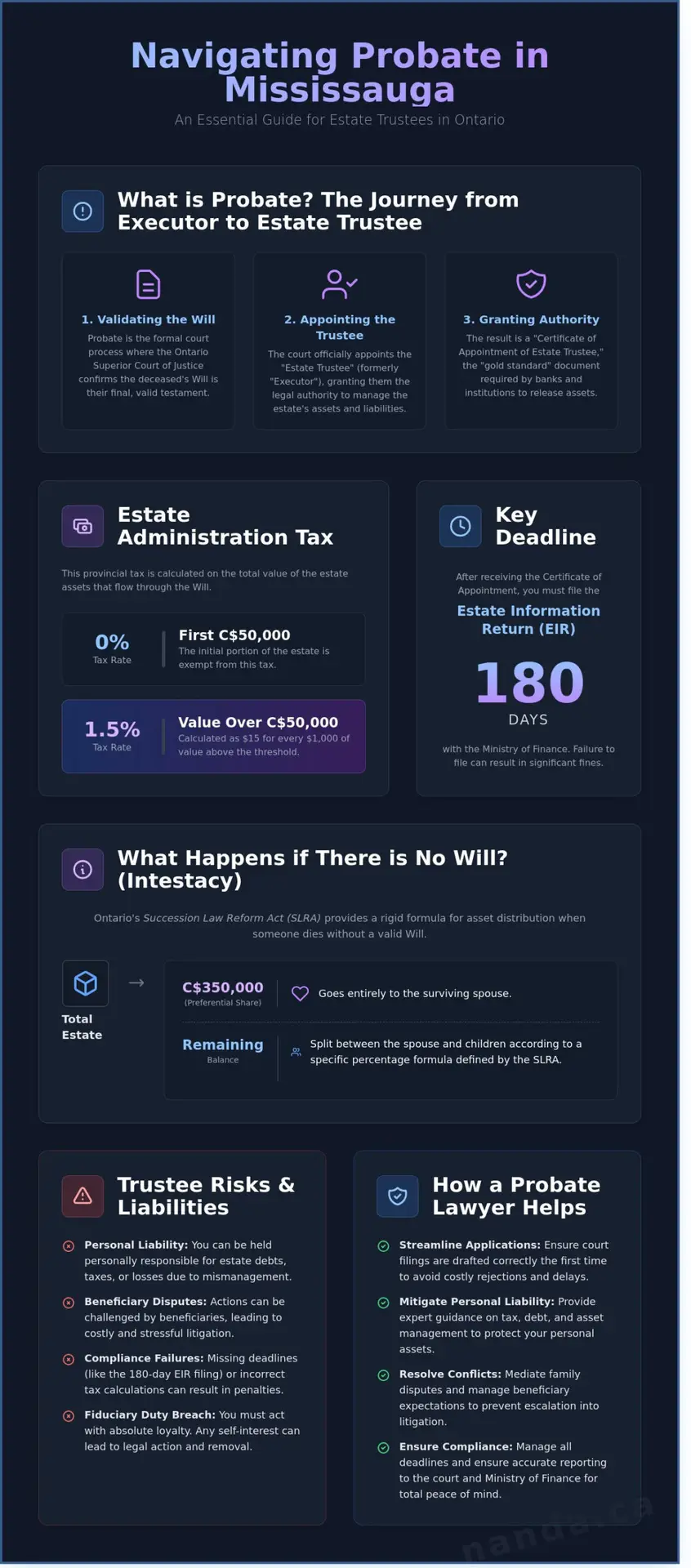
Obtaining the Certificate of Appointment of Estate Trustee is the central goal of the application process. Financial institutions, insurance companies, and the Land Registry Office typically demand this certificate before they allow the transfer of bank accounts or real estate titles. It acts as the “gold standard” of authority. Engaging a probate lawyer ensures that the application is prepared correctly the first time, preventing the delays that often occur when court registrars reject incomplete or inaccurate filings.
The Legal Framework: Succession Law Reform Act (SLRA)
The Succession Law Reform Act (SLRA) dictates how property moves from one generation to the next in Ontario. When a resident dies “intestate,” meaning without a valid Will, the SLRA provides a rigid hierarchy for distribution. For instance, the first C$350,000 of the estate, known as the “preferential share,” goes to the surviving spouse if the death occurred after January 1, 2021. Any remaining balance is split between the spouse and children according to specific percentages. We help families understand these legislative defaults to ensure no beneficiary is overlooked during the administration process.
Estate Administration Tax (EATR) in Ontario
Tax obligations, specifically the Estate Administration Tax, apply to most estates that require court validation. Once the court issues the Certificate of Appointment, the Estate Trustee must file an Estate Information Return (EIR) with the Ministry of Finance. This document requires a detailed inventory of all assets owned at the time of death, from real estate to investment portfolios. You must submit this return within 180 days of receiving the certificate. Failure to meet this deadline or providing inaccurate data can lead to significant fines. Our team ensures these filings are meticulous and timely to maintain your peace of mind.
The Legal Responsibilities and Liabilities of an Ontario Estate Trustee
Accepting the role of an Estate Trustee, formerly known as an executor, carries significant weight under Ontario law. You’re stepping into a fiduciary role, which is the highest standard of care recognized by our legal system. This means you must act with absolute loyalty and honesty, putting the interests of the beneficiaries and creditors ahead of your own. Under the Ontario Estates Act, your primary obligation is to protect the estate’s value while ensuring all legal debts are satisfied before a single dollar is distributed to heirs.
Personal liability is a very real threat for those who rush the process. If you distribute assets to beneficiaries and the Canada Revenue Agency (CRA) later determines the estate owes back taxes, you could be held personally responsible for that debt. This risk extends to unpaid creditors as well. In 2023, estate litigation cases in Ontario saw a rise in claims against trustees who failed to account for obscure debts or missed tax filing deadlines. Working with an experienced probate lawyer allows you to identify these pitfalls early, ensuring you don’t use your own savings to pay for the deceased’s liabilities.
Creating a comprehensive inventory is your first major hurdle. You’re required to identify and value every asset the deceased owned, from a family home in the Creditview neighborhood to global investment accounts or vacation properties in the Caribbean. You’ll need to document bank accounts, life insurance policies, and physical belongings. This inventory forms the basis of the Estate Administration Tax (probate tax) calculation, which is roughly 1.5% of the estate’s value over C$50,000. Accuracy here isn’t optional; the Ministry of Finance has four years to audit your filings and can impose heavy penalties for underreporting.
Ontario courts generally recognize the “Executor’s Year” as a standard guideline for settling an estate. This 365-day window starts from the date of death and gives you time to realize assets and pay debts without pressure from beneficiaries. While complex estates often take longer, especially those involving foreign jurisdictions, missing this window without a valid reason can lead to beneficiaries seeking a court order to remove you. Our team at Nanda & Associate Lawyers Professional Corporation can help you establish a structured timeline to meet these milestones efficiently.
Protecting the Estate Trustee from Personal Liability
To shield yourself from surprise claims, you should place a Notice to Creditors in a local Mississauga publication and online platforms. This 30-day notice period protects you from personal liability if a creditor emerges after the assets are distributed. Additionally, seeking a formal “Passing of Accounts” provides a court-approved seal on your financial management. When you follow the advice of legal counsel, you’re held to a “standard of care” defense; showing you acted reasonably and prudently based on professional guidance is your best protection against disgruntled beneficiaries.
Managing Diverse and Complex Assets
Mississauga’s diverse economy means many estates involve private corporate shares or family-run businesses. Since 98% of Ontario businesses are classified as small or medium-sized, handling these requires specific knowledge of shareholder agreements and tax elections. You must also account for digital assets, including cryptocurrency wallets and monetized social media accounts, which often lack physical documentation. Professional appraisals are mandatory for unique items like jewelry, art, or classic cars to ensure the “fair market value” reported to the court is defensible. Consulting with a probate lawyer helps ensure these complex valuations meet the strict requirements of the Ontario Superior Court of Justice.
Determining if Probate is Required for a Mississauga Estate
Determining if probate is required involves looking at how assets are titled and their total value. Most financial institutions in Ontario won’t release funds from accounts exceeding C$50,000 without a court-issued Certificate of Appointment of Estate Trustee. They enforce this policy to protect themselves from liability and ensure they’re paying the correct legal representative. If you’re unsure if your specific situation requires court intervention, consulting a probate lawyer can clarify your obligations under the Estates Act and the Succession Law Reform Act.
The Small Estate threshold is a vital piece of legislation for many Mississauga families. As of April 1, 2021, estates valued at C$50,000 or less qualify for a simplified procedure. This process involves a shorter application form and faster processing times, which reduces the administrative burden on executors. You can find more details on these specific requirements in the Guide to Administering Estates in Ontario.
Joint ownership with a right of survivorship often allows assets to bypass the probate process entirely. When a spouse passes away, the surviving partner usually takes full ownership of a joint bank account or a primary residence without needing court approval. We often see this provide immediate financial relief to grieving families because these funds aren’t frozen during the legal transition. However, it’s essential to distinguish between true joint ownership and assets held in trust, as the latter might still require court validation.
Real Estate and the “Land Titles” Requirement
Mississauga real estate almost always triggers the need for probate. Most land in the city is registered under the Land Titles system, which demands a court certificate to change the owner’s name on a deed after a death. A rare “First Dealings” exemption exists for properties held by the deceased since before the mid-1990s conversion of the registry. Our real estate lawyers in Mississauga assist families in verifying these titles to determine if a simpler transfer is available. If the property doesn’t qualify for this exemption, a probate lawyer must secure the necessary court grant before the home can be sold or transferred to an heir.
Assets That Bypass the Probate Process
Certain assets are classified as “Non-Estate Assets” and don’t count toward the probate tax calculation. These assets move directly to the recipient based on contract law rather than the instructions in a will.
- Life Insurance: Proceeds go directly to the named individual, often within weeks of the claim.
- Registered Accounts: RRSPs, RRIFs, and TFSAs with designated successors or beneficiaries pass outside the estate.
- Pensions: Many workplace pension plans include survivor benefits that bypass the court system.
Keeping these designations updated is a critical part of estate planning. If a beneficiary isn’t named, or if the estate is named as the beneficiary, the asset becomes an “Estate Asset” and becomes subject to the 1.5% Estate Administration Tax on values over C$50,000.
Resolving Estate Litigation and Probate Disputes in Ontario
Disputes over a loved one’s final wishes often arise during the most vulnerable moments of grief. The most frequent question we hear at our Mississauga office is whether these conflicts can be resolved without a judge. The answer is yes. In fact, roughly 90% of estate disputes in Ontario settle through mediation or mandatory settlement conferences before reaching a full trial. This approach saves families significant time and emotional exhaustion. When a peaceful resolution isn’t possible, we rely on the Ontario Rules of Civil Procedure to provide a structured path for litigation. These rules ensure transparency during the discovery phase, allowing your probate lawyer to request essential evidence, such as:
- Medical records from the date the Will was signed
- Financial statements showing unusual asset transfers
- Previous versions of the Will for comparison
- Correspondence between the deceased and the drafting lawyer
This methodical process helps clarify the facts before any court appearance, often leading to a settlement that respects the family’s privacy and legacy. Our civil litigation lawyers advocate for beneficiaries whose rights have been compromised. Whether it’s an executor failing to distribute assets or a suspicious last-minute change to a document, we provide the calm, strategic representation needed to protect your interests. We don’t just look at the paperwork; we examine the circumstances surrounding the estate to ensure the deceased’s true intentions are honored. If you’re facing an unfair situation, consult with our Mississauga legal team to explore your options. Our firm brings a diverse, multilingual perspective to these sensitive cases, ensuring every client feels heard throughout the complex litigation process.
Common Grounds for Will Challenges
Challenging a Will requires specific legal standing. In Mississauga, many cases hinge on testamentary capacity or undue influence, where a caregiver pressured the deceased. A Will is also void if it fails Section 12 of the SLRA regarding proper witnessing. Your probate lawyer will review these technical details to determine if the document stands up to legal scrutiny and ensure the deceased’s true intentions are protected.
Dependant Support Claims
Under Part V of the SLRA, spouses and children can file a claim if a Will lacks “adequate provision.” You have a strict six-month window from the date probate is granted to file. Missing this deadline often bars you from seeking support. We’ve helped many families navigate these claims since the 2021 legislative updates, ensuring dependents receive the financial stability they deserve under Ontario law.
How a Mississauga Probate Lawyer Streamlines the Process
The transition of assets after a loss involves a rigorous legal framework governed by the Estates Act and the Succession Law Reform Act. In a city as diverse as Mississauga, where 53% of the population was born outside of Canada according to 2021 Census data, legal needs often cross cultural and linguistic boundaries. Our firm recognizes that clear communication is the foundation of trust. By offering a multilingual legal team, we ensure that every family member understands their rights and obligations without the risk of misinterpretation. This inclusivity is vital when explaining the nuances of Ontario law to international beneficiaries or executors who may be unfamiliar with local probate requirements.
One of the most technical hurdles in estate settlement is drafting the application for the Certificate of Appointment of Estate Trustee. A probate lawyer from our team meticulously prepares these court filings to prevent the administrative rejections that often plague self-represented executors. Errors in these documents can stall the distribution of assets for six to ten months; a delay that most families cannot afford. We handle the exhaustive inventory of assets and the calculation of Estate Administration Tax, ensuring the Ontario Superior Court of Justice receives a precise and professional application from the start.
Emotions often run high during family meetings, especially when significant assets or sentimental items are at stake. We act as a neutral mediator in these high-pressure environments. Our presence provides a buffer that keeps conversations focused on the legal realities of the Will rather than personal grievances. By involving wills and estate lawyers in Mississauga early in the process, executors can mitigate the risk of litigation. We provide the objective perspective needed to resolve disputes before they escalate into costly court battles that could deplete the estate’s value.
Strategic Estate Administration
Effective administration requires a multidisciplinary approach. We coordinate directly with tax professionals and accountants to ensure the final T1 return and any necessary T3 Trust returns are filed by the Canada Revenue Agency deadlines. Our team oversees the “Passing of Accounts” process under the Estates Act, providing a transparent ledger of all receipts and disbursements. Before the final distribution of funds, we secure formal beneficiary releases to protect the executor from future personal liability.
The Nanda & Associate Advantage
With over 30 years of collective experience navigating the Mississauga legal landscape, Nanda & Associate Lawyers offers a sophisticated “one-stop” solution. Because our firm also excels in real estate and business law, we seamlessly manage the sale of primary residences or the complex transfer of corporate shares held within an estate. This integrated expertise means you don’t have to hire three different firms to settle one estate. We provide a cohesive strategy that prioritizes the stability of your family’s financial future.
If you’re ready to ensure your estate is handled with the professional gravity it deserves, we’re here to help. Contact us today to secure the peace of mind that comes with expert legal guidance.
Take Control of Your Estate Administration Today
Managing an estate in Ontario involves strict adherence to the Estates Act and careful navigation of potential litigation. It’s a role that carries significant legal weight, as trustees face personal liability for errors in distribution or tax filings. You don’t have to carry this burden alone. Our team at Nanda & Associate Lawyers has served the Mississauga community since 2003, providing the steady hand needed to resolve disputes and process applications efficiently. We offer comprehensive expertise in both administration and litigation, providing multilingual support in over 15 languages to ensure every family member understands the process clearly. Whether you’re just starting the probate application or facing a complex challenge in court, a skilled probate lawyer provides the clarity and protection your family deserves. We’re here to turn a stressful transition into a manageable, structured path forward that protects your legacy.
Book a Consultation with a Mississauga Probate Lawyer
Frequently Asked Questions
How long does the probate process take in Mississauga?
The probate process in Mississauga typically takes between 6 and 12 weeks for the court to issue a Certificate of Appointment of Estate Trustee. Total estate administration often spans 12 to 18 months depending on the complexity of the assets involved. Processing times fluctuate based on the current caseload at the Superior Court of Justice in Brampton. We help clients navigate these timelines by ensuring all documents are filed correctly the first time to avoid unnecessary delays.
Can I be held personally liable if I am the executor of a Will?
You can be held personally liable for financial losses or errors made during the administration of an estate. Under the Trustee Act, an executor is responsible for paying debts, filing tax returns, and distributing assets according to the law. If you distribute funds before settling all liabilities, creditors can pursue your personal assets. Consulting a probate lawyer provides a protective layer of guidance to ensure you meet your fiduciary duties without risking your own financial security.
What are the costs associated with probate in Ontario?
Ontario charges an Estate Administration Tax based on the total value of the deceased person’s assets. Since January 1, 2020, estates valued at C$50,000 or less don’t pay any tax. For estates exceeding C$50,000, the rate is C$15 for every C$1,000 of value. You must also account for professional fees and court filing costs. We assist in calculating these figures accurately to ensure full compliance with the Ministry of Finance while providing peace of mind during a difficult time.
Do I need probate if the deceased had a small estate in Mississauga?
You might still need probate for a small estate if a bank or the Land Registry Office requires a court certificate to release assets. However, Ontario introduced a simplified Small Estate Certificate process in April 2021 for estates valued at C$150,000 or less. This streamlined procedure reduces the paperwork and time required for smaller files in Mississauga. We can help you determine if your specific situation qualifies for this faster and more efficient alternative.
Can a Will be challenged if it was signed just before death?
A Will can be challenged if there are concerns regarding the deceased’s mental capacity or if they were pressured into signing it. Ontario courts look for testamentary capacity, meaning the person understood the nature of their assets and the impact of the document. If a Will is signed shortly before death, it often triggers suspicious circumstances investigations. Our team provides robust representation in cases where the validity of a document is in question to ensure the true intentions of the deceased are respected.
What happens to a Mississauga property if the owner dies without a Will?
If a property owner dies without a Will in Mississauga, their estate is distributed according to the Succession Law Reform Act. This is called intestacy. The law provides a preferential share to a surviving spouse, which was increased to C$350,000 for deaths occurring after March 1, 2021. Anything remaining is split between the spouse and children. This rigid legal formula doesn’t account for your personal wishes or specific family dynamics, which is why proactive planning is so vital.
Is an Estate Trustee required to live in Ontario?
An Estate Trustee isn’t required to live in Ontario, but being a non-resident can create significant logistical and legal hurdles. If the executor lives outside of Canada or the Commonwealth, the court might require them to post a bond as financial security for the estate. This can be a costly and complicated process. We often suggest appointing a local co-executor or seeking legal advice to manage the complexities of cross-border estate administration effectively and seamlessly.
How do I remove an executor who is not doing their job?
Removing an executor requires a court order from the Superior Court of Justice under Section 37 of the Trustee Act. You must prove that the executor is unfit for the role due to a conflict of interest, serious misconduct, or a total failure to act. The court doesn’t take this step lightly and requires clear evidence of a breach of fiduciary duty. Working with a probate lawyer is essential to build a persuasive case and protect the estate’s remaining assets for the rightful beneficiaries.