




On November 12, 2025, a homeowner in Mississauga discovered an unauthorized C$15,000 lien registered against their title just days before their scheduled closing. It’s a chilling reminder that real estate law involves much more than just signing papers; it’s about rigorous due diligence and proactive protection. We understand that the pressure of meeting strict Ontario closing timelines while worrying about title fraud or hidden costs can make any property transaction feel incredibly stressful. You likely believe that a clear title should be a given, yet the reality of modern property markets requires a more vigilant approach.
We’re here to ensure your property transition is handled with the professional precision it deserves. This guide promises to help you master the complexities of provincial regulations so you can protect your Mississauga investments and enjoy total peace of mind. You’ll learn how to calculate land transfer taxes accurately, avoid common closing pitfalls, and secure a legally sound transfer of ownership under the Land Titles Act. We’ll provide the clarity you need to move forward with confidence.
Key Takeaways
-
Understand how the transition to the 100% Electronic Land Registration System (ELRS) under the Ontario Land Registration Reform Act streamlines property transactions in the Peel Region.
-
Learn why establishing a "clear title" and adhering to the Ontario Planning Act are essential legal pillars for securing your property usage and subdivision rights.
-
Discover how title insurance serves as a critical shield against modern risks like title fraud, survey errors, and outstanding municipal work orders in the 2026 market.
-
Navigate the critical milestones of the closing process, from the initial review of the Agreement of Purchase and Sale to mastering the complexities of real estate law during the title search phase.
-
Explore the advantages of multidisciplinary legal representation for complex investments, ensuring your interests are protected through strategic advocacy and professional oversight.
Table of Contents
-
Understanding the Legal Framework of Real Estate Law in Mississauga
-
Key Legal Pillars: Title Ownership and the Ontario Planning Act
-
Beyond the Deed: Protecting Your Investment with Title Insurance
-
The Closing Process: Navigating Legal Timelines in Peel Region
-
Strategic Legal Advocacy for Real Estate Transactions in Brampton
Understanding the Legal Framework of Real Estate Law in Mississauga
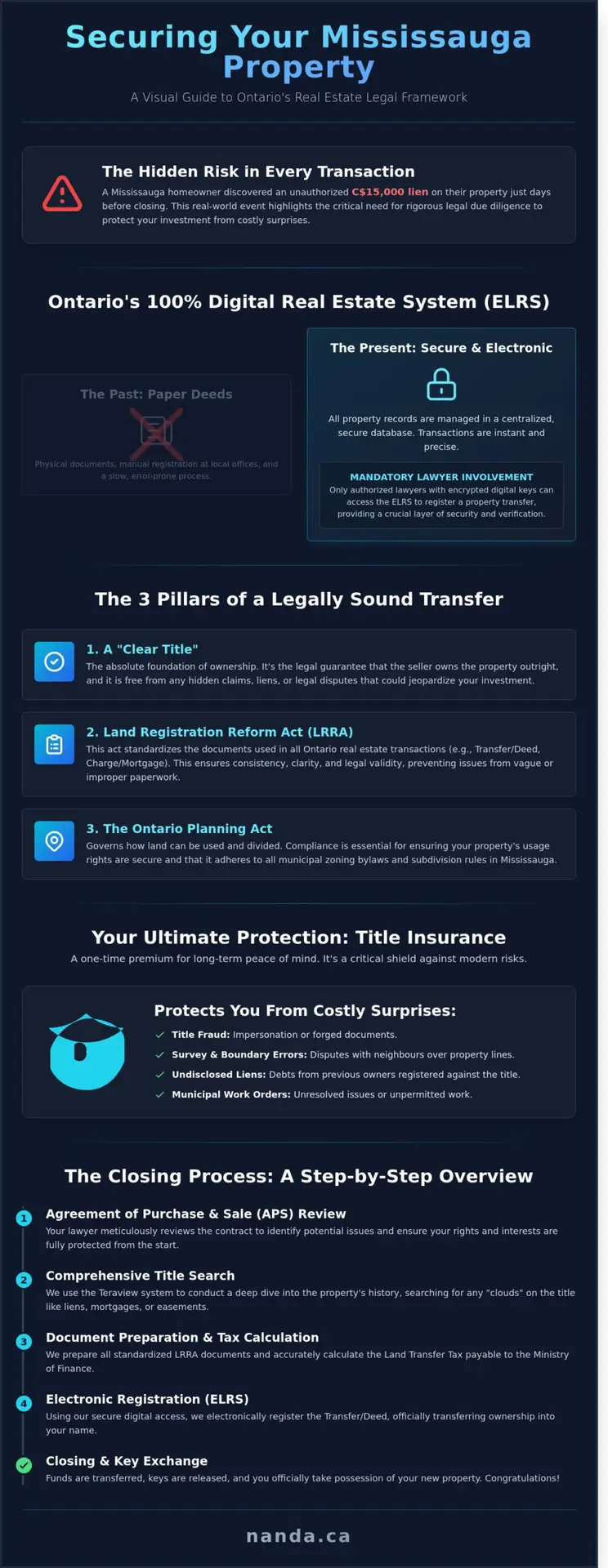
Real estate law in Ontario is a specialized field that governs how individuals acquire, use, and transfer land. It isn’t just a collection of contracts; it’s a rigorous framework built upon centuries of Canadian Property Law and modern provincial statutes. In Mississauga, every transaction must align with the Land Registration Reform Act. This legislation serves as the rulebook for property dealings, ensuring that ownership remains clear and undisputed. Since the province completed its transition to a 100% digital Electronic Land Registration System (ELRS) in 2010, the days of physical paper deeds in local registry offices are over. All property records for the Peel Region now live in a secure, centralized database.
You can’t legally complete a home purchase or sale in Ontario without a lawyer. The ELRS isn’t accessible to the general public for document registration. Only authorized legal professionals with encrypted digital keys can sign and register the electronic documents that transfer title from a seller to a buyer. This mandatory involvement provides a vital layer of security. It protects Mississauga residents from title fraud and ensures that every C$900,000 or C$2,000,000 transaction is backed by professional verification. We act as the final checkpoint, confirming that the digital record accurately reflects the intentions of our clients.
The transition to a digital system has streamlined the process, but it has also increased the need for precision. Electronic filings are processed almost instantly, meaning errors can be difficult and costly to reverse. Our team manages the entire digital workflow, from conducting title searches in the Teraview system to ensuring that the Land Transfer Tax is calculated and paid correctly to the Ministry of Finance. This digital expertise is a core component of modern real estate law practice, allowing us to offer seamless transitions for families moving within the Greater Toronto Area.
The Role of the Land Registration Reform Act
The Land Registration Reform Act (LRRA) standardized the documents used in every real estate law transaction across the province. Before this act, property documents were often verbose and inconsistent. Now, we use five standard forms, including the Transfer/Deed and the Charge/Mortgage. For a deed to be valid in Mississauga, it must meet strict criteria set by the LRRA, including a precise legal description and the Property Identification Number (PIN). We take full responsibility for verifying these details. A single digit error in a PIN can cloud a title for years, so our meticulous review process is essential for your peace of mind.
Why Peel Region Buyers Need Local Legal Counsel
Mississauga’s housing market moves at a relentless pace. In 2023, many properties saw multiple offers within days of listing. This high-velocity environment requires real estate lawyers in Mississauga who understand the specific nuances of the Peel Land Registry Office (LRO #43). Local expertise is indispensable when dealing with regional issues like Credit Valley Conservation Authority restrictions or specific Mississauga zoning bylaws. We maintain a direct interface with local authorities to resolve title encumbrances quickly. Our deep roots in the community mean we don’t just see a file number; we see a home in a neighborhood we know intimately, allowing us to provide tailored solutions that a distant, automated firm simply can’t offer.
Key Legal Pillars: Title Ownership and the Ontario Planning Act
A "clear title" is the absolute foundation of any property transaction in Brampton. It acts as a guarantee that the seller owns the property entirely, free from undisclosed liens, mortgages, or legal disputes. When our firm conducts a title search, we’re looking for any "clouds" that could jeopardize your ownership. This is a critical step in real estate law because even a small error in a deed from 1995 can stall a multi-million dollar closing today. We ensure that the chain of ownership is unbroken and that no third party can claim an interest in your home after you’ve paid for it.
One common misconception among buyers is that a professional home inspection replaces the need for a legal title search. While a 2024 home inspection identifies physical defects like a cracked foundation or outdated wiring, it cannot detect legal "defects." An inspector won’t find a restrictive covenant that prevents you from building a fence or an easement that allows the city to dig up your backyard. Only a lawyer’s search of the Land Registry Office reveals these financial and legal encumbrances. Relying solely on an inspection leaves you vulnerable to inherited debts and usage restrictions that no contractor can fix.
Brampton’s evolving landscape makes zoning bylaws particularly impactful. In 2024, the city implemented stricter Residential Rental Licensing (RRL) requirements for specific wards to manage secondary suites. If a property description claims a "legal basement apartment," we verify this against municipal records. A property might look like a duplex, but if it’s zoned as a single-family dwelling, you could face city enforcement actions or be unable to secure a mortgage. We align the physical reality of the property with the legal descriptions found in Ontario’s Realty Directive and local planning documents.
Joint Tenancy vs. Tenancy in Common
For Brampton couples, Joint Tenancy is the most frequent choice because it includes the "right of survivorship." If one partner passes away, the property transfers automatically to the survivor, bypassing probate. Conversely, Tenancy in Common is often preferred by business partners or investors because it allows for unequal ownership shares, such as a 70/30 split. This structure doesn’t include survivorship rights; instead, a person’s share becomes part of their estate. Because these decisions impact your future, we often coordinate with wills and estate lawyers in Brampton to ensure your property titling aligns with your broader legacy goals. For Mississauga residents specifically, understanding how property ownership structures affect wills and estates planning in Mississauga is crucial for protecting your family’s financial future.
Compliance with the Ontario Planning Act
The Ontario Planning Act is a strict piece of legislation that controls how land is divided. Section 50 is particularly unforgiving; it prohibits the transfer of a portion of land unless it meets specific criteria, such as being part of a registered plan of subdivision. If a seller accidentally attempts to sell a piece of land that violates these rules, the entire deed is considered "void ab initio," meaning it has no legal effect from the start. This can lead to a total loss of investment if not caught early. Our real estate law experts perform a rigorous municipal compliance search to protect you. Our checklist includes:
-
Verifying that the property isn’t being "abuted" by other land owned by the same seller, which could trigger merger rules.
-
Checking for active work orders or open building permits from the City of Brampton.
-
Confirming that any previous severances received official consent from the Committee of Adjustment.
-
Reviewing the property’s compliance with the 1990 Planning Act standards.
If you’re unsure how these complex land-use rules apply to your specific lot, our real estate legal team can review your agreement to identify potential risks before you sign.
Beyond the Deed: Protecting Your Investment with Title Insurance
Title insurance has evolved from an optional safeguard into a non-negotiable standard for real estate law in Ontario by 2026. While your deed proves ownership, title insurance protects the actual integrity of that ownership. It’s a one-time premium paid during the closing process that stays in effect as long as you or your heirs hold an interest in the property. In the high-velocity Greater Toronto Area market, this insurance is the primary mechanism that facilitates faster closings. It allows lawyers to bypass certain time-consuming municipal searches that can take 10 to 15 business days, ensuring your deal doesn’t collapse due to administrative delays.
The Real Estate Council of Ontario (RECO) and other regulatory bodies highlight that even the most diligent title search can’t uncover every risk. Title insurance covers specific issues like survey errors, where a neighbor’s structure encroaches on your land, or existing liens that weren’t properly discharged by previous owners. It provides a level of protection that a traditional Solicitor’s Opinion on Title cannot match. While a solicitor’s opinion confirms the lawyer has reviewed the public records, title insurance acts as an indemnity policy. It pays for the legal defense and potential loss of value if a covered title defect emerges later.
Our team at Nanda & Associate Lawyers Professional Corporation prioritizes securing comprehensive policies for every client. We’ve seen how these policies save homeowners from financial ruin when unknown municipal work orders or tax arrears surface months after the keys are handed over. We ensure the policy is tailored to your specific property type, whether it’s a high-rise condo or a detached residential home.
Combating Title Fraud in the Greater Toronto Area
Title fraud has become a sophisticated criminal enterprise in 2026, frequently targeting unsuspecting Mississauga homeowners. Modern fraud often involves "Identity Theft," where criminals forge documents and use high-quality fake identification to impersonate a property owner. They may then secure a massive mortgage against the property or even attempt to sell it to an innocent third party. A real estate lawyer in Mississauga acts as your first line of defense against these schemes. We employ rigorous digital identity verification protocols to ensure all parties are who they claim to be. If fraud does occur, title insurance is the only tool that covers the legal costs required to restore your name to the title, which can otherwise exceed C$50,000 in litigation fees.
Municipal Work Orders and Unpermitted Renovations
Brampton has seen a 14% increase in municipal enforcement actions regarding unpermitted basement apartments over the last two years. Many buyers discover too late that their "turn-key" investment property contains "hidden" renovations that don’t meet the Ontario Building Code. When the city issues a work order, the legal fallout can involve forced reversals, meaning you must strip the basement back to the studs at your own expense. When you work with a real estate lawyer in Brampton, we investigate outstanding work orders during the due diligence phase. If a violation exists but was unknown at the time of purchase, title insurance often mitigates these costs, covering the expenses associated with bringing the structure up to code or removing the illegal addition entirely.
The Closing Process: Navigating Legal Timelines in Peel Region
Closing a property in Mississauga or Brampton involves a strict sequence of events governed by the Agreement of Purchase and Sale (APS). We treat this timeline as a roadmap to protect your equity and legal standing. According to 2023 Teranet data, electronic registrations in Ontario now process within minutes once funds are verified, but the preparation leading up to that moment requires weeks of diligent work. Our team manages these deadlines to ensure your transition is seamless and legally sound.
Our first priority is the Review of the APS. We examine the contract to confirm that all conditions, such as financing and home inspections, are met or waived by the specified deadlines. This ensures the deal becomes firm and binding. We look for specific clauses that protect you from hidden liabilities, especially in Peel Region’s competitive market where "as-is" clauses are becoming more frequent.
Conducting Title Searches follows shortly after the deal is firm. We must complete this by the Requisition Date, which is typically 15 to 30 days before closing. This is our window to demand that the seller fix liens, work orders, or title defects. In local practice, we find that roughly 18% of older properties in Brampton have minor title discrepancies or old municipal work orders that require formal clearance before the transfer can proceed.
Preparation of Mortgage Documents occurs in the final week. We coordinate directly with your lender to receive instructions and ensure your down payment and mortgage funds are ready. We also prepare the Statement of Adjustments during this time. This stage is where we calculate the exact balance of funds needed to close, including provincial Land Transfer Tax and legal disbursements.
The Closing Day itself is the culmination of these efforts. Once we receive mortgage funds and your balance of equity, we transfer the money to the seller’s lawyer through the Bank of Canada’s Large Value Transfer System. After the funds are verified, we register the deed electronically. Keys are usually released by 3:00 PM or 4:00 PM, depending on the speed of the banking system. Understanding the nuances of real estate law helps prevent last-minute surprises during this high-stakes transition.
The Statement of Adjustments Explained
The Statement of Adjustments is the final financial reconciliation of the deal. It ensures that neither the buyer nor the seller pays for expenses they don’t own. For example, if a seller pre-paid C$4,800 in annual property taxes but moves out on July 1st, the buyer provides a credit for the remaining six months of the year. These adjustments are separate from "closing costs," which include your legal fees and provincial taxes. We provide a clear breakdown so you know exactly where every cent of your investment goes.
Managing Mortgage Instructions and Funding
We act as the essential bridge between you and your financial institution. Lenders send us detailed instructions that we must satisfy before they release the C$600,000 or C$900,000 required for your purchase. If a bank experiences a technical delay or a wire transfer stalls, the deal might not close on time. In rare cases where a party refuses to close or a major breach occurs, you may need to consult our civil litigation lawyers to protect your deposit and pursue damages. Our familiarity with real estate law allows us to troubleshoot these delays before they jeopardize your move-in date.
If you’re preparing for a property transfer in Peel Region, contact our real estate team to secure your closing date.
Strategic Legal Advocacy for Real Estate Transactions in Brampton
Success in the Brampton property market demands a legal partner who understands the intersection of local dynamics and provincial regulations. Nanda & Associate Lawyers Professional Corporation provides a multidisciplinary approach that offers superior protection for complex transactions. We don’t just process paperwork; we analyze how your property deal impacts your overall financial and legal standing. Our firm serves as a one-stop solution for Ontario residents, offering a diverse team capable of communicating in multiple languages, reflecting the rich cultural mosaic found across vibrant communities like Brampton, where over 52% of residents were born outside of Canada according to 2021 Census data. This ensures that every client feels heard and every contractual nuance is explained clearly, regardless of their primary language.
Commercial Real Estate and Business Integration
Investing in commercial property requires a rigorous analysis of risks that go far beyond a standard residential title search. We focus heavily on the due diligence period, typically a 30 to 60-day window where we examine the property’s legal and physical viability. Our team reviews Phase I and Phase II Environmental Site Assessments to protect you from liability under the Environmental Protection Act. We also evaluate zoning compliance under the Planning Act to ensure your intended use for the property is permitted by the City of Brampton.
Our firm bridges the gap between property acquisition and corporate strategy. We work closely with business lawyers in Brampton to structure your purchase through a holding company or joint venture if it serves your tax and liability interests. We scrutinize commercial leases to identify hidden costs, such as "triple net" expenses or restrictive relocation clauses. By applying our deep knowledge of real estate law, we ensure your commercial investment provides a stable foundation for your business growth.
A Reassuring Approach to Stressful Closings
Closing day is often the most stressful point in any transaction, but it doesn’t have to be. We’ve built a practice centered on providing peace of mind through meticulous preparation and tailored solutions. Our collaborative environment means that senior associates review every file involving complex title issues, such as old easements or unregistered hydro arrears. This collective expertise allows us to resolve potential roadblocks before they threaten your closing date.
We treat every client with empathy, acknowledging that a home is more than just an asset. Our team handles the heavy lifting of communicating with lenders and title insurance providers so you can focus on your transition. Whether you’re a first-time buyer or a seasoned investor, we provide the calm confidence needed to finalize your deal. We use real estate law to protect your interests, ensuring that every document you sign is clear and every right you have is upheld.
For a professional consultation regarding your next property transaction, contact our team to secure the expert representation you deserve. You can book your appointment through our secure portal at https://nanda.ca/book-consultation/.
Protect Your Property Interests in Peel Region
Navigating the complexities of real estate law requires more than just a signature on a deed. It demands a precise understanding of the Ontario Planning Act and a proactive approach to title insurance to shield your equity from unforeseen claims. Since 2003, our firm has anchored its practice in Mississauga, helping thousands of families and businesses manage the strict legal timelines of the local closing process. We provide comprehensive support across 15 different languages; this ensures you’re never left wondering about the status of your transaction. Whether you’re a first-time buyer or a seasoned developer, the right legal advocacy transforms a stressful closing into a seamless transition. You deserve the peace of mind that comes from multidisciplinary expertise spanning real estate, business, and litigation. Our team is ready to protect your interests through every stage of the property lifecycle. When purchasing property in Mississauga, it’s also important to consider how your real estate investment fits into your broader estate planning strategy, including comprehensive wills and estates planning to ensure your property transfers smoothly to your beneficiaries. Secure your property investment; book a consultation with our real estate team today. You can move forward with the confidence that your investment is soundly protected.
Frequently Asked Questions
What does a real estate lawyer do in Ontario?
A real estate lawyer manages the legal transfer of property ownership according to the Land Titles Act. We conduct comprehensive title searches to ensure the property is free of liens and coordinate the secure transfer of funds on your closing day. Our team also reviews the Agreement of Purchase and Sale to protect your interests and ensure all aspects of real estate law are followed correctly.
Is title insurance mandatory for a Mississauga home purchase?
Title insurance isn’t legally mandatory under Ontario provincial law, but 95 percent of Canadian mortgage lenders require it as a strict condition of financing. For a Mississauga home purchase, this insurance protects you against title fraud and existing municipal work orders. It provides a layer of security that a standard lawyer’s opinion cannot match, covering issues like survey errors or zoning non-compliance.
How much are land transfer taxes in Brampton?
Brampton residents only pay the Ontario Land Transfer Tax, as the city doesn’t impose an additional municipal tax like the one found in Toronto. The provincial tax uses a tiered scale starting at 0.5 percent for the first C$55,000 and reaching 2.5 percent for the portion of the price over C$2,000,000. First time homebuyers often qualify for a maximum rebate of C$4,000 to help offset these closing costs.
What happens if I miss the requisition date in my contract?
Missing the requisition date means you lose the legal right to demand that the seller fix non-fundamental title defects before the closing occurs. This deadline, typically set 15 to 30 days before the closing date, is a critical milestone in real estate law contracts. While you may still have recourse for major issues like a total lack of legal access, smaller encumbrances or minor encroachments become your responsibility after this date passes.
Can one lawyer represent both the buyer and the seller in Ontario?
One lawyer cannot represent both the buyer and the seller in most Ontario transactions because it creates a direct conflict of interest. The Law Society of Ontario Rule 3.4-14 strictly limits joint retainers to ensure each party receives completely independent legal advice. Exceptions are rare and only apply in specific scenarios, such as transfers between family members or in remote areas where only one lawyer exists within a 50 kilometer radius.
What is the difference between a title search and a home inspection?
A title search is a legal investigation of the property’s history through the Ontario Land Registry to confirm ownership and identify outstanding debts. A home inspection is a physical assessment of the building’s structure, electrical systems, and plumbing. While the lawyer ensures you legally own the land and that it’s free of claims, the inspector ensures the physical asset is safe and identifies necessary repairs.
How long does the real estate closing process take in Peel Region?
The closing process in Peel Region typically spans 60 to 90 days from the date the Agreement of Purchase and Sale becomes firm. This timeframe allows our team to complete the title search, fulfill all contract conditions, and process mortgage documents with your lender. On the actual closing day, the electronic transfer of title and funds usually completes by the 5:00 PM deadline set by the provincial registration system.
What are the legal implications of buying a house with a tenant in Ontario?
Buying a tenanted property means you automatically inherit the existing lease agreement and all obligations under the Residential Tenancies Act, 2006. If you intend to occupy the home yourself, you must serve an N12 notice at least 60 days before the end of a rental period. You’re also required to pay the tenant one month’s rent as compensation or offer them another unit that’s acceptable to them before they vacate.
Disclaimer
This content is for general information only and does not constitute legal advice or create a lawyer-client relationship. Every case is different—please consult a qualified lawyer for advice specific to your situation.