


On March 12, 2024, a Brampton resident discovered that the executor of their family’s legacy had stopped responding to all inquiries regarding the final accounting of assets. This silence often marks the painful start of complex estate disputes that can fracture even the closest families. You likely feel a profound sense of betrayal and anxiety as you face the prospect of being unfairly excluded from your rightful inheritance. It’s exhausting to balance the weight of grief with the fear that your future security is being mismanaged by someone you once trusted.
We believe you deserve total transparency and a fair distribution of assets according to the law. This guide provides the exact legal steps and Ontario procedures you need to protect your interests and resolve conflict effectively. You’ll learn how to navigate the specific requirements of the Estates Act and what to expect from the current 2024 court schedules at the Peel Region Superior Court of Justice. We’ll outline the process for removing an incompetent executor and the tactical moves necessary to bring clarity to your family’s situation.
Key Takeaways
-
Identify the common grounds for estate disputes in Brampton and understand how these matters are handled within the Superior Court of Justice in the Peel Region.
-
Navigate the complexities of Ontario’s legal framework, including the Succession Law Reform Act and the Estates Act, to ensure fair asset distribution.
-
Learn the procedural requirements for halting probate, including how to properly file a Notice of Objection and participate in mandatory mediation.
-
Protect your legal rights by understanding the strict two-year limitation period and the specific documentary evidence required to support your claim.
-
Discover how professional legal guidance can provide a comprehensive solution to resolve conflicts while maintaining family stability and peace of mind.
Table of Contents
-
Legal Explanation: Ontario Legislation Governing Estate Disputes
-
Conclusion: Strategic Estate Litigation with Nanda & Associate Lawyers
Introduction to Estate Disputes in Brampton: Key Takeaways
Losing a family member is an emotionally taxing experience. When legal complications arise regarding their final wishes, the stress can feel overwhelming. In legal terms, estate disputes are formal disagreements involving the validity of a will, the distribution of assets, or the conduct of an appointed executor. For residents in our community, these legal battles are heard at the Superior Court of Justice in the Peel Region, located at 7755 Hurontario Street in Brampton.
The legal framework governing these issues is complex. While Inheritance law in Canada provides a broad foundation, Ontario’s specific statutes, such as the Succession Law Reform Act, dictate how dependants can claim support. Successfully resolving these conflicts requires a blend of technical precision and local procedural knowledge. Our wills and estate lawyers Brampton team focuses on providing the steady guidance needed to protect your interests during these sensitive times.
Key Takeaways for Brampton Residents:
-
Strict Timelines: Most challenges are subject to the Limitations Act, 2002, which generally imposes a two-year window from the date the claim is discovered.
-
Mandatory Mediation: Brampton is part of a mandatory mediation jurisdiction under Rule 75.1 of the Rules of Civil Procedure; parties must attempt to settle before proceeding to a full trial.
-
Standing is Essential: You cannot challenge a will simply because you feel the distribution is unfair; you must prove a legal right to participate in the proceedings.
Common Triggers for Estate Litigation
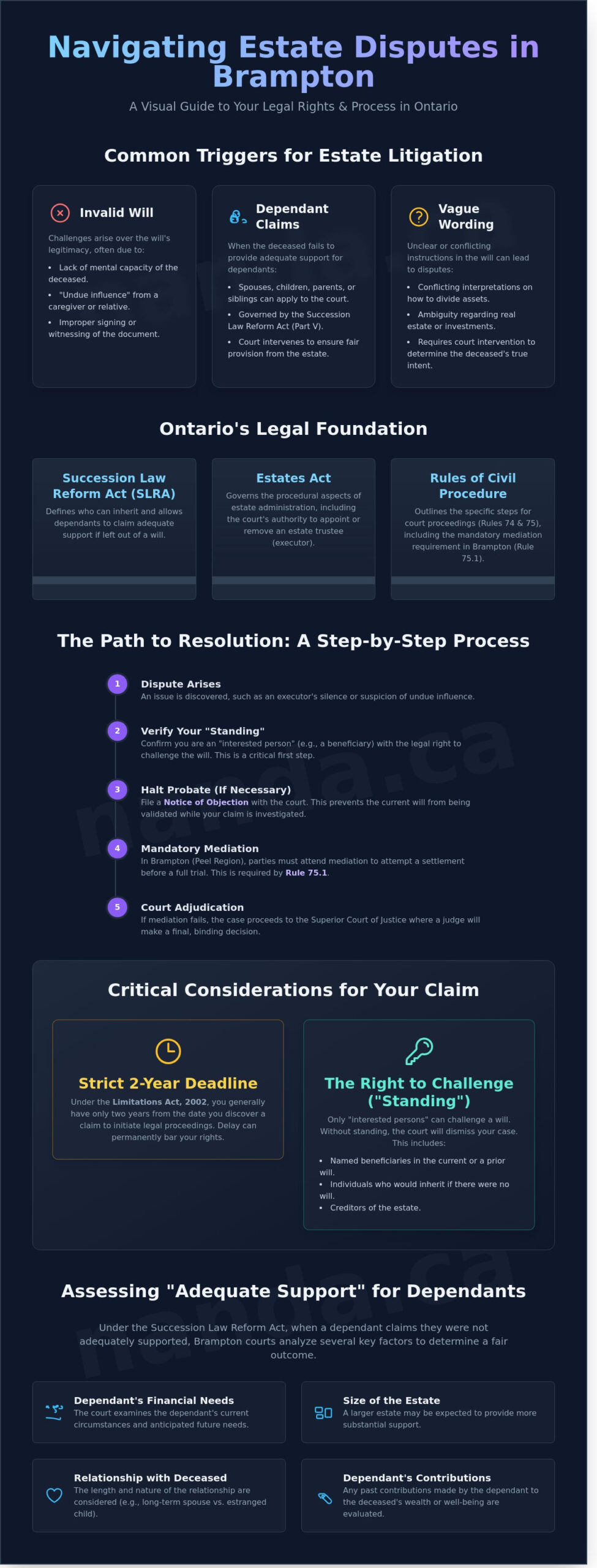
Most estate disputes in Ontario stem from three primary sources. First is the validity of the document itself. This often involves allegations that the deceased lacked the mental capacity to sign the will or was under "undue influence" from a caregiver or relative. Second, claims by dependants are frequent. Under the Succession Law Reform Act, if a deceased person fails to provide adequate support for a spouse or child, the court can intervene. Finally, ambiguous language in a will often leads to conflicting interpretations of how assets like real estate or investments should be divided.
Why Standing Matters in Brampton Courts
Before the Superior Court of Justice reviews the merits of a case, the applicant must establish "standing." In Ontario, the Estates Act requires that a person be an "interested person" to challenge a will. This typically includes named beneficiaries, individuals who would inherit if there were no will, or creditors of the estate. A common pitfall occurs when distant relatives or friends attempt to intervene without a clear financial or legal stake. Without proper standing, the court will dismiss the application regardless of the evidence presented, making early verification of your legal status a critical first step.
Legal Explanation: Ontario Legislation Governing Estate Disputes
Understanding the statutory framework is the first step in resolving estate disputes in Brampton. The legal landscape in Ontario is governed by a trio of primary sources: the Succession Law Reform Act (SLRA), the Estates Act, and the Rules of Civil Procedure. These laws work together to ensure that a deceased person’s wishes are respected while protecting the rights of vulnerable dependants. We’ve seen how these regulations provide a structured path for those who feel unfairly excluded from a will. For a clearer picture of the procedural side, Ontario’s guide to administering estates offers a helpful overview of how these laws apply to the probate process.
The Estates Act specifically handles the procedural aspects of probate and the appointment of estate trustees. When a conflict arises regarding who should manage the assets, this Act provides the Brampton Superior Court of Justice with the authority to intervene. Additionally, Rule 74 and Rule 75 of the Ontario Rules of Civil Procedure dictate the exact steps for bringing a challenge before a judge. In 2024, legal shifts have placed an even higher burden on fiduciary duty expectations, requiring executors to act with unprecedented transparency or face personal liability for mismanagement. If you’re concerned about how an estate is being handled, our wills and estate lawyers in Brampton can help you evaluate your standing.
The Succession Law Reform Act (SLRA)
The Succession Law Reform Act (SLRA) serves as the primary framework for testamentary challenges in Ontario. Under Part V of this Act, a dependant who wasn’t left "adequate support" can apply to the court for a larger share of the estate. This applies to spouses, children, parents, and siblings whom the deceased was supporting immediately before death. When determining what’s "adequate," Brampton courts analyze several factors:
-
The dependant’s current financial circumstances and future needs.
-
The size of the total estate.
-
The length and nature of the relationship with the deceased.
-
Any previous contributions made by the dependant to the deceased’s wealth.
Testamentary Capacity and Undue Influence
A will is only valid if the person making it had the mental capacity to understand the document’s nature and effect. Ontario courts still rely on the "Banks v Goodfellow" test, a legal standard established in 1870, to determine if a testator was of sound mind. This test requires that the individual understood the extent of their property and the claims of those they’re excluding.
In many estate disputes, we also look for "suspicious circumstances" during the will’s execution. This might include a sudden change in beneficiaries or a will drafted while the deceased was in isolation. The burden of proof typically shifts to the person defending the will once suspicious circumstances are proven. It’s a complex area of law that requires methodical evidence gathering to protect the true intentions of the deceased.
Timelines and Process: Navigating the Brampton Court System
Timing is everything in estate disputes. If you believe a will is invalid or a dependant has been unfairly excluded, your first move is filing a Notice of Objection (Form 75.1) at the Superior Court of Justice. This document acts as a temporary freeze, preventing the court from issuing a Certificate of Appointment to the executor. Without this certificate, the executor can’t distribute assets, which protects the estate’s value while you prepare your legal challenge.
Filing Your Claim in Peel Region
You’ll file your documents at the Brampton courthouse located at 7755 Hurontario Street. Most estate disputes begin as an "Application" when the facts aren’t heavily contested, or an "Action" when you’re alleging complex issues like fraud or undue influence. Once filed, you must serve notice to every beneficiary named in the will and any person who would inherit if the will were set aside. This transparency ensures all parties have a voice in the upcoming proceedings.
Mandatory Mediation and Settlement
Peel Region is one of the few jurisdictions in Ontario where mediation is mandatory under Rule 75.1 of the Rules of Civil Procedure. You’ll meet with a neutral third-party mediator to explore a resolution before a judge hears the case. Understanding how recent changes to Ontario estate law affect your standing is vital during these sessions, especially regarding how separation now impacts a will’s validity. Settling out of court often saves C$10,000 or more in trial costs and keeps family matters private.
If the executor remains uncooperative or refuses to share financial details, we often move for a "passing of accounts." This court-ordered process forces the executor to provide a line-by-line justification of every dollar spent or distributed from the estate. It’s a powerful tool for transparency that often uncovers mismanagement or hidden assets.
Navigating these procedural hurdles requires precision. Our civil litigation lawyers step in to manage the heavy lifting of court appearances, cross-examinations, and formal discoveries. We focus on building a methodical case so you can focus on your family’s stability during a difficult transition. Our team ensures every deadline is met and every filing is technically sound, providing the calm confidence you need to see the process through to a fair conclusion.
Practical Advice for Resolving Estate Disputes Effectively
Resolving estate disputes requires a methodical approach that balances legal precision with emotional intelligence. The process often feels overwhelming for dependants in Brampton, but success relies on early intervention and meticulous record-keeping. We recommend consulting with wills and estate lawyers as soon as a conflict arises to ensure you don’t inadvertently waive your rights or miss critical filing deadlines. Taking proactive steps today prevents procedural errors that could jeopardize your financial security in the future.
Evidence Gathering and Documentation
Brampton courts rely heavily on objective data rather than hearsay. To build a robust case, you should compile medical records from the 24 months preceding the deceased’s passing to establish their mental capacity. Financial statements showing a history of dependency and copies of prior wills are also vital for demonstrating the testator’s long-term intentions. You should maintain a chronological log of all interactions with the estate trustee, noting dates, times, and the substance of conversations. While executor invoices are often subject to solicitor-client privilege, you have a right to contest the reasonableness of these fees during the passing of accounts process.
-
Medical Assessments: Focus on records detailing cognitive decline or undue influence.
-
Financial Proof: Gather tax returns or bank transfers showing regular support.
-
Communication Logs: Save every email and text message exchanged with the executor.
Understanding the Two-Year Limitation Period
The Limitations Act, 2002 sets a strict two-year window for most estate disputes in Ontario. This clock typically starts on the date of death, or when a reasonable person would have discovered they had a claim. However, the Real Property Limitations Act provides a different framework for cases involving land, sometimes allowing for a 10-year period to recover interests in real estate. It’s vital to identify which statute applies to your specific situation to avoid being barred from the courtroom. Failing to meet the limitation period usually results in a permanent loss of the right to sue.
Managing family dynamics during active litigation is equally important for a successful outcome. Clear, professional communication helps de-escalate tensions and can lead to more favorable mediation results. Our team focuses on providing stable, authoritative guidance to help you navigate these interpersonal complexities while protecting your legal interests. If you’re concerned about a pending deadline or need to evaluate the strength of your evidence, we’re here to help.
Protect your inheritance by speaking with an estate litigator in Brampton today.
Conclusion: Strategic Estate Litigation with Nanda & Associate Lawyers
Challenging a will is a complex legal undertaking that requires more than just a sense of unfairness. It demands a rigorous application of the Succession Law Reform Act and a precise understanding of the procedural requirements in Ontario. Nanda & Associate Lawyers Professional Corporation provides the steady, authoritative guidance necessary to navigate these high-stakes situations. We focus on securing your future through comprehensive legal solutions that prioritize both your financial stability and your peace of mind. When you partner with us, you gain access to a collaborative team that treats your case with the gravity it deserves.
Estate disputes often involve intricate layers of asset division, especially when family businesses or international properties are part of the equation. We leverage our multidisciplinary expertise to ensure no detail is overlooked. Our lawyers work closely with financial experts to value estates accurately, ensuring that dependants receive the full support they’re entitled to under the law. We don’t just fill out forms; we build robust, evidence-based strategies designed to withstand intense scrutiny in a courtroom setting.
Our Approach to Brampton Estate Disputes
Our team has extensive experience appearing before the Superior Court of Justice in Peel. We understand the local judicial environment and the specific expectations of the court at 7755 Hurontario Street. Brampton’s vibrant, multicultural community requires a law firm that is both globally minded and locally rooted. We offer services in multiple languages to ensure that communication remains seamless and that cultural nuances are respected throughout the litigation process. This personalized approach allows us to handle sensitive estate disputes with the empathy and sophistication they require.
Taking the Next Step Toward Resolution
Acting quickly is essential in estate matters because statutory timelines can expire, potentially
forfeiting your right to a claim. You shouldn’t wait until the probate process is finalized to seek advice. During your initial consultation, we’ll examine the validity of the will and determine the most effective path forward, whether through mediation or formal litigation. We’ll provide a clear, methodical breakdown of your rights and the likely outcomes of your case. Protect your interests and find the resolution you need by visiting our booking page to speak with our wills and estate lawyers in Brampton.
Secure Your Family Legacy with Strategic Legal Guidance
Navigating the complexities of Ontario law requires a steady hand and a clear strategy. You’ve learned how the Succession Law Reform Act governs your rights and why the specific procedures at the Brampton Superior Court of Justice dictate your legal timeline. Resolving estate disputes doesn’t have to tear a family apart when you have the right advocate by your side. At Nanda & Associate Lawyers, we provide comprehensive legal solutions that prioritize your stability and peace of mind.
Our team brings decades of collective experience to the table, offering dedicated representation at the Brampton Superior Court of Justice. We’re a diverse firm that provides multilingual support in over 15 languages, ensuring our advice is accessible to everyone in our community. Whether we’re negotiating a settlement or litigating a complex claim, we focus on your long-term interests. You don’t have to face these transitions alone. Protect your inheritance; contact our estate litigation team in Brampton today. We’re here to help you move forward with confidence.
Frequently Asked Questions
How long do I have to challenge a will in Brampton?
You generally have two years from the date of the testator’s death or the date you discovered the claim to initiate a challenge under the Limitations Act, 2002. This two year window is a strict statutory deadline across Ontario. If you’re seeking dependant support, you must file your claim within six months of the probate grant according to Section 61 of the Succession Law Reform Act. Missing these dates often results in the loss of your legal right to pursue the matter.
Can I remove an executor who is not communicating with beneficiaries?
You can petition the Ontario Superior Court of Justice to remove an executor if they fail to fulfill their fiduciary duties, including the duty to communicate. Section 37 of the Trustee Act allows for the removal of an estate representative who is unfit or refuses to act. We often see courts intervene when an executor’s silence persists for more than 90 days or causes 100 percent deadlock in the administration process. Our team helps you navigate this process to ensure the estate remains protected.
What happens if a person dies without a will in Ontario?
The estate is distributed according to the rigid formula found in Part II of the Succession Law Reform Act when someone dies intestate. A surviving spouse is entitled to a preferential share, which was increased to C$350,000 for deaths occurring after March 1, 2021. Any remaining assets are divided between the spouse and children in specific proportions. This process removes your ability to choose specific beneficiaries or appoint a preferred estate trustee, which is why we recommend proactive planning.
Is mediation mandatory for estate disputes in Brampton?
Mediation isn’t strictly mandatory in Brampton under Rule 75.1 of the Rules of Civil Procedure, unlike in Toronto, Ottawa, or Windsor. However, 85 percent of estate litigation cases in Peel Region are referred to mediation by a judge’s order to facilitate a settlement. We find that resolving estate disputes through this collaborative process often saves families months of litigation time and reduces the emotional burden of a public court battle.
What are the legal grounds for contesting a will in Peel Region?
You must prove specific legal grounds such as a lack of testamentary capacity, undue influence, or a failure to comply with the formal requirements of the Succession Law Reform Act. For example, if the testator didn’t have two witnesses present during the signing, the document is likely invalid. Claims also arise when a deceased person fails to provide "adequate provision" for a dependant they were supporting before their death. We carefully review the evidence to determine if your case meets these legal thresholds.
Who pays the legal fees in an Ontario estate dispute?
The modern "costs follow the event" principle means the losing party typically pays a portion of the winner’s legal costs. While people once believed the estate always paid for estate disputes, Ontario courts changed this approach in the 2005 McDougald Estate case. Today, if a challenge is deemed meritless, the person bringing the claim might be ordered to pay 60 to 70 percent of the other side’s legal bills. This makes it vital to have a strong, evidence based strategy from the start.
Can a spouse be completely cut out of a will in Brampton?
It’s nearly impossible to completely disinherit a spouse because of the protections in the Family Law Act and the Succession Law Reform Act. A surviving spouse can choose to take their entitlement under the will or elect to receive an equalization payment of the net family property. This election must be filed within six months of the death. Additionally, dependants can claim support if the will doesn’t provide enough for their daily needs, ensuring their financial stability is maintained.
How do I force an executor to show the estate accounts?
You can bring an application for a formal "passing of accounts" under the Estates Act if an executor refuses to provide financial transparency. This legal process requires the executor to present a detailed ledger of all assets, debts, and distributions to the court for approval. If an executor hasn’t provided an informal accounting within 12 months of the grant of probate, beneficiaries have the right to seek a court order compelling them to do so. We provide the guidance needed to hold executors accountable.