


Launching a business with trusted partners is a venture built on shared vision and ambition. But as your company evolves, critical questions will inevitably arise: How will major decisions be made? What happens if a shareholder wants to exit the company, becomes disabled, or passes away unexpectedly? Without a clear framework, these scenarios can lead to damaging disputes that threaten your investment and your professional relationships. For any corporation in Mississauga, comprehensive shareholder agreements are not simply a recommendation-they are the cornerstone of a stable and secure future. This is where experienced business lawyers Mississauga come into the picture.
This 2026 guide is designed to provide you with clarity and confidence. We will demystify the legal complexities, explaining exactly what a shareholder agreement is, why your business cannot afford to operate without one, and how to create a document that protects your investment and partnerships for the long term. Our goal is to provide you with a clear roadmap, ensuring you have the peace of mind that comes from knowing your company’s future is protected by a solid legal foundation.
Key Takeaways
-
Discover how a well-structured agreement serves as a crucial roadmap for your business, proactively protecting your investment and preserving partner relationships.
-
Pinpoint the essential clauses every Ontario agreement must contain to effectively manage share transfers, establish clear exit strategies, and define decision-making power.
-
Learn why relying on trust alone is a significant risk and how comprehensive shareholder agreements are designed to protect friendships by creating clear rules for when business pressures arise.
-
Gain a clear understanding of the methodical process for creating your agreement with a Mississauga business lawyer, ensuring your unique business goals are addressed from the very first meeting.
Table of Contents
-
What is a Shareholder Agreement and Why is it Crucial in Ontario?
-
Core Clauses Every Ontario Shareholder Agreement Must Include
-
The Process: Drafting Your Agreement with a Mississauga Lawyer
What is a Shareholder Agreement and Why is it Crucial in Ontario?
For any incorporated business in Ontario with more than one owner, a shareholder agreement is not a luxury-it is a foundational necessity. In simple terms, a Shareholders’ agreement is a private contract signed by the corporation’s shareholders that outlines their rights, responsibilities, and the rules of engagement for managing the company. Its primary purpose is to provide a clear roadmap for decision-making and to pre-emptively solve disputes before they can escalate.
This document is distinct from your company’s Articles of Incorporation or By-Laws. While Articles and By-Laws are public-facing documents that govern the corporation’s basic structure under the Ontario Business Corporations Act (OBCA), a shareholder agreement is a confidential tool that governs the relationships between the shareholders themselves. For a growing Mississauga business, relying on a handshake deal is a significant and unnecessary risk that leaves your investment vulnerable to unforeseen events.
The Reality of Business Partnerships
Even the most successful business partnerships can be tested by unexpected life events, often referred to as the "4 Ds": Death, Disability, Divorce, and Disagreement. Imagine a thriving tech startup in Mississauga founded by two partners. If one partner suddenly wishes to exit the business due to a personal dispute, what happens to their shares? Without an agreement, they could sell to a competitor or a third party, forcing the remaining founder into a partnership they never wanted. A shareholder agreement provides the pre-planned solution, detailing buyout procedures, valuation methods, and rights of first refusal to prevent such a crisis.
Legal Standing in Ontario
In Ontario, well-drafted shareholder agreements are legally binding and are expressly recognized under the OBCA. This gives them significant power. In fact, a shareholder agreement can be used to customize your corporate governance, overriding certain default provisions within the Act to better suit your company’s unique needs. It provides critical clarity on matters where the law is otherwise silent, such as how to break a deadlock between 50/50 partners or the specific terms for a shotgun clause. This legal clarity is invaluable, protecting the interests of all shareholders and ensuring the stable, long-term health of your business.
Core Clauses Every Ontario Shareholder Agreement Must Include
A well-drafted shareholder agreement is not merely a legal formality; it is the foundational blueprint for your company’s stability and future success. It proactively addresses potential conflicts before they arise, providing a clear and agreed-upon roadmap for navigating complex situations. While every business is unique, certain provisions are non-negotiable for providing robust protection. Understanding the Core Clauses in a Shareholder Agreement is the first step toward securing your investment and partnerships. Below is a checklist of essential components we ensure are included in the shareholder agreements we prepare for our Ontario clients.
Protecting Ownership and Control
These clauses are designed to control who owns the company and ensure fairness during transitions.
-
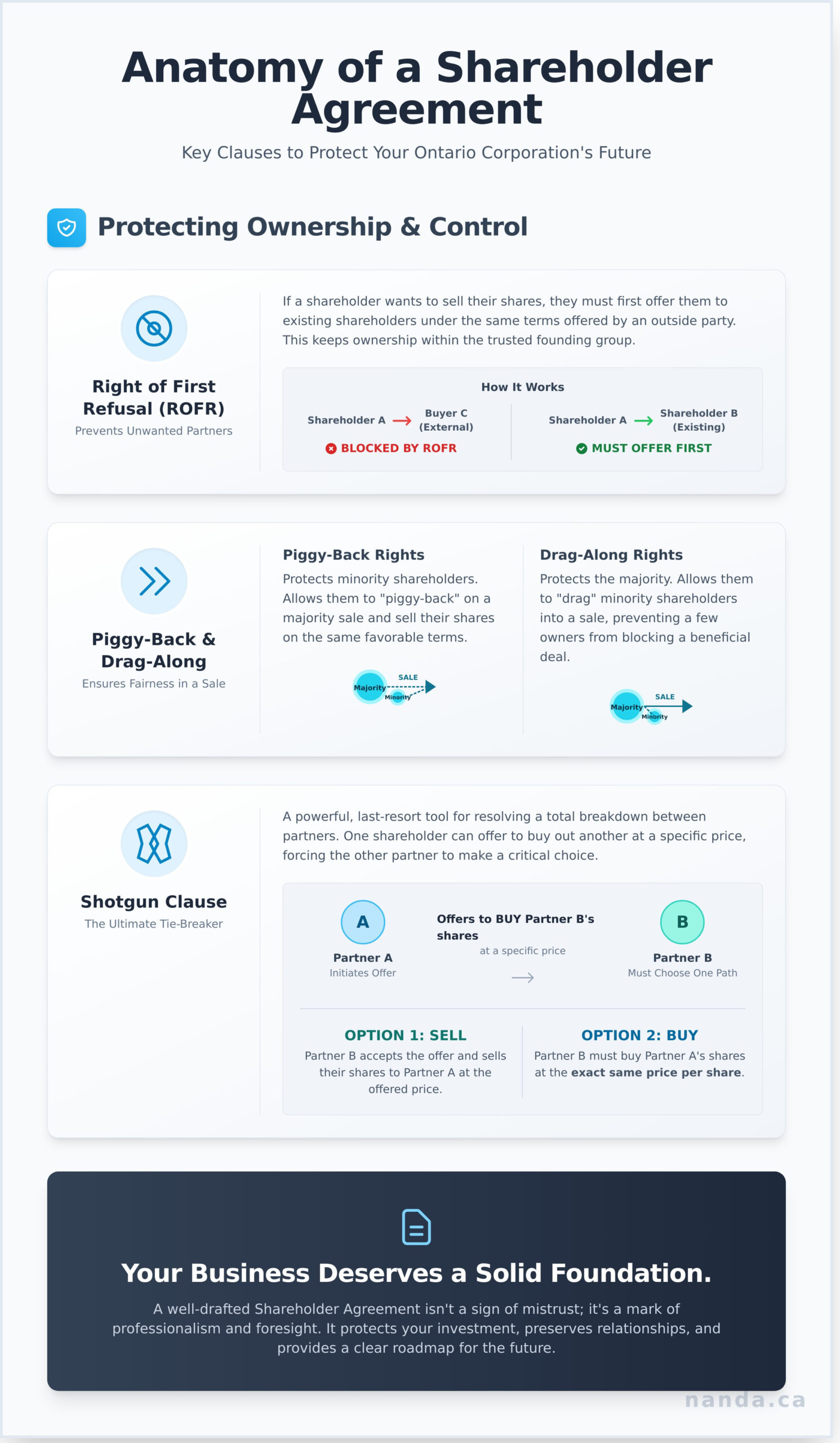
Right of First Refusal (ROFR): This clause solves the problem of an unwanted partner. If a shareholder wishes to sell their shares, they must first offer them to the existing shareholders at the same price and terms offered by an outside party. This keeps ownership within the trusted founding group.
-
Piggy-Back and Drag-Along Rights: These provisions ensure fairness during a company sale. Piggy-back rights protect minority shareholders, allowing them to "piggy-back" on a majority shareholder’s sale and sell their shares on the same favorable terms. Conversely, drag-along rights allow the majority to "drag" minority shareholders into a sale, preventing a small number of owners from blocking a beneficial acquisition for the entire company.
-
Shotgun Clause (Buy-Sell): As a last resort for resolving intractable disputes, this clause allows one shareholder to offer to buy out another at a specified price per share. The receiving shareholder must either sell their shares at that price or buy the offering shareholder’s shares at the exact same price. It is a powerful mechanism that forces a fair resolution when partners can no longer work together.
Defining Operations and Exit Strategies
Clear rules for day-to-day management and shareholder exits prevent operational paralysis and financial disputes.
-
Management & Director Roles: The agreement must clearly outline the responsibilities and decision-making authority of each shareholder and director. This prevents confusion over who is responsible for what, from daily operations to major strategic decisions.
-
Dispute Resolution: To avoid costly and public court battles, a mandatory mediation or arbitration clause is crucial. This requires shareholders to attempt to resolve disagreements through a neutral third party before resorting to litigation.
-
Triggers for Share Sale: Life is unpredictable. The agreement must define what happens to a shareholder’s shares upon critical events like death, disability, bankruptcy, or even divorce. This ensures an orderly and predetermined process for the transfer or buyout of shares.
-
Valuation Formula: One of the most common sources of conflict is the value of the business. A shareholder agreement should pre-determine the method for valuing shares, whether it’s a fixed formula, a multiple of earnings, or based on an independent appraisal. This ensures a fair and objective price is established when a buyout is triggered.
Common Misconceptions About Shareholder Agreements
At Nanda & Associate Lawyers Professional Corporation, our business lawyers understand that new business ventures are built on optimism and trust. This often leads partners to overlook foundational legal protections, believing certain myths about their necessity. The most common objection we hear is, "We’re friends, we trust each other." While this trust is essential, a shareholder agreement is not a sign of its absence; rather, it is a tool to protect that very relationship from the inevitable pressures of running a business.
By proactively establishing clear rules and expectations, you create a roadmap for navigating future challenges. This foresight prevents misunderstandings from escalating into disputes that can damage both the business and the personal bonds between partners. Let us debunk some other common myths.
Myth: ‘It’s Too Expensive for a Startup’
Many entrepreneurs view legal fees as an avoidable expense. However, this perspective is short-sighted. The cost of drafting a tailored agreement should be viewed as an affordable insurance policy. A single shareholder dispute that ends in litigation can easily cost tens of thousands of Canadian dollars in legal fees, not to mention the immense cost of lost time and business disruption. In contrast, the one-time legal fee for a professionally prepared agreement is a modest, foundational investment in your company’s long-term stability and peace of mind.
This principle of foundational investment extends beyond legal structures to other critical business areas, such as technology. Just as a solid legal agreement prevents future disputes, a well-managed IT infrastructure prevents costly downtime and security breaches.
Myth: ‘Our Articles of Incorporation Are Enough’
This is a critical misunderstanding. Your Articles of Incorporation are a public document filed with the government, containing only basic, mandated information like the corporation’s name and share structure. It does not govern the relationship between the owners. We often use an analogy to provide clarity:
-
Your Articles of Incorporation are like your car’s registration-a public document proving its legal existence.
-
Your shareholder agreement is the owner’s manual-a private, detailed guide explaining how to operate, maintain, and handle problems effectively.
This private agreement handles sensitive, internal matters such as dispute resolution mechanisms, share valuation methods, restrictions on selling shares, and plans for unexpected events like the death or disability of a shareholder-details crucial for smooth operation that have no place in a public filing.
The Process: Drafting Your Agreement with a Mississauga Lawyer
Creating a shareholder agreement is a foundational act of foresight for your Ontario business. It is a structured, collaborative process that transforms verbal understandings into a legally enforceable document, providing clarity and security for all partners. At Nanda & Associate Lawyers, our Mississauga corporate lawyers guide our clients through a methodical, four-step process to ensure their agreement is comprehensive, fair, and tailored to the unique dynamics of their company.
This legal foresight is essential, and for modern businesses, it goes hand-in-hand with establishing a solid technological foundation.
The journey follows a clear and logical path:
-
Initial Strategic Consultation: We begin with an in-depth meeting to discuss your business’s long-term goals, the specific roles of each shareholder, and potential points of future friction. This is where we map out the core components of your agreement.
-
Expert Drafting: Based on your collaborative discussions, our corporate lawyers draft the initial shareholder agreement. We translate your shared vision into precise, unambiguous legal language that protects your interests.
-
Collaborative Review and Revision: The draft is circulated to all shareholders for careful review. This is an essential, iterative phase where we facilitate feedback, answer questions, and make revisions until every party is confident the document accurately reflects their mutual understanding.
-
Final Execution and Safekeeping: Once all parties are in full agreement, the document is formally signed and executed. We ensure it is properly integrated into your corporate records, making it an official, binding instrument for your business governance.
Preparing for Your Consultation
To ensure your initial meeting is as productive as possible, we recommend you and your partners discuss several key scenarios beforehand. Proactive conversation is the first step toward building robust shareholder agreements. Consider what documents to bring and what difficult questions to ask, such as:
-
What happens if a shareholder wishes to sell their shares, passes away, or becomes disabled?
-
How will the company and its shares be valued in different circumstances?
-
Which major decisions will require a unanimous vote versus a simple majority?
-
Bring your Articles of Incorporation and any existing business plans to provide essential context.
The Lawyer’s Role in Facilitating Agreement
An experienced business lawyer provides far more than just legal drafting. We act as a neutral facilitator, guiding you through sensitive conversations with objectivity and a focus on finding mutually beneficial solutions. Our team ensures every clause is fully compliant with Ontario’s Business Corporations Act and can propose standard yet crucial provisions-like shotgun clauses or rights of first refusal-that you may not have considered. This expertise is vital for creating a document that is both practical and legally sound. Start the conversation with our business law team today.
Why Choose Nanda Lawyers for Your Shareholder Agreement?
Drafting a shareholder agreement is more than a legal formality; it is a foundational act of business foresight. The legal partner you choose to guide this process must not only understand corporate law but also appreciate the unique vision and dynamics of your Ontario enterprise. At Nanda & Associate Lawyers, our Mississauga business lawyers move beyond generic templates to provide tailored, strategic counsel that protects your interests today and fosters sustainable growth for tomorrow.
Our firm is uniquely positioned as a multidisciplinary practice. This means our business law team collaborates seamlessly with our experts in family law, real estate, and estate planning. This integrated approach is critical when crafting robust shareholder agreements. We anticipate complex scenarios-such as a shareholder’s divorce, disability, or death-and build in clear, enforceable mechanisms that safeguard the company’s stability and protect all stakeholders. We are not just drafting a document; we are building a comprehensive legal shield for your business.
Local Expertise, Comprehensive Solutions
Rooted in Mississauga, our lawyers possess an intimate understanding of the Greater Toronto Area’s dynamic business landscape. We recognize the specific challenges and opportunities facing local entrepreneurs. As your trusted advisors, we provide ongoing legal support that evolves with your company’s needs. To serve our diverse community, our team proudly offers legal services in over 15 languages, ensuring clear communication and culturally sensitive counsel for every client.
Schedule Your Confidential Consultation
Securing your business’s future begins with a conversation. We invite you to schedule a confidential consultation with our experienced business law team. During this initial meeting, we will:
-
Review your current corporate structure and shareholder relationships.
-
Discuss your long-term business goals and potential concerns.
-
Outline a strategic path for creating a custom agreement that aligns with your vision.
This is your opportunity to gain clarity and take the single most important step in establishing a stable foundation for your company. Protect your investment and your partnerships by acting today. Contact the dedicated team at Nanda to book your consultation and secure the peace of mind you deserve.
Secure Your Partnership and Your Company’s Future
Navigating the complexities of business ownership in Mississauga requires foresight and a solid legal foundation. As this guide has outlined, a shareholder agreement is not merely a preventative measure but a proactive strategy for ensuring clarity, stability, and longevity for your enterprise. It defines the rules of engagement, protects individual interests, and provides a clear path forward during times of transition or disagreement. For any multi-owner corporation in Ontario, comprehensive shareholder agreements are an absolute necessity for sustainable success.
At Nanda & Associate Lawyers, we have been serving the Mississauga community since 2003, offering comprehensive legal solutions tailored to every stage of your business. Our expertise in the Ontario Business Corporations Act ensures your agreement is both robust and strategically aligned with your goals. Protect your business partnership. Schedule a consultation with our Mississauga business lawyers.
Take the decisive step today to secure the future you are working so hard to build.
Frequently Asked Questions About Shareholder Agreements
What happens if we don’t have a shareholder agreement in Ontario?
Without a shareholder agreement, your corporation is governed by the default rules of Ontario’s Business Corporations Act. This can lead to significant problems, as these rules are generic and may not suit your business’s specific needs. Disputes over share transfers, decision-making deadlocks, or a shareholder’s exit can become complex and expensive legal battles. An agreement provides a clear, customized roadmap to prevent such conflicts and protect your business’s stability and continuity.
How much does it cost to draft a shareholder agreement in Mississauga?
The cost to draft a shareholder agreement is an investment in your company’s future security. In Mississauga, the price can vary based on the complexity of the business structure and the number of shareholders involved. A straightforward agreement may cost approximately C$2,000 to C$4,000, while more intricate arrangements with multiple share classes or complex buy-sell provisions will be higher. We provide a tailored quote after understanding your unique corporate needs and objectives.
Can a shareholder agreement be changed or updated later on?
Yes, a shareholder agreement is a living document that should evolve with your business. It can and should be amended to reflect significant changes, such as the addition of new shareholders, changes in business strategy, or new financing rounds. Typically, any amendments require the unanimous written consent of all shareholders who are party to the agreement. We recommend reviewing your agreement every few years to ensure it remains relevant and effective for your business.
Is a shareholder agreement legally binding in Canada?
Absolutely. When properly drafted by legal professionals and signed by all shareholders, a shareholder agreement is a legally binding contract in Canada. It is enforceable in court and can override certain default provisions in corporate law, allowing you to create specific rules for your corporation. Its strength lies in its ability to provide clear, enforceable terms that govern the relationship between shareholders, protecting the interests of all parties and the corporation itself.
What is the difference between a shareholder agreement and a partnership agreement?
The primary difference lies in the legal structure of the business. A shareholder agreement is used for an incorporated company, which is a distinct legal entity separate from its owners (the shareholders). It governs the relationship between these shareholders. In contrast, a partnership agreement is for a partnership, which is not a separate legal entity. This agreement outlines the relationship, responsibilities, and profit distribution between the partners who directly own the business.
Do I need a shareholder agreement if I am the only shareholder?
While a shareholder agreement is designed to manage relationships between multiple shareholders, a sole shareholder should still consider its future value. If you plan to bring in investors, partners, or key employees who will receive shares, having an agreement in place is a proactive step. It is also a critical tool for estate planning, allowing you to dictate how your shares should be managed or transferred upon your death or incapacity, ensuring a seamless transition.
How does a shareholder agreement handle the death of a shareholder?
Effective shareholder agreements provide clear mechanisms for handling the death of a shareholder, preventing potential disruption. They typically include buy-sell provisions that require the deceased’s estate to sell the shares to the remaining shareholders or the corporation. Often, these provisions are funded by corporate-owned life insurance policies, ensuring the necessary funds are available to complete the transaction smoothly. This protects the business from having shares pass to an heir who may not be involved or qualified.
Can a shareholder be forced to sell their shares under an agreement?
Yes, an agreement can include clauses that compel a shareholder to sell their shares under specific, pre-determined circumstances. These are known as "shotgun" clauses, which can resolve a deadlock by allowing one shareholder to offer to buy out another, who must either accept or buy out the offering shareholder at the same price. Other provisions, like "drag-along" rights, can force minority shareholders to sell if the majority agrees to sell the entire company.