




Key Takeaways & The Legal Framework for Refinancing in Toronto
- Legal Process: Refinancing involves the formal discharge of an existing debt and the registration of a new ‘Charge/Mortgage’ under the Land Registration Reform Act.
- Mandatory Legal Counsel: In Ontario, a real estate lawyer is required to facilitate the electronic transfer of funds and update title registration through the Teranet system.
- Equity Access: Homeowners can typically access up to 80% of their property’s appraised value to consolidate debt or fund major capital improvements.
- Title Insurance: Lenders require a new title insurance policy for the refinanced amount, even if a policy was purchased during the initial home acquisition.
What if the lower interest rate you secured for 2026 is completely wiped out by a single oversight in your title insurance? Most homeowners view refinancing as a purely financial transaction, but the legal transition is where the real complexity lies. You’ve likely spent weeks comparing rates, yet the legal shift from one lender to another often becomes a source of stress when payouts are delayed. Working with a Toronto Mortgage Refinance Lawyer: Legal Steps for Refinancing Your Home ensures you aren’t caught off guard by hidden closing costs or unexpected liens on your property.
Our real estate lawyers understand that you want a seamless experience that protects your equity, especially since title fraud attempts in Ontario reached record levels in 2023. This guide provides a clear, step-by-step roadmap to help you manage the province’s specific legal requirements with confidence. We’ll examine the role of title insurance, the process of discharging your old mortgage, and the essential steps to secure your financial future. By the end of this article, you’ll have the knowledge needed to transition to your new mortgage without the common headaches that plague many Toronto residents.
Understanding the Legal Definition of Refinancing
When you refinance, you aren’t simply updating a contract with your bank. You’re executing a series of legal maneuvers that alter your property’s title. This process requires a Toronto Mortgage Refinance Lawyer: Legal Steps for Refinancing Your Home to ensure the existing ‘Charge’ is discharged at the Ontario Land Registry Office. A clear understanding of refinancing includes knowing that the old debt is replaced by a fresh registration. Most homeowners must choose between a ‘standard charge’ and a ‘collateral charge’. A standard charge only secures the specific mortgage loan; however, a collateral charge can secure various debt obligations, including lines of credit. This distinction is vital because it impacts how easily you can switch lenders in the future. Our team ensures you understand these implications before signing any binding documents.
Why Toronto Homeowners Refinance in 2026
The 2026 Toronto real estate market presents unique financial pressures and opportunities. Our team sees many residents seeking to lower their monthly carrying costs by securing more favorable interest rates than those available during previous peak cycles. Beyond rate hunting, debt consolidation remains a primary driver. By rolling high-interest credit card debt or personal loans into a mortgage product, homeowners often see a drastic reduction in total interest paid.
Additionally, with Toronto’s average home price maintaining its position, accessing equity for renovations is a strategic move to add long-term value. Whether it’s adding a secondary suite or modernizing a kitchen, these improvements are frequently funded through the 80% loan-to-value limit permitted under Canadian federal regulations. Working with a Toronto Mortgage Refinance Lawyer: Legal Steps for Refinancing Your Home ensures these funds are disbursed correctly while protecting your legal interests throughout the transaction. Our real estate lawyers Toronto handle the administrative burden so you can focus on your financial goals with confidence.
The Essential Role of a Toronto Mortgage Refinance Lawyer
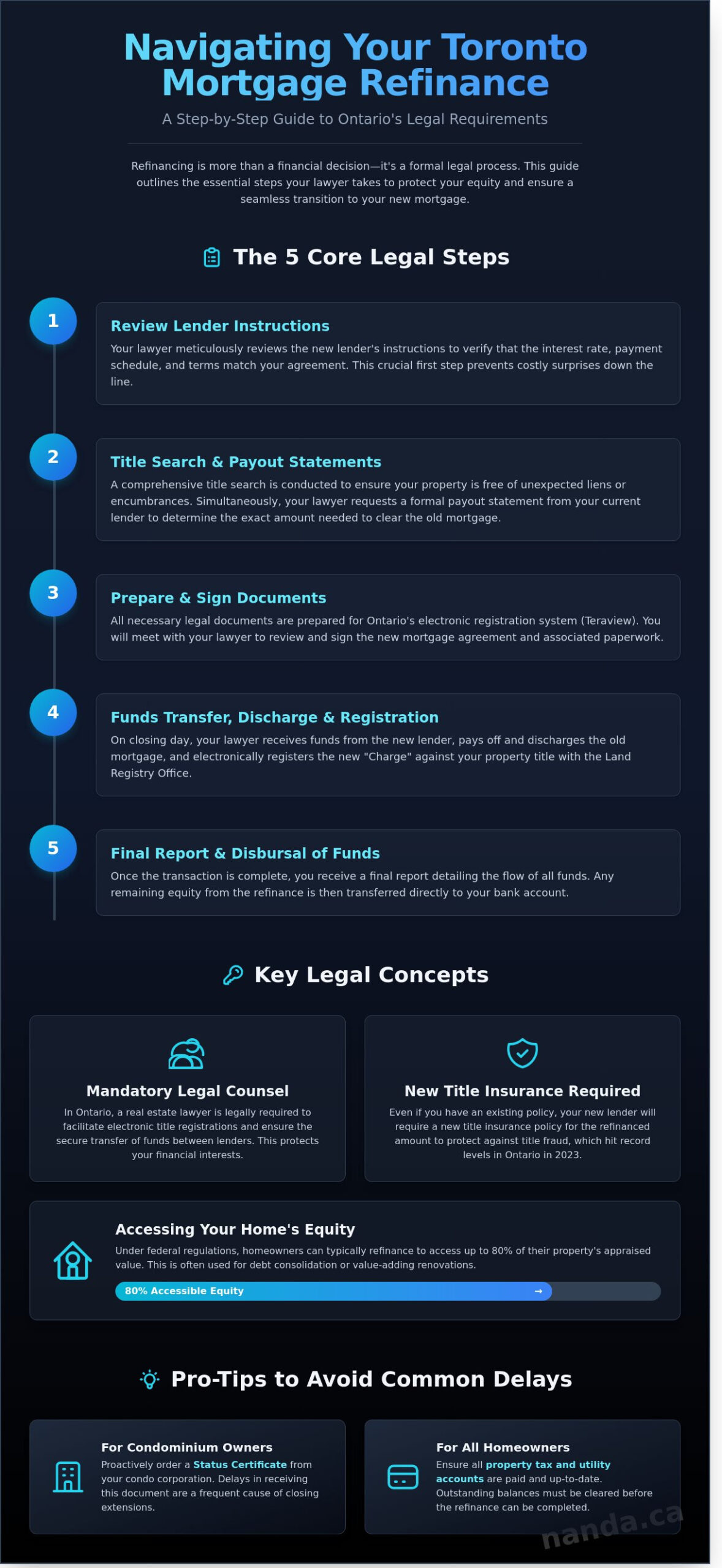
Refinancing involves more than just signing a new contract with a bank; it’s a sophisticated legal process that requires meticulous oversight. Your lawyer’s primary responsibility is to protect your interests while satisfying the new lender’s stringent requirements. We begin by reviewing the lender’s instructions to confirm that the interest rates, payment schedules, and terms match the verbal or written agreements you’ve already made. This step prevents surprises during the final signing.
Once the terms are verified, we prepare the necessary legal documents for the Teraview electronic registration system. This is the platform used across Ontario to register the new mortgage charge against your property. A central part of this process involves managing the Statement of Adjustments. This document provides a transparent breakdown of the new loan, showing exactly how the C$ funds are allocated. It details the payout of the existing mortgage, any property tax adjustments, and the final amount deposited into your account. Understanding the legal framework for refinancing helps homeowners appreciate why these administrative steps are non-negotiable for Canadian financial institutions. Following a Toronto Mortgage Refinance Lawyer: Legal Steps for Refinancing Your Home ensures that your equity remains protected throughout this transition.
Title Searches and Execution Checks
Before a lender advances funds, they must be certain the property title is clear. We perform a sub-search of the title to identify any existing liens or encumbrances that could jeopardize the lender’s priority position. This includes checking for executions or judgments against the borrowers. If a court judgment from 2024 remains unpaid, the lender will typically require it to be settled before the refinance can close. We also verify that property taxes are fully paid to the City of Toronto. Our Toronto real estate lawyers are skilled at identifying “title clouds” that might otherwise delay your funding.
Title Insurance: Protecting the New Lender
While you likely purchased an owner’s title insurance policy when you first bought your home, a refinance requires a new Lender’s Policy. This policy is specific to the new loan amount and the new financial institution. It provides coverage against risks such as title fraud, which has remained a significant concern for Ontario homeowners over the last three years. Title insurance in Ontario serves as a critical shield for lenders, indemnifying them against losses arising from undiscovered title defects or municipal work orders. By securing this policy, we ensure the transaction meets the high standards required by modern lenders. If you’re ready to secure your financial future, our team can help you manage the legal complexities of your refinance.
The Step-by-Step Refinancing Process in Ontario
The transition from one lender to another involves a precise sequence of legal events. It begins when your new bank or credit union sends formal mortgage instructions to our office. These documents outline the specific terms we must meet before funds can be released. A Toronto Mortgage Refinance Lawyer: Legal Steps for Refinancing Your Home ensures these instructions align with your expectations and provincial regulations.
Next, we request a payout statement from your existing lender. This document calculates the exact balance required to discharge your current debt on the closing date, including any per diem interest or prepayment penalties. Recent Canadian government mortgage reforms introduced in late 2024 have changed how some homeowners can access equity, particularly for adding secondary suites, making the timing of these statements even more vital for 2026 refinances.
Our legal team then conducts a thorough title search. We verify that the property title is clear of unexpected liens, executions, or encumbrances. Once the title is confirmed, we prepare the new mortgage documents for your review. During the signing appointment, which we offer via secure video or in-person, we’ll explain the legal implications of the Charge and the standard charge terms. On closing day, the process moves quickly. We receive the funds from the new lender, pay off the old mortgage in full, and register the new Charge on title through the Ontario Land Registry.
The Payout and Discharge Phase
The Discharge of Charge is the legal document that officially removes the old lender’s interest from your property title. It’s a critical step. If a discharge isn’t registered correctly, your title remains “clouded,” which can prevent future sales. Our firm manages this by ensuring the old lender receives the exact payout amount on the scheduled closing date. For those interested in how these processes differ from standard transfers, our Real Estate Lawyers in Toronto provide additional context on property title management in Ontario.
The Closing and Reporting Letter
Once the new mortgage is registered, we provide a final reporting binder. This package includes the registered mortgage deed and a detailed accounting of all funds. As your real estate lawyer in Toronto, we act as the central hub between you, the old bank, and the new lender. This ensures that every dollar is accounted for and your legal interests remain protected throughout the 2026 lending environment.
Practical Advice: Avoiding Delays in Your Toronto Refinance
Efficiency in a refinance depends on meticulous preparation. A Toronto Mortgage Refinance Lawyer: Legal Steps for Refinancing Your Home involves coordinating with lenders, title insurers, and municipal offices. Proactive steps prevent the common administrative bottlenecks that push back closing dates and create unnecessary stress. In 2024, data suggests that administrative oversights accounted for approximately 18% of postponed real estate closings in Ontario. By addressing these requirements early, you ensure the transition to your new mortgage rate is seamless.
Condo-Specific Refinancing Requirements
If you own a Toronto condominium, the Status Certificate is your most critical document. Lenders require this to verify the corporation’s reserve fund health and ensure there are no pending legal actions or special assessments. Under the Ontario Condominium Act, management offices have up to 10 days to deliver this document after a formal request. Order it the moment your application receives conditional approval. For owners who aren’t currently in Ontario, you might need notary public services to authenticate signatures or verify identity documents remotely.
Managing Closing Costs and Disbursements
Homeowners often confuse legal fees with disbursements. Disbursements are out-of-pocket expenses your lawyer pays on your behalf, such as title search fees, execution searches, and government registration costs. These costs are typically deducted directly from your mortgage proceeds before the final balance is deposited into your account. We recommend maintaining a financial cushion of at least C$500 to C$1,000 to cover unexpected adjustments or utility arrears on the closing date. This prevents a shortfall that could stall the registration of your new mortgage.
Ensure your property taxes and utility bills, specifically water and sewer accounts, are paid in full. Lenders won’t fund the loan if there’s a risk of a municipal lien taking priority over their mortgage. You must also provide valid government-issued photo identification. The name on your ID must exactly match the name registered on the property title. If you’ve changed your name due to marriage or other reasons without updating the title, inform your Toronto Mortgage Refinance Lawyer: Legal Steps for Refinancing Your Home immediately to prepare the necessary name change applications.
Transparency regarding existing debts is essential for a smooth closing. If your lender requires specific credit cards or personal loans to be paid out as a condition of the refinance, provide the most recent statements early. Your legal team needs these to calculate exact payout amounts and ensure the remaining funds meet your expectations. Providing these documents at the last minute is a primary cause of funding delays. When you’re ready to secure your financial future through a refinance, book a consultation with our real estate team today.
Conclusion: Securing Your Financial Stability with Nanda & Associate Lawyers
Refinancing your property is a significant financial pivot that requires more than just a favorable interest rate from a lender. It’s a process of restructuring your most valuable asset to better serve your long-term goals. While the bank’s primary role is to provide the capital, your Toronto Mortgage Refinance Lawyer: Legal Steps for Refinancing Your Home serves as the safeguard for your legal interests. We ensure that every document you sign protects your equity and that the transition between lenders is executed without technical errors or hidden liabilities.
At Nanda & Associate Lawyers, we’ve built our practice on a foundation of seamless collaboration. We recognize that legal security is the bedrock of financial peace of mind. Our team doesn’t just process paperwork; we provide a comprehensive oversight that identifies potential risks before they become costly hurdles. Whether you’re consolidating debt or accessing equity for a new investment, our firm ensures the legal framework of your refinance is robust and reliable.
Our commitment to the diverse communities of the Greater Toronto Area is reflected in our ability to serve clients in over 15 languages. This multilingual capability ensures that complex legal concepts are never lost in translation. We believe that every homeowner deserves to fully understand their rights and obligations. By bridging cultural and linguistic gaps, we provide a level of accessibility and comfort that is rare in the legal profession.
Why GTA Homeowners Trust Our Real Estate Team
Since 2003, our firm has delivered strategic solutions for homeowners facing a wide variety of legal challenges. Our deep experience in real estate law across Mississauga and Brampton allows us to anticipate the specific needs of local property owners. We’ve handled thousands of transactions where complex title issues, such as historical liens or restrictive covenants, threatened to delay a refinance. Our lawyers manage these complications with calm confidence, ensuring your closing dates are met and your financial plans stay on track. We don’t believe in one-size-fits-all advice; we provide tailored representation that respects your unique situation.
Book Your Mortgage Refinance Consultation
Taking the next step in your financial journey shouldn’t be stressful. We’ve designed our firm to be a “one-stop” resource for all your legal needs, from the initial title search to the final registration of your new mortgage. Our methodical approach ensures that no detail is overlooked, providing you with the stability you need to move forward. If you’re ready to secure your home’s future, we’re here to help. You can book your mortgage refinance consultation today to speak with a member of our dedicated team. Let us provide the professional legal oversight required to turn your financial goals into a reality.
Securing Your Financial Future Through Strategic Refinancing
Refinancing your property in 2026 requires more than just a lower interest rate; it demands a meticulous approach to the Ontario legal framework. You’ve learned that navigating title discharges and ensuring your new charge is registered correctly through Teraview are critical steps to protect your equity. Avoiding common pitfalls, such as undisclosed liens or registration errors, ensures your transition remains seamless and stress-free. Professional oversight isn’t just a formality, it’s the safeguard that keeps your investment secure during shifting market conditions.
Since 2003, our team has served the Greater Toronto Area by providing clear, sophisticated legal guidance. We understand that every homeowner’s situation is unique, which is why we offer support in over 15 languages to ensure you feel heard and protected. When you work with a Toronto Mortgage Refinance Lawyer: Legal Steps for Refinancing Your Home becomes a structured, predictable process rather than a source of anxiety. Our firm specializes in complex Teraview electronic registrations, giving you the peace of mind that your financial interests are handled by experienced professionals who value your long-term stability.
Book a consultation with our Toronto mortgage refinance lawyers today to begin your application with confidence. Taking control of your home’s equity is a powerful step toward financial freedom, and we’re ready to help you navigate every legal detail.
Frequently Asked Questions
Do I really need a lawyer to refinance my mortgage in Toronto?
Yes, you must retain a Toronto Mortgage Refinance Lawyer: Legal Steps for Refinancing Your Home to complete the transaction because only licensed legal professionals can access the Ontario Land Registry system. We handle the title search, ensure the new lender’s security is registered correctly, and verify that the previous mortgage is legally discharged. This process protects your equity and ensures the new financial agreement is binding and enforceable under provincial regulations.
How long does the legal process for a mortgage refinance take in Ontario?
The legal component usually takes 10 to 14 business days once we receive your formal mortgage instructions from the bank or private lender. This timeline accounts for the 3 to 5 days often required to obtain payout statements from your current financial institution. While we can sometimes expedite the process for urgent files, providing at least two weeks of lead time ensures a seamless transition without late interest penalties.
What documents will my real estate lawyer need from me for a refinance?
We require several specific documents to verify your identity and the property’s status before we can proceed. You must provide two pieces of government issued identification, including one photo ID, along with your most recent property tax bill and a valid home insurance binder showing the new lender as the loss payee. If you’re using the funds to consolidate debt, we also need the current statements for any accounts you intend to pay off during the closing.
Can I refinance my home if there is a lien or judgment on the title?
You can proceed with a refinance, but any existing liens or court ordered judgments must be addressed to provide the new lender with first priority on the title. We work to obtain clear payout figures for these debts and ensure they’re settled directly from the mortgage advance. Resolving these encumbrances is a critical part of the Toronto Mortgage Refinance Lawyer: Legal Steps for Refinancing Your Home to ensure your title is clear for the future.
What is a ‘Statement of Adjustments’ in a mortgage refinance?
This document acts as a financial balance sheet for your transaction, showing the total mortgage amount advanced by the lender minus all required deductions. It lists specific costs like the payout of your existing mortgage, property tax adjustments, legal disbursements, and any debt consolidations. We review this statement with you line by line to ensure you understand exactly how much net cash you’ll receive once the transaction closes.
Is it possible to complete my mortgage refinance signing remotely in Ontario?
You can sign your documents from the comfort of your home using our virtual commissioning process. Since the 2020 emergency orders were made permanent, we’ve used encrypted platforms to verify your identity and witness your signature digitally. This modern approach saves you a trip to our office while maintaining the same high standards of security and legal validity required for Ontario real estate transactions.
What happens if my current lender takes too long to provide a payout statement?
If a lender fails to provide a statement within the standard 5 business day window, it can stall the entire funding process. We mitigate this risk by requesting these documents as soon as you retain our firm and by maintaining direct contact with the bank’s discharge department. If a delay occurs, we’ll communicate with your new lender to see if they’ll accept an estimated figure to keep your closing on schedule.
Does a mortgage refinance affect my existing title insurance policy?
While your original owner’s title insurance policy protects you for as long as you own the home, the new lender requires their own specific coverage for the new loan amount. We arrange this new policy as part of the closing process to protect the lender against title defects or fraud. This ensures your property remains fully protected under the updated financial structure without compromising the coverage you secured when you first purchased the home.
Disclaimer
This content is for general information only and does not constitute legal advice or create a lawyer-client relationship. Every case is different—please consult a qualified lawyer for advice specific to your situation.