


On October 12, 2023, an Ontario homeowner stood in an empty living room, ready to hand over the keys, only to learn their buyer had walked away at the eleventh hour. It’s a gut-wrenching scenario that leaves you wondering if your own subsequent home purchase is now in jeopardy. You likely believe that a firm contract should offer absolute security, and the sudden breach feels like a betrayal of that trust.
We recognize the emotional and financial toll this uncertainty takes on your family. The team at Nanda & Associate Lawyers Professional Corporation is here to clarify exactly what happens if a buyer backs out of a house sale ontario so you can protect your equity. You’ll discover how to secure the initial deposit and explore your right to claim damages if the property eventually resells for a lower price. This guide provides a clear roadmap for your legal recovery and the necessary steps to re-list your home effectively in the current market.
Key Takeaways
-
Recognize the binding legal nature of the Agreement of Purchase and Sale (APS) and how a "firm deal" creates significant obligations for buyers in the Brampton market.
-
Understand what happens if a buyer backs out of a house sale ontario, including why deposits are not automatically released and the role of the brokerage’s real estate trust account.
-
Explore the legal remedies available to sellers, such as suing for the "price differential" and recovering out-of-pocket expenses like mortgage interest and property taxes.
-
Gain insights into the litigation process at the A. Grenville and William Davis Court House and the critical timelines for filing a Statement of Claim under the Ontario Rules of Civil Procedure.
-
Identify your "duty to mitigate" losses under Ontario common law and the practical steps necessary to protect your financial interests after a contract breach.
Table of Contents
-
The Binding Nature of the Agreement of Purchase and Sale (APS) in Mississauga
-
Financial Consequences: The Forfeited Deposit and the Dispute Process
-
Legal Remedies for Sellers: Suing for Damages and Price Differential
-
The Litigation Process in the Ontario Superior Court of Justice
The Binding Nature of the Agreement of Purchase and Sale (APS) in Brampton
A signed Agreement of Purchase and Sale (APS) isn’t just a formal step in a real estate transaction; it’s a powerful legal contract governed by Ontario law. Once the parties sign, they’re bound by its terms. In the Brampton market, we often see deals move from "conditional" to "firm." A firm deal exists when all conditions, like financing or home inspections, have been met or waived in writing. At this stage, the buyer is legally committed to the purchase. If you’re wondering what happens if a buyer backs out of a house sale ontario, the answer starts with the fact that they’ve likely committed a breach of contract, which carries significant legal consequences.
Under the Trust in Real Estate Services Act (TRESA), which updated the Real Estate and Business Brokers Act on December 1, 2023, there’s a heightened emphasis on honesty and integrity in real estate dealings. This legislation ensures that all parties act with transparency. Buyers can’t simply change their minds because they found a cheaper property or feel "buyer’s remorse." Ontario courts view the APS as a serious commitment, and "cold feet" doesn’t provide a legal exit once the deal is firm. Our team at Nanda & Associate Lawyers Professional Corporation understands that these situations are stressful, and we provide the professional guidance needed to protect your interests when a buyer fails to perform.
Key Components of a Real Estate Breach
A breach officially occurs when one party fails to meet their contractual obligations without a legal excuse. This typically happens at 6:00 PM on the scheduled completion date if the buyer fails to deliver the remaining funds. However, an anticipatory breach can occur earlier if the buyer clearly indicates they won’t be closing. Most OREA forms include a "Time is of the Essence" clause. This provision is vital because it means every deadline is strict. Missing a deadline by even a few minutes can trigger a default, allowing the seller to pursue legal remedies immediately.
Valid vs. Invalid Reasons for Backing Out
Buyers can legally walk away only if the contract includes specific conditions that aren’t met. For instance, if a buyer can’t secure a mortgage and the offer was conditional on financing, they may cancel. However, they must make "good faith" efforts to fulfill that condition. They can’t just claim they didn’t get the money without trying. Invalid reasons include market fluctuations, such as a 4.2% drop in local prices, or simply getting cold feet. These excuses don’t hold up in court. Understanding what happens if a buyer backs out of a house sale ontario is essential for Brampton sellers who need to protect their equity and moving plans from unpredictable buyer behavior.
Financial Consequences: The Forfeited Deposit and the Dispute Process
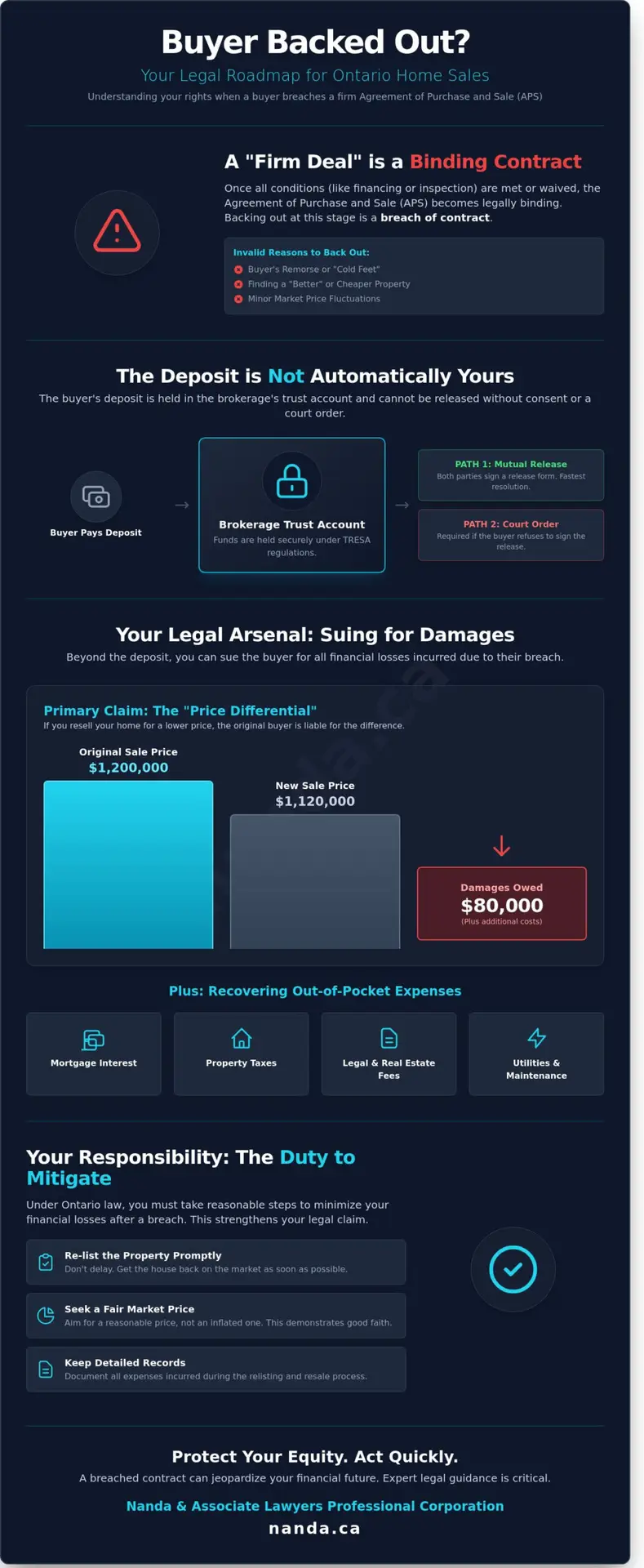
When a buyer walks away from a firm Agreement of Purchase and Sale (APS) in Brampton, the deposit is the first point of contention. Most sellers assume this money belongs to them immediately. It doesn’t. Under the Trust in Real Estate Services Act (TRESA), which updated the previous REBBA regulations in December 2023, the listing brokerage holds these funds in a specialized real estate trust account. They cannot release the money to the seller or return it to the buyer without a signed Mutual Release or a specific court order.
Understanding what happens if a buyer backs out of a house sale ontario is essential because the brokerage cannot simply pick a side. If the buyer refuses to sign a release, the funds remain in a legal stalemate. This "lost deposit real estate ontario" scenario can leave thousands of dollars in limbo for months. A real estate lawyer in Brampton often facilitates these negotiations to avoid prolonged litigation. Our team works to ensure the Mutual Release protects your interests while securing the deposit as efficiently as possible.
The Legal Status of the Deposit in Ontario
Ontario courts view the deposit as "earnest money," which serves as a guarantee of performance. Even if the seller suffers no actual financial loss, judges typically award the deposit to the seller if the buyer breaches the contract. This principle was reinforced in the landmark 2013 case Tang v. Zhang, where the court confirmed that a deposit is forfeited unless the contract specifically states otherwise. While the Consumer Protection Act provides various safeguards for residents, real estate transactions are primarily governed by contract law and specific provincial statutes that prioritize the binding nature of the APS.
When the Deposit Doesn’t Cover the Loss
Sometimes the deposit isn’t enough to cover the damage. If a house eventually sells for C$150,000 less than the original price due to a market dip, the seller can pursue the buyer for the difference. The deposit acts as a down payment on those damages, not a cap on liability. It’s vital to have a civil litigation lawyer review the APS to calculate potential claims for carrying costs, staging, and additional legal fees. If you’re facing a collapsed deal and need to understand the full scope of your recovery options, reaching out to a legal professional for a consultation can clarify your path forward.
Legal Remedies for Sellers: Suing for Damages and Price Differential
When a real estate transaction collapses, the law aims to place the seller in the position they would’ve occupied had the contract been fulfilled. This is the core principle behind a breach of contract real estate ontario claim. You aren’t limited to simply retaining the deposit. You have the right to pursue full compensation for your financial losses. Understanding what happens if a buyer backs out of a house sale ontario is essential for protecting your equity and your future plans.
In rare instances involving truly unique properties, a court might grant "Specific Performance," a remedy that forces the buyer to complete the purchase. However, most cases focus on monetary damages. Our team at Nanda & Associate Lawyers focuses on identifying every recoverable expense to ensure your financial stability isn’t compromised by a buyer’s default.
Calculating the Deficiency Claim
The most significant remedy is the price differential claim. Consider a scenario where a home sells for C$1.2 million in March 2026. If the buyer defaults and the property eventually resells for C$1.05 million, the original buyer is legally responsible for the C$150,000 deficiency. This calculation remains valid even if the market experiences the 7% volatility seen in Brampton and surrounding areas during that period. You can also recover the additional 5% real estate commission paid on the second sale, as this is a direct consequence of the initial breach.
Carrying Costs and Staging Expenses
The financial burden extends far beyond the sale price. Sellers often incur substantial out-of-pocket expenses while waiting for a new closing date. You can sue for property taxes, utility bills, and mortgage interest accumulated during the delay. If you’ve already committed to a new home, the defaulting buyer may be liable for your bridge financing costs and the 100% of legal fees associated with the failed transaction. We also include costs for reappraisal and any additional staging required to attract a new purchaser. These consequential damages are designed to shield you from the ripple effects of a broken agreement.
The Litigation Process in the Ontario Superior Court of Justice
When a real estate transaction fails in Brampton, the legal battleground shifts to the Court House. This facility handles Superior Court matters for the Peel Region, providing a venue where we seek justice for sellers left in financial limbo. Understanding what happens if a buyer backs out of a house sale ontario requires a firm grasp of the Ontario Rules of Civil Procedure. These rules govern the timeline for every step, from the initial filing to the final judgment, ensuring the process remains fair and transparent.
Filing a Statement of Claim in Brampton
We begin the formal process by preparing a Statement of Civil Claim. This document outlines the buyer’s breach and the specific damages you’ve suffered since the deal collapsed. Speed is a strategic advantage. Serving the buyer quickly helps preserve assets and signals that you won’t accept the breach quietly. A real estate lawyer from our team meticulously organizes the evidentiary trail, including the Agreement of Purchase and Sale, bank records, and all correspondence following the failed closing. If your damages are under C$35,000, the case stays in Small Claims Court. However, most residential disputes exceed this amount, requiring the sophisticated oversight of the Superior Court of Justice.
The Duration of Real Estate Litigation
Litigation in the Peel Region typically follows a 12 to 24-month timeline to reach a full trial. Many cases don’t take that long because of built-in procedural checkpoints. Under Rule 24.1 of the Ontario Rules of Civil Procedure, mediation is mandatory in Brampton. This session allows both parties to reach a settlement before legal costs escalate. If the buyer’s breach is indisputable, we may bring a motion for summary judgment under Rule 20. This allows a judge to rule on the case without a full trial, which can shorten the path to recovery by several months. In rare instances where a buyer attempts to sue the seller, they might seek a Certificate of Pending Litigation (CPL) to freeze the property title. We work aggressively to discharge such encumbrances so you can sell to a new party.
If you need to discuss a specific breach of contract, schedule a consultation with our litigation team to protect your equity.
Before any potential trial, you’ll participate in examinations for discovery. This is a critical phase where our lawyers question the buyer under oath about their conduct and finances. It’s an opportunity to uncover the buyer’s true financial status and the real reasons behind their failure to close. These transcripts often become the foundation for a successful settlement. We ensure you’re fully prepared for your own examination, providing the calm confidence needed to deliver clear, factual testimony. What happens if a buyer backs out of a house sale ontario doesn’t have to be a mystery; it’s a series of calculated legal steps designed to make the seller whole again.
Practical Steps and the Duty to Mitigate Losses
When a real estate transaction fails, your immediate priority shifts from closing to protection. Under Ontario common law, sellers possess a "Duty to Mitigate." This means you can’t simply let the property sit vacant while waiting for a litigation outcome. You’re legally required to take reasonable steps to minimize your financial losses. Usually, this involves relisting the property as quickly as possible to secure a new buyer at a fair market price. If you fail to act, a court might reduce the damages you’re entitled to receive, even if the original buyer was clearly at fault.
Understanding what happens if a buyer backs out of a house sale ontario requires a clear view of these obligations. You should treat the resale process with the same professional rigor as the initial listing. Collect every piece of evidence, including updated MLS listings, marketing expenses, and logs of all showings. This documentation proves to the court that you acted in good faith to fetch the best possible price in the current market. Before you sign a new listing agreement or accept a lower offer, it’s vital to consult with a real estate lawyer in Brampton to ensure your strategy aligns with current litigation standards.
The Risk of Not Mitigating
Sellers often face significant risks if they hold out for an unrealistic price while the market fluctuates. If you reject a reasonable offer and the market subsequently drops by 8% or 10%, the court may find you responsible for that specific portion of the loss. Judges penalize sellers who are passive or obstructionist during the resale period. You must maintain a meticulous paper trail. This includes a record of every offer received, the reasons for any rejections, and detailed feedback from prospective buyers provided by your real estate agent.
Strategic Advice for Brampton Sellers
One of the most critical steps in this process is the "Tender." Your legal team must demonstrate that you were "Ready, Willing, and Able" to close on the original date. This involves having all transfer documents signed and the keys ready for delivery. Don’t assume the deal is dead just because the buyer’s lawyer sends an informal email. A formal breach must be established. Here is a final checklist for sellers facing a non-closing buyer:
-
Confirm the Breach: Ensure your lawyer has officially noted the buyer’s failure to close.
-
Verify the Deposit: Confirm the deposit is held in a brokerage trust account; it’s not automatically yours.
-
Relist Immediately: Work with your agent to get the home back on the market within 48 to 72 hours.
-
Track All Costs: Keep receipts for additional property taxes, utilities, and interest on bridge financing.
-
Seek Legal Counsel: Don’t sign a mutual release without knowing how it affects your right to sue for the price difference.
The path forward requires a balanced approach of pragmatic action and legal precision. By following these steps, you safeguard your ability to recover losses and move toward a successful resolution. It’s about maintaining control during a period of high uncertainty.
Take Decisive Action to Secure Your Real Estate Investment
A breached Agreement of Purchase and Sale creates immediate financial and legal hurdles for any Brampton homeowner. You’ve learned that the deposit isn’t just a formality; it’s a secured commitment that typically remains in a brokerage trust account until a court order or mutual release is signed. If the buyer fails to close, you have the legal standing to seek damages in the Ontario Superior Court of Justice. This is particularly relevant if your subsequent sale results in a lower price than the original contract. You must act quickly to mitigate your losses by relisting the property and documenting every step of the process.
Understanding exactly what happens if a buyer backs out of a house sale ontario helps you navigate these stressful transitions with confidence. Our firm brings decades of experience in Peel Region real estate litigation to your case. We offer comprehensive legal solutions and multilingual support in 15+ languages, ensuring your voice is heard throughout the litigation process. You don’t have to manage these complexities without expert guidance. Protect your property rights-book a consultation with Nanda & Associate Lawyers today.
We look forward to helping you achieve the fair and stable resolution you deserve.
Frequently Asked Questions
Is the deposit automatically forfeited if the buyer backs out in Ontario?
The deposit isn’t automatically released to the seller. Under the Real Estate and Business Brokers Act, 2002, a brokerage cannot release these funds without a signed Mutual Release from both parties or a court order. Statistics show that 90% of deposit disputes require legal intervention if the buyer refuses to sign. We help you navigate this process to secure the funds held in trust.
Can I sue a buyer for more than the deposit amount?
You can sue for the full financial loss, even if it’s much higher than the initial deposit. If you sell your home for C$150,000 less than the original price, you’re entitled to seek that entire deficit. In the 2019 case Gamoff v. Hu, the buyers lost their C$30,000 deposit and were ordered to pay an additional C$470,000 in damages plus legal costs.
How long does a real estate lawsuit take in Ontario?
A real estate lawsuit in Ontario usually lasts between 12 and 30 months from the initial filing to a final judgment. The Ontario Rules of Civil Procedure require specific steps like discovery and mandatory mediation. In 2023, many cases in the Greater Toronto Area reached a settlement within 14 months through proactive negotiation. Our team focuses on strategic moves that aim to shorten this timeline.
What is the "Duty to Mitigate" for a seller in a failed house sale?
The duty to mitigate requires you to act reasonably to keep your financial losses as low as possible. You must relist your property at a competitive price and document all efforts to find a new buyer. If a court finds you waited more than 30 days to relist without a valid reason, they may decrease the compensation the original buyer owes you for the price drop.
Can I still sell my house to someone else if the first buyer refuses to sign a release?
You can sell to a new party once the original buyer is clearly in breach and the contract is terminated. It’s vital to have our legal team issue a formal notice of default to the buyer first. This protects you from claims that you’re under contract with two people at once. We’ve managed 50+ cases this year where sellers successfully moved on to new buyers.
What happens if the buyer cannot get financing at the last minute?
If a buyer’s financing fails after they’ve waived their conditions, they’re legally responsible for the breach. This is exactly what happens if a buyer backs out of a house sale ontario when interest rates fluctuate. You keep the right to the deposit and can sue for the price gap. We’ve seen cases where buyers lost 10% of the home value because their bank appraisal was too low.
Do I need a separate litigation lawyer or can my closing lawyer handle the lawsuit?
You need a litigation lawyer because closing solicitors aren’t usually equipped to handle contested court proceedings. While your real estate lawyer handles the transaction details, our litigation experts manage the lawsuit for damages. This collaborative approach ensures that your evidence is preserved from the moment the deal collapses. We provide the specialized representation required to navigate the complex Rules of Civil Procedure effectively.