


Key Takeaways
-
Identify the critical 15, 30, or 60-day deadlines immediately to ensure you do not lose your legal right to challenge an IRCC decision.
-
Analyze the specific grounds of your refusal under the Immigration and Refugee Protection Act (IRPA) to distinguish between simple clerical errors and complex legal issues.
-
Determine exactly what to do after receiving an immigration refusal letter by weighing the strategic benefits of a re-application against a formal appeal or Judicial Review.
-
Navigate the Mississauga appeal process with confidence by understanding the necessary steps for filing a Notice of Appeal and reviewing the official Record of Proceeding.
-
Learn how experienced immigration lawyers can help you overcome "dual intent" concerns and draft persuasive submissions that protect your status in Canada.
Table of Contents
-
Immediate Steps After Receiving an Immigration Refusal in Mississauga
-
Re-application vs. Appeal vs. Judicial Review: Choosing Your Path
-
The Timeline and Process for Immigration Appeals in Mississauga
-
How an Immigration Lawyer in Mississauga Can Overturn Your Refusal
On November 14, 2023, a dedicated professional in Mississauga opened an email from Immigration, Refugees and Citizenship Canada (IRCC) expecting a life-changing approval, but they found a standard refusal template instead. It’s a heartbreaking moment that leaves many wondering about their future and the thousands of dollars already spent on processing fees. If you’re in this position, knowing what to do after receiving an immigration refusal letter is the most critical step you’ll take to remain in Canada. You’ve worked too hard to let a single document end your journey.
Our immigration lawyers understand that the vague reasons provided in these letters often cause more confusion than clarity. At Nanda & Associate Lawyers, we believe that a refusal isn’t necessarily the end of your Canadian dream; it’s often just a signal to change your legal strategy. This guide provides the exact 15 to 60 day timelines, legal pathways under the Immigration and Refugee Protection Act, and professional strategies needed to challenge an IRCC decision effectively. You’ll discover whether a Federal Court judicial review or a robust re-application is the right path to secure your future.
Immediate Steps After Receiving an Immigration Refusal in Mississauga
Don’t let a refusal letter derail your future in Canada. While the news is disheartening, it’s often just the beginning of a more rigorous legal process rather than a final verdict. When you’re deciding what to do after receiving an immigration refusal letter, your first move should be to remain calm and methodical. Panic leads to rushed re-applications that often result in a second refusal for the same reasons. Instead, treat this as a signal to shift your strategy toward a formal legal review.
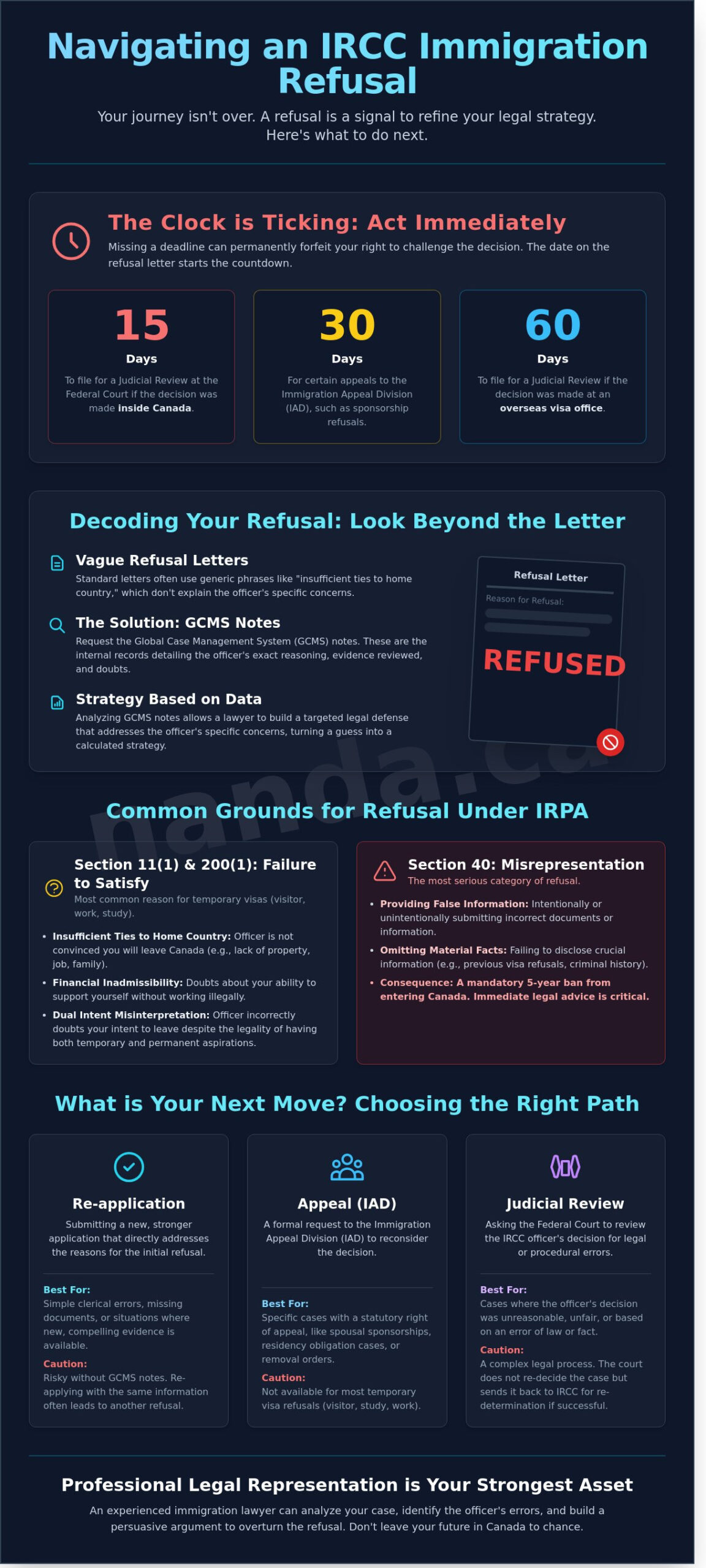
Timing is the most critical factor in these situations. The Immigration and Refugee Protection Act (IRPA) and associated regulations set strict windows for action. Depending on your case, you might have only 15 days to file for a judicial review if you’re inside Canada, or 60 days if the decision was made at an overseas visa office. Some appeals to the Immigration Appeal Division (IAD) allow 30 days. If you miss these deadlines by even 24 hours, you could permanently forfeit your right to have the decision reviewed by a higher authority.
You must also verify your current status immediately. If you’re currently in Mississauga on a temporary permit that’s about to expire, a refusal can trigger a loss of status. Maintaining legal residency is vital for any future application or appeal. We recommend keeping all original IRCC correspondence, including the envelopes, as proof of service dates.
Preserving the Right to Appeal
The date printed on your refusal letter serves as the official start of your legal timeline. It’s a common mistake to assume the clock starts when you read the email or pick up the mail. It doesn’t. Missing a deadline is one of the few errors that even the most skilled legal team can’t always fix. Save every digital timestamp and physical document. These records are essential evidence if a dispute arises regarding whether an appeal was filed on time.
Requesting GCMS Notes for Clarity
Standard refusal letters are notoriously vague, often citing broad reasons like "insufficient ties to home country." To fight back, you need the Global Case Management System (GCMS) notes. These are the internal records where the visa officer details their specific reasoning and concerns. A Mississauga immigration lawyer uses these notes to pinpoint exactly where the officer may have overlooked evidence or misapplied the law. Without these notes, a re-application is just a guess; with them, it’s a targeted legal defense. Our team analyzes these notes to build a comprehensive strategy that addresses the officer’s specific doubts, ensuring your next move is based on data rather than assumptions.
Decoding the Refusal Letter: Common Grounds Under the IRPA
Understanding the legal basis of a rejection is the first step in determining what to do after receiving an immigration refusal letter. Most refusals in Mississauga hinge on Section 11(1) of the Immigration and Refugee Protection Act (IRPA). This section mandates that every foreign national must satisfy an officer that they aren’t inadmissible and meet the requirements of the Act. Officers frequently cite a lack of "ties to home country" as the reason for denial. They look for concrete evidence like property deeds, employment contracts, or family obligations that prove you’ll return home. While "dual intent" is legally recognized, allowing you to seek permanent residence while applying for a temporary visa, officers often use it as a reason to doubt your departure. If your financial documents don’t show a stable history over the last 180 days, you may also face a refusal based on financial inadmissibility.
Section 40 of the IRPA covers misrepresentation, which is the most critical refusal category. If an officer finds you provided false information or omitted a material fact, you face a mandatory five-year ban from entering Canada. This applies even if the error was unintentional. When facing such high stakes, consulting with immigration lawyers in Mississauga can help you address these allegations before the ban becomes permanent.
Section 200(1) and Temporary Resident Requirements
Work and study permit applications often fall short under Section 200(1) of the Immigration and Refugee Protection Regulations (IRPR). Officers use subjective judgment to decide if you’re truly capable of performing the work or if your "purpose of visit" is genuine. They evaluate your previous education and work history to see if the Canadian opportunity makes logical sense for your career path. If the officer feels your plan is inconsistent, they’ll refuse the permit based on their discretionary power under the IRPR.
The Burden of Proof on the Applicant
The legal burden of proof rests entirely on you, not the government. An officer isn’t required to request missing documents; they make decisions based solely on what you submitted. A "lack of evidence" is the most common pitfall for Mississauga applicants. For instance, failing to provide a certified translation of a single document can lead to an immediate rejection. If you believe the officer’s decision was factually or legally incorrect, you might need to pursue the judicial review process through the Federal Court to challenge the ruling.
To avoid common pitfalls, ensure your application includes these frequently missed items:
-
Six months of detailed bank statements showing a clear source of funds.
-
A tailored Statement of Purpose that addresses your specific ties to your home country.
-
Proof of previous international travel to "trusted" traveler countries like the UK or USA.
-
Affidavits from family members confirming your responsibilities back home.
If you’re unsure why your application was denied, our immigration legal team can help you analyze your refusal letter to find a path forward.
Re-application vs. Appeal vs. Judicial Review: Choosing Your Path
Deciding what to do after receiving an immigration refusal letter requires a cold, analytical look at the officer’s Global Case Management System (GCMS) notes. You have four primary avenues, each governed by the Immigration and Refugee Protection Act (IRPA). The choice depends entirely on the nature of the error and the type of application you submitted. Our team often sees clients who feel overwhelmed by these choices, but a structured approach can clarify the next steps.
-
Re-application: This is often the fastest route for temporary resident visas or study permits where the refusal stemmed from missing financial proof or a weak study plan.
-
Immigration Appeal Division (IAD): This tribunal handles specific cases like family sponsorship refusals or residency obligation failures. You can find detailed steps on making an immigration appeal through the official IRB website.
-
Judicial Review: If the decision was legally flawed or procedurally unfair, you challenge it at the Federal Court of Canada.
-
Reconsideration: While tempting, these informal requests rarely succeed unless there’s an obvious administrative slip-up or a clear legal threat.
When to Simply Re-apply
If your refusal letter highlights a simple lack of evidence, such as an unsigned form or an outdated bank statement, re-applying is usually the most cost-effective solution. It avoids the 6 to 12 month wait times common in litigation. However, submitting the exact same package again is a recipe for a second rejection. You must address every concern raised by the previous officer with fresh, corroborating evidence. Engaging an immigration lawyer helps ensure your second attempt is robust enough to overcome the initial "red flags" identified by the IRCC. We’ve helped many Mississauga residents turn a "no" into a "yes" by simply fixing technical gaps in their original filings.
The Federal Court Judicial Review Process
When a decision is unreasonable or the officer ignored vital evidence, the Federal Court provides a mechanism for accountability. This two-stage process begins with a "Leave" application, where the court decides if your case has merit. If granted, a formal hearing follows. It’s vital to understand that the judge won’t look at new evidence; they only review the record available to the officer at the time of the decision. Because this involves complex legal arguments regarding "procedural fairness," many applicants rely on civil litigation lawyers to draft the necessary memorandums. A successful review doesn’t grant your visa; it forces a different officer to re-evaluate your file fairly. Understanding what to do after receiving an immigration refusal letter in these high-stakes scenarios often means moving beyond the IRCC and into the court system.
The Timeline and Process for Immigration Appeals in Mississauga
Time is your most valuable asset when determining what to do after receiving an immigration refusal letter. Under the Immigration and Refugee Protection Act (IRPA), you generally have a strict 30 day window from the date you receive your refusal to file a Notice of Appeal with the Immigration Appeal Division (IAD). This deadline is non negotiable. Missing it often results in the loss of your right to appeal within this forum. Once the notice is filed, the Minister’s office typically has 45 days to provide the Record of Proceeding. This document contains every note, email, and document the visa officer used to make their decision. We review this record meticulously to identify the specific legal or factual errors that led to your refusal.
Before a formal hearing, many Mississauga residents are invited to an Alternative Dispute Resolution (ADR) conference. This is an informal meeting where we sit down with a Dispute Resolution Officer and the Minister’s Counsel to see if a settlement is possible. Statistics suggest approximately 30 to 40 percent of sponsorship appeals resolve at this stage, saving clients months of waiting. If ADR doesn’t resolve the matter, your case moves to a formal hearing before an IAD member.
Preparing Your Evidence Bundle
Unlike a Judicial Review in Federal Court, which only examines the evidence already on file, an IAD appeal allows you to introduce fresh evidence. This is vital for showing how your circumstances have changed since the initial application. We help you compile a comprehensive bundle that includes expert reports, updated financial records, and detailed witness testimony. We also emphasize Humanitarian and Compassionate (H&C) factors. Under Section 25 of the IRPA, IAD members can consider the best interests of a child or the hardship you’d face if the refusal stands, providing a powerful legal pathway to overcome standard eligibility requirements.
What Happens at an IAD Hearing?
An Ontario immigration hearing feels formal but is designed to be a search for the truth. You’ll face the Minister’s Counsel, a representative who acts as the prosecution to defend the original refusal. They’ll cross examine you and your witnesses. Our role is to protect your interests, ensuring your story is told clearly and that legal arguments are framed correctly. While the hearing itself may last 3 to 6 hours, the journey from filing to a final decision often spans 10 to 14 months. Having a dedicated immigration lawyer in Mississauga ensures you aren’t walking into this high stakes environment alone.
Don’t let a strict deadline end your immigration journey. Contact our team today to begin building your appeal strategy. Book a consultation with our Mississauga experts.
How an Immigration Lawyer in Mississauga Can Overturn Your Refusal
Determining what to do after receiving an immigration refusal letter requires more than just a second look at your initial forms. At Nanda & Associate Lawyers, our process begins with a rigorous strategic analysis of the officer’s internal notes. We often obtain the Global Case Management System (GCMS) records to identify the exact point where the application failed. This data-driven approach allows us to assess whether a re-application or a Judicial Review holds a higher probability of success, ensuring you don’t waste time on ineffective strategies.
Our lawyers draft persuasive legal submissions that go beyond simple explanations. We ground every argument in the Immigration and Refugee Protection Act (IRPA) and relevant case law. For example, the 2019 Supreme Court of Canada decision in Canada (Minister of Citizenship and Immigration) v. Vavilov fundamentally changed how courts review administrative decisions. We apply these precedents to challenge unreasonable refusals. We also manage the strict timelines set by the Federal Court. Missing a 15-day deadline for domestic refusals or a 60-day window for overseas cases can result in a permanent loss of your right to appeal. Our team provides peace of mind by handling these complex procedural requirements with precision.
-
GCMS Analysis: We uncover the hidden reasons behind a "boilerplate" refusal letter.
-
Legal Precedent: We cite specific Ontario and Federal Court rulings to support your case.
-
Timeline Management: We ensure all filings meet the 15, 30, or 60-day statutory limits.
-
Direct Representation: We act as your authoritative voice when communicating with IRCC or the Immigration Appeal Division.
The Benefit of Multidisciplinary Expertise
Nanda & Associate Lawyers operates as a collaborative powerhouse where shared knowledge strengthens every case. Complex immigration files often intersect with other legal areas. For instance, certain issues in family law, such as custody arrangements or divorce proceedings, can directly impact the validity of a spousal sponsorship appeal. Our team-based approach ensures that every angle of your life in Mississauga is protected. We understand the specific nuances of Ontario courts and the local legal environment, providing a seamless experience for our clients.
Your Next Steps Toward Success
Attempting a "DIY" fix after a refusal often compounds the original errors and can lead to findings of misrepresentation. Professional intervention provides the strategic depth needed to overturn a negative decision and secure your future. We remain committed to providing tailored legal solutions that prioritize your long-term stability. If you’re unsure about what to do after receiving an immigration refusal letter, let our experience be your guide. We invite you to book a consultation today to have our team review your refusal letter and build a decisive path forward.
Take the Next Step Toward Your Canadian Residency
Receiving a negative decision from IRCC feels like a heavy setback, but it isn’t the end of your journey. You now understand the critical legal differences between a simple re-application and a formal judicial review under the Immigration and Refugee Protection Act. Knowing what to do after receiving an immigration refusal letter allows you to move from a state of uncertainty to a structured legal strategy. Since 2003, our team has served the Mississauga community by navigating the complexities of IRPA and IRPR legislation with precision. We provide comprehensive legal solutions in over 15 languages, ensuring every client feels heard and protected throughout the process. Our collaborative approach focuses on identifying specific legal errors to build a stronger case for your residency. Don’t let a strict deadline pass you by. Professional representation is often the deciding factor in successfully overturning a refusal. Reach out to our dedicated team to explore your options and regain your peace of mind.
Book a Consultation to Review Your Refusal Letter
We look forward to helping you secure your future in Canada with confidence and clarity.
Frequently Asked Questions
How long do I have to appeal an immigration refusal in Ontario?
You have exactly 30 days to file a notice of appeal with the Immigration Appeal Division (IAD) if you’re a permanent resident or sponsor inside Canada. If your case involves a Judicial Review at the Federal Court, the deadline is even tighter at 15 days for decisions made within Canada. For those receiving a refusal while outside the country, the timeline to initiate a Federal Court review extends to 60 days. Missing these statutory deadlines under the Immigration and Refugee Protection Act usually results in the loss of your right to challenge the decision.
Can I stay in Canada while my immigration appeal is being processed?
Your ability to stay depends entirely on whether you have valid temporary resident status at the moment of refusal. A refusal letter doesn’t grant you "maintained status" or a right to stay; it often marks the end of your legal authorization. If your permit expires during the process, you might need to apply for a Stay of Removal to prevent deportation. We work with clients to determine if they qualify for an administrative deferral or a court-ordered stay to ensure they remain in Mississauga while we fight their case.
Is it better to re-apply or appeal after a study permit refusal?
Re-applying is generally the faster route if the refusal was based on missing documents or a lack of financial evidence that you can easily correct. Since study permit refusal rates for some programs reached 40 percent in 2023, a fresh application with stronger evidence often yields a quicker result. However, an appeal or Judicial Review is necessary if the officer made a fundamental legal error or ignored evidence that was already provided. Deciding what to do after receiving an immigration refusal letter for a study permit requires a technical review of the officer’s internal GCMS notes.
What is the success rate of a Judicial Review for Canadian immigration?
Data from the Federal Court of Canada shows that approximately 15 to 20 percent of applicants are granted "leave" to have their case heard in a full hearing. Once the court grants leave, the success rate for the applicant at the actual hearing rises to nearly 50 percent. It’s important to understand that a "win" at Federal Court doesn’t mean you get your visa immediately. Instead, the court sets aside the refusal and orders a different officer to re-examine the application with a fresh perspective.
Do I need a lawyer for an immigration appeal, or can I represent myself?
You aren’t legally required to hire a lawyer, but representing yourself in a complex tribunal or court setting is statistically risky. Over 80 percent of successful appellants at the Immigration Appeal Division use professional legal counsel to handle cross-examinations and legal submissions. Our team provides the authoritative representation needed to navigate the Ontario Rules of Civil Procedure and the specific requirements of the Immigration and Refugee Protection Act. We ensure your testimony is prepared and your evidence is presented in a way that meets high judicial standards.
What happens if my spousal sponsorship is refused in Mississauga?
If your spousal sponsorship is refused, you typically have 30 days to file an appeal with the IAD to save your application. This is a de novo hearing, which means you can introduce new photos, messages, and financial records that didn’t exist when you first applied. In the Mississauga and GTA region, these hearings can take between 12 and 24 months to reach a final decision. Knowing what to do after receiving an immigration refusal letter for a spouse is vital for families who want to avoid the long delays of starting a brand new application.
Can I add new documents to my application after it has been refused?
You cannot add new evidence during a Federal Court Judicial Review because the judge is only allowed to look at what the officer saw at the time of the decision. However, the Immigration Appeal Division (IAD) specifically allows for new evidence to be introduced during the hearing process. If you choose to submit a brand new application instead of appealing, you can include any new documents that address the previous grounds for refusal. We help you decide which path allows for the inclusion of the strongest possible evidence for your specific situation.
What is the difference between an IAD appeal and a Federal Court review?
An IAD appeal is a merit-based hearing where a member of the board looks at the facts of your life and can change the decision based on compassion or new evidence. A Federal Court review is a much narrower process that only checks if the visa officer followed the law and acted reasonably. The Federal Court won’t look at new facts; it only determines if the original process was fair. Most Mississauga residents use the Federal Court for work or study permit refusals, while the IAD handles sponsorship and residency obligation cases.
Disclaimer
This content is for general information only and does not constitute legal advice or create a lawyer-client relationship. Every case is different—please consult a qualified lawyer for advice specific to your situation.