Key Takeaways
-
Understand the foundational principles of wills and estates law in Ontario to ensure your final wishes are legally enforceable and your assets are protected.
-
Navigate the complexities of the Succession Law Reform Act and the Estates Act to maintain full compliance with provincial legal frameworks.
-
Identify the critical risks associated with DIY will kits and how professional legal representation prevents costly litigation and technical errors.
-
Learn the essential steps for managing the probate process in Mississauga, including applying for a Certificate of Appointment at the Peel Region court.
-
Protect your business interests and long-term legacy through strategic planning and the implementation of comprehensive Powers of Attorney.
Table of Contents
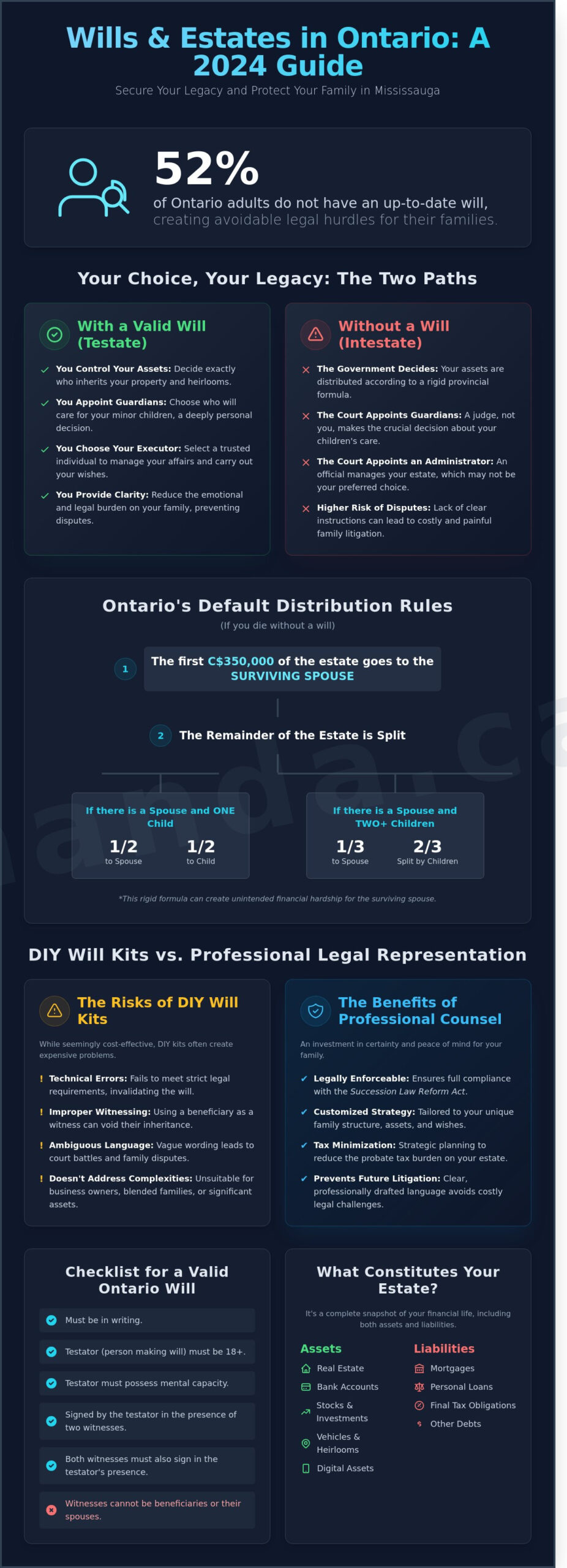
Recent 2024 data suggests that nearly 52% of Ontario adults don’t have an up to date will, which often leads to avoidable legal hurdles for their survivors. You’ve worked hard to build your assets, and it’s natural to feel concerned about how the wills and estates process might impact your family’s future. We understand that the fear of high probate taxes or the risk of family disputes can make starting this journey feel daunting. You aren’t alone in wanting to ensure your legacy remains intact and your children are cared for without unnecessary stress.
This guide provides the clarity you need to navigate the complexities of Ontario estate law with confidence. You’ll gain expert insights into drafting a robust will that minimizes the tax burden on your beneficiaries while protecting your family legacy right here in Mississauga. We’ll walk through the current requirements of the Succession Law Reform Act and explain the local probate process so you can move forward with a clear, strategic plan for the years ahead.
Understanding Wills and Estates in Mississauga
In the legal context of Ontario, an estate represents the sum total of every asset, piece of property, and financial liability you leave behind. While many people associate wills and estates with extreme wealth, the reality is that anyone owning a home or holding a bank account in Mississauga needs a structured plan. A Last Will and Testament serves as your primary tool for ensuring your final wishes carry legal weight. Without this document, your legacy is subject to the rigid formulas of the Succession Law Reform Act, which may not reflect your personal values or family needs.
Mississauga residents deal with specific pressures that make professional planning vital. With the average residential property price in the city hovering around C$1,040,000 as of early 2024, even a "simple" estate involves significant tax implications and valuation challenges. We often see families navigating the complexities of diverse structures, including blended families or dependents living abroad. The distinction between dying "testate" (with a valid will) and "intestate" (without one) is the difference between maintaining control and letting the government distribute your assets based on a pre-set legal template.
What Constitutes an Estate in Ontario?
Your estate is a comprehensive snapshot of your financial life at the time of your passing. It includes tangible assets like Mississauga real estate, vehicles, and heirlooms. It also covers intangible assets, such as bank accounts, stocks, and digital footprints like cryptocurrency or monetized social media accounts. Crucially, an estate also includes liabilities. We ensure our clients account for mortgages, personal loans, and final tax obligations. This prevents heirs from inheriting a complex web of debt that could erode their intended inheritance. A clear accounting of wills and estates helps protect the net value passed to the next generation.
Why a Formal Will is Essential for Family Protection
A formal will is the only way to bypass the Ontario government’s default distribution rules. Under current laws updated in 2021, if you die without a will, the first C$350,000 goes to a surviving spouse, with the remainder split between the spouse and children. This rigid split often creates unintended financial hardship for the survivor. By working with wills and estate lawyers Mississauga, you can customize these allocations to suit your family’s actual needs.
Planning ahead provides several key protections for your loved ones:
-
Guardianship: You can name guardians for minor children, preventing the court from making this deeply personal decision.
-
Asset Control: You decide exactly who receives specific family heirlooms or properties.
-
Emotional Clarity: A clear will reduces the burden on grieving family members, preventing disputes that often lead to litigation.
-
Executor Appointment: You choose a trusted individual to manage your affairs rather than leaving it to a court-appointed administrator.
Taking these steps creates a sense of security and ensures your family doesn’t face unnecessary legal hurdles during a period of intense grief.
The Legal Framework Governing Ontario Estates
Ontario’s legal system for wills and estates relies on two primary pillars: the Succession Law Reform Act (SLRA) and the Estates Act. These statutes create a structured environment to ensure a person’s final wishes are honored while protecting the rights of survivors. For a will to be considered valid in Mississauga, it must meet strict criteria set out in the SLRA. The person making the will, known as the testator, must be at least 18 years old and possess the mental capacity to understand the document’s nature and effect. Additionally, the document requires the signatures of two adult witnesses who are present at the same time as the testator. These witnesses cannot be beneficiaries or the spouses of beneficiaries, as this would void their specific inheritance under Section 12 of the SLRA.
The Superior Court of Justice plays a central role in this framework. It’s the body responsible for issuing the Certificate of Appointment of Estate Trustee, formerly known as probate. This court oversight ensures that the estate is handled according to the law and provides a forum for resolving disputes if a will is challenged. We understand that the intersection of these laws can feel overwhelming, but they exist to provide a stable foundation for your family’s future security. If you have questions about your current documents, you can schedule a professional review to ensure your plan meets every legal requirement.
Navigating the Succession Law Reform Act (SLRA)
The SLRA does more than just dictate how a will is signed; it defines the support obligations a deceased person owes to their dependants. Under Part V of the Act, if a person dies without providing "adequate provision" for a spouse, parent, or child they were supporting, the court can freeze the distribution of assets to provide for those individuals. Significant legislative updates on January 1, 2022, changed how life transitions impact your planning. Marriage no longer automatically revokes an existing will in Ontario, which means an outdated plan could accidentally exclude a new spouse. Conversely, separated spouses may now be treated as though they predeceased the testator, effectively barring them from inheriting unless a new will explicitly states otherwise. These nuances require a sophisticated approach to wills and estates to avoid unintended litigation.
Estate Trustees and the Estates Act
The Estates Act governs the practical administration of assets, placing a heavy burden on the Estate Trustee. This individual holds a fiduciary duty, which is the highest standard of care recognized by Ontario law. They’re required to act with total transparency and prioritize the interests of the beneficiaries above their own. Their responsibilities include:
-
Identifying and valuing all estate assets, from real estate to digital accounts.
-
Paying off all valid debts and funeral expenses.
-
Filing terminal tax returns with the Canada Revenue Agency.
-
Distributing the remaining assets according to the will or the laws of intestacy.
Because the personal liability for an Estate Trustee is high, our wills and estate lawyers Mississauga provide essential guidance to ensure trustees meet their fiduciary obligations without error. We help navigate the complex filings required by the Estates Act, providing the peace of mind that the estate is being managed with professional precision.
Professional Legal Representation vs. DIY Will Kits
The primary objection to professional legal services is usually the initial investment. However, a cheap kit is often the most expensive choice a person can make. In Ontario, the legal landscape for wills and estates is governed by the Succession Law Reform Act, which demands strict adherence to formality. A single technical error in how a document is signed can render an entire estate plan void. This forces the estate into probate litigation, where legal costs quickly climb. We’ve seen families spend months in court because a DIY template didn’t clearly define an executor’s powers or failed to include a residuary clause. While a kit might cost C$50 today, the resulting litigation can easily exceed C$50,000, depleting the very inheritance you intended to protect.
Professional drafting goes beyond filling in blanks on a digital form. It involves a strategic analysis of your financial landscape. We look at advanced tax strategies, such as the use of dual wills to minimize Estate Administration Tax (EAT). In Ontario, EAT is calculated at approximately 1.5% on estate values over C$50,000. By using a Secondary Will for assets that don’t require probate, such as private company shares or certain personal belongings, we help clients save thousands of dollars. Protecting your legacy requires this level of sophisticated planning that online algorithms simply can’t replicate. Our goal is to provide comprehensive legal solutions that ensure your assets pass to your loved ones with minimal government interference.
Common Pitfalls of Generic Online Templates
Execution errors are the leading cause of invalid wills in Mississauga. Ontario law requires two witnesses to be physically present at the same time as the testator during the signing. DIY users often fail this step; they might have witnesses sign at different times or use witnesses who are also beneficiaries. This mistake can void a gift to that specific person or invalidate the entire document. Ambiguous language is another frequent hurdle. Terms like "my personal effects" or "my close relatives" are legally vague and invite challenges from disgruntled family members. Additionally, generic kits rarely account for international assets. If you own property in Florida or India, a standard Ontario template might not meet foreign legal requirements, leaving your executors in a logistical deadlock.
The Advantage of a Multidisciplinary Legal Team
Effective estate planning doesn’t happen in a vacuum. It overlaps significantly with real estate law, especially for Mississauga homeowners whose primary residence is their most significant asset. Our team ensures your property titles and joint tenancy agreements match your testamentary goals. We also coordinate with family law experts to address how life changes affect your wills and estates. For instance, since January 1, 2022, marriage in Ontario no longer automatically revokes an existing will, but separation now has different impacts on inheritance rights than it did in previous years. By housing business, family, and estate experts under one roof, we offer a "one-stop" benefit. This integrated approach ensures your business succession plan, your real estate holdings, and your personal legacy are all synchronized and secure.
The Estate Administration and Probate Process in Mississauga
Managing the legal aftermath of a death requires a methodical approach to ensure the deceased’s final wishes are honored. The process of wills and estates administration in Ontario follows a specific sequence designed to protect beneficiaries and creditors alike. It begins with locating the original will and identifying the named Estate Trustee. This individual holds the fiduciary responsibility to manage assets, pay liabilities, and distribute the remaining estate. If there isn’t a will, the court appoints an administrator under the Estates Administration Act to handle these duties.
-
Step 1: Secure the original will and verify its validity with legal counsel.
-
Step 2: Submit an application for a Certificate of Appointment of Estate Trustee to the Superior Court of Justice.
-
Step 3: Calculate the total value of the estate and remit the required Ontario Estate Administration Tax.
-
Step 4: Issue formal notices to all beneficiaries and settle outstanding debts, including final tax returns with the CRA.
-
Step 5: Distribute the assets according to the will’s instructions and perform a final passing of accounts to close the estate.
Filing for Probate at the Mississauga (Peel) Courthouse
Mississauga residents typically file probate applications through the Superior Court of Justice located in Brampton, which serves the entire Peel Region. You’ll need the original will, proof of death, and a detailed inventory of assets. Accuracy is vital here. Errors in the application forms often lead to significant delays or rejections by the court registrar. We provide comprehensive support for probate and estate administration in Mississauga to ensure your filing meets every legal requirement from the start.
Understanding Timelines and Estate Administration Tax
In 2026, the timeline for obtaining a Certificate of Appointment generally ranges from 4 to 8 months, though complex estates can take longer. The Estate Administration Tax (EAT) is a significant factor in your planning. In Ontario, the rate is C$15 for every C$1,000 of estate value exceeding C$50,000. For an estate valued at C$1,000,000, this results in a tax bill of C$14,250. You can reduce this exposure through strategic planning, such as using joint tenancies or designated beneficiaries on insurance policies. Our team helps you implement these strategies to protect your family’s inheritance. If you need assistance navigating these requirements, book a consultation with our experienced legal team today.
Strategic Planning: Protecting Your Legacy and Business
Estate planning in Mississauga involves more than just drafting a document to distribute assets. It requires a holistic approach to legacy protection that accounts for potential incapacity and long-term wealth preservation. Effective management of wills and estates requires foresight into both life and death. In Ontario, the Substitute Decisions Act governs Powers of Attorney, which are essential components of a complete plan. You need a Power of Attorney for Property to manage your finances and a Power of Attorney for Personal Care to oversee healthcare decisions. Without these documents, your family might face a costly and slow guardianship application through the Ontario Superior Court of Justice if you become unable to manage your own affairs due to illness or injury.
Integrating Business Assets into Your Estate Plan
Mississauga’s 98,000 plus businesses require specific attention during the planning process. We often recommend using dual wills to minimize Estate Administration Tax, which is roughly 1.5% on Ontario estate assets over C$50,000. By separating your personal assets from your private corporate shares, you can potentially save thousands of dollars in probate fees. Our business lawyers Mississauga work closely with our estate team to ensure your shareholder agreements and articles of incorporation align with your succession goals. This collaboration prevents operational gridlock and ensures business continuity if a key stakeholder passes away.
Choosing and Supporting the Right Executor
Your Estate Trustee carries a heavy legal burden. They’re responsible for inventorying assets, paying outstanding debts, and filing final tax returns with the Canada Revenue Agency. When selecting an executor for your wills and estates, you should prioritize individuals who are organized, financially literate, and capable of handling conflict. For complex estates or those involving cross-border assets, appointing a professional corporate executor provides a neutral, expert alternative. We provide executors with the legal resources they need to navigate the probate process and fulfill their fiduciary duties while minimizing their personal liability.
A strategic plan is only effective if it remains current. We suggest reviewing your legal documents every 3 to 5 years. Major life events, such as a new marriage, a divorce, or the sale of a local business, should trigger an immediate update. This proactive maintenance ensures your strategy reflects current Ontario laws and your personal wishes. If you’re ready to secure your family’s future, please visit our booking page to schedule a consultation with our experienced team.
Securing Your Mississauga Legacy for 2026 and Beyond
Navigating the complexities of wills and estates requires more than just a template; it demands a strategic vision for your family’s future. You’ve learned that while DIY kits might seem convenient, they often fail to address the nuances of Ontario estate administration and the probate process. Proper planning involves a multidisciplinary approach that protects your business interests and personal legacy from unnecessary litigation. It’s about more than just documents. It’s about certainty.
Since 2003, our professional legal corporation has served the Mississauga community with dedicated advocacy. We provide support in over 15 languages, ensuring every family member understands the steps we’re taking to safeguard their inheritance. Whether you’re drafting your first will or managing a complex estate dispute, our team offers the calm confidence you need during life’s most significant transitions. We handle the technical details so you can focus on what matters most to your family.
Protect your family and your legacy today by booking a comprehensive consultation with our Mississauga estate lawyers. We’re ready to help you build a foundation of lasting security and peace of mind.
Frequently Asked Questions
What happens if I die without a will in Mississauga, Ontario?
Your assets are distributed according to the strict formulas set out in the Ontario Succession Law Reform Act. For 2026, the preferential share for a surviving spouse is C$350,000, meaning they receive the first portion of your estate. If your estate’s value exceeds this amount, the remainder is split between your spouse and children. This process often leads to unintended results and higher administrative costs for your family members.
Is a holographic (handwritten) will legally valid in Ontario?
Yes, a holographic will is legally valid in Ontario if it’s written entirely in your own handwriting and signed at the bottom. You don’t need witnesses for this specific format under Section 6 of the Succession Law Reform Act. While valid, these documents often lack the clarity found in professional wills and estates plans. This can lead to expensive litigation and delays during the probate process at the Brampton Courthouse.
How much is the Estate Administration Tax (probate fee) in Ontario for 2026?
The Estate Administration Tax for 2026 is calculated as C$15 for every C$1,000 of estate value that exceeds the C$50,000 threshold. Estates valued at C$50,000 or less are currently exempt from this tax. You must file a detailed Estate Information Return with the Ministry of Finance within 180 days after receiving your Estate Certificate. Our team helps ensure these valuations are accurate to avoid future audits or penalties.
Can I exclude a family member from my will under the Succession Law Reform Act?
You can technically exclude a family member, but Ontario law requires you to provide adequate support for any legal dependents. Spouses and minor children have a statutory right to claim support regardless of what’s written in your will. If a dependent is left out, they’ve got six months from the start of probate to file a claim. We provide strategic advice to help minimize the risk of these estate challenges.
How often should I update my wills and estates documents?
We recommend reviewing your estate plan every 3 to 5 years or immediately after a major life transition. Significant events like a 2025 marriage, a 2026 business expansion, or the birth of a grandchild should trigger an immediate update. Regular reviews ensure your wills and estates documents reflect current Ontario tax regulations and your evolving personal goals. Keeping your plan current provides the peace of mind that your legacy is protected.
What is the difference between a Power of Attorney and an Estate Trustee?
A Power of Attorney manages your financial or healthcare affairs while you’re alive but unable to make decisions, whereas an Estate Trustee manages your assets after you pass away. The authority of a Power of Attorney ends the moment you die. At that point, the Estate Trustee named in your will takes over to handle funeral arrangements, pay outstanding debts, and distribute your Mississauga property to your chosen beneficiaries.
Do I need a lawyer to file for probate in the Peel Region?
You aren’t legally required to hire a lawyer to file for probate, but the application process at the Superior Court of Justice is complex and detail oriented. Small errors in the paperwork can lead to months of delays in the Peel Region court system. Our firm provides the professional representation needed to navigate the 2026 application requirements efficiently. This ensures your Estate Certificate is issued without unnecessary hurdles for your family.
How can I protect my Mississauga business in my estate plan?
You can protect your business by using a dual will strategy that separates your corporate shares from your personal assets. This approach allows your business to continue operating seamlessly after your passing without waiting for court approval. By using a secondary will for your private company shares, you can save your estate approximately 1.5% in Estate Administration Tax on the total value of your business. This strategy provides essential stability for your employees and partners.
Disclaimer
This content is for general information only and does not constitute legal advice or create a lawyer-client relationship. Every case is different—please consult a qualified lawyer for advice specific to your situation.