


Imagine this: it’s a Tuesday afternoon, and a Mississauga project manager with 12 years of loyal service is suddenly informed their position has been eliminated. They’re handed a standard severance package and feel immense pressure to sign on the spot, despite a sinking feeling that it isn’t fair. The shock and financial anxiety of an unexpected job loss can be overwhelming, leaving you to question your next steps and whether you’re being treated lawfully. We understand that feeling of uncertainty.
This guide is designed to provide you with the clarity and confidence you need during this difficult time. We will help you navigate the complexities of Ontario’s employment law and show how partnering with an experienced wrongful dismissal lawyer in Mississauga can be the key to protecting your rights and securing the full severance you deserve. You’ll learn about the crucial signs of an unfair dismissal, how to properly evaluate a severance offer, and the strategic steps involved in achieving a just outcome and peace of mind.
Key Takeaways
- Discover the critical difference between Ontario’s minimum ESA entitlements and your full Common Law rights-a distinction a wrongful dismissal lawyer Brampton can clarify to show why your initial severance offer is likely too low.
- Understand that “wrongful dismissal” typically means termination without adequate notice or pay in lieu, not necessarily for an unjust reason.
- Calculate the true value of your severance by learning how to account for lost bonuses, health benefits, car allowances, and pension contributions beyond your base salary.
- Learn the strategic legal steps a wrongful dismissal lawyer Brampton can take, often starting with a powerful demand letter to secure a fair settlement without a prolonged court battle.
Understanding Wrongful Dismissal in Brampton’s Modern Workforce
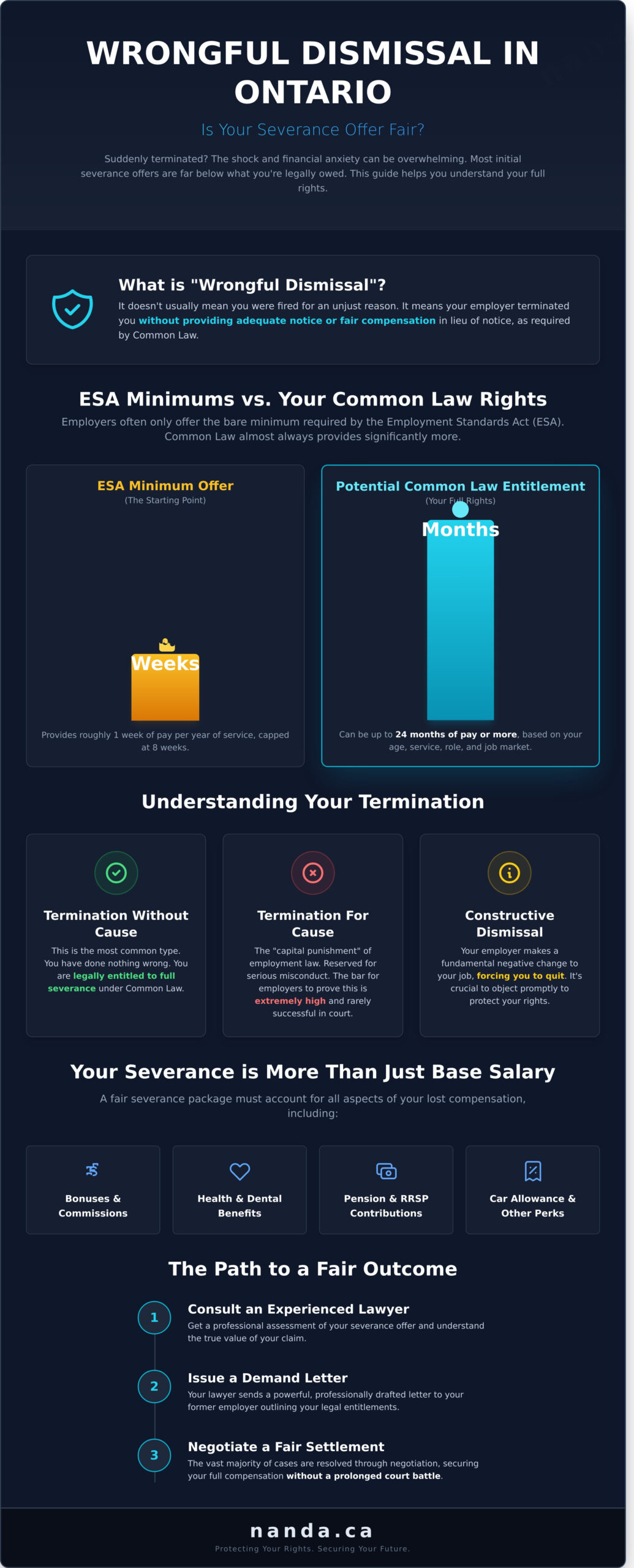
Losing your job is a profoundly stressful event. In Ontario, the law provides critical protections for employees, but the rules can be confusing. Many people believe “wrongful dismissal” means they were fired for an unfair or invalid reason. In reality, the term usually refers to a termination where the employer failed to provide sufficient notice or pay in lieu of that notice. While the Employment Standards Act, 2000 (ESA) sets out the minimum notice period, your full entitlement under common law is often significantly greater. This gap between the minimum standard and what you are truly owed is where your rights are most at risk.
Brampton’s economic landscape is a perfect example of this evolving challenge. The city’s role as a national logistics hub, with massive fulfillment centres lining the Highway 410 corridor, has created thousands of jobs. Simultaneously, a burgeoning tech sector is attracting new talent. As we look toward 2026, industry shifts like increased warehouse automation and consolidation among tech firms are expected to drive restructuring and, inevitably, terminations. For families in Peel Region, where the cost of living continues to rise, a sudden loss of income without a proper severance package can be financially devastating. Understanding your rights is the first step to securing your family’s stability, and a knowledgeable wrongful dismissal lawyer in Brampton can provide the necessary clarity.
The Difference Between Termination With Cause and Without Cause
A termination “for cause” or “just cause” is what legal professionals often call the “capital punishment” of employment law. It means your employer is firing you for serious misconduct without any notice, pay in lieu of notice, or severance. The bar for proving just cause is extremely high and it is rarely upheld by courts. Common employer mistakes we see in Brampton workplaces include alleging cause for simple incompetence or poor performance without a documented history of progressive discipline. For the vast majority of employees, termination is “without cause,” meaning you have done nothing wrong. In these cases, you are legally entitled to either working notice or a compensation package, often called severance. This principle is a cornerstone of Wrongful dismissal in Canada, ensuring employees have a financial bridge while they search for new work.
Constructive Dismissal: When You Are Forced to Quit
Sometimes, an employer doesn’t fire you directly. Instead, they unilaterally make a fundamental change to your job, hoping you will resign. This is known as constructive dismissal. Key indicators include:
- A significant reduction in your salary or hours.
- A demotion in your title or a major reduction in responsibilities.
- A toxic or harassing work environment.
- A mandatory transfer to a distant geographic location.
Many Brampton employees unfortunately miss the window to make a claim because they try to adapt to the new, unfair conditions. By continuing to work without formally objecting, you risk legally accepting the changes. It’s critical to object to these fundamental breaches of your employment contract promptly and in writing to protect your right to claim damages.
Common Law vs. ESA: Why Your Severance Offer is Likely Too Low
When you are terminated without cause, your employer will present you with a severance offer. It’s a moment of stress and uncertainty, and many people accept the first offer, believing it’s fair or final. This is often a costly mistake. In Ontario, there are two distinct legal systems that govern your entitlements: the Employment Standards Act, 2000 (ESA) and the judge-made Common Law. Employers hope you only know about the first.
The ESA sets out the absolute minimum notice or pay in lieu of notice you must receive. These statutory minimums are often just a few weeks of pay. For example, the rules for Ontario’s Employment Standards Act severance pay provide a baseline, but this is rarely the full extent of your entitlement. Common Law, on the other hand, provides for a “reasonable notice” period, which is almost always significantly longer and more valuable than the ESA minimums. An experienced wrongful dismissal lawyer in Brampton understands that an employer’s initial offer is typically a strategic starting point, not the final word.
The Four Pillars of Reasonable Notice (Bardal Factors)
Ontario courts don’t use a simple formula to determine your Common Law entitlements. Instead, they assess what is “reasonable” based on four key factors established in the landmark 1960 case, Bardal v. Globe & Mail Ltd. These “Bardal Factors” help determine the time you would reasonably need to find a comparable new job.
- Character of Employment: A senior executive with specialized skills and significant responsibilities will be entitled to a longer notice period than an entry-level employee, as their role is typically harder to replace.
- Length of Service: The longer you have dedicated your career to a company, the greater protection you are afforded. A 15-year employee at a Brampton manufacturing facility has earned a far greater entitlement than someone with only 15 months of service.
- Age of the Employee: Courts explicitly recognize the challenges older workers face. An employee terminated at age 58 will likely face more difficulty in securing new employment than a 30-year-old, justifying a longer notice period.
- Availability of Similar Employment: The health of the job market in Brampton and the Greater Toronto Area is a critical factor. If you work in a niche industry with few local employers, your notice period will be extended to reflect that reality.
Termination Clauses: Are They Enforceable?
Employers often try to limit your rights to the ESA minimums by inserting a “termination clause” into your employment contract. However, a wave of recent Ontario court decisions has rendered thousands of these clauses unenforceable. The “Waksdale effect,” stemming from the 2020 Court of Appeal decision in Waksdale v. Swegon North America Inc., established that if any part of a termination provision is illegal, the entire clause is void. This means even a single flawed sentence can invalidate the employer’s attempt to limit your severance, opening the door to your full Common Law entitlements.
This is why you should never sign a release or accept a severance package without a professional review. The gap between the ESA minimums and your true entitlement can represent tens of thousands of dollars. Bridging that gap requires the expertise of a skilled civil litigation lawyer who can assess the enforceability of your contract and advocate for the fair compensation you deserve. If you’ve been presented with an offer, allow our team to review it before you sign away your rights.
Calculating the Real Value: Severance, Benefits, and Bonuses
When you are wrongfully dismissed, your employer’s initial severance offer often reflects only the bare minimums required by law. These figures, guided by Ontario’s Employment Standards Act, frequently overlook the full scope of your compensation under common law. A proper severance package isn’t just about your base salary; it must replace every financial benefit you’ve lost for the entire duration of a reasonable notice period. At Nanda & Associate Lawyers Professional Corporation, we ensure the calculation reflects the true value of your employment.
Your total compensation is a comprehensive figure that includes every perk and benefit. A thorough assessment of your entitlements must factor in:
- Bonuses and Commissions: Pro-rated amounts you would have earned during the notice period.
- Retirement Contributions: The value of employer-matched RRSP or pension contributions, which could be 3-6% of your salary.
- Health and Dental Benefits: The cost to replace your medical, dental, vision, and disability insurance coverage.
- Allowances and Perks: The cash value of items like a car allowance (often C$500-C$800 monthly) or a company phone plan.
- Equity and Incentives: The loss of stock options, profit sharing, or other long-term incentive plans that would have vested during the notice period.
Ignoring these elements can result in accepting an offer that is tens of thousands of dollars less than what you are rightfully owed. A common battleground is the annual bonus. Employers may claim you must be “actively employed” to receive it, but Ontario courts have consistently ruled that if the bonus was an integral part of your compensation, you are entitled to a pro-rated share for your notice period.
In cases where an employer’s conduct is particularly egregious, additional damages may be awarded. Aggravated damages compensate you for mental distress caused by a bad-faith or unduly insensitive dismissal. Punitive damages are rare but serve to punish an employer for malicious conduct, such as fabricating a “just cause” reason for termination to avoid paying severance.
The Duty to Mitigate: A Tactical Guide
After being dismissed, you have a legal “duty to mitigate” your losses by making reasonable efforts to find a comparable new job. In the dynamic 2026 Greater Toronto Area economy, this typically involves a consistent search within the Brampton and Peel region. While income from a new job will reduce what your former employer owes, it doesn’t erase your initial claim. A meticulously kept “Job Search Log” detailing applications and interviews is your primary evidence to prove you fulfilled this duty.
Special Damages and Human Rights Violations
A termination may be more than just wrongful; it could be discriminatory. If your dismissal is connected to your age, disability, family status, or another protected ground under the Ontario Human Rights Code, you could be entitled to separate damages. A dedicated wrongful dismissal lawyer in Brampton can identify these complex intersections, including potential claims for mental distress or defamation if your employer harmed your professional reputation within Brampton’s business community.
The Legal Roadmap: From Demand Letter to Brampton Court
Understanding the path your wrongful dismissal claim will take can provide significant peace of mind. While every case is unique, the legal process follows a structured and predictable sequence. Our role is to guide you through each stage, from the initial assertive steps to the final resolution, ensuring your rights are protected at every turn. We handle the complexities so you can focus on your future.
The journey to a fair resolution typically involves five key stages:
- Step 1: The Initial Consultation and Strategy Session. This is where we listen. We’ll review your employment history, the circumstances of your termination, and your severance offer. Together, we build a tailored strategy based on the specific facts of your case.
- Step 2: The Demand Letter. We draft and send a formal demand letter to your former employer. This professional correspondence outlines your legal position and demands a fair severance package, officially starting the negotiation process.
- Step 3: Mediation and Settlement Conferences. Most wrongful dismissal cases in the Peel Region settle before trial. We will engage in negotiations, and if necessary, attend a mandatory settlement conference or mediation to reach a resolution without court intervention.
- Step 4: Litigation. If a fair settlement cannot be reached, we will commence a lawsuit. For residents of Brampton, this means filing a claim at the A. Grenville and William Davis Courthouse, the Ontario Superior Court of Justice for the Peel Region.
- Step 5: Finalizing the Release and Securing Payment. Once a settlement is agreed upon or a judgment is awarded, we finalize the legal documents, including a Full and Final Release, and ensure you receive your payment promptly.
The Power of the Demand Letter
A demand letter is far more than a simple complaint; it’s a strategic legal tool. A letter sent by an experienced wrongful dismissal lawyer in Brampton immediately signals to your former employer that you are serious about enforcing your rights. It demonstrates that your claim has been legally vetted and carries the implicit weight of potential litigation. By setting a firm deadline for response, typically 7 to 14 days, we compel the employer to address the matter urgently, preventing them from delaying or ignoring your claim. This initial step often opens the door to a negotiated settlement, which provides a certain, timely outcome without the costs and risks of a full trial.
Navigating the Peel Region Court System
Should litigation become necessary, your case will proceed through the Ontario Superior Court of Justice in Brampton. It’s vital to have a legal team familiar with the specific procedures and timelines of this court. As of 2026, a fully contested wrongful dismissal lawsuit can take between 18 to 30 months to reach a trial. Fortunately, many claims fall under the “Simplified Procedure” (Rule 76 of the Rules of Civil Procedure). This streamlined process applies to claims for C$200,000 or less and is designed to be faster and less expensive. It limits pre-trial discoveries and caps legal costs, making it an effective path for securing justice in many employment law cases.
Navigating this legal roadmap requires experience and strategic foresight. If you believe you have been wrongfully dismissed, let a skilled wrongful dismissal lawyer brampton from our team chart the most effective course for your claim. Contact us today to understand your options.
Why Nanda & Associate Lawyers is Your Strategic Ally in Brampton
When you face an unjust termination, you don’t just need a lawyer; you need a strategic ally. At Nanda & Associate Lawyers, our firm is built to be precisely that. We deliver what we call the “Nanda Advantage”-the power and resources of a large firm combined with the personalized, attentive care of a boutique practice. Our multidisciplinary approach is central to this promise. By integrating insights from our experts in business law, we don’t just see your side of the story; we anticipate the employer’s entire playbook. This comprehensive understanding allows us to craft proactive strategies that protect your interests from every angle.
Our commitment extends beyond legal tactics to reflect the community we serve. Brampton is one of Canada’s most diverse cities, and we believe your legal team should reflect that reality. Our professionals can serve you in over 15 languages, including Punjabi, Hindi, Urdu, and Spanish, ensuring clear communication and genuine understanding. You can discuss the sensitive details of your case with confidence, knowing nothing will be lost in translation. This is a cornerstone of our pledge to provide “Comprehensive Legal Solutions” for every terminated worker, regardless of their background.
Employment Law for Immigrant Workers
For immigrant workers, a wrongful dismissal creates a cascade of crises that extend far beyond employment law. Your immigration status, work permit validity, and long-term goal of permanent residency can all be thrown into jeopardy. Our firm is uniquely structured to manage this complexity. When you work with us, your case is supported by an expert immigration lawyer in Brampton from our own team. We build a unified strategy to address LMIA conditions and work permit extensions while simultaneously pursuing your wrongful dismissal claim, safeguarding your future in Canada.
Starting Your Recovery Today
Reclaiming your professional life begins with a single, decisive step. We make that step simple and empowering. When you schedule your initial consultation with a leading wrongful dismissal lawyer brampton from our firm, we ask that you gather a few key documents to help us make a swift and accurate assessment of your case:
- Your original employment contract or offer letter
- Your three most recent pay stubs
- The official termination letter or any related correspondence
- Any records of performance reviews or disciplinary actions
Our “Client-First” philosophy is not just a slogan; it is the operational principle that guides our every move. We bring calm confidence to high-stakes litigation, shielding you from the stress of the legal process so you can focus on your next career move. Your job was taken from you unfairly. Let us help you secure the compensation and justice you deserve. Contact Nanda & Associate Lawyers today to craft a tailored strategy and start your recovery.
Secure Your Professional Future in Brampton
Facing a sudden job loss is difficult, but it’s crucial to remember your rights. The initial severance package you receive is rarely the final word; it often represents the bare minimum required by law, not the full common law entitlement you’ve earned. Understanding this difference is the first step toward securing fair compensation. Partnering with an experienced wrongful dismissal lawyer brampton provides the strategic guidance needed to navigate this complex process and protect your financial stability.
At Nanda & Associate Lawyers, we have been dedicated to protecting employees’ rights in the Brampton and Mississauga communities since 2003. Our diverse legal team, speaking over 15 languages, has a proven track record of success in Ontario Superior Court litigation. You don’t have to accept an unfair offer. Take control of your situation and ensure you receive the compensation you deserve. Contact Nanda & Associate Lawyers for a Professional Consultation in Brampton and let our team help you move forward with confidence.
Frequently Asked Questions
How much severance pay am I entitled to in Brampton?
Your severance pay entitlement in Brampton is determined by common law, not just the minimums in Ontario’s Employment Standards Act, 2000 (ESA). While the ESA provides a base of one week per year of service up to 8 weeks, common law notice can be significantly more, often reaching up to 24 months’ pay. Factors like your age, position, length of service, and the availability of similar employment all influence the final amount we can pursue for you.
Can I still sue for wrongful dismissal if I already signed a release?
Yes, you may still be able to sue for wrongful dismissal even after signing a release, depending on the circumstances. If you were pressured, not given adequate time to seek legal advice, or if the agreement is fundamentally unfair, a court might set it aside. For example, if you were offered only ESA minimums without being informed of your greater common law rights, the release could be successfully challenged. It’s critical to have any release reviewed by a lawyer.
What is the statute of limitations for a wrongful dismissal claim in Ontario?
The statute of limitations for filing a wrongful dismissal lawsuit in Ontario is generally two years from the date your employment was terminated. This deadline is established by Ontario’s Limitations Act, 2002. Waiting beyond this two-year period will almost certainly prevent you from pursuing a claim in court. It’s vital to act promptly and consult with legal counsel well before the deadline approaches to protect your rights and build a strong case.
Do I have to accept a “comparable” job offer if my employer fires me?
You have a duty to mitigate your losses, which may include accepting a comparable job offer from your former employer, but you aren’t always required to do so. If the new role involves a significant demotion, reduced pay, a toxic work environment, or is otherwise unsuitable, you may be justified in refusing it. The court will assess if your refusal was reasonable in the circumstances. Each situation is unique and requires a careful legal assessment of the offer.
Can I be fired while on sick leave or disability in Ontario?
No, you cannot be fired *because* you are on a protected sick leave or disability, as this would violate Ontario’s Human Rights Code. Your employer can, however, terminate your employment for legitimate business reasons unrelated to your leave, such as a company-wide restructuring. If this happens, they must still provide you with proper notice or severance pay. If you believe your disability was a factor, you may have a human rights claim in addition to your wrongful dismissal case.
What happens if my employer claims “Just Cause” but I disagree?
If you disagree with a “just cause” termination, you should immediately seek legal advice to challenge the allegation. The burden of proof is entirely on your employer to show your misconduct was so severe that it fundamentally broke the employment relationship, which is a very high legal standard. A skilled wrongful dismissal lawyer in Brampton can analyze the evidence, contest your employer’s claims, and negotiate for the severance package you are rightfully owed. Don’t simply accept a for-cause termination.
How much does a wrongful dismissal lawyer in Brampton cost?
Most reputable employment lawyers, including our firm, handle wrongful dismissal cases on a contingency fee basis. This means you don’t pay any legal fees upfront. Instead, our fee is a pre-agreed percentage of the final settlement or court award we secure for you, typically ranging from 25% to 35%. This arrangement provides you with access to justice without requiring you to pay out-of-pocket while you are unemployed. We ensure our fee structure is transparent from the start.
Is a 1-week per year of service rule always the law in Ontario?
No, the “one-week-per-year” guideline is a common misconception that refers only to the absolute minimum entitlement under Ontario’s Employment Standards Act, 2000. The courts almost always award a much more generous notice period under common law, which can be closer to one month per year of service, up to a general maximum of 24 months. Relying on the one-week rule often means leaving a significant amount of your rightful compensation on the table.