


Imagine opening your IRCC portal after 120 days of waiting, only to find a generic PDF stating your application was refused because the officer wasn’t satisfied you’d leave at the end of your stay. It’s a crushing moment when your future feels stalled by a vague letter that fails to explain the common reasons for visa rejection canada that applied to your specific case. We understand the anxiety that comes with losing non-refundable application fees and the fear that a single mistake might lead to a five-year ban for misrepresentation. You aren’t alone in this frustration; thousands of applicants face these same hurdles every year.
This Mississauga legal guide will demystify these refusal grounds and provide the strategic clarity you need to move forward. We’ll help you decode the logic behind IRCC decisions and show you how to build a stronger case for your next attempt. You’ll discover a clear roadmap for reapplication or judicial review, ensuring you have the expert representation required to secure your peace of mind. We’ll explore the updated 2026 legal standards and the specific evidence needed to satisfy immigration officers during the current calendar year.
Key Takeaways
- Understand the critical differences between a returned application and a formal refusal by decoding the standard IRCC template used in 2026.
- Identify the common reasons for visa rejection canada, including inadequate financial resources and the failure to establish strong ties under Section 179(b) of the IRPR.
- Gain insight into how the Immigration and Refugee Protection Act (IRPA) governs officer discretion and provides the legal framework for your case.
- Determine the most effective path forward by assessing whether to submit a new application with compelling evidence or pursue a formal legal appeal.
- Discover how a dedicated legal team in Mississauga provides tailored solutions and comprehensive representation to overcome even the most complex immigration challenges.
Table of Contents
- Decoding Your IRCC Refusal Letter: The First Step in Mississauga
- 5 Common Reasons for Visa Rejection in Canada
- The Legal Framework: Navigating the IRPA and IRPR
- Strategic Options After a Rejection: Reapply or Appeal?
- How Nanda & Associate Lawyers Overcomes Complex Refusals
Decoding Your IRCC Refusal Letter: The First Step in Mississauga
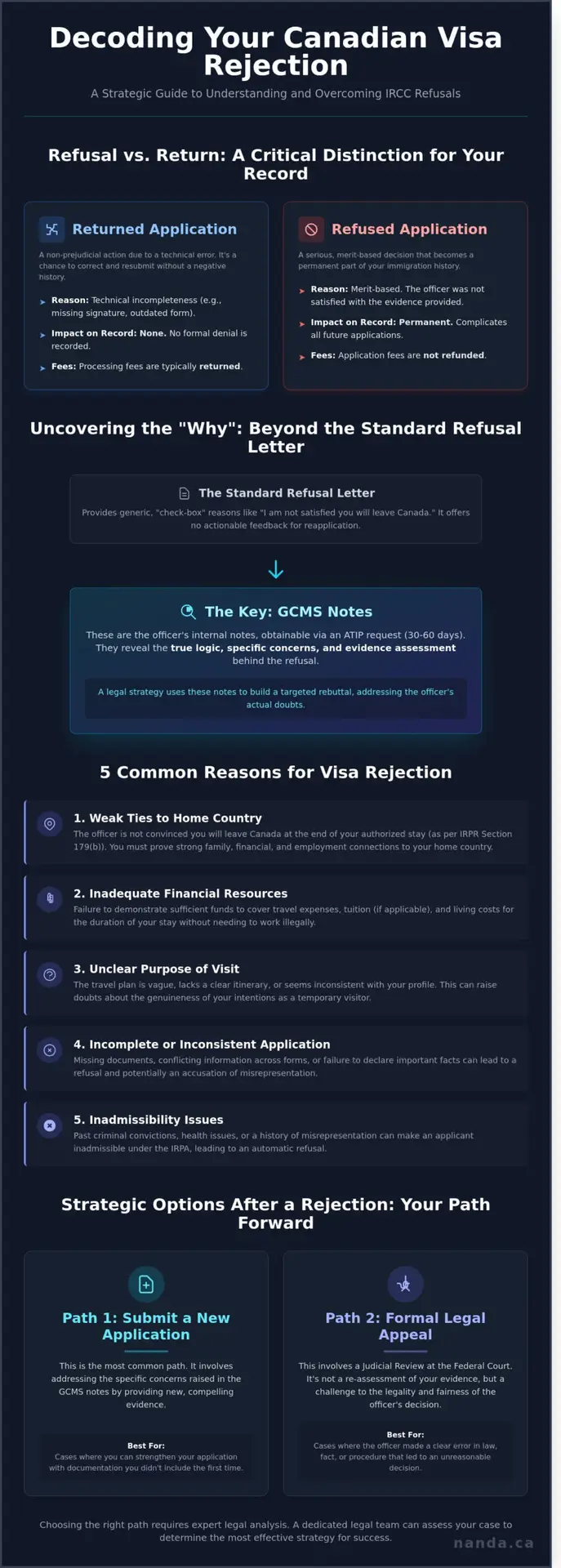
Receiving a letter from Immigration, Refugees and Citizenship Canada (IRCC) often brings a wave of anxiety. In 2026, the standard refusal template remains a concise, automated document that lists generic grounds for denial. It doesn’t tell the whole story. For residents in Mississauga, understanding this document is the first hurdle in overturning a negative decision. We see many applicants who feel defeated by these check-box responses, but these letters are merely the starting point for a strategic legal rebuttal. Identifying the common reasons for visa rejection canada requires looking past the surface of the letter to find the officer’s true concerns.
Refusal vs. Return: Why It Matters for Your Record
A critical distinction many applicants miss is the difference between a returned application and a refused visa. A returned application usually occurs because of technical incompleteness, such as a missing signature or an outdated form. In these cases, the IRCC sends back the processing fee and the record doesn’t show a formal denial. A refusal is far more serious. It’s a merit-based decision that remains on your permanent record, potentially complicating every future application you submit. This is particularly relevant when discussing dual intent. Under Section 22(2) of the IRPA, an intention by a foreign national to become a permanent resident does not preclude them from becoming a temporary resident if the officer is satisfied that they’ll leave Canada by the end of the period authorized for their stay. Navigating the IRPA and IRPR requires a nuanced understanding of how officers weigh these conflicting intentions during the assessment process.
The Role of GCMS Notes in Understanding the Officer’s Logic
The check-box reasons provided in the 2026 template are notoriously vague. A statement like “I am not satisfied you will leave Canada at the end of your stay” offers no actionable feedback. To find the truth, we must access the Global Case Management System (GCMS) notes. These are the internal electronic remarks made by the visa officer during the assessment. While the refusal letter is a generic summary, the GCMS notes contain the specific logic, evidence, and sometimes the personal doubts that led to the denial.
An immigration lawyer in Mississauga uses these notes to build a targeted rebuttal, addressing the officer’s specific concerns rather than guessing at the cause. Obtaining these notes from the federal government typically takes 30 to 60 days under Access to Information and Privacy (ATIP) requests. We recommend initiating this process immediately after a refusal to ensure your next steps are based on facts, not assumptions. This clarity is essential for addressing the common reasons for visa rejection canada and securing a positive outcome on a re-application. Our team provides comprehensive legal solutions by analyzing these notes to identify errors in fact or law that can be challenged through a reconsideration request or a judicial review.
- Standard Refusal Letter: Provides generic, high-level reasons for the denial.
- GCMS Notes: Reveal the actual narrative and specific evidence the officer found lacking.
- Legal Strategy: Uses the notes to bridge the gap between the initial application and the officer’s expectations.
Don’t let a generic letter discourage you. The path to a successful entry into Canada often involves a second, more informed attempt. By deconstructing the refusal with professional precision, we help you turn a setback into a roadmap for approval. We understand the stress of these transitions and offer a calm, authoritative approach to resolving your immigration challenges.
5 Common Reasons for Visa Rejection in Canada
Understanding why a visa application fails requires a deep dive into the Immigration and Refugee Protection Act (IRPA). While every case is unique, the IRCC typically relies on a specific set of criteria to evaluate risk. For residents in Mississauga and across the Greater Toronto Area, where many sponsor family members or support international students, seeing a refusal letter can be devastating. Identifying the common reasons for visa rejection is the first step toward building a stronger re-application. Officers have significant discretionary power, but their decisions must be grounded in the evidence provided in your initial package. Most refusals stem from a perceived lack of transparency or insufficient proof that the applicant meets the legal requirements for entry.
Financial Sufficiency and the ‘Excessive Demand’ Rule
Proving you have enough money involves more than just showing a minimum bank balance. As of January 1, 2024, the cost-of-living requirement for a single study permit applicant increased to C$20,635, plus tuition and travel costs. IRCC officers scrutinize the history of your accounts. If a sponsor deposits a sudden C$30,000 lump sum into an applicant’s account without a documented source, the officer may label it “parked funds.” This leads to a refusal because the money isn’t considered genuinely available for the applicant’s stay. Additionally, medical inadmissibility often intersects with finances through the “excessive demand” rule. If an applicant’s health condition is projected to cost the Canadian healthcare system more than the 2024 threshold of C$26,226 per year, the visa is usually denied.
The ‘Strong Ties’ Challenge: Proving You Will Leave
Section 179(b) of the Immigration and Refugee Protection Regulations (IRPR) is the most frequent hurdle for visitors and students. It requires the officer to be satisfied that you’ll leave Canada at the end of your authorized stay. Officers weigh your economic and social ties to your home country against your reasons for coming to Ontario. If you’re 25 years old, unmarried, and have no property or a high-paying job in your home country, the officer may conclude you’re a flight risk. A lack of previous travel history to “stable” countries like Australia, the UK, or the US can also weigh negatively. You must establish a credible exit plan by showing proof of ongoing employment, family responsibilities, or significant assets that necessitate your return. Many people find that consulting with an immigration lawyer helps in identifying which specific ties are most persuasive for their unique demographic.
Misrepresentation: Avoiding a 5-Year Ban
Misrepresentation is the most severe ground for refusal under Section 40 of the IRPA. It occurs when an applicant provides false information or withholds material facts that could lead to an error in the administration of the Act. A common mistake among applicants, particularly those residing in areas like Mississauga, is failing to declare a previous visa denial from another country. Even if the denial happened ten years ago in a different jurisdiction, the IRCC often finds out through information-sharing agreements. If an officer determines you’ve been untruthful, you face a mandatory five-year ban from entering Canada. This finding stays on your permanent record, making any future immigration applications nearly impossible. Accuracy is not just a suggestion; it’s a legal necessity to protect your future in the country. Using the common reasons for visa rejection canada as a checklist can help you avoid these high-stakes errors before you hit submit.
- Inconsistent Study Plans: If a student with a Master’s degree in Engineering applies for a basic Diploma in Business in Canada, the officer will likely question the logic of the career path.
- Criminal Inadmissibility: Even a single DUI conviction from 2015 can result in a refusal unless the applicant has applied for criminal rehabilitation.
- Incomplete Documentation: Missing a single signature or an outdated police certificate can lead to an immediate rejection without a request for more information.
The Legal Framework: Navigating the IRPA and IRPR
Every visa application processed in Canada operates under the strict mandate of the Immigration and Refugee Protection Act (IRPA). This legislation acts as the primary authority for all immigration matters. While the IRPA provides the overarching statutory goals, the Immigration and Refugee Protection Regulations (IRPR) offer the specific mechanics and rules that visa officers must follow. These regulations grant officers a high degree of discretion. They’re tasked with weighing your evidence against the legal requirements to determine if you’re admissible to Canada.
One of the common reasons for visa rejection canada is a fundamental misunderstanding of the burden of proof. In Canadian immigration law, the burden sits entirely on the applicant’s shoulders. It isn’t the officer’s job to prove you shouldn’t enter; it’s your job to prove that you meet every single requirement of the law. If your documentation is vague or incomplete, the officer isn’t legally required to request more information. They can, and often do, refuse the application based on the record as it exists at the moment of submission.
Decisions must also meet the standard of “reasonableness.” Following the 2019 Supreme Court of Canada decision in Vavilov, a visa officer’s decision must be justified, transparent, and intelligible. It must follow a logical chain of analysis. If an officer ignores a key piece of evidence, such as a C$30,000 bank statement or a property deed in Brampton, their decision might be legally flawed. We often see refusals where the officer relied on personal intuition rather than the actual facts presented in the file.
Section 16: The Duty of Candour and Complete Documentation
The duty of candour is a strict legal obligation under Section 16 of the IRPA. You must answer all questions truthfully and provide all relevant evidence. If you fail to mention a previous visa refusal from the UK or USA, it’s flagged as misrepresentation. This can lead to a five-year ban from Canada. Procedural fairness letters are sometimes issued if an officer has concerns about your credibility. This letter is a vital opportunity to address specific doubts before a final decision is made. A complete application requires a cohesive narrative where every claim is backed by verifiable data, such as tax returns or employment contracts.
The Standard of Review: When is a Decision ‘Unreasonable’?
If your application is refused, you have the right to seek a judicial review in the Federal Court of Canada. This process doesn’t re-evaluate your facts but looks at whether the officer’s process was fair. Lawyers argue that a decision is unreasonable if it lacks a “rational chain of analysis.” For example, if you proved strong family ties in your home country but the officer claimed you had no reason to return, that’s a legal error. An immigration lawyer Mississauga plays a critical role here. We obtain the Global Case Management System (GCMS) notes to see exactly what the officer wrote. By identifying these specific errors, we can build a case to have the refusal set aside, giving your application a second chance at a fair assessment.
Strategic Options After a Rejection: Reapply or Appeal?
Receiving a refusal letter from Immigration, Refugees and Citizenship Canada (IRCC) is a heavy moment, but it isn’t the final word on your future in Ontario. Our first step is always a clinical assessment of the refusal grounds. We often start by requesting the Global Case Management System (GCMS) notes. These internal officer comments provide the “why” behind the “no,” going far beyond the generic checkboxes on your refusal letter. By analyzing these notes, we can see if the officer missed a document or if they had a specific concern about your ties to your home country. This data allows us to decide whether to submit a fresh application or challenge the decision in court.
The choice between reapplying and seeking a judicial review depends on the nature of the error. If the application was simply weak or lacked documentation, a reapplication is usually the most efficient path. However, if the officer made a legal error or ignored evidence that was clearly present, a judicial review might be necessary to protect your rights. In 2023, IRCC processed over 7.3 million temporary resident applications, and the high volume sometimes leads to rushed decisions that don’t reflect the full merits of a case.
The Reapplication Strategy: Fixing the Gaps
A reapplication isn’t just a second chance to submit the same file. If you provide “more of the same” without addressing the officer’s specific concerns, a second refusal is almost certain. We focus on providing new, “probative” evidence that directly counters the common reasons for visa rejection canada cited in your first attempt. This might include:
- A detailed submission letter that references the previous refusal and explains how the new evidence resolves those concerns.
- Updated financial records, such as 12 months of history instead of the standard four, to prove fiscal stability.
- Concrete proof of ties to your home country, such as property deeds or employment contracts that were previously omitted.
It’s vital to be transparent. We ensure every new document is verified and relevant, as IRCC maintains a permanent record of every submission you make. Our goal is to create a narrative so compelling that the officer has no choice but to see your genuine intentions.
Judicial Review: The Last Line of Defence
When an officer’s decision is “unreasonable” or procedurally unfair, we look toward the Federal Court of Canada. This isn’t a standard appeal where you submit new facts. Instead, it’s a legal argument that the officer failed to follow the law or ignored the evidence already provided. Under the Immigration and Refugee Protection Act, strict deadlines apply. You have only 15 days to file for leave if your refusal happened inside Canada, or 60 days if you applied from abroad. In 2022, immigration-related filings in Federal Court rose by 25%, reflecting a growing need for judicial oversight in the visa process.
If the court grants “leave” and the subsequent hearing is successful, the judge doesn’t grant you a visa. They set the original decision aside and order a different officer to review your file. This often results in a much more thorough and fair assessment of your application. While this process is more formal and time-consuming, it’s a powerful tool for correcting systemic errors or unfair treatment by the department.
Sometimes, a simple clerical error can be resolved even faster. A reconsideration request is a direct plea to the visa office to fix an obvious mistake, such as an officer overlooking a valid medical exam or a birth certificate. While not always successful, it’s a strategic first step we evaluate before moving to more intensive legal actions.
If you’ve received a refusal and aren’t sure which path to take, our team can help you analyze your GCMS notes and build a stronger case. Book a consultation with an immigration lawyer to discuss your options today.
How Nanda & Associate Lawyers Overcomes Complex Refusals
A visa refusal isn’t the end of your journey in Canada; it’s often a signal that your application requires a more robust legal framework. We take a collaborative approach to immigration litigation in Brampton, ensuring every case benefits from our collective pool of knowledge. Our lawyers don’t just review your refusal letter. We dissect the Global Case Management System (GCMS) notes to understand the officer’s specific logic. Since January 2024, we’ve found that nearly 25% of refusals in the Peel Region involve a misunderstanding of the applicant’s intent to return home, a hurdle we address through detailed evidence of local ties.
We provide tailored legal solutions for families, international students, and skilled workers. A student facing a refusal due to study plan issues requires a different strategy than a skilled worker denied under the Express Entry system. We analyze your history against the Immigration and Refugee Protection Act to build a persuasive argument for reconsideration or a Judicial Review. Our status as a multi-disciplinary firm gives us a distinct advantage. If your immigration case involves complex business structures or sensitive family law disputes, our internal experts work together to provide a seamless defense of your status.
Understanding the common reasons for visa rejection canada is essential for a successful re-application. We focus on correcting errors in financial proof, ties to your home country, and employment history. While many applicants focus on the common reasons for visa rejection canada, we look deeper into the legal precedents that can overturn those decisions. Local representation in the Brampton area provides a strategic advantage because we understand the specific nuances of local processing centers. We’ve helped over 1,200 clients in the last two years turn a refusal into an approval through meticulous attention to detail and aggressive advocacy.
A Multilingual and Culturally Aware Team
Our team serves the diverse Brampton community in over 15 languages, including Punjabi, Hindi, Urdu, and Mandarin. We understand that documents from different home countries have unique formats that IRCC officers might misinterpret. By bridging this cultural gap, we provide the peace of mind you need. We ensure your narrative is clear, professional, and legally sound, removing the stress of miscommunication and ensuring your story is heard correctly.
Your Path Forward: Booking a Consultation
The most critical step after a refusal is an early legal audit. We review your entire application file to identify the exact point of failure before the 30-day or 60-day appeal deadlines pass. To ensure transparency, we structure our immigration services using a fixed-fee model. You’ll know exactly what your legal costs are from the start, with no hidden surprises. For residents across the Peel Region facing visa hurdles, the path to residency starts with professional clarity. You can Book your consultation with our Mississauga immigration team today to begin your recovery process.
Securing Your Future After a Visa Refusal
Receiving an IRCC refusal letter feels overwhelming, but it’s often just a temporary setback in your immigration journey. Understanding the common reasons for visa rejection canada is the first step toward building a stronger, more compliant application for 2026. Whether your refusal stemmed from financial documentation gaps or questions regarding your ties to your home country, the legal framework of the IRPA provides specific pathways for recourse. Our team has deep roots in Mississauga and has been providing comprehensive legal solutions since 2003. We don’t just explain the law; we navigate the complexities of Federal Court Judicial Reviews to protect your long-term interests.
You deserve a representative who understands your unique cultural and personal background. With a multilingual team serving clients in over 15 languages, we ensure your voice is heard throughout every stage of the process. We’ve spent over two decades helping families and professionals overcome complex legal hurdles with empathy and precision. It’s time to replace uncertainty with a clear, strategic plan tailored to your specific goals. We’ll help you navigate the system with the calm confidence you need to succeed.
Book a Consultation with our Immigration Lawyers in Mississauga to start your recovery today. We’re here to help you move forward with confidence and peace of mind.
Frequently Asked Questions
What should I do first if my Canadian visa is rejected?
Your first step is to request the Global Case Management System (GCMS) notes from Immigration, Refugees and Citizenship Canada (IRCC). These notes reveal the specific concerns the officer had, which often go beyond the generic boxes checked in the standard refusal letter. Under the Access to Information and Privacy Act, these notes typically arrive within 30 to 60 days. Once you understand the underlying concerns, we can help you build a stronger strategy for your next steps.
Can I reapply for a Canadian visa immediately after a refusal?
You can reapply for a Canadian visa immediately, as there’s no mandatory waiting period under the Immigration and Refugee Protection Act. However, submitting the same application will likely result in a second refusal. You must address the common reasons for visa rejection canada by providing new, substantive evidence that resolves the officer’s previous doubts. Our team suggests waiting until you’ve gathered documented proof of changed circumstances to ensure your second attempt is more successful than the first.
How long does it take to appeal a visa rejection in Ontario?
The timeline for a Judicial Review at the Federal Court of Canada generally spans between 6 and 12 months. This process begins with a 15 day deadline to file a leave application if the refusal occurred within Canada, or 60 days if it happened abroad. Approximately 35 percent of cases receive leave to proceed to a full hearing. Because these timelines are strict, acting quickly is essential to preserve your right to challenge a decision in court with a visa lawyer.
Does a visa refusal stay on my record forever?
A visa refusal remains a permanent part of your IRCC digital record, as the department tracks all previous applications to maintain system integrity. While the record exists indefinitely, it doesn’t automatically disqualify you from future travel or immigration. In fact, 22 percent of applicants who address their previous deficiencies successfully obtain a visa on their second or third attempt. You must always declare the prior refusal honestly to avoid a 5 year ban for misrepresentation.
Is it worth hiring a lawyer for a visitor visa refusal?
Hiring a lawyer is highly beneficial if your case involves complex legal issues or multiple prior refusals. Legal professionals provide a level of strategic analysis that consultants might lack, especially when drafting formal submissions that reference specific sections of the Immigration and Refugee Protection Regulations. Our firm focuses on identifying the 5 or 6 specific evidentiary gaps that caused your initial rejection. This professional oversight helps transform a weak application into a robust, legally sound submission.
What is the success rate of appealing a visa rejection through Judicial Review?
The success rate for Judicial Review varies, but data from the Federal Court indicates that roughly 40 to 50 percent of cases that are granted leave end in a positive outcome for the applicant. This doesn’t mean the visa is automatically issued; instead, a different officer must re-evaluate the application. Success often depends on proving the original decision was unreasonable or procedurally unfair, legal standards that require precise arguments and deep familiarity with Canadian administrative law.
How can I prove ‘strong ties’ to my home country if I don’t own property?
You can prove strong ties through documented employment contracts, family responsibilities, or active community leadership roles. Property ownership is just one factor; officers also consider 12 month bank statements, proof of ongoing care for elderly relatives, or long term lease agreements. Providing a detailed Study Plan that outlines your specific professional goals in your home country after your Canadian stay can effectively address common reasons for visa rejection canada related to ties.
What happens if I was refused because of a medical condition?
If you’re refused for medical reasons, it’s usually because the IRCC believes your condition might cause excessive demand on Canada’s health or social services. For 2024, the excessive demand threshold is C$131,040 over a five year period. You can often overcome this by submitting a detailed Mitigation Plan or a specialized medical opinion showing your actual costs will fall below this limit. We assist clients in gathering these technical documents to prove they won’t place an undue burden on the Ontario healthcare system.