




<existing_article>
Last Tuesday, a marketing coordinator in Mississauga realized her PR application was at risk because her job duties didn’t perfectly match the updated 2021 National Occupational Classification. It’s a common fear for many local professionals who rely on the CEC to transition from a temporary work permit to a permanent home. You’ve likely invested years into your Canadian career, yet the constant shift in CRS score cut-offs can make your future feel uncertain and stressful.
We understand that the pressure to get every technical detail right is immense, especially when a single clerical error could lead to a refusal or a removal order. We’re here to help you master the complexities of the Canadian Experience Class and learn how to navigate the permanent residency process with precision. Precision is paramount. This guide provides a clear roadmap by breaking down the specific requirements of the Immigration and Refugee Protection Act, clarifying NOC code nuances, and ensuring you have total confidence that your work experience qualifies for a successful invitation to apply.
Key Takeaways
-
Understand why Mississauga’s diverse corporate and industrial sectors make it a strategic hub for candidates pursuing permanent residency through the Express Entry system.
-
Master the specific eligibility requirements under the Immigration and Refugee Protection Act, focusing on the skilled work experience necessary for a successful CEC application.
-
Learn how to navigate the online profile submission process and gather essential supporting documents, such as reference letters, with total precision.
-
Identify and avoid the most common documentation errors, including NOC code misclassification and employment gaps, that frequently lead to application refusals.
-
Discover how a comprehensive legal review can provide the peace of mind and strategic oversight needed to secure your professional future in Canada.
Table of Contents
-
Understanding the Canadian Experience Class (CEC) Pathway in Mississauga
-
Essential Eligibility Criteria Under the Immigration and Refugee Protection Act
-
Step-by-Step Guide: How to Apply for CEC Permanent Residency
-
Avoiding Common CEC Application Refusals and Documentation Errors
-
Strategic Legal Representation for Mississauga CEC Applicants
Understanding the Canadian Experience Class (CEC) Pathway in Mississauga
The Canadian Experience Class (CEC) is a cornerstone of Canada’s immigration strategy, designed specifically for skilled workers who’ve already established professional roots here. For individuals living and working in Mississauga, this pathway is often the most direct route to Permanent Residency. Mississauga is a powerhouse of economic activity, home to over 99,000 businesses and a massive corporate sector that spans aerospace, life sciences, and advanced manufacturing. This diverse industrial landscape provides the high-quality work experience required to qualify for the CEC stream.
Transitioning from a temporary work permit to PR status provides the stability needed to build a long-term life in Ontario. While other programs like the Federal Skilled Worker (FSW) stream exist, the CEC is distinct because it recognizes the value of Canadian integration. You don’t need to provide proof of settlement funds if you’re currently working in Canada under valid authorization. This removes a significant financial hurdle for many local applicants who are already contributing to the regional economy.
The Role of Express Entry in Your PR Journey
The Express Entry System acts as the digital gateway for your application. It uses the Comprehensive Ranking System (CRS) to assign points based on factors like your age, Canadian education, and specific work experience. Mississauga applicants often benefit from higher CRS scores due to their local employment, but the pool remains highly competitive. We’ve seen that maintaining a valid work permit while waiting for an Invitation to Apply (ITA) is essential. If your status expires before you receive an ITA, it can jeopardize your ability to remain in Canada during the processing period.
Why Local Professional Guidance Matters
The complexity of the Mississauga job market means that aligning your job duties with the correct National Occupational Classification (NOC) is not always straightforward. Consulting an immigration lawyer in Mississauga helps ensure that your employment letters and tax documents meet the strict standards of Immigration, Refugees and Citizenship Canada (IRCC). We focus on identifying potential issues in your employment history, such as gaps in service or misaligned TEER categories, before they lead to a refusal. Our team provides the strategic oversight needed to navigate these technical requirements with confidence and clarity.
Essential Eligibility Criteria Under the Immigration and Refugee Protection Act
Understanding why a cec application was refused starts with a rigorous look at the statutory requirements. The Immigration and Refugee Protection Regulations (IRPR) set high standards for applicants, and even a minor oversight in documenting your history can lead to a negative decision. Our team often sees cases where applicants meet the spirit of the law but fail to provide the specific evidence required by the IRCC.
Decoding Skilled Work Experience
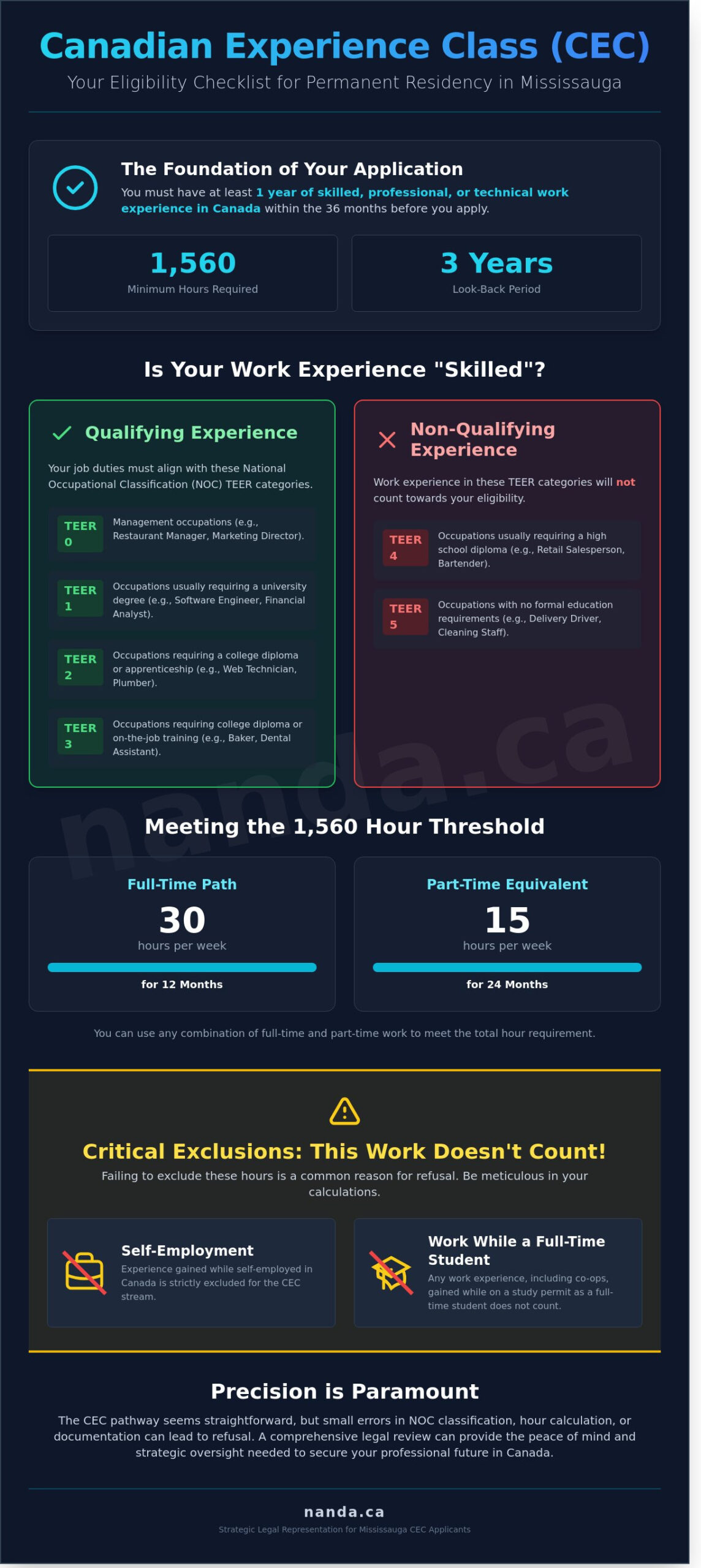
The cornerstone of this program is the one-year Canadian skilled work experience requirement. You must have completed at least 1,560 hours of work within the 36 months preceding your application. While this sounds straightforward, the "skilled" definition is narrow. Only experience in National Occupational Classification (NOC) TEER categories 0, 1, 2, or 3 qualifies. If your role was classified under TEER 4 or 5, those hours won’t count toward your eligibility.
-
Full-Time vs. Part-Time: You can meet the requirement through 30 hours per week for 12 months or an equivalent amount in part-time hours (e.g., 15 hours per week for 24 months).
-
Exclusions: Work experience gained while you were a full-time student doesn’t count. This includes co-op terms or off-campus work hours while on a study permit.
-
Self-Employment: Unlike some other streams, self-employed work experience is strictly excluded from the qualifying period for this category.
It’s vital to verify your specific job duties against the Official CEC Eligibility Requirements to ensure your NOC code was selected correctly. Misalignment between your job title and your actual daily duties is a frequent cause for refusal in Mississauga.
Legislative Foundations: IRPA and IRPR
Section 87.1 of the IRPR dictates the specific parameters for the Canadian Experience Class. Beyond work hours, you must demonstrate your intent to reside outside the province of Quebec. Because Quebec maintains its own immigration selection system, any indication that you plan to settle in Montreal or surrounding areas can trigger a refusal. We help clients provide clear evidence of their ties to Ontario to satisfy this requirement.
Language proficiency is another non-negotiable pillar. For TEER 0 or 1 jobs, you need a Canadian Language Benchmark (CLB) of 7 in all four abilities. For TEER 2 or 3 jobs, a CLB 5 is the minimum. If your test results are even one day past their two-year validity period at the time of your CEC invitation, the application will be rejected.
Finally, you must have had legal work authorization throughout your entire qualifying period. Working while your permit was expired or during a period where you didn’t have "maintained status" can lead to a refusal and potential admissibility issues under the Immigration and Refugee Protection Act. Many professionals in Mississauga initially entered Canada through LMIA-supported work permits, which provided the foundation for their current CEC eligibility. If you’re concerned about a gap in your work history, speaking with an immigration lawyer in Mississauga can provide the clarity you need to move forward confidently.
Step-by-Step Guide: How to Apply for CEC Permanent Residency
Applying for permanent residency through the cec program requires more than just meeting the minimum eligibility. It demands a meticulous approach to the Express Entry system. You start by creating an online profile that accurately reflects your age, language proficiency, and Canadian work experience. IRCC uses this data to calculate your Comprehensive Ranking System (CRS) score. If your score meets the cutoff in a specific draw, you’ll receive an Invitation to Apply (ITA). This is where the real work begins. You have exactly 60 calendar days to submit a complete electronic Application for Permanent Residence (e-APR). Missing this deadline by even a few minutes results in your invitation expiring, forcing you to re-enter the pool. For a detailed breakdown of eligibility, you can consult this Guide to the Canadian Experience Class to ensure you’ve met the initial requirements.
Preparing Your Documentation Strategy
The strength of your application rests on your evidence. Employment reference letters are the most common point of failure. These letters must include your job title, dates of employment, salary, and a detailed list of duties that align with the National Occupational Classification (NOC) 2021 system. If your duties don’t match the lead statement of your chosen NOC, an officer may refuse the application. You also need a valid Educational Credential Assessment (ECA) if your degree is from outside Canada. Ensure your ECA is less than five years old at the time of submission. As you approach the final stages, you’ll need to complete a medical exam with an IRCC-approved panel physician and provide biometrics at a designated Service Canada location in Mississauga.
Navigating the Post-ITA Process
Once you receive an ITA, consistency is vital. Review every entry in your original profile against your supporting documents. If you got married or had a child after receiving your invitation, you must declare these changes immediately. Failure to do so can lead to a refusal or a five-year ban for misrepresentation. Our immigration lawyers in Mississauga often see applications fail because of minor discrepancies in personal history dates. In 2024, IRCC aims to process 80% of cec applications within six months. Staying organized during this window ensures you’re ready when the final request for your passport or Confirmation of Permanent Residence (COPR) arrives.
-
Reference Letters: Must be on official company letterhead and signed by a supervisor.
-
Police Certificates: Required for every country where you lived for six months or more since age 18.
-
Digital Photos: Must meet specific IRCC dimensions and file size requirements.
-
Proof of Funds: While often waived for those currently working in Canada under the CEC, it’s wise to have your financial records ready.
Avoiding Common CEC Application Refusals and Documentation Errors
Success in a cec application depends on precision. Many applicants in Mississauga face setbacks because they overlook minor technicalities that IRCC officers view as fundamental failures. Data from IRCC indicates that nearly 15 percent of economic class applications face delays or refusals due to incomplete documentation. We’ve seen that even a single missing signature or an outdated police certificate can cause a file to be returned immediately. This isn’t just a delay; it’s a loss of time that could affect your work permit’s expiration date. If your permit expires while you’re waiting for a returned application to be re-processed, you might lose your right to work in Canada.
Misrepresentation is another severe risk that carries long-term consequences. Under Section 40 of the Immigration and Refugee Protection Act, providing false or misleading information results in a five-year ban from entering Canada. This applies even if the error was unintentional, such as forgetting to list a previous visa refusal from another country or misstating the dates of your employment. We help clients audit their entire history to ensure every detail is factual and verifiable. Addressing these issues before submission is the only way to protect your future in Ontario.
The Critical Importance of NOC Alignment
Your job title at a Mississauga firm might be "Junior Coordinator," but your actual duties could align with a different NOC code. IRCC officers ignore titles; they focus on the "lead statement" and "main duties" listed in the National Occupational Classification database. If your reference letter doesn’t mirror at least 80 percent of those duties, your cec experience might be disqualified. We work with employers to draft letters that accurately reflect your professional contributions while meeting the specific legal standards required by immigration authorities.
Managing Refusals and Appeals
A returned application is different from a refusal. If your file is sent back for being incomplete, you often lose your spot in the processing queue and your filing fee. A formal refusal on merit is more complex. In these cases, a Judicial Review at the Federal Court of Canada might be necessary if the officer made an error in law or fact. If you’ve received a negative decision, an immigration lawyer can review the Global Case Management System (GCMS) notes to identify exactly where the application failed and build a stronger re-filing strategy.
If you’re worried about documentation errors or have already faced a refusal, contact us for a comprehensive review of your CEC file.
Strategic Legal Representation for Mississauga CEC Applicants
Receiving a refusal letter for your permanent residency is a heavy burden, but it doesn’t have to be the final word on your Canadian journey. A comprehensive legal review of your Express Entry profile serves as your strongest defense against future setbacks. At Nanda & Associate Lawyers Professional Corporation, we’ve seen how minor discrepancies in job duties or missing documentation can derail an otherwise perfect cec application. We provide a rigorous audit of your history, ensuring every detail aligns with the requirements of the Immigration and Refugee Protection Act before you resubmit.
Our firm delivers tailored solutions for the diverse skilled workforce in Mississauga. We don’t rely on generic templates; we build a strategy based on your specific professional background and the current IRCC processing trends. This includes:
-
Admissibility Advocacy: We address complex issues like medical or criminal inadmissibility that often require detailed legal submissions rather than simple form-filling.
-
Status Restoration: If your refusal has left you without valid status, we act quickly to explore restoration options under Section 182 of the Immigration and Refugee Protection Regulations.
-
Evidence Strengthening: We help you gather robust proof of your Canadian work experience, ensuring your NOC codes and TEEER categories are accurately represented to prevent claims of misrepresentation under Section 40 of the IRPA.
Moving beyond the digital portal requires a human touch. Your path to Canadian citizenship depends on a flawless PR foundation. By securing your residency now, you protect your ability to sponsor family members and build long-term equity in Ontario.
A Multidisciplinary Approach to Your Future
Our firm recognizes that your life in Mississauga is multifaceted. If you’re an entrepreneur transitioning from a work permit to PR, our business lawyers in Mississauga ensure your corporate structures don’t conflict with immigration compliance. We support entire families through this transition, providing the calm confidence and peace of mind that only professional legal representation can offer during such a high-stakes period.
Your Next Steps in Mississauga
Delaying your re-application is a significant risk. The immigration landscape changed rapidly in 2024 with the introduction of category-based draws; waiting too long could mean missing a window where your specific skills are in high demand. We help you prepare for a stable life in the Peel Region, from securing your home to finalizing your professional standing. The Canadian Experience Class (CEC) serves as the premier pathway for Mississauga skilled workers to secure their future and build a permanent life in Canada.
Don’t let a refusal stop your progress. Contact Nanda & Associate Lawyers Professional Corporation today to develop a strategic plan for your PR success. Schedule your consultation at https://nanda.ca/book-consultation/.
Secure Your Future in Mississauga with Professional CEC Guidance
Transitioning from a temporary worker to a permanent resident is a significant milestone for your life in Mississauga. Success in the cec pathway requires more than just meeting the one year work experience threshold. You need to ensure every document strictly aligns with the Immigration and Refugee Protection Act and the latest Express Entry protocols. Small errors in job classification or missing proof of experience lead to unnecessary refusals that delay your life goals.
Our firm brings over 20 years of experience in Ontario immigration law to your specific case. We’ve built a multilingual team capable of serving Mississauga residents in 15+ languages, ensuring you understand every step of your application. We focus on providing comprehensive legal solutions that protect your status while you focus on your career in Canada. Don’t leave your permanent residency to chance when strategic representation is available to manage the details.
Our strategic approach simplifies the complexities of federal mandates and helps you navigate the process with confidence. Book a Consultation with a Mississauga Immigration Lawyer today to start your journey toward a stable future. We’re ready to help you build your home here.
Frequently Asked Questions
How many months of work experience do I need for CEC in 2026?
You need at least 12 months of full-time skilled work experience in Canada to qualify for the Canadian Experience Class. This experience must equal 1,560 hours of paid labor and be completed within the 3 years preceding your application. We often see applicants struggle because they miscalculate these hours, so it’s vital to track your employment history with precision.
Can I apply for CEC if I am currently working part-time in Mississauga?
Yes, you can apply for the cec stream using part-time experience as long as you accumulate the required 1,560 hours. IRCC counts part-time hours toward the 12-month requirement, meaning 15 hours per week for 24 months satisfies the criteria. Our team helps Mississauga professionals document these hours through pay stubs and employment records to ensure a seamless verification process.
What is the minimum CLB level required for CEC candidates?
The minimum language requirement depends on your job’s National Occupational Classification (NOC) TEER category. For positions in TEER 0 or 1, you must achieve a Canadian Language Benchmark (CLB) level 7 in all four abilities. If your experience is in TEER 2 or 3, the requirement is CLB 5. These scores must be from a designated test, such as CELPIP or IELTS, taken within the last 24 months.
Does work experience gained on a student permit count toward CEC?
No, any work experience you gained while holding a student permit doesn’t count toward your eligibility. The Immigration and Refugee Protection Act specifies that qualifying experience must be obtained while on a valid work permit after you’ve completed your studies. This is a strict rule that often leads to application refusals if not properly understood by international graduates in Mississauga.
What happens if my work permit expires while my CEC application is in progress?
You may be eligible to apply for a Bridging Open Work Permit (BOWP) if your current permit is set to expire within 4 months. You must submit your BOWP application before your current status lapses to maintain your right to work in Canada under maintained status. This strategic move provides peace of mind and financial stability while you wait for IRCC to finalize your permanent residency.
Can I include my spouse and children in my CEC application?
You can include your spouse or common-law partner and any dependent children under 22 years of age in your cec application. They’ll undergo the same medical and security clearances as you do during the process. We provide tailored support to ensure your family’s documentation is comprehensive, helping you avoid delays that could separate your household during the transition.
How long does it take to get PR through the CEC stream after an ITA?
IRCC currently aims to process 80 percent of applications within 6 months after you submit your complete profile. While many of our clients see results within this window, complex cases involving multiple employers or international background checks can take 8 to 10 months. We monitor your application’s progress through the Global Case Management System to provide you with steady updates.
Do I need a job offer to qualify for the Canadian Experience Class?
You don’t need a formal job offer to be eligible for this program. Your qualification is based on your past 12 months of Canadian work experience rather than future employment promises. While a valid job offer can provide 50 or 200 additional points to your CRS score, it isn’t a mandatory requirement for submission. This flexibility makes the program a primary pathway for skilled workers already established in the local Mississauga economy.
</existing_article>
Disclaimer
This content is for general information only and does not constitute legal advice or create a lawyer-client relationship. Every case is different—please consult a qualified lawyer for advice specific to your situation.