




Key Takeaways
- Understand the formal legal definition of corporate dissolution under the Ontario Business Corporations Act and the common reasons Mississauga business owners choose a voluntary exit.
- Learn the mandatory statutory requirements for a valid filing, including the necessity of passing a special resolution with at least two-thirds shareholder approval.
- Discover the essential steps in how to dissolve a corporation in ontario while ensuring all corporate minutes and board resolutions are accurately documented.
- Identify potential post-dissolution risks and understand how Section 242 of the OBCA affects director liability long after the business has officially closed.
- Explore how professional business lawyers coordinate with tax experts to synchronize CRA tax clearance with your legal filings for a seamless and protected transition.
Table of Contents
-
Legal Requirements under the Ontario Business Corporations Act (OBCA)
-
The Step-by-Step Process for Closing a Mississauga Corporation
What if simply walking away from your Mississauga business could leave your personal bank account vulnerable to creditors years after the doors close? Many directors assume that ceasing operations is enough, but under the Ontario Business Corporations Act, a formal legal exit is the only way to truly sever ties. We understand the weight of this transition. You’ve likely spent years building your enterprise, and now, you just want a clean break without the lingering shadow of a Canada Revenue Agency audit or unexpected legal claims.
As experienced business lawyers in Mississauga, it is our goal to provide a comprehensive roadmap on how to dissolve a corporation in Ontario so you can transition to your next chapter with confidence. This guide details the essential steps for Mississauga business owners to secure tax clearance, settle liabilities, and protect personal assets from future litigation. We’ll examine the specific roles of directors and shareholders in this process, ensuring your 2026 exit is as seamless and secure as possible.
Understanding Corporate Dissolution in Mississauga
Corporate dissolution is the formal legal termination of a business entity under provincial law. It’s the process that effectively "ends the life" of the corporation. In Mississauga, business owners often reach a point where closing the doors becomes a strategic necessity rather than a sign of failure. Whether you’re a retiring founder in the Streetsville area or a tech startup in the City Centre restructuring after a major asset sale, understanding Corporate dissolution is essential for protecting your personal interests. The process is strictly governed by the Ontario Business Corporations Act (OBCA), which dictates exactly how a company must wind down its affairs.
Learning how to dissolve a corporation in Ontario requires a methodical approach. It’s not as simple as stopping operations or closing your bank accounts. Many directors mistakenly believe they can simply let a company become "inactive" or "delinquent." This is a dangerous path. An inactive company still exists in the eyes of the law, meaning it still has filing requirements and potential tax liabilities. Formal dissolution is the only way to ensure the entity is fully extinguished and the directors’ ongoing responsibilities are discharged.
Voluntary vs. Involuntary Dissolution
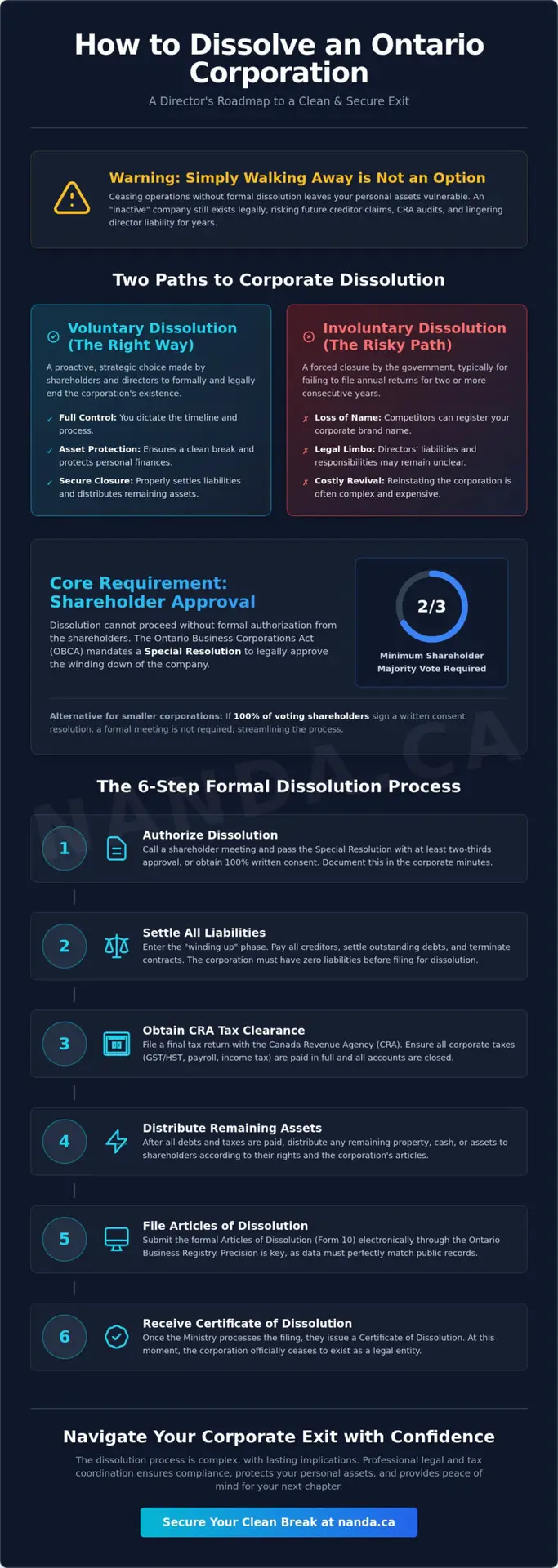
Voluntary dissolution is a proactive choice made by the corporation’s shareholders and directors. It’s an organized exit strategy that allows you to control the timeline and the distribution of assets. In contrast, involuntary or administrative dissolution happens when the government forces the closure. This usually occurs because the company failed to file its annual returns for two consecutive years. The risks of involuntary dissolution are significant. You’ll lose your corporate name protection, allowing a competitor to potentially register your brand name. Reinvigorating a corporation that has been administratively dissolved is often more expensive and complex than doing it right the first time.
The Legal Standing of a Dissolved Mississauga Corporation
Once the Ministry of Public and Business Service Delivery issues a Certificate of Dissolution, the corporation ceases to exist as a legal person. It can no longer enter into new contracts, hire employees, or initiate lawsuits. Before reaching this final step, the company must enter a "winding up" phase. During this period, the board of directors is responsible for settling all outstanding debts, paying final taxes to the Canada Revenue Agency, and distributing any remaining property to shareholders. It’s a high-stakes period where errors can lead to personal liability. We recommend consulting a business lawyer in Mississauga to ensure local compliance and to verify that all statutory obligations under the OBCA are met before the final filing. This professional oversight provides the peace of mind that your transition is legally sound and your personal assets remain protected.
Legal Requirements under the Ontario Business Corporations Act (OBCA)
The Ontario Business Corporations Act (OBCA) sets a strict statutory framework for winding down a business entity. You can’t simply walk away from a corporate structure; the law requires a formal, documented exit to protect shareholders and creditors alike. By 2026, the Ontario Business Registry has fully transitioned to a digital-first filing landscape, making the submission of Articles of Dissolution an entirely electronic process. This system requires precision, as any discrepancy in corporate data can lead to immediate rejection. A primary prerequisite under the OBCA is that the corporation must have no remaining liabilities or debts. If your Mississauga business still holds assets, these must be distributed to shareholders according to their rights and preferences after all creditors are paid in full. Learning how to dissolve a corporation in Ontario involves ensuring that the company’s internal records match the public registry’s data perfectly.
The Shareholder Approval Process
Legally ending a corporation begins with internal authorization. Directors must call a meeting of shareholders to vote on the proposal. You’re required to send a formal notice of this meeting to every shareholder entitled to vote, typically between 10 and 50 days before the event. A Special Resolution acts as the core legal authority for dissolution, requiring approval from at least two-thirds of the votes cast at the meeting. For many Mississauga enterprises with few shareholders, the "written consent" alternative is more efficient. If 100% of the shareholders sign a written resolution, you can skip the formal meeting entirely. This document becomes a permanent part of your corporate minute book, proving that the decision was unanimous and legally binding. Our business lawyers in Mississauga often recommend this route for family-owned or closely-held corporations to save time and administrative costs.
CRA Compliance and Tax Clearance
Your legal obligations to the province are inextricably linked to your federal tax status. The corporation must be in good standing with the Canada Revenue Agency (CRA) before the Ministry will approve the wind-up. If the company has been active for more than 12 months, you’ll need to secure a "Consent to Dissolve" from the Ontario Ministry of Finance. This ensures all provincial taxes, including employer health taxes or retail sales taxes, are settled. You must also file a final corporate tax return (T2) and explicitly mark it as "Final." Failing to do this can result in the CRA keeping your business accounts open, potentially triggering late filing penalties or unnecessary audits. For a smooth transition, dissolving an Ontario corporation requires a final reconciliation of all GST/HST accounts and payroll remittances. Checking these boxes provides the peace of mind that no lingering tax liabilities will haunt the directors personally after the company ceases to exist.
Director Liability and Post-Dissolution Risks
The single most dangerous misconception about corporate closure is that dissolution acts as an immediate shield against all legal claims. Many directors believe that once they file the paperwork, their liability vanishes. This isn’t the case. Under the Ontario Business Corporations Act (OBCA), a corporation is technically kept alive for certain legal purposes even after it’s been formally dissolved. You cannot simply walk away from a Mississauga business and assume every obligation has expired.
Section 242 of the OBCA provides a mechanism for the "continuation of actions." This means that any civil, criminal, or administrative proceeding can be brought against the corporation as if it hadn’t been dissolved. Creditors typically have a two-year window to initiate these claims. If you’re researching how to dissolve a corporation in ontario, you must account for this "tail" of liability. Directors also face direct personal exposure for specific debts. For instance, you are personally liable for up to six months of unpaid employee wages and vacation pay. Additionally, the Canada Revenue Agency (CRA) can hold directors personally responsible for unremitted HST and payroll source deductions, regardless of the corporation’s status.
Protecting Personal Assets During a Mississauga Business Closure
Closing a business requires a strategic, disciplined sequence of payments to creditors. If you pay one supplier but leave another unpaid, it might be classified as a "voidable preference" under the law. This could lead to personal litigation against you to recover those funds. Using an Ontario civil litigation guide helps identify these risks before they escalate into costly court battles. Professional legal oversight is essential to ensure that the priority of claims is followed correctly. By adhering to the statutory order of payments, we help you shield your personal assets from the corporation’s outstanding liabilities.
The "Tail" of Liability for Shareholders
Shareholders aren’t immune to post-dissolution risks either. If a corporation distributes its remaining assets to shareholders while leaving creditors unpaid, those shareholders may be legally required to return the assets. The OBCA establishes that shareholders can be liable to the extent of the amount they received during the liquidation process. It’s not a permanent debt, but it’s a significant risk if the wind-up isn’t handled with precision. This underscores why a comprehensive business law in Mississauga strategy is vital. When we manage the dissolution process, we ensure that every potential claimant is accounted for, providing you with the peace of mind that your personal finances won’t be compromised by past business ventures. Knowing how to dissolve a corporation in ontario means understanding that the end of the business is a process, not a single event.
The Step-by-Step Process for Closing a Mississauga Corporation
Closing a business involves a strict legal sequence. It’s not just about ending operations; it’s about fulfilling statutory obligations. To learn how to dissolve a corporation in ontario, you must navigate the Ontario Business Corporations Act with precision. This ensures you avoid personal liability and complete the closure with peace of mind. Our team at Nanda & Associate Lawyers often guides directors through these five essential stages to ensure no detail is overlooked.
-
Step 1: Board Initiation. The directors must hold a formal meeting to pass a resolution proposing the dissolution. They also set the date for a meeting of the shareholders.
-
Step 2: Shareholder Approval. Shareholders must authorize the dissolution through a special resolution. This requires at least two-thirds of the votes cast. In many private corporations, this is handled through a unanimous written consent signed by every shareholder.
-
Step 3: Liability Clearance. The corporation must identify all known creditors in Mississauga and across Ontario. Every debt must be paid or adequately provided for before assets move to the owners.
-
Step 4: Final Distribution. Once debts are cleared, any remaining cash or property is distributed to shareholders based on their specific share classes and rights.
-
Step 5: Ministry Filing. The final step is submitting the Articles of Dissolution to the provincial government to receive a Certificate of Dissolution.
Asset Liquidation and Debt Settlement
Directors face a choice between selling assets for cash or distributing them "in kind" to shareholders. While "in kind" distributions can be simpler for certain physical assets, they must be valued accurately for tax purposes. The legal priority of creditors over shareholders is absolute in the distribution hierarchy. You cannot bypass a creditor to pay a shareholder. Distributing assets before paying debts is a breach of fiduciary duty. This error often leads to directors being held personally liable for the unpaid corporate debts.
Filing the Articles of Dissolution
The formal exit requires filing Form 10, known as the Articles of Dissolution, with the Ministry of Public and Business Service Delivery. This document must include your Ontario Corporation Number and the requested effective date. Most Mississauga businesses now utilize digital filing through the Ontario Business Registry. While the government filing fee for a voluntary dissolution is currently C$0 for online submissions, paper filings may still incur costs. Once processed, you’ll receive a Certificate of Dissolution, which serves as the legal "death certificate" of the entity.
We’re dedicated to helping you manage this transition with confidence. If you’re ready to begin the formal closure of your business, book a consultation with our experienced business lawyers in Mississauga today to protect your professional reputation and personal assets.
How a Mississauga Business Lawyer Simplifies Dissolution
Closing a business is a significant transition that requires more than just stopping operations or closing a bank account. It involves a formal legal procedure to end the entity’s existence and shield directors from future liability. Our team at Nanda & Associate Lawyers provides the professional oversight needed to ensure every step complies with the Business Corporations Act. We specialize in drafting the precise corporate minutes and shareholder resolutions required to authorize the closure. Without these formal records, the dissolution could be challenged years later by creditors or stakeholders.
A major hurdle for many directors is learning how to dissolve a corporation in ontario while managing tax obligations. We coordinate directly with your accountants to ensure that legal filings and tax clearances are perfectly synchronized. This collaboration is vital because filing Articles of Dissolution before receiving a final tax clearance from the Canada Revenue Agency (CRA) can create complications. Our experienced business law professionals manage these timelines to provide a seamless transition. We focus on these details so you can focus on your next chapter with confidence.
-
Accurate Documentation: We prepare all special resolutions and director consents to meet Ontario’s strict regulatory standards.
-
Debt Resolution: We advise on the legal priority of payments to ensure all creditors are addressed according to provincial law.
-
Asset Distribution: We guide the structured distribution of remaining assets to shareholders after all liabilities are cleared.
Customized Strategic Advice for Mississauga Entrepreneurs
Every business closure is unique. A small family-owned retail shop in Streetsville faces different challenges than a large manufacturing firm near the Pearson corridor. We provide a tailored approach for each Mississauga company, especially those with multi-jurisdictional interests. If your corporation has assets or contracts in other provinces or across the border, we handle those complexities with authoritative guidance. We ensure your local interests remain protected while addressing the broader scope of your business footprint.
Finalizing Your Corporate Legacy
The goal of a professional dissolution is a clean break. This prevents future litigation, unexpected tax audits, or personal liability claims against directors. By following a comprehensive legal strategy, you protect the legacy of what you’ve built. We encourage you to seek professional support to ensure your corporate structure is closed correctly the first time. Our Mississauga business law service page offers a deeper look at how we support local enterprises through every stage of their lifecycle.
When you’re ready to learn more about how to dissolve a corporation in ontario safely and efficiently, we’re here to help. Contact us today to discuss your specific corporate needs. You can book a consultation with one of our dedicated associates to begin the process with peace of mind.
Securing Your Professional Legacy in Mississauga
Closing a business chapter requires the same level of diligence as the day you first opened your doors. You’ve seen that strict adherence to the Ontario Business Corporations Act (OBCA) is the only way to shield directors from personal liability and ensure a clean break from corporate obligations. Since 2003, our firm has rooted itself in the Mississauga community, helping local entrepreneurs navigate these complex transitions with confidence. We understand that mastering how to dissolve a corporation in Ontario means more than just filing a form; it involves meticulous debt settlement and strategic asset distribution.
Our multilingual team provides services in over 15 languages, ensuring that every detail of your dissolution is handled with cultural awareness and legal precision. We bridge the gap between business law and civil litigation to protect your long-term interests. It’s vital to have a partner who understands the local landscape and the specific regulatory hurdles of the Greater Toronto Area. We’re here to provide the steady guidance and comprehensive legal solutions your business deserves during this transition.
Book a Consultation with a Mississauga Business Lawyer today to finalize your corporate affairs. We’re ready to help you move toward your next venture with complete peace of mind.
Frequently Asked Questions
Can I dissolve my Ontario corporation if it still has outstanding debts?
No, you cannot legally dissolve a corporation that still has unpaid liabilities or obligations. According to the Ontario Business Corporations Act, a company must discharge all its debts or obtain creditor consent before filing for dissolution. If your Mississauga business has more debt than assets, you’ll likely need to explore insolvency proceedings or a formal proposal under the Bankruptcy and Insolvency Act. We ensure our clients settle all financial obligations to prevent directors from facing personal liability after the business closes.
How long does the dissolution process typically take in Mississauga?
The dissolution process usually takes between 60 and 90 days to complete from the initial filing. This timeline depends heavily on how quickly the Ministry of Finance issues a Letter of Consent, which confirms you’ve met all tax obligations. Since 2024, digital filing through the Ontario Business Registry has streamlined parts of the process. However, any gaps in your annual tax filings or unpaid C$100 penalties can cause significant delays in receiving your final Certificate of Dissolution.
What happens to the corporate bank account after the Certificate of Dissolution is issued?
You must close your corporate bank account only after all assets are distributed and the final tax refund is processed. If funds remain in an account after the Certificate of Dissolution is issued, those assets may legally escheat to the Crown under the Escheats Act, 2015. This means the government could take ownership of the money. We recommend keeping a small balance to cover final administrative costs and then closing the account immediately before the final filing is approved.
Do I need a lawyer to file Articles of Dissolution in Ontario?
While the law doesn’t mandate hiring a lawyer, professional guidance is essential to master how to dissolve a corporation in Ontario safely. Directors can be held personally liable for up to two years after dissolution if creditors weren’t properly notified or if assets were distributed incorrectly. Our legal team provides the peace of mind that all corporate minute books are updated and that your Mississauga business closure complies with every statutory requirement under the Business Corporations Act.
What is the difference between dissolving a corporation and a "voluntary winding up"?
Winding up is the preliminary process of liquidating assets and paying off creditors, while dissolution is the final legal act that ends the corporation’s existence. Under Section 193 of the Ontario Business Corporations Act, a voluntary winding up requires a special resolution supported by at least 66.67 percent of shareholder votes. Once the liquidator finishes their work and the final accounts are approved, we then file the Articles of Dissolution to officially close the company’s doors.
Can a dissolved corporation be revived later if I want to restart the business?
Yes, you can revive an Ontario corporation within 20 years of its dissolution by filing Articles of Revival. This process restores the company to its previous legal standing as if the dissolution never happened. You’ll need to submit a revival fee and clear any outstanding tax returns with the Canada Revenue Agency. It’s a common strategy for business owners in Mississauga who discover forgotten assets or need to defend a legal claim that arose after the company was closed.
How do I handle a Mississauga business closure if one shareholder disagrees with the dissolution?
When shareholders disagree, you must follow the specific voting requirements outlined in your Shareholders’ Agreement or the Ontario Business Corporations Act. Generally, you need a special resolution passed by two-thirds of the shareholders to proceed with a voluntary dissolution. If the board is deadlocked, a shareholder might apply to the Superior Court of Justice for a "just and equitable" winding up. We help clients navigate these disputes to reach a resolution that protects their investment and professional reputation.
Are there specific record-keeping requirements for dissolved corporations in Ontario?
You’re required to keep all corporate records and accounting books for at least six years following the date of dissolution. This period aligns with Canada Revenue Agency requirements for tax audits and Section 242 of the Ontario Business Corporations Act. These records must be stored in a secure location where they can be produced if a court order is issued. We advise our clients to digitize these documents to ensure they remain accessible and protected against physical damage over the years.
Disclaimer
This content is for general information only and does not constitute legal advice or create a lawyer-client relationship. Every case is different—please consult a qualified lawyer for advice specific to your situation.