




Key Takeaways
Discover the strategic advantages of incorporating in Mississauga and how establishing a separate legal entity provides essential liability protection for business owners.
Navigate the mandatory statutory requirements of the Ontario Business Corporations Act (OBCA) to ensure your new enterprise remains compliant with provincial regulations.
Learn the precise procedural steps from a Toronto Business Incorporation Lawyer: How to Start a Corporation in Ontario, including how to conduct a NUANS name search and file your Articles of Incorporation.
Secure your company’s future by understanding the necessity of a Corporate Minute Book and the role of Shareholders’ Agreements in mitigating internal partnership risks.
Explore how professional legal guidance from an experienced business lawyer facilitates a seamless transition from a sole proprietorship to a structured corporation, positioning your business for sustainable growth.
Table of Contents
Introduction: Why Incorporating in Mississauga is a Strategic Business Move
Legal Explanation: Understanding the Ontario Business Corporations Act (OBCA)
The Incorporation Process: Timelines and Statutory Requirements
Practical Advice: Post-Incorporation Governance and Risk Management
Conclusion: Partnering with a Business Incorporation Lawyer in Mississauga
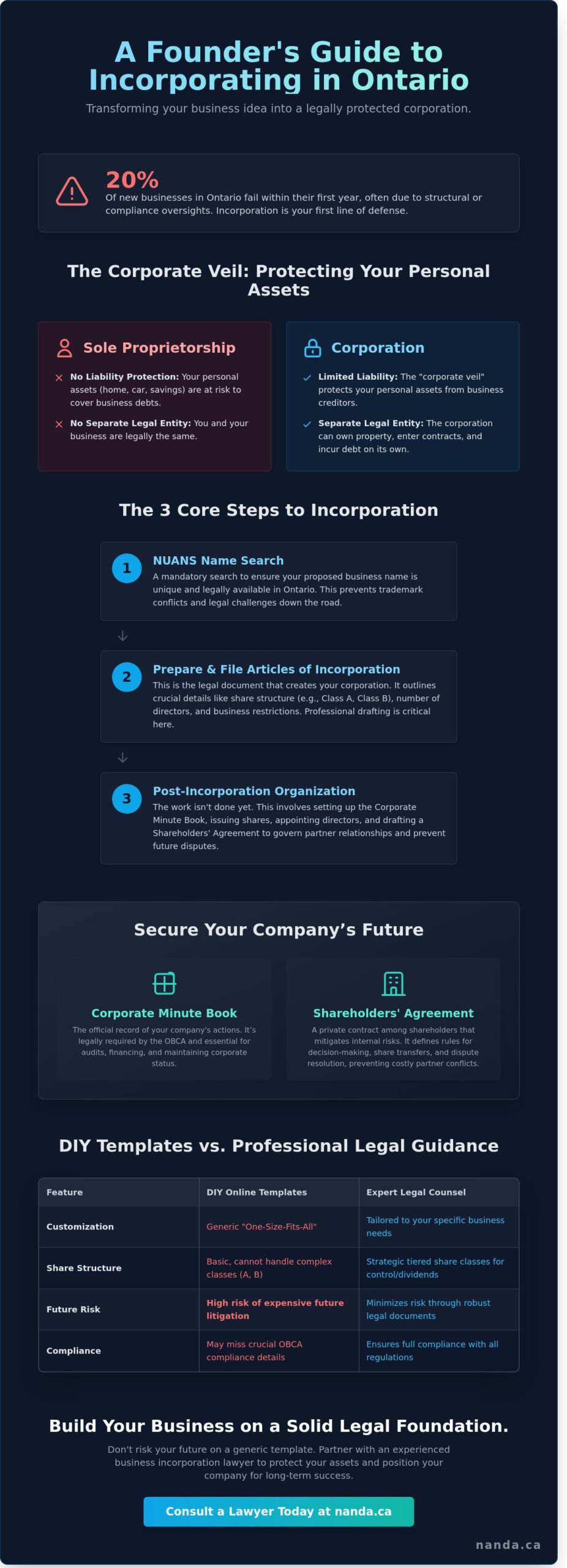
What if the very business you’re building to secure your family’s future is actually the greatest threat to your personal assets? Statistics Canada reported in 2023 that approximately 20% of new businesses in Ontario fail within their first year, often due to structural or compliance oversights. You likely feel that your current setup lacks the necessary protection, yet the technical differences between federal and provincial filings can feel overwhelming. Consulting with a Toronto Business Incorporation Lawyer: How to Start a Corporation in Ontario is the first step toward transforming that uncertainty into a foundation of legal strength.
Our experienced business lawyers understand the pressure of protecting your family while pursuing your professional goals. In this guide, you’ll learn the essential legal steps, specific timelines, and the strategic advantages of incorporating your business in Toronto under the Ontario Business Corporations Act. We’ll provide a clear roadmap for provincial compliance and explain how to structure your founding documents to prevent future partner disputes. By the end, you’ll understand exactly how to establish a separate legal entity that protects your wealth and ensures long term stability.
Introduction: Why Incorporating in Mississauga is a Strategic Business Move
Mississauga’s economic profile in 2026 reflects a city that has evolved into a premier global business hub. It now hosts more than 98,000 businesses, including over 1,400 multinational firms and a significant concentration of Fortune 500 headquarters. For entrepreneurs, this environment offers a unique launchpad. When you consult a Toronto Business Incorporation Lawyer: How to Start a Corporation in Ontario, you’re taking the first step toward securing your place in this competitive market. The city’s focus on high-growth sectors like life sciences and advanced manufacturing makes it an ideal location for new entities looking to scale rapidly.
The transition from a sole proprietorship to a separate legal entity is a pivotal moment for any founder. Operating as a sole proprietor means your personal assets are indistinguishable from your business debts. By incorporating, you create a “corporate veil” that protects your personal holdings. The foundational principles of Canadian corporate law ensure that your business exists as a distinct legal person, capable of entering contracts, incurring debt, and owning property independently of its shareholders.
At Nanda & Associate Lawyers, we adopt a “Sophisticated Mentor” approach to business law. We don’t just file paperwork; we help you build a foundation for long-term growth. Our collaborative team of experts provides comprehensive legal solutions that address the immediate needs of incorporation while anticipating future challenges. We treat every client with individual care, ensuring your corporate structure aligns with your specific vision for the future.
The Advantage of a Mississauga-Based Corporation
Choosing Mississauga provides a distinct strategic edge. You gain proximity to Toronto’s financial core, located just 25 kilometers away, while benefiting from a more localized, community-driven business environment. This position allows for seamless access to regional business networks and world-class infrastructure, including Pearson International Airport. Our business lawyers understand the local regulatory nuances that can impact your operations, providing you with a home-field advantage in the Greater Toronto Area.
The Role of a Business Incorporation Lawyer
Many entrepreneurs are tempted by generic online templates to save costs, but DIY incorporation often leads to expensive litigation later. These “one-size-fits-all” forms frequently fail to address complex share structures or specific voting rights. Our guidance as a Toronto Business Incorporation Lawyer: How to Start a Corporation in Ontario helps you customize your articles of incorporation. We focus on:
Creating tiered share classes (Class A, Class B) to manage control and dividends.
Drafting robust shareholder agreements to prevent future disputes.
Ensuring compliance with the Ontario Business Corporations Act.
By prioritizing legal accuracy from day one, you protect your investment and provide peace of mind for your partners and investors.
Legal Explanation: Understanding the Ontario Business Corporations Act (OBCA)
The Ontario Business Corporations Act (OBCA) serves as the primary legislative framework for companies operating within the province. It functions as a comprehensive rulebook that dictates how a company is formed, managed, and eventually dissolved. Our team views the OBCA as the foundation of corporate governance, providing the structure necessary for businesses to thrive in the Toronto marketplace. One of the most vital concepts established by this statute is “Separate Legal Personality.” This means the law treats your corporation as a distinct person, capable of signing contracts, owning property, and initiating litigation independently of its owners.
Understanding these regulations is the first step for any entrepreneur. A Toronto Business Incorporation Lawyer: How to Start a Corporation in Ontario helps clarify how these rules apply to your specific goals. Under the OBCA, shareholders enjoy specific statutory rights that ensure transparency and fairness. These include the right to vote on major corporate changes, the right to receive dividends when declared, and the right to inspect corporate records. These protections create a stable environment for investment and growth.
Provincial (Ontario) vs. Federal (Canada) Incorporation
Choosing between provincial and federal incorporation is a strategic decision that affects your brand’s reach and compliance workload. Ontario incorporation is often the most efficient path for Toronto businesses that plan to operate primarily within the province. It offers robust name protection within Ontario, ensuring no other provincial entity can use a confusingly similar name. While federal incorporation provides nationwide name protection, it often involves more complex annual filings. Our business lawyers can help you evaluate which jurisdiction aligns with your five year expansion plan. Additionally, provincial corporations must comply with the Corporations Information Act, which requires an annual return to be filed to keep the public record accurate and up to date.
Limited Liability: Protecting Your Personal Assets
The primary motivation for many Toronto entrepreneurs to incorporate is the protection of personal wealth. The corporate veil is a legal barrier protecting personal assets from corporate creditors. This separation ensures that if the business faces financial hardship or legal action, your personal home, savings, and vehicles remain shielded from the company’s liabilities. It’s a cornerstone of modern commerce that allows for calculated risk taking without the threat of personal ruin.
However, this protection isn’t an absolute shield. Ontario courts can “pierce the corporate veil” if the corporation is used for fraudulent purposes or if directors fail to maintain proper corporate formalities. Directors also face specific personal liabilities under various statutes. For instance, directors can be held personally responsible for up to six months of unpaid employee wages or unremitted Harmonized Sales Tax (HST) and payroll deductions. Maintaining strict compliance with the OBCA is the best way to preserve your limited liability status. If you’re concerned about your current corporate structure, you might consider speaking with our team about a tailored legal review of your business operations.
The Incorporation Process: Timelines and Statutory Requirements
Establishing a legal entity in Ontario requires strict adherence to the Business Corporations Act. This isn’t merely a clerical task; it’s the creation of a distinct legal person. Our team at Nanda & Associate Lawyers guides clients through each phase to ensure the corporate foundation is resilient. Partnering with a Toronto Business Incorporation Lawyer: How to Start a Corporation in Ontario ensures that your filings comply with provincial regulations from day one.
Step 1: Conducting a NUANS name search: Before filing, you must obtain a Newly Upgraded Automated Name Search (NUANS) report. This 7-page document identifies similar existing corporate names or trademarks. It remains valid for 90 days.
Step 2: Drafting the Articles of Incorporation (Form 1): This document defines the corporation’s structure, including its name, registered office location, and share capital.
Step 3: Establishing the initial Board of Directors: You must identify the individuals who’ll manage the corporation’s affairs. In Ontario, at least 25 percent of directors must be resident Canadians.
Step 4: Filing with the Ministry of Public and Business Service Delivery: The final step involves submitting your completed articles and the required fee through the Ontario Business Registry.
Standard Timelines for Ontario Incorporation
The speed of your incorporation depends heavily on the filing method. Digital filings through the Ontario Business Registry are typically processed within 24 hours. By 2026, the Ministry expects these systems to provide near-instantaneous confirmations for standard applications. Paper filings submitted by mail are significantly slower, often taking 30 to 45 business days for approval. Delays often occur if the NUANS report reveals a high potential for name confusion or if the registered office address is incomplete. It’s vital to have a physical registered office address in Toronto. A P.O. Box isn’t sufficient for service of legal documents.
Essential Documents Required for Filing
Drafting the Articles of Incorporation requires strategic decisions regarding share classes. We often help clients distinguish between Common and Preferred shares. Common shares generally carry voting rights, while Preferred shares may offer priority during dividend distributions or liquidation. You must also define any restrictions on share transfers, which is a common requirement for private companies looking to maintain control over ownership. Appointing the first incorporators and directors is the final piece of the statutory puzzle. These individuals hold the initial organizational meeting to adopt bylaws and issue shares. For professional guidance on these structures, you can consult our business lawyers to ensure your corporate minute book is set up correctly.
Practical Advice: Post-Incorporation Governance and Risk Management
Receiving your Certificate of Incorporation is a significant milestone, but it doesn’t mean your legal obligations are complete. Effective governance is what separates a vulnerable entity from a resilient business. A Toronto Business Incorporation Lawyer: How to Start a Corporation in Ontario will emphasize that the Corporate Minute Book is your most vital asset for internal order. Under the Ontario Business Corporations Act, every corporation must maintain records including articles of incorporation, bylaws, and minutes of meetings. We’ve seen cases where missing records led to delays in securing financing or blocked a potential sale. Keeping these documents updated ensures you’re always ready for due diligence and regulatory scrutiny.
Why the Shareholders’ Agreement is Your Most Important Document
A corporation’s bylaws provide a basic framework, but a Shareholders’ Agreement offers the tailored protection needed for private companies. This document acts as a safeguard against future conflict. We include “Shotgun Clauses” to provide a clear exit strategy if partners can no longer work together. It also addresses critical scenarios like the death or long-term disability of a founder. Protecting minority shareholders is equally vital; without specific provisions, those with smaller stakes may lack a voice in major decisions.
Ongoing Statutory Maintenance
Compliance isn’t a one-time event. You must hold an Annual General Meeting (AGM) to elect directors and appoint auditors. We help clients maintain the Register of Directors and the Register of Shareholders to reflect current ownership accurately. A corporation must file an Annual Return within six months of its year-end to avoid dissolution by the government. This simple administrative task is often overlooked, leading to the loss of corporate status. Our team ensures your filings are current so your business remains in good standing with the Ministry of Public and Business Service Delivery. If internal friction does arise, our civil litigation lawyers provide the strategic representation needed to resolve disputes before they threaten your operations.
Don’t leave your corporate governance to chance. Reach out to our team to ensure your business foundation is secure from day one.
Book a consultation with our business law experts
Conclusion: Partnering with a Business Incorporation Lawyer in Mississauga
Incorporating a business marks the transition from a vision to a formal legal entity. While the initial filing of Articles of Incorporation is a critical milestone, the true value of a Toronto Business Incorporation Lawyer: How to Start a Corporation in Ontario lies in the strategic architecture they build around your venture. At Nanda & Associate Lawyers, we provide more than just document preparation. We offer a comprehensive legal framework that protects your personal assets and optimizes your corporate governance from day one.
Our commitment to providing comprehensive legal solutions means we look at your business through a multi-dimensional lens. We ensure your bylaws are robust, your shareholder agreements are clear, and your business remains compliant with the Business Corporations Act (Ontario). This proactive approach prevents the costly disputes and administrative errors that often derail new companies. You aren’t just starting a business; you’re building an asset that requires professional oversight to thrive. Transitioning from a founder to a corporate leader involves shifting your focus from daily operations to high-level strategy. We handle the legal complexities so you can lead with confidence.
Asset Protection: We help shield your personal wealth from business liabilities.
Tax Efficiency: Proper incorporation structures allow for better fiscal planning.
Scalability: A clean legal setup makes it easier to attract investors or secure bank financing.
Regulatory Compliance: We ensure your minute books and annual filings meet all provincial standards.
Strategic Mentorship for Your New Venture
Our business lawyers act as long-term partners for your growth. We understand that Mississauga is home to a diverse and vibrant entrepreneurial community, ranging from tech startups to established manufacturing firms. This local insight allows us to provide advice that’s both legally sound and practically relevant to the regional economy. We don’t just see ourselves as your legal counsel; we’re mentors who are invested in your long-term success. Whether you’re navigating your first incorporation or restructuring an existing enterprise, our team provides the steady hand you need.
Securing your business future starts with a single, decisive step. If you’re ready to formalize your vision using the expertise of a Toronto Business Incorporation Lawyer: How to Start a Corporation in Ontario, we invite you to reach out for a professional consultation. We’ll review your specific goals and outline a roadmap that ensures your corporation is built on a solid foundation. You can take the first step toward professional corporate leadership by visiting to schedule your session with our team. Let’s work together to protect what you’ve built and prepare your company for the years of growth ahead.
Securing Your Company’s Future in the Ontario Market
Starting a business requires more than just filing paperwork; it demands a strategic legal foundation that protects your personal assets and ensures compliance with the Ontario Business Corporations Act. You’ve learned that proper post-incorporation governance and risk management are essential for long-term stability. Since 2003, our team has helped entrepreneurs navigate these complexities with a focus on building scalable ventures. We provide multilingual support in over 15 languages, ensuring every founder understands their statutory obligations clearly.
Whether you’re refining your minute books or drafting initial shareholder agreements, consulting a Toronto Business Incorporation Lawyer: How to Start a Corporation in Ontario helps you avoid common pitfalls that stall growth. Our comprehensive expertise across Business Law and Civil Litigation means your company is prepared for both daily operations and unforeseen legal challenges. Protect your assets and build a scalable foundation for your venture. Book a consultation with our Toronto business lawyers today. Your vision deserves the security of a dedicated legal partner who understands the local landscape.
Frequently Asked Questions
What is the difference between an Ontario and Federal corporation?
The primary difference lies in name protection and the geographic scope of your business operations. Federal incorporation provides name protection across all of Canada, while an Ontario corporation protects your name only within the province. We often recommend federal status for clients planning national expansion, though it requires additional annual filings that a provincial entity avoids.
How long does it take to incorporate a business in Toronto?
You can typically incorporate a business in Toronto within 24 hours if you file electronically through the Ontario Business Registry. This timeline assumes you’ve already completed your mandatory name search and have your articles of incorporation ready. If you choose to work with a Toronto Business Incorporation Lawyer: How to Start a Corporation in Ontario, we ensure every detail is accurate to prevent government processing delays.
Do I need a lawyer to incorporate my business in Ontario?
You aren’t legally required to hire a lawyer, but seeking professional guidance helps you avoid costly structural errors. We help you draft customized bylaws, issue shares correctly, and establish a solid foundation for future growth. Many entrepreneurs who self-incorporate find they eventually need legal assistance to fix disorganized minute books or improper share allocations that surface during a sale or audit.
What are the ongoing costs of maintaining a corporation?
Maintaining a corporation involves annual government filings, tax preparation, and keeping your corporate minute book updated. You must file an Annual Return with the Ontario Ministry of Public and Business Service Delivery within six months of your fiscal year end. These administrative tasks ensure your company remains in good standing and protects the limited liability status that keeps your personal assets safe.
Can a non-resident of Canada start a corporation in Ontario?
Yes, a non-resident can start a corporation in Ontario because the province eliminated the Canadian residency requirement for directors on July 5, 2021. This change, introduced through the Better for People, Smarter for Business Act, makes the region an attractive hub for international entrepreneurs. You can now form a board of directors comprised entirely of non-residents while still benefiting from the province’s stable legal environment.
What is a NUANS search and why is it mandatory?
A NUANS search is a mandatory report that compares your proposed business name against a database of existing trademarks and corporations. It ensures your name isn’t confusingly similar to another entity, which helps prevent future trademark litigation. The report stays valid for 90 days, providing the necessary window to submit your articles of incorporation to the government with a Toronto Business Incorporation Lawyer: How to Start a Corporation in Ontario.
What happens if I don’t maintain my corporate minute book?
Failing to maintain your corporate minute book can lead to significant hurdles during audits, loan applications, or the eventual sale of your business. The Ontario Business Corporations Act requires every company to keep accurate records of resolutions, meeting minutes, and share registries. Without these documents, you’ll struggle to prove ownership or demonstrate that the corporation is a separate legal entity from your personal finances.
Can I incorporate my professional practice?
You can incorporate a professional practice in Ontario if your specific regulatory body allows for a Professional Corporation. Doctors, lawyers, and accountants often use this structure to manage taxes more effectively while adhering to the professional standards of their industry. We provide tailored advice to ensure your articles of incorporation comply with both the Business Corporations Act and your professional regulator’s specific bylaws.
Disclaimer
This content is for general information only and does not constitute legal advice or create a lawyer-client relationship. Every case is different—please consult a qualified lawyer for advice specific to your situation.