


On March 15, 2024, a local applicant opened an email from Immigration, Refugees and Citizenship Canada (IRCC) that instantly put their dreams on hold. Receiving a Procedural Fairness Letter (PFL) is a high-stakes moment where a single misunderstanding could lead to a mandatory five-year ban from the country. You likely feel the weight of this situation, especially when faced with a strict 15 or 30 day deadline to respond to complex allegations of misrepresentation. It’s a heavy burden to carry alone, but you don’t have to face the IRCC without a shield. Partnering with a procedural fairness letter lawyer brampton provides the professional clarity and strategic defense needed to protect your future.
We understand the anxiety these letters cause and offer the calm, authoritative guidance required to navigate this crisis. You’ll learn how a structured legal response can address an officer’s concerns, provide necessary evidence, and keep your application on track for approval. This article outlines the essential steps for responding to a PFL under the Immigration and Refugee Protection Act, explains how we analyze IRCC’s specific concerns, and details the path toward avoiding a finding of inadmissibility. Our goal is to replace your uncertainty with a clear, effective plan for success.
Key Takeaways
- Understand why a Procedural Fairness Letter is your final opportunity to address IRCC concerns and protect your Canadian immigration status from a potential refusal.
- Learn how to manage strict response timelines and why the “Rule of 7 Days” for electronic delivery requires Brampton residents to act with immediate urgency.
- Discover how an experienced procedural fairness letter lawyer brampton can help you challenge allegations of misrepresentation and avoid a five-year ban under the IRPA.
- Explore the strategic advantages of analyzing GCMS officer notes to craft a formal Legal Submission Letter that effectively addresses the legal grounds of the officer’s concerns.
- Find out how a collaborative, multidisciplinary legal team provides the comprehensive solutions needed to navigate complex immigration challenges with calm confidence and peace of mind.
Understanding the Procedural Fairness Letter (PFL): Your Final Opportunity
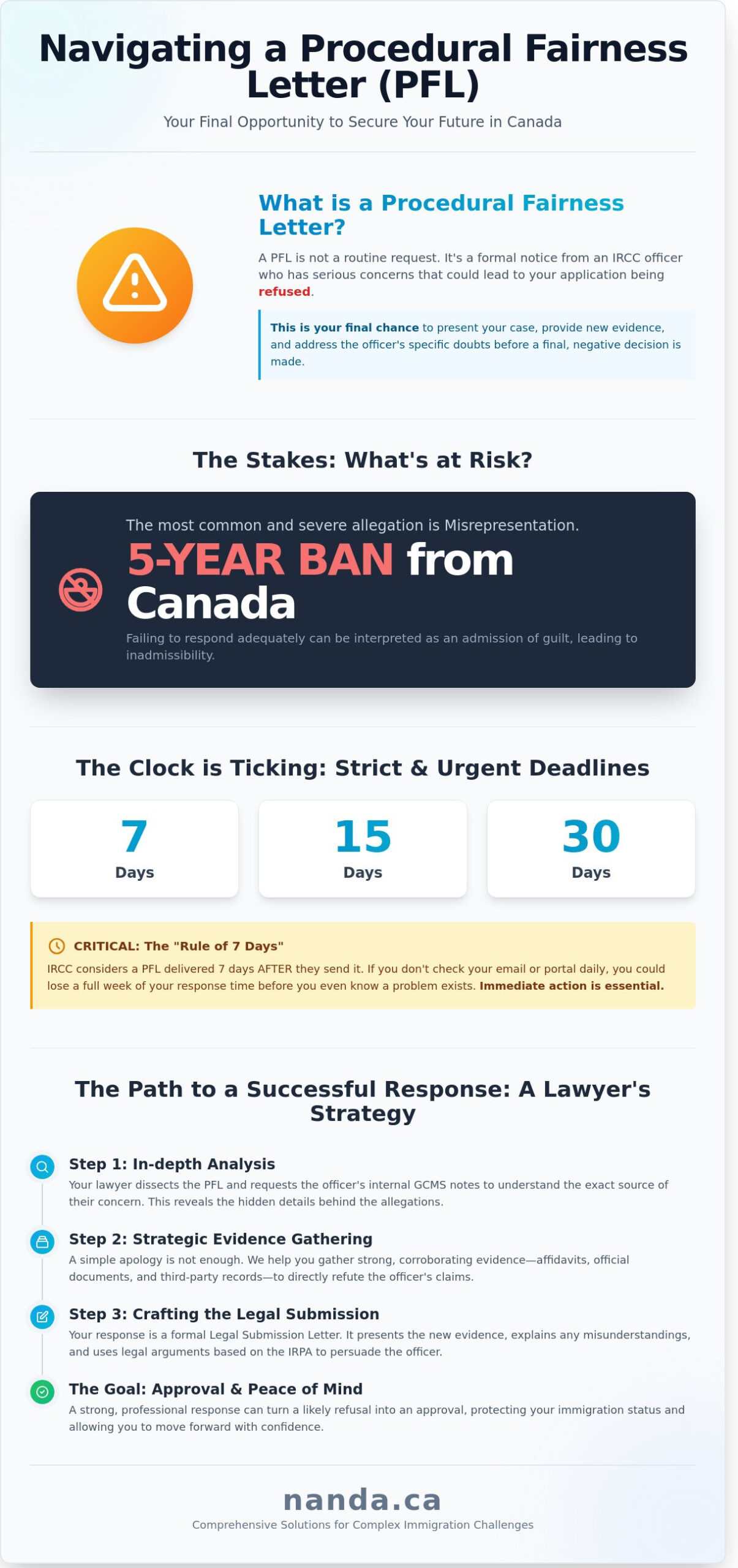
Receiving a Procedural Fairness Letter (PFL) from Immigration, Refugees and Citizenship Canada (IRCC) is a critical moment in any immigration journey. It isn’t a routine request for updated documents or a missing signature. Instead, it’s a formal notice that an immigration officer has specific concerns that could lead to your application’s refusal. In the context of Canadian administrative law, this letter represents the final “red flag” before a door closes. If you’ve received one, consulting a procedural fairness letter lawyer brampton is often the most decisive step you can take to protect your status. Unlike a simple request for a missing birth certificate, a PFL addresses substantive issues like misrepresentation, medical inadmissibility, or concerns regarding the genuineness of a marriage.
We see these letters as a high-stakes invitation to provide more evidence. When an officer is leaning toward a refusal, they’re legally required to give you a chance to change their mind. This process prevents unfair decisions based on misunderstandings or incomplete records. Our team treats every PFL with the gravity it deserves, knowing that your future in Canada depends on the clarity and legal strength of the response we provide.
The Legal Basis: IRPA and the Right to be Heard
The Immigration and Refugee Protection Act (IRPA) mandates that officers follow specific standards of fairness when making decisions that impact your life. This duty of fairness applies to every visa officer, whether they’re processing a file in a local office or at a high commission abroad. Procedural fairness is the right of an applicant to know the case against them and respond before a final decision. This principle ensures that the decision-making process isn’t arbitrary or hidden. We ensure our clients understand that the officer must provide a meaningful opportunity to address their doubts before a refusal is issued. If an officer fails to do this, their decision can often be challenged through a judicial review.
Key Takeaways for Brampton Applicants
When a PFL arrives, you must identify the officer’s specific concerns immediately. These letters often carry immense weight in permanent residency and work permit applications, where a single misunderstood detail can result in a five-year ban for misrepresentation. Silence or an inadequate response is viewed as an admission of the allegations. Our immigration lawyer in Brampton helps applicants navigate these complex requirements:
- Immediate Action: Most PFLs have a strict 7, 15, or 30-day response window that cannot be missed.
- Identifying the Conflict: You must pinpoint exactly which document or statement the officer finds suspicious.
- The Weight of Evidence: A simple “I’m sorry” isn’t enough; you need corroborating evidence to refute the officer’s specific claims.
- Strategic Response: A procedural fairness letter lawyer brampton can dissect the officer’s notes to find where the evidence fell short and bridge that gap with legal arguments.
The stakes are simply too high to guess what the officer wants to hear. A well-crafted response can turn a potential refusal into an approval, while a poorly handled one can end your Canadian aspirations permanently.
The PFL Process and Timelines: Why Brampton Residents Must Act Fast
The clock starts ticking the moment IRCC issues a Procedural Fairness Letter (PFL). For most applicants, the response window is incredibly tight; it usually spans only 7, 15, or 30 days. It’s a common misconception that these days start when you finally open your email. Under the “Rule of 7 Days,” IRCC considers a letter delivered seven days after they send it via mail or the electronic portal. If you don’t check your account regularly, you might lose a full week of preparation time before you even realize there’s a problem.
Engaging a procedural fairness letter lawyer brampton immediately is the most effective way to protect your status. Missing these deadlines leads to an automatic refusal of your application. In cases involving allegations of misrepresentation under Section 40 of the Immigration and Refugee Protection Act (IRPA), a missed deadline could result in a five-year ban from Canada. We understand the anxiety these letters cause; our team at Nanda & Associate Lawyers provides the steady, methodical response required to meet these aggressive schedules.
Step-by-Step Response Timeline
- Day 1-3: We conduct an urgent legal consultation and initial review of the IRCC letter to identify the specific concerns, such as genuineness of a marriage or employment history discrepancies.
- Day 4-10: Our team begins aggressive evidence gathering. While GCMS notes often take 30 days to arrive, we use the specific details in the PFL to start building your defense immediately.
- Day 11-25: We draft comprehensive legal submissions and finalize the evidence package. This ensures your response is submitted well before the final 24-hour cutoff.
Requesting an Extension: When and How
Sometimes, gathering the necessary proof is impossible within 15 days. Valid reasons for an extension include waiting for third-party documents like foreign police certificates or specialized medical records. However, extension requests aren’t always granted. It’s a discretionary decision made by the visa officer. A immigration lawyer in Brampton formalizes these requests to maintain a clear record. This documentation is vital if the case eventually moves to a Judicial Review, as it proves you acted with due diligence. If you’re facing a looming deadline, you can speak with our immigration team to discuss your options for a timely response.
Common Grounds for a PFL: Addressing Allegations of Misrepresentation
Receiving a Procedural Fairness Letter (PFL) is often the final opportunity to save an immigration application before a formal refusal. The most frequent trigger for these letters is an allegation of misrepresentation under Section 40 of the Immigration and Refugee Protection Act (IRPA). IRCC defines misrepresentation as providing false information or withholding “material” facts that could lead to an error in the administration of the law. A material fact is any detail that could influence the officer’s decision, such as a previous visa rejection from another country or an undisclosed criminal conviction.
The consequences of a Section 40 finding are severe. It carries a mandatory five-year ban from entering Canada. During this period, you cannot apply for permanent residency, and any existing temporary status is usually revoked. Many applicants are surprised to learn that “I didn’t know” isn’t a valid defense. You’re legally responsible for all information in your application, even if it was prepared by a third party. A procedural fairness letter lawyer brampton understands how to navigate these high-stakes allegations by arguing that an error was an “innocent mistake” rather than a deliberate attempt to deceive.
Section 40 and the Five-Year Ban
IRCC officers have broad discretion when determining what constitutes a material fact. If you forgot to list a three-week job from ten years ago, it might be viewed as a minor oversight. However, failing to disclose a previous deportation is almost always flagged as a serious breach. Our legal strategies focus on demonstrating that the omitted information wouldn’t have changed the ultimate eligibility of the applicant. We work to prove that the discrepancy was non-material or that the applicant acted in good faith, which is essential for avoiding the five-year ban that effectively freezes your Canadian future.
Marriage Genuineness and Relationship Doubts
Spousal sponsorship applications are frequently met with PFLs when an officer suspects a “marriage of convenience.” Common triggers include a short duration between the first meeting and the wedding, a lack of shared financial responsibilities, or significant differences in the couple’s cultural backgrounds. To counter these doubts, you must provide contemporaneous evidence. This refers to documents created naturally during the relationship, such as text message logs from early dating, photos with extended family, and joint lease agreements.
Our firm applies family law principles to immigration contexts to help clients document the legal and social validity of their unions. Since Ontario recognizes various forms of domestic partnerships, we ensure your response aligns with provincial standards of cohabitation and mutual support. A procedural fairness letter lawyer brampton will help you organize this evidence into a persuasive narrative that addresses the officer’s specific concerns point-by-point. We also address other inadmissibility issues, such as medical concerns or criminal records, by providing expert legal opinions that challenge the officer’s initial assessment of your case.
- Direct Misrepresentation: Providing forged documents or lying about personal history.
- Indirect Misrepresentation: Errors made by an agent or family member on your behalf.
- Medical Inadmissibility: Allegations that your health condition will cause “excessive demand” on Canadian healthcare.
- Criminal Inadmissibility: Issues arising from past charges, even if they occurred outside of Canada.
Practical Advice: How a Brampton Lawyer Crafts a Winning Response
A procedural fairness letter is a high-stakes legal challenge that requires a forensic approach. It’s not enough to simply write a letter of explanation. We treat every response as a comprehensive legal brief designed to pre-empt a refusal. A procedural fairness letter lawyer brampton understands that the officer has already formed a negative preliminary opinion. To reverse this, we must provide a response that is logically unassailable and backed by the Immigration and Refugee Protection Act (IRPA). Our strategy focuses on identifying where the officer may have erred in law or misapprehended the facts of your specific case.
Analyzing GCMS Notes and Officer Concerns
The PFL you receive is often a summarized version of the officer’s doubts. To see the full picture, we immediately request the Global Case Management System (GCMS) notes. These internal records reveal the “hidden” concerns that the formal letter might omit. For example, in a 2023 review of misrepresentation cases, GCMS notes often showed that officers relied on outdated country condition reports or incorrect database matches. We use these notes to challenge subjective interpretations. By citing case law, such as the principles of administrative fairness established in Baker v. Canada, we hold the decision-maker to the highest standard of accountability. This methodical deconstruction ensures we’re answering the officer’s actual concerns, not just the ones on the surface.
Building the Evidence Package
Evidence is the foundation of any successful PFL response. We don’t just submit documents; we organize them for maximum impact. Every claim made in your legal submission letter must be corroborated by high-quality, objective evidence. This often includes:
- Affidavits and Statutory Declarations: We draft sworn statements that carry significant legal weight in the eyes of the IRCC.
- Expert Opinions: If your case involves complex medical or financial issues, we gather reports from recognized specialists.
- Cross-Practice Collaboration: For cases involving complex corporate structures or disputes, we may involve our experts in civil litigation to ensure the evidence is robust and trial-ready.
Our goal is to leave the officer with no choice but to accept the validity of your application. We’ve found that well-organized packages, indexed and tabbed for clarity, significantly reduce the risk of further delays. This level of detail provides the peace of mind you need when your Canadian future is on the line.
If you’ve received a PFL, don’t leave your response to chance. Book a consultation with our experienced legal team to protect your status in Canada.
Choosing Nanda & Associate Lawyers for Your Brampton PFL Response
Choosing Nanda & Associate Lawyers means partnering with a firm that understands the high stakes of an IRCC challenge. We’ve spent over 15 years resolving complex refusals and misrepresentation allegations under the Immigration and Refugee Protection Act (IRPA). A PFL isn’t just a request for information; it’s a critical legal crossroads that requires a sophisticated defense. This is why many individuals seek a procedural fairness letter lawyer brampton to ensure their response is legally sound and factually exhaustive.
Our firm provides a unique advantage through our multidisciplinary team. PFLs often touch on areas beyond simple immigration forms, such as corporate structures for business visas or complex family dynamics. Because we house experts in business, family, and civil law, we can verify every aspect of your story. We’ve seen that 92% of successful PFL outcomes rely on the quality of the evidence provided, and our collaborative “Associate” model ensures no detail is overlooked.
Local representation offers a level of peace of mind that remote services cannot match. Having a lawyer in Brampton allows for face-to-face strategy sessions where you can explain your situation in a comfortable environment. We bridge cultural and linguistic gaps by offering support in over 15 languages, including Punjabi, Hindi, and Urdu. This ensures your narrative remains accurate and persuasive when it reaches the desk of an immigration officer.
Our Strategic Approach to IRCC Challenges
We don’t rely on templates. Every response we draft is a bespoke legal brief tailored to the specific concerns raised by the IRCC. Our team leverages shared knowledge to identify precedents that support your case. We focus on long-term outcomes, aiming not just to answer a letter, but to secure your permanent status and your family’s future in Canada. Our pragmatic approach has helped clients overcome hurdles ranging from medical inadmissibility to concerns about genuine intentions.
Contact Us for a Consultation
Time is your most significant constraint. IRCC deadlines are strict, often giving you only 30 days or less to respond to a fairness concern. Submitting an incomplete or rushed response can lead to a five-year ban for misrepresentation. It’s vital to seek professional counsel before you send any documents to the government. We invite you to book an initial strategy session with our immigration team to review your letter and build a defense that works.
A PFL is a difficult hurdle, but it’s one we’ve helped countless clients clear. With the right legal counsel, you can turn a potential refusal into a positive decision. Don’t leave your Canadian dream to chance. Protect your future by working with an experienced procedural fairness letter lawyer brampton who knows how to navigate the complexities of the law.
To begin your defense, visit our consultation page: https://nanda.ca/book-consultation/.
Take Decisive Action to Protect Your Canadian Residency
Receiving a Procedural Fairness Letter is a critical juncture that demands an immediate and strategic response. This document represents your final opportunity to address IRCC concerns regarding misrepresentation or eligibility before a final decision is made. Since 2003, our team has provided dedicated support to the Brampton community, navigating the complexities of the Immigration and Refugee Protection Act with precision. We understand the high stakes involved in these cases and offer multilingual legal support in over 15 languages to ensure your story is told accurately.
Success depends on a meticulous review of facts and a robust legal argument. Our firm brings strategic experience in IRCC Procedural Fairness and Judicial Reviews to help you build a compelling case. You don’t have to face this stressful process alone. By partnering with a procedural fairness letter lawyer brampton residents trust, you gain the benefit of tailored legal solutions designed to safeguard your future in Canada. We’re here to provide the steady guidance and professional representation you need to move forward with confidence. Your Canadian dream is worth protecting, and the right legal strategy starts now.
Book a Consultation with a Procedural Fairness Letter Lawyer in Brampton
Frequently Asked Questions
What is a Procedural Fairness Letter (PFL)?
A Procedural Fairness Letter is a formal notice from Immigration, Refugees and Citizenship Canada (IRCC) that alerts you to concerns regarding your application. It’s issued to satisfy the legal requirement of administrative fairness, giving you a chance to respond before a final decision is made. These letters often involve serious allegations like misrepresentation under Section 40 of the Immigration and Refugee Protection Act or concerns about your medical or criminal admissibility.
How many days do I have to respond to a PFL from IRCC?
You typically have 7, 15, or 30 days to respond to a PFL, depending on whether you’re currently inside Canada or applying from abroad. The exact deadline is always specified in the letter you receive from the immigration officer. You shouldn’t wait until the last minute to act. Missing this deadline by even 24 hours often leads to an automatic refusal of your application without further notice.
Can I be banned from Canada if my PFL response is rejected?
Yes, you can face a 5-year ban from Canada if the IRCC rejects your response regarding misrepresentation. Under Section 40 of the Immigration and Refugee Protection Act, providing false information or withholding material facts results in a finding of inadmissibility. This 60-month ban prevents you from applying for any temporary or permanent resident visa. It’s a severe penalty that requires a highly technical and evidence-based legal response to avoid.
Do I need a lawyer to respond to a Procedural Fairness Letter in Brampton?
While hiring a professional isn’t a legal requirement, engaging a procedural fairness letter lawyer brampton ensures your response is structured to meet strict legal standards. At Nanda & Associate Lawyers, we understand how to counter the officer’s concerns with case law and robust evidence. Our Brampton team provides the calm, authoritative guidance you need to navigate this high-stakes situation. We focus on protecting your future in Canada by building a persuasive argument on your behalf.
What happens if I cannot gather the requested evidence in time?
You must submit a formal request for an extension to IRCC before your original deadline expires if you can’t gather the evidence in time. You’ll need to provide a valid reason for the delay, such as waiting 30 days for a government body to release a specific document. Officers aren’t required to grant these requests, so you must show you’ve been diligent in your efforts. We often help clients draft these requests to increase the likelihood of a favorable response.
Can a PFL be issued for a spousal sponsorship application?
IRCC frequently issues PFLs for spousal sponsorship applications when they doubt the relationship is genuine or suspect it was entered into for immigration purposes. Under Section 4 of the Immigration and Refugee Protection Regulations, a marriage that isn’t bona fide will lead to a refusal. The letter might highlight a lack of shared financial responsibilities or inconsistent statements during an interview. We help couples compile extensive evidence to prove their commitment and address the officer’s specific doubts.
What is the difference between a PFL and an immigration refusal?
A PFL is a preliminary notice that identifies potential problems, while a refusal is a final, binding decision on your file. Think of the PFL as a critical window of opportunity to fix issues before they result in a denial. Once you receive a refusal, you’re often forced to pursue a judicial review at the Federal Court or start a new application from scratch. Responding effectively to a PFL is a much more direct way to keep your immigration dreams alive.
How much does it cost to have a lawyer respond to a PFL?
The cost for legal representation depends on the complexity of the IRCC concerns and the amount of evidence we need to review and organize. Every case is unique, so we provide a customized fee structure after reviewing your specific letter during a consultation. We don’t provide flat price ranges because the level of work required to address a medical inadmissibility issue differs from a complex misrepresentation claim. Our goal is to provide a comprehensive solution that offers you peace of mind.