




Brampton has changed dramatically over the past decade. What was once considered the suburban fringe of the GTA has become one of Ontario’s most active real estate markets — and with rising property values comes rising legal complexity. Whether you’re buying a home, settling a parent’s estate, or trying to untangle jointly owned property after a death in the family, the legal decisions you make early on will shape everything that follows.
What surprises many people is how often real estate law and estate law end up in the same conversation. A family home doesn’t stop being a legal matter just because someone passes away — if anything, that’s when the legal questions multiply. Getting the right advice, from the right professional, at the right stage can be the difference between a clean resolution and months of avoidable complications.
This guide walks through both sides of that equation.
What an Estate Administration Lawyer Actually Does?
People often assume that once a will exists, settling an estate is largely administrative. It rarely is.
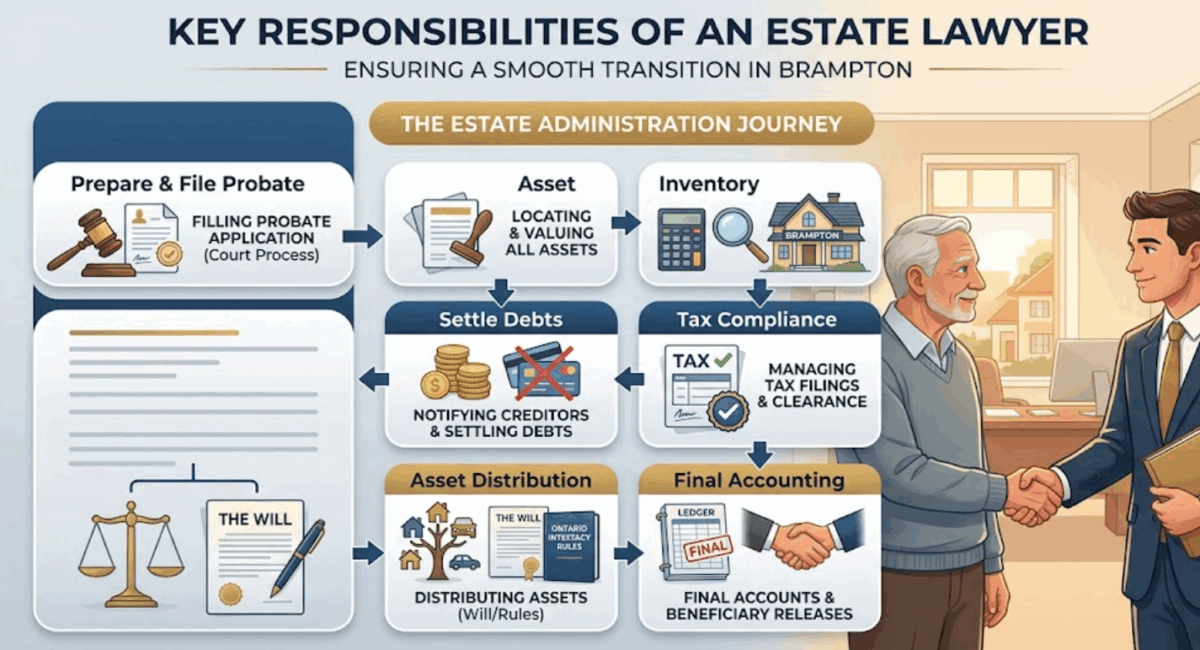
When someone passes away, the person named as executor takes on significant legal responsibility. They’re not just distributing belongings — they’re filing probate applications with the court, tracking down and valuing assets, notifying creditors, handling outstanding tax obligations, and ultimately accounting to every beneficiary for every dollar that moved through the estate. Get any of that wrong, and the executor can be held personally liable.
Working with a qualified estate administration lawyer is what keeps that liability in check. That process starts with confirming whether the will is legally valid, then applying to the court for a Certificate of Appointment of Estate Trustee — what most people still call “probate.” From there, the lawyer helps marshal the estate’s assets, settle its debts, and arrange distributions to beneficiaries in a way that holds up legally.
When there’s no valid will at all, the situation becomes considerably more complicated. The court must appoint someone to administer the estate, and Ontario’s intestacy rules — not the deceased’s wishes — determine who inherits what.
Disputes add another layer. Beneficiaries sometimes contest the will itself, or disagree about how assets should be distributed. These situations call for early legal intervention; waiting until a dispute escalates usually means higher costs and strained family relationships.
When someone passes away, the person named as executor takes on significant legal responsibility. They’re not just distributing belongings — they’re filing probate applications with the court, tracking down and valuing assets, notifying creditors, handling outstanding tax obligations, and ultimately accounting to every beneficiary for every dollar that moved through the estate. Get any of that wrong, and the executor can be held personally liable.
Working with a qualified estate administration lawyer is what keeps that liability in check. That process starts with confirming whether the will is legally valid, then applying to the court for a Certificate of Appointment of Estate Trustee — what most people still call “probate.” From there, the lawyer helps marshal the estate’s assets, settle its debts, and arrange distributions to beneficiaries in a way that holds up legally.
When there’s no valid will at all, the situation becomes considerably more complicated. The court must appoint someone to administer the estate, and Ontario’s intestacy rules — not the deceased’s wishes — determine who inherits what.
Disputes add another layer. Beneficiaries sometimes contest the will itself, or disagree about how assets should be distributed. These situations call for early legal intervention; waiting until a dispute escalates usually means higher costs and strained family relationships.
Commercial vs. Residential Real Estate Law: They’re Not Interchangeable
This distinction matters more than most people realise, and conflating the two can lead to hiring the wrong professional for the job.
A residential real estate lawyer handles the legal side of home purchases, sales, and private property transfers. The work is important, but it follows a relatively standardised framework: title searches, mortgage review, statement of adjustments, closing documentation. Ontario’s conveyancing rules are well-established, and most residential transactions move from accepted offer to closing in 30 to 90 days.
Commercial transactions are a different discipline entirely. A commercial real estate lawyer deals with income-producing or business-use properties — retail units, office buildings, industrial sites, mixed-use developments — and the legal considerations are far more extensive.
Here’s how the two compare in practice:
Residential Real Estate Legal Services:
- Focuses on homes, condominiums, and private property transfers
- Follows standardised Ontario conveyancing rules
- Covers title searches, mortgage review, and closing documentation
- Transactions typically complete within 30 to 90 days
- Negotiation scope is largely defined by standard purchase agreements
Commercial Real Estate Legal Services:
- Covers office buildings, retail units, industrial sites, and mixed-use developments
- Involves zoning compliance, environmental due diligence, and land-use restrictions
- Requires review of existing leases, commercial financing structures, and regulatory requirements
- Timelines often extend to weeks or months depending on deal complexity
- Negotiation scope is extensive and rarely standardised
The practical takeaway: if you’re buying a condo or selling a family home, a residential real estate lawyer is your professional. If you’re acquiring a strip mall or entering into a commercial lease arrangement, you need someone whose practice is built around those transactions specifically.
For estates that include both types of property — which happens more often than you’d think — coordinated advice from professionals with the relevant specialisations is the only reliable approach.
What a Real Estate Law Firm Provides Beyond Closing?
Most clients think of a real estate lawyer as the person who makes sure the paperwork is right on closing day. That’s true, but it’s a narrow view of what a capable firm actually does.
A full-service real estate law firm handles the entire legal infrastructure of a transaction. What that looks like in practice:
- Conducting title searches to identify encumbrances, ownership disputes, or registered claims against the property
- Preparing and reviewing mortgage documentation to satisfy lender requirements
- Coordinating title insurance to protect against defects that don’t surface until after closing
- Managing the flow of closing funds between parties
- Liaising with provincial and municipal registries throughout the process
- Flagging legal risks that could unravel a deal long after the paperwork is signed
When something goes wrong mid-transaction — and in complex deals, something often does — your lawyer is the person managing the legal fallout while keeping the deal intact.
There’s also an estate-planning dimension that catches many clients off guard. A property transferred to a surviving spouse when one owner dies triggers questions about how title was held, what the tax implications are, and whether the transfer aligns with the broader estate plan. A jointly held property being sold by an executor raises a different set of questions. An elderly homeowner whose child holds a power of attorney — and who now wants to sell — requires careful legal handling to ensure the transaction is valid and protected from challenge later.
These aren’t edge cases. In Brampton’s market, where properties often represent the single largest asset in an estate, these scenarios are routine. A firm that can address both the transactional and estate dimensions without sending you elsewhere is a genuine practical advantage.
Estate Will Attorneys: Why Estate Planning and Property Can’t Be Separated
Ask most homeowners whether they have an up-to-date will, and the honest answer is often no — or “I think so.” That gap creates real problems, particularly when property is involved.
A will drafted before a property was acquired, or before a title was restructured, may not reflect your actual intentions. A property that passes outside your estate through joint tenancy may bypass your intended beneficiaries entirely. An estate without clear documentation around real property often ends up in extended probate, with legal and administrative costs eating into what you intended to leave behind.
This is exactly where an experienced estate will attorney becomes essential — not just for drafting documents, but for building a plan that accounts for how your property is held today and how it should transfer tomorrow. Here’s what that process typically covers:
- Drafting or updating your will to accurately reflect current property ownership and how title is held
- Establishing powers of attorney for property and personal care, so financial decisions — including selling or mortgaging real estate — can be managed if you become incapacitated
- Identifying properties held jointly and ensuring the ownership structure aligns with your estate intentions
- Minimising probate delays through clear asset documentation and beneficiary designations
- Coordinating with real estate professionals where jointly held or trust-held property is involved
- Ensuring full compliance with Ontario’s estate laws throughout the planning and administration process
For older homeowners in particular, Ontario’s rules around probate fees, estate freezes, and the interaction between property ownership and estate administration deserve specific attention. Consulting a qualified estate lawyer early — while options are still open — consistently produces better outcomes than addressing these issues under pressure.
Estate Administration vs. Real Estate Legal Services: A Practical Comparison
Estate Administration:
- Managed by an estate administration lawyer
- Triggered by the death of a property owner
- Focuses on probate applications, will validity, and asset distribution
- Brampton-specific considerations include powers of attorney, beneficiary disputes, and Ontario probate fees
- Involves settling outstanding debts and taxes before distributing to beneficiaries
Real Estate Legal Services:
- Handled by a residential or commercial real estate lawyer depending on property type
- Triggered by the purchase, sale, or lease of property
- Focuses on title searches, mortgage documentation, and closing procedures
- Brampton-specific considerations include zoning compliance, title insurance, and municipal registry requirements
- Covers everything from offer review through to final closing funds management
Where They Overlap:
- Inherited properties almost always require both disciplines working at the same time — one lawyer managing probate, another handling conveyancing if the property is being sold or transferred
- Estate-directed property sales require a real estate lawyer to execute what the estate administration lawyer has already structured
- Power of attorney situations involving property decisions sit squarely at the intersection of both practice areas
- Treating these two processes as sequential rather than parallel is one of the most common — and costly — mistakes families make in Brampton
Choosing the Right Lawyer: What to Actually Consider
There’s no shortage of lawyers in Brampton. The question isn’t whether you can find legal help — it’s whether the person you retain actually has the experience your specific situation demands.
If your primary concern is a property transaction — buying, selling, or transferring — you want a dedicated real estate lawyer in Brampton who knows the local market, understands Peel Region’s municipal requirements, and has handled deals similar to yours. If your concern centres on a will, an estate, or a probate matter, you need someone whose practice is built around estate law specifically.
A few additional things worth thinking through before you book a consultation:
- Nature of the matter: Is your primary concern settling a deceased parent’s estate, or completing a property transaction? If it’s both simultaneously — say, an inherited home you want to sell quickly — you need access to both disciplines, ideally from a firm that handles each in-house
- Complexity of the situation: A straightforward residential purchase with a clean title is very different from a contested estate involving multiple beneficiaries, unclear ownership records, and a property whose value is in dispute — complexity demands specialisation
- Timeline pressures: Probate has court deadlines; property transactions have closing dates — bringing in the right professional late, or discovering mid-process that your lawyer lacks the relevant expertise, compounds both pressure and cost simultaneously
- Jurisdiction and local knowledge: Confirm your lawyer is licensed to practise in Ontario and genuinely familiar with Brampton’s municipal regulations, regional market norms, and Peel Region-specific considerations — local knowledge shapes how legal strategies are built and executed
- Conflict of interest: In family estate matters, a single lawyer typically cannot represent multiple beneficiaries at the same time — if interests diverge, and in contentious estates they often do, each party needs independent counsel
- Communication, not just credentials: A technically skilled lawyer who communicates poorly can cost you as much as a poor technical outcome — clarity and responsiveness matter throughout a transaction or estate administration, not just at the start
One more thing worth stating plainly: engaging the right professional before a transaction closes or before an estate becomes contested is almost always cheaper and less stressful than trying to correct problems after the fact.
Key Takeaways
Legal decisions around property and estates aren’t made once and forgotten — they follow you, and the consequences of getting them wrong tend to surface at the worst possible moments. Here’s what to carry forward:
- Specialisation is not optional: Estate administration, residential conveyancing, commercial property law, and estate planning are distinct practice areas — competence in one doesn’t guarantee competence in another
- Overlapping matters need coordinated advice: Inherited property, jointly owned assets, and trust-held real estate sit at the intersection of multiple practice areas — plan for both disciplines to be involved simultaneously, not sequentially
- Local knowledge carries real weight: Brampton’s specific market conditions, municipal considerations, and community demographics shape how legal strategies are built — a real estate lawyer in Brampton familiar with the region will anticipate issues a generalist might miss
- Timing is everything: Proactive planning — whether drafting a will while healthy or retaining legal counsel before an offer closes — consistently produces better outcomes than reactive damage control
- Professional guidance is an investment, not overhead: If your estate or property matter involves any real degree of complexity, the cost of proper legal advice is a fraction of what errors, delays, or disputes will cost you later
If your situation involves any of the above — or you’re simply not sure where to start — the right move is a direct conversation with a qualified legal team who knows both the law and the local landscape.
Book a consultation with Nanda & Associates to discuss your specific circumstances with an experienced Brampton legal team.