




Key Takeaways
- Learn exactly what happens if you miss mortgage payments Canada and how Ontario legislation protects your rights during the initial stages of default.
- Understand why the Power of Sale process is the most common legal path for lenders in Mississauga and how it moves faster than a traditional foreclosure.
- Identify the critical 35-day redemption window that starts the moment you receive a formal Notice of Sale from your lender.
- Discover the specific legal steps required to reinstate your mortgage by covering arrears and associated lender costs to halt a property sale with the help of experienced civil litigation lawyers.
- Explore strategic options to protect your home equity in Mississauga through refinancing or private lending solutions before the lender takes possession.
Table of Contents
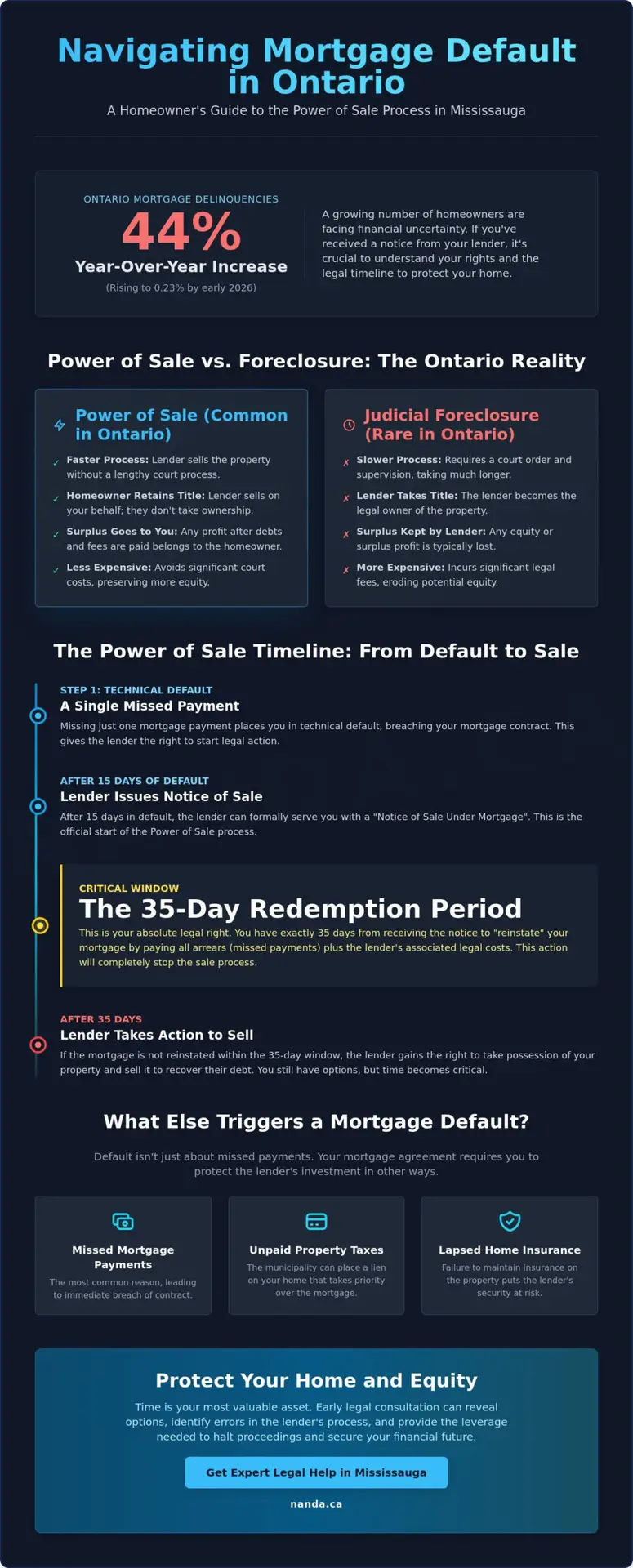
Did you know that mortgage delinquencies in Ontario rose to 0.23% by early 2026, marking a significant 44% year-over-year increase? If you’re worried about what happens if you miss mortgage payments Canada, you’re part of a growing number of homeowners navigating a complex financial environment. The sudden arrival of a lender notice can create a sense of immediate panic. Our experienced civil litigation lawyers recognize the stress these transitions cause, but it’s important to remember that Ontario law provides specific protections to help you maintain your stability.
We promise to help you understand the precise legal timeline and the strategic steps you can take in Mississauga to protect your home. This guide explains the 35 day redemption period triggered by a Notice of Sale and the specific maneuvers available to stop a Power of Sale. We’ll explore how to navigate the 2026 mortgage landscape to reinstate your mortgage and find a clear path to preserve your equity.
Immediate Steps for Mississauga Homeowners
Your home is likely your most significant asset. When financial hurdles arise, the fear of losing it is overwhelming. In Mississauga, lenders typically use the Power of Sale process rather than a judicial Foreclosure. This is a critical distinction. Power of Sale is a contractual right that allows a lender to sell your property without a court order. This makes the process significantly faster than the court-supervised alternative. Understanding what happens if you miss mortgage payments Canada is the first step toward regaining control. The speed of the Ontario system means you must act quickly to protect your equity.
The reality is that missing just one payment triggers a technical default. Under most standard charge terms in Ontario, this breach of contract allows the lender to accelerate the debt. This means they could potentially demand the entire mortgage balance. However, you aren’t without recourse. You maintain a statutory right to reinstate the mortgage. This means you can stop the process by paying the overdue amounts and the lender’s reasonable legal costs before the property is sold. Legal intervention can often delay or halt the eviction process while you secure new financing.
Understanding Mortgage Default in Ontario
While "arrears" refers specifically to the unpaid money, "default" is the legal status of being in breach of your mortgage agreement. Under the Mortgages Act, a default can also occur if you fail to pay property taxes or let your home insurance lapse. These are often overlooked triggers that can lead to a Notice of Sale. A missed payment is more than just a late fee; it’s a fundamental breach of the contract you signed. Knowing what happens if you miss mortgage payments Canada helps you prioritize which debts to settle first to keep your housing secure.
The Importance of Early Legal Consultation
Time is your most valuable asset. Engaging civil litigation lawyers Brampton early in the process changes the dynamic with your lender. We review every notice for technical errors. A single mistake in a Notice of Sale can sometimes provide the leverage needed to halt proceedings. Proactive legal representation ensures you aren’t navigating these complex timelines alone. We provide a buffer between you and the lender’s counsel. This allows for a methodical approach to saving your home rather than a reactive one driven by anxiety. Our team works to ensure your rights are respected throughout every stage of the default process.
Power of Sale vs. Foreclosure: The Legal Reality in Ontario
When you’re searching for what happens if you miss mortgage payments Canada, it’s easy to get confused by terminology used in other provinces or the United States. In Mississauga, the legal reality is that lenders almost exclusively use the Power of Sale process rather than a judicial foreclosure. The primary difference lies in who holds the title and what happens to the money once the property is sold. In a Power of Sale, the lender doesn’t take ownership of your home. Instead, they exercise a contractual right to sell it to recover their debt. This is a vital distinction because it means any surplus funds from the sale, after the debt and legal fees are paid, legally belong to you.
Lenders in Mississauga prefer this path because it’s significantly faster and less expensive than a court-supervised process. By avoiding the Superior Court of Justice for the sale itself, a bank can often resolve a default in a matter of months. While this speed feels aggressive, it also protects your interests in a specific way. Since the lender has a legal duty to sell the property for fair market value, you’re more likely to recover your equity than you would be in other legal scenarios. It’s a pragmatic approach that prioritizes debt recovery while respecting your financial stake in the property.
The Power of Sale Process Under the Mortgages Act
The Mortgages Act sets strict rules that lenders must follow before they can sell your home. Once you’ve been in default for at least 15 days, the lender can issue a formal Notice of Sale. This document marks the beginning of a mandatory 35 day redemption period. During these 35 days, you have the absolute legal right to pay the arrears and bring the mortgage back into good standing. Exploring mortgage relief options during this window is the most effective way to stop the process before the lender gains the right to take possession. If you’ve received a notice, you might want to civil litigation lawyers to review the document for accuracy.
Foreclosure: When and Why It Happens
Foreclosure is a judicial process that involves the Ontario Superior Court of Justice. Unlike a Power of Sale, a successful foreclosure results in the lender taking full title to your property. If the house is worth more than the mortgage debt, the lender keeps that extra value, and the homeowner gets nothing. This process is much rarer in Mississauga because it’s slow, involves heavy litigation, and is often contested by borrowers. Because it requires a court order, it’s a much more formal and adversarial path. If you find yourself facing a court-supervised debt recovery action, consulting with civil litigation lawyers is a necessary step to defend your home and your financial future.
The Timeline: From Late Payment to Eviction in Mississauga
The legal clock starts ticking the moment a payment is missed. In Mississauga, the transition from a late payment to a formal legal proceeding is surprisingly swift. Homeowners often ask what happens if you miss mortgage payments Canada, and the answer lies in a rigid statutory timeline. Between Day 1 and Day 15, you’re technically in a grace period, though your lender will likely charge a late fee ranging from $25 to $100. By Day 15, the lender’s counsel typically sends a formal demand letter. This isn’t just a reminder; it’s a legal warning that the lender intends to enforce their security.
Once the default passes the 15-day mark, the lender gains the right to issue a Notice of Sale Under Mortgage. This usually happens between Day 16 and Day 45. This document is the catalyst for the 35-day redemption period. If you haven’t resolved the arrears by the end of this window, the lender can move to take possession of the property. Understanding this sequence is vital because your options for saving your home narrow as each deadline passes.
Phase 1: The Demand Letter and Initial Default
A demand letter often contains an "acceleration clause." This clause is a powerful tool for lenders. It states that because you’ve breached the agreement, the entire principal balance is now due immediately, not just the missed installments. Many homeowners make the mistake of ignoring these letters or hoping the bank will simply wait. Following the Financial Consumer Agency of Canada guidelines can help you understand your rights, but you must respond to the lender’s counsel directly. Failing to engage during these first 30 days is a common error that makes future negotiations much more difficult.
Phase 2: Legal Proceedings and the Writ of Possession
If the 35-day redemption period expires without a resolution, the lender moves to the next stage. They’ll file a Statement of Claim for Debt and Possession at the Ontario Superior Court of Justice. This document asks the court for two things: the money you owe and the right to take your house. Once the court grants a judgment, the lender obtains a Writ of Possession. This is the legal "green light" for eviction. In Mississauga, evictions are carried out by the Sheriff. They’re the only officials authorized to physically remove occupants and change the locks. Understanding what happens if you miss mortgage payments Canada means recognizing that the Sheriff’s involvement is the final, irreversible step. If you’ve received a Statement of Claim, consulting civil litigation lawyers Brampton is essential to determine if there are grounds to set aside the judgment or delay the Writ of Possession.
Practical Advice: Strategic Options to Save Your Home
Facing a Power of Sale is a high-stakes situation, but you still have several strategic paths to preserve your home and financial reputation. Many homeowners worry about what happens if you miss mortgage payments Canada, yet they often overlook the powerful legal right to reinstate their mortgage. Reinstatement is frequently the most effective solution. It involves paying all overdue installments along with the lender’s reasonable legal expenses. Once these funds are cleared, the mortgage is legally brought back into good standing, and the Power of Sale process must stop immediately. This right exists right up until the lender has signed a deal to sell the property to a third party. Knowing what happens if you miss mortgage payments Canada is the first step toward choosing the right path for your family.
If reinstatement isn’t financially feasible, you might consider redeeming the mortgage. This requires paying off the entire principal balance, typically through a new loan from a different financial institution. While this is more complex, it allows you to move away from a hostile lender and start fresh. Another proactive approach is a Forbearance Agreement. This is a negotiated contract where the lender’s legal team agrees to temporarily reduce or suspend payments while you resolve a short-term financial crisis, such as a temporary job loss. Finally, if staying in the home is no longer viable, a strategic Short Sale allows you to sell the property on your own terms before the bank takes possession. This usually results in a higher sale price than a bank-forced liquidation, helping you save more of your equity and protecting your credit score.
Negotiating with Federally Regulated Lenders
If your mortgage is with a major Canadian bank, they’re bound by the Financial Consumer Agency of Canada (FCAC) expectations. These guidelines require lenders to provide tailored support to borrowers in financial distress. We can leverage these rules to negotiate more favourable terms or extensions. Understanding the nuances of real estate lawyers in Brampton is essential when presenting your case to a bank’s legal department. Our team ensures that your lender follows these consumer protection standards, giving you the breathing room needed to find a permanent solution.
Refinancing and Private Lending Solutions
When traditional banks say no, B-lenders or private mortgage providers can offer a lifeline to stop a Power of Sale. These loans often have higher interest rates but serve as a bridge to stabilize your situation until you can qualify for a traditional mortgage again. However, you must be cautious. The private lending market can be aggressive, and it’s easy to fall into predatory terms that erode your equity through hidden fees or extremely short terms. It’s vital to have a legal professional review any new loan documents to ensure you aren’t trading one crisis for another. Before signing any new debt agreement to save your equity, book a consultation with us to ensure your long-term interests are fully protected.
How Nanda & Associate Lawyers Professional Corporation Protects Mississauga Homeowners
We understand that the threat of losing your home is one of the most stressful experiences a family can face. Nanda & Associate Lawyers Professional Corporation provides a sense of security through calm confidence and professional representation. We don’t just see a legal case; we see a family’s future that requires protection. By applying a sophisticated, multidisciplinary approach, we help you navigate the complexities of the Ontario Mortgages Act while keeping your long-term interests in focus. Our role is to act as your shield, ensuring that lenders respect every statutory requirement before they attempt to exercise their rights.
Our firm presents itself as a versatile, one-stop legal resource that is both globally minded and locally rooted. This means we bring a high level of sophistication to every negotiation, whether we’re dealing with a local private lender or a major national bank. When you’re searching for what happens if you miss mortgage payments Canada, you’ll find that the answer isn’t always simple. It requires a collaborative team of experts who can analyze your situation from multiple angles, including real estate and civil litigation perspectives. We focus on providing comprehensive legal solutions that go beyond immediate crisis management to ensure your financial stability is restored.
Our Strategic Defense Process
Our team begins every case by conducting a meticulous review of all lender communications and mortgage documents. Even small technical errors in a Notice of Sale or a Statement of Claim can provide the legal grounds needed to stall a property auction. We look for discrepancies in the calculation of arrears or failures to follow the strict timelines set by Ontario law. When you’re worried about what happens if you miss mortgage payments Canada, you need a team that knows how to challenge the lender’s counsel effectively. We represent your interests in direct negotiations, seeking to find creative ways to reinstate the mortgage or secure a forbearance. Our expertise as real estate lawyers Brampton allows us to provide insights into how different lenders approach the enforcement process across the city.
Your Path Forward: Peace of Mind and Stability
We act as multidisciplinary mentors, combining insights from real estate, civil litigation, and business law to protect your assets. Our diverse, multilingual team reflects the multicultural nature of Mississauga. This ensures you can discuss your case in the language you’re most comfortable with, removing barriers to understanding during a high pressure time. We focus on long-term financial stability rather than just a quick fix. Our goal is to guide you through the stress of default toward a solution that keeps your family secure. If you’re ready to explore your options and regain control of your home equity, book a consultation with us today. We’re here to provide the steady, methodical guidance you need to achieve peace of mind.
Regaining Control of Your Home and Financial Future
Time is the most critical factor when you’re facing a Power of Sale in Mississauga. We’ve explored the rigid timelines of the Ontario Mortgages Act and the strategic options like reinstatement or forbearance that can stop a property sale in its tracks. Understanding what happens if you miss mortgage payments Canada is essential for any homeowner; however, knowledge alone isn’t enough without decisive action to protect your interests. Our team brings over 20 years of experience in Ontario real estate law to your defense. We provide a multilingual legal team that understands the diverse needs of our community. Our strategic litigation expertise allows us to challenge lender errors and protect your hard-earned equity.
You don’t have to face this transition alone. We’re here to provide the sophisticated mentorship and comprehensive legal solutions you deserve to find a path toward stability. Secure Your Home’s Future; Book a Consultation with Our Civil Litigation Lawyers. We look forward to helping you achieve the peace of mind you need to move forward with confidence.
Frequently Asked Questions
Can I stop a Power of Sale once it has started in Mississauga?
Yes, you can stop a Power of Sale by exercising your legal right to reinstate the mortgage. This requires you to pay all outstanding arrears along with the lender’s reasonable legal costs before they sign a sale agreement with a buyer. Once these funds are paid, the lender is legally required to halt the enforcement process and return the mortgage to good standing.
How many missed payments before a bank starts legal action in Ontario?
Most banks in Ontario begin the legal enforcement process after you have missed two or three consecutive payments, typically around the 60 to 90 day mark. However, under the Mortgages Act, a lender can technically issue a Notice of Sale as early as 15 days after your first missed payment. Acting during this early window is the best way to minimize escalating legal fees.
What is the difference between a Notice of Sale and a Statement of Claim?
A Notice of Sale is a contractual document that starts the 35-day redemption period and warns you that the lender intends to sell the property. A Statement of Claim is a formal court document filed at the Ontario Superior Court of Justice. The Statement of Claim is used to obtain a court judgment for the debt and a Writ of Possession to evict occupants.
Will I lose my equity if my house is sold under Power of Sale in Mississauga?
No, you do not lose your equity in a Power of Sale because the lender has a duty to account for all proceeds. After the mortgage principal, interest, and legal costs are paid, any remaining surplus funds from the sale must be returned to you. This is a significant legal protection that ensures you receive the value you’ve built in your home.
Can the bank sue me for more money if the house sells for less than the mortgage?
Yes, the bank can pursue you for a "shortfall" if the sale proceeds are not enough to cover the total debt. This is a common risk when considering what happens if you miss mortgage payments Canada. If a deficiency exists, the lender can seek a personal judgment against you. They may then use this judgment to garnish your wages or seize other personal assets to recover the balance.
Is it possible to negotiate with the bank after receiving a demand letter?
Negotiation is highly possible and encouraged immediately after you receive a demand letter from the lender’s counsel. This is often the most flexible stage of the process where you can propose a repayment plan or a Forbearance Agreement. Lenders generally prefer a negotiated settlement over the high costs and time required for a full Power of Sale or court-supervised eviction.
How does a missed mortgage payment affect my credit score in Canada?
A single missed payment can cause your credit score to drop by 50 to 100 points once it is reported to bureaus like Equifax. This reporting typically occurs after the payment is 30 days overdue. This drop is a major part of what happens if you miss mortgage payments Canada. The negative mark remains on your credit history for up to seven years, impacting your future borrowing power.
What should I do if I receive a Writ of Possession from the Sheriff?
You must act immediately and seek legal counsel because a Writ of Possession is the final step before an actual eviction. While the situation is urgent, a lawyer may be able to file an emergency motion in court to stay the writ. This usually requires showing a procedural error by the lender or providing a guaranteed plan to pay the full arrears and costs immediately.
Disclaimer
This content is for general information only and does not constitute legal advice or create a lawyer-client relationship. Every case is different—please consult a qualified lawyer for advice specific to your situation.