




Key Takeaways
- Understand how the Ontario Substitute Decisions Act protects your autonomy by preventing court-appointed guardianship and unwanted government intervention.
- Distinguish between a Continuing Power of Attorney for Property and a Power of Attorney for Personal Care to ensure both your finances and medical wishes are legally secured.
- Learn how proactive planning for incapacity ontario allows you to grant explicit authority for sensitive healthcare decisions, including 2026 updates regarding Medical Assistance in Dying (MAID).
- Identify the specific qualities required for a reliable substitute decision-maker in Mississauga to minimize family conflict and ensure seamless asset management.
- Discover why professional legal oversight from experienced wills and estate lawyers is essential to avoid the common pitfalls of generic DIY kits and to provide a comprehensive shield for your estate.
Table of Contents
-
Key Takeaways and Introduction: Why Incapacity Planning Matters in Mississauga
-
The Legal Framework: Power of Attorney for Property vs. Personal Care
-
Conclusion: Securing Your Future with Nanda & Associate Lawyers
Why Incapacity Planning Matters in Mississauga
What if your family was legally barred from helping you when you need them most? Many Mississauga residents assume a spouse or adult child can automatically manage their bank accounts or medical treatment if they fall ill; however, without specific legal documents, the Ontario government often intervenes. Proactive planning for incapacity ontario ensures that you, not the courts, decide who manages your property and personal care. At Nanda & Associate Lawyers Professional Corporation, our experienced wills and estate lawyers have seen how a lack of preparation leads to frozen assets and unnecessary family conflict under the Substitute Decisions Act.
You deserve the peace of mind that comes with knowing your healthcare wishes are documented and your assets are protected for the next generation. We’re dedicated to providing the sophisticated, empathetic legal support required to handle these sensitive transitions. This guide explains how to establish valid Power of Attorney documents while addressing 2026 legal changes, including new rules for Medical Assistance in Dying (MAID) authority and updated probate thresholds. By the end, you’ll have a clear roadmap to secure your future and protect your loved ones from administrative hurdles.
Unexpected illness or a sudden accident can leave any adult unable to manage their own affairs. While many Mississauga residents believe their next of kin can automatically step in, the reality is far more complex. Without a clear legal framework, your family might find themselves locked out of your bank accounts or unable to direct your medical treatment. At Nanda & Associate Lawyers Professional Corporation, we act as your professional mentors, helping you navigate the intricacies of planning for incapacity Ontario to ensure your voice is heard even when you cannot speak for yourself.
The Legal Definition of Mental Capacity
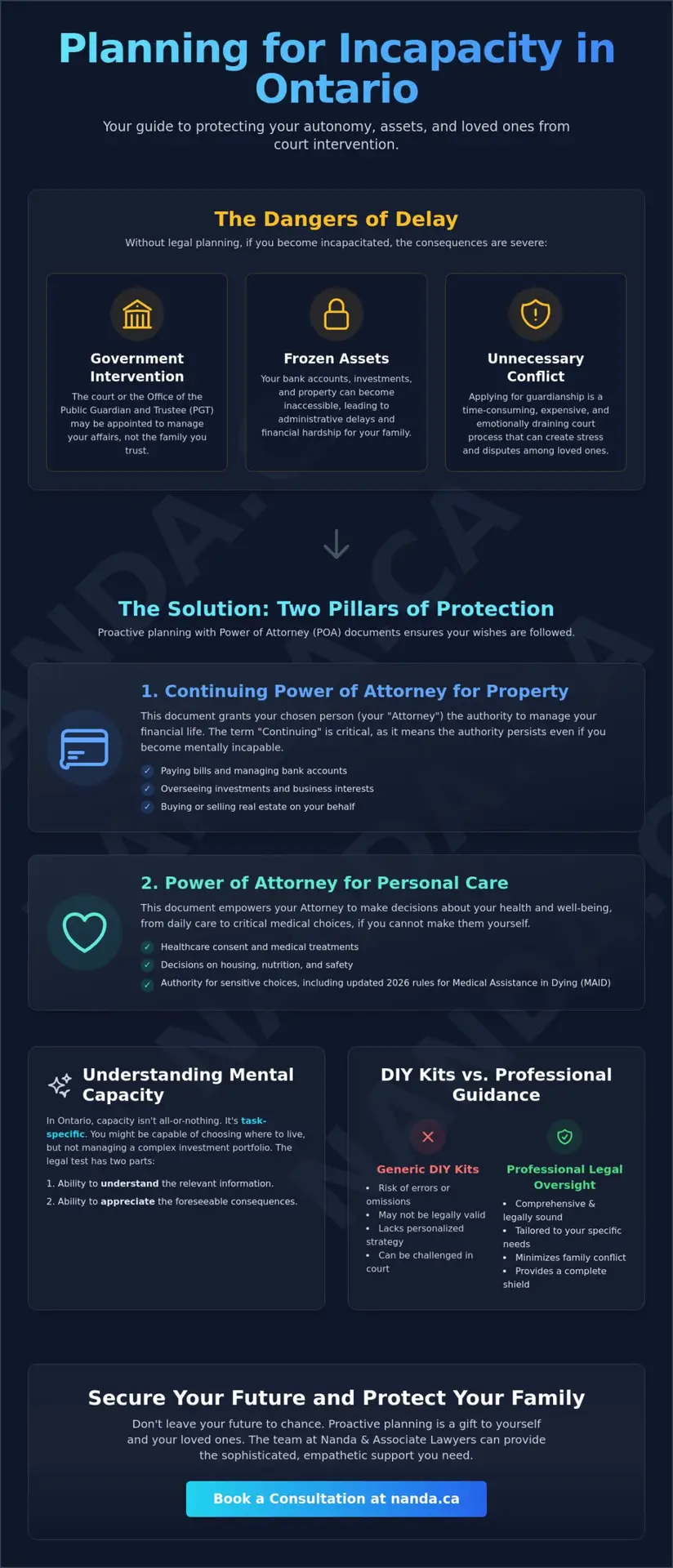
Mental capacity isn’t a simple "yes or no" status. Under the Substitute Decisions Act, 1992, Ontario applies a two-part test to determine if an individual can make their own decisions. First, you must be able to understand the information relevant to the decision. Second, you must be able to appreciate the reasonably foreseeable consequences of a decision or lack of one. Capacity is also task-specific. You might have the capacity to decide where you want to live but lack the capacity to manage a diverse investment portfolio. Mental capacity in Ontario is not a fixed state but a legal determination based on your ability to understand specific decisions at a specific time.
The Consequences of Failing to Plan
If you haven’t appointed a Power of Attorney (POA) and become incapable, your loved ones face a difficult path. They may have to apply to the court to become your guardian, a process that is often time-consuming and emotionally draining. In the absence of a private guardian, the Office of the Public Guardian and Trustee (PGT) may step in to manage your property. This level of government intervention can be avoided through early preparation. For families near Trillium Health Partners sites, an emergency medical crisis shouldn’t be compounded by legal uncertainty. Our wills and estate lawyers in Mississauga help you avoid these risks. It’s also vital to note that while some administrative costs have shifted, the Ontario government deferred automatic court fee increases from January 1, 2026, to January 1, 2027, providing a brief window for residents to finalize their plans under the current fee structure.
The Legal Framework: Power of Attorney for Property vs. Personal Care
Effective planning for incapacity ontario relies on two distinct legal pillars. While the Substitute Decisions Act (SDA) provides the framework for appointing your representative, the Health Care Consent Act (HCCA) dictates the rules for specific medical treatments. Understanding the interplay between these laws is vital for Mississauga residents. Our wills and estate lawyers in Mississauga often emphasize that these documents serve different masters: one manages your wallet, while the other manages your well-being. This distinction ensures that your financial stability and your physical health receive specialized protection tailored to your unique needs.
Continuing Power of Attorney for Property
This document grants an attorney the power to handle your financial life. This includes paying bills, managing real estate, and overseeing investments. The term "Continuing" is critical; it means the authority persists even if you lose mental capacity. Attorneys are bound by a strict fiduciary duty, meaning they must act with honesty, integrity, and solely in your best interest. You can choose to make this document effective immediately upon signing or "springing," meaning it only takes effect once how capacity is assessed in Ontario confirms you are no longer capable. Given the 3% increase in planning application fees for 2026 in several municipalities, having an attorney who understands current administrative costs is more important than ever.
Power of Attorney for Personal Care
Unlike property documents, a POA for Personal Care only "triggers" when you’re legally determined to be incapable of making specific health or lifestyle choices. This covers housing, nutrition, hygiene, and overall safety. Within this document, you can include Advance Directives, sometimes called Living Wills, which outline your preferences for end-of-life care. As of April 2026, revisions to Ontario estate law have clarified that a health attorney can only make decisions regarding Medical Assistance in Dying (MAID) if you’ve granted that explicit authority within the document itself. If you’re unsure which structure fits your family dynamics, speaking with our estate planning team can provide the clarity you need.
The "continuing" nature of these documents is what provides security. By creating these legal tools while you’re capable, you ensure a seamless transition of authority. This prevents the need for your family to seek court-ordered guardianship, which can be a lengthy and public process. Instead, your chosen attorney can step in immediately to protect your interests, ensuring that your mortgage is paid and your medical care aligns with your personal values without a day of interruption.
The Process: How Capacity is Assessed in Mississauga
Determining whether a loved one can still make their own decisions is a sensitive process that balances personal autonomy with the need for protection. In Mississauga, this transition isn’t merely a medical opinion; it’s a formal legal procedure governed by specific provincial standards. When planning for incapacity Ontario, you must understand that capacity is often assessed by designated professionals who follow the guidelines set by the Ministry of the Attorney General. If you’re in the early stages of organizing your affairs, our Notary Public Mississauga can assist with the initial authentication of your Power of Attorney documents before a crisis occurs.
The assessment process follows a structured timeline. Once a request is made, a capacity assessor reviews the individual’s ability to understand information and appreciate the consequences of their choices. It’s vital to recognize that the person being assessed has significant rights. They must be informed of the assessment’s purpose and they generally have the right to refuse it, unless a court order says otherwise. They also have the right to legal counsel to protect their interests during these proceedings. Under Ontario’s laws on mental capacity, the focus remains on the least restrictive means of support, ensuring that individuals retain as much control as possible.
When is a Formal Assessment Required?
Specific life events often trigger the need for a formal evaluation. For example, if a Mississauga resident needs to sell their home to fund long-term care but hasn’t granted a Power of Attorney, a capacity assessment is usually the first step toward guardianship. Assessments are also necessary when there’s a suspected misuse of a POA or a dispute among family members. In these cases, the Ontario Superior Court of Justice in Mississauga may become involved to oversee guardianship applications. While the government deferred automatic court fee increases from January 1, 2026, to January 1, 2027, the legal process still requires careful adherence to the Substitute Decisions Act to avoid costly delays.
Finding a Capacity Assessor in Mississauga
Residents of Mississauga can access a roster of qualified assessors through the Capacity Assessment Office. These professionals are often social workers, nurses, or occupational therapists who have undergone specialized training. During the interview, the assessor will engage the individual in a series of questions designed to test their cognitive grasp of their financial or personal care situation. While some assessments are funded by the province in specific circumstances, most private assessments involve a fee paid by the person requesting the service or from the incapable person’s property. We recommend coordinating with Nanda & Associate Lawyers Professional Corporation to ensure the assessment meets all evidentiary requirements for future court filings or property transactions.
Practical Advice: Choosing Your Substitute Decision-Maker
Selecting your attorney is the most significant step in planning for incapacity ontario. You’re essentially choosing the person who’ll hold the keys to your bank accounts and the authority over your medical care. This isn’t a role for someone who’s easily overwhelmed or financially disorganized. For a deeper look at how these choices impact your total estate plan, you can review our wills and estate lawyers in Mississauga resource. We recommend evaluating potential candidates based on a specific set of criteria:
-
Unwavering Trust: This person will have access to your life savings and must act with total integrity.
-
Geographic Proximity: While not a legal requirement, having an attorney in Mississauga makes it much easier to manage local property and attend medical appointments at Trillium Health Partners.
-
Financial Literacy: Your attorney must understand basic accounting and record-keeping to fulfill their fiduciary duties under the Substitute Decisions Act.
-
Emotional Resilience: They must be capable of making difficult decisions under pressure without being swayed by conflicting family opinions.
If you decide to name more than one person, you must specify if they act "jointly" or "jointly and severally." Choosing "jointly" means they must agree on every single decision, which provides a system of checks and balances but can lead to gridlock. "Jointly and severally" allows either person to act independently. This is often more practical if one attorney is traveling or temporarily unavailable. It’s also vital to name an alternate attorney. If your primary choice is unable or unwilling to act when the time comes, having a successor prevents the legal vacuum that leads to court intervention.
Family Members vs. Professional Attorneys
Many people automatically choose their eldest child or a spouse. However, if your estate is complex or if there’s significant friction among your children, a professional attorney or a trust company might be a safer choice. This can prevent the need for civil litigation lawyers to resolve family disputes later. Clear communication is your best tool; discuss your wishes with your family now so they aren’t surprised by your choices during a crisis. If you’re ready to formalize these roles, you can book a consultation with our team to ensure your documents are robust and legally sound.
Drafting Specific Instructions
A generic Power of Attorney often lacks the detail needed to protect your specific interests. You can tailor your document to include restrictions, such as requiring a second medical opinion before incapacity is declared, or permissions, like allowing the attorney to continue making charitable donations on your behalf. A well-drafted Power of Attorney is a roadmap that prevents family members from having to guess your intentions during a crisis. This includes documenting your end-of-life wishes, which carry significant weight in Ontario when clearly stated in a Power of Attorney for Personal Care.
Conclusion: Securing Your Future with Nanda & Associate Lawyers
Proactive planning for incapacity ontario is the only way to guarantee that your legacy and your well-being remain in the hands of those you trust. While "DIY" kits might seem convenient, they often lack the legal precision required to withstand a challenge in the Ontario Superior Court of Justice. These generic forms frequently overlook critical updates, such as the April 2026 revisions regarding specific authority for Medical Assistance in Dying (MAID) or the nuances of the Health Care Consent Act. Relying on a professional ensures your documents are not just completed, but are strategically robust and legally compliant with the latest provincial standards.
At Nanda & Associate Lawyers, we understand that Mississauga is a vibrant, multicultural community with unique family dynamics. Our team reflects this diversity, offering multilingual legal support that bridges the gap between complex legislation and your personal comfort. We don’t just provide documents; we provide a sense of security. Our wills and estate lawyers specialize in creating tailored solutions that protect your assets from unnecessary government intervention and minimize the risk of future family conflict. We prioritize your long-term interests by establishing a legal shield that prevents court-ordered guardianship and the freezing of your personal accounts.
Comprehensive Legal Solutions for Mississauga Families
Our firm’s strength lies in our collaborative approach. We combine deep expertise in estate planning with a practical understanding of civil litigation, allowing us to anticipate and prevent potential legal hurdles before they arise. We’ve guided countless Mississauga families through the stress of capacity transitions, always prioritizing empathy alongside legal authority. Whether you’re navigating the 2026 probate threshold changes or simply want to ensure your healthcare wishes are respected, we’re here to act as your multidisciplinary mentors. We also stay ahead of administrative shifts, such as the deferral of court fee increases to January 1, 2027, to ensure our clients receive timely and methodical guidance.
The peace of mind that comes with a professional legal plan is invaluable. It allows you to focus on living your life today, knowing that your tomorrow is secure. Don’t leave your most important decisions to chance or the Public Guardian and Trustee. We invite you to take the first step toward a protected future. Please book a consultation with our dedicated team today to discuss a strategy tailored to your specific needs and family goals.
Securing Your Legacy Through Proactive Legal Planning
Establishing clear directives for your property and personal care is one of the most significant gifts you can give your family. We’ve explored how the 2026 updates to the Substitute Decisions Act clarify authority over medical decisions and how updated probate thresholds impact your broader estate strategy. Choosing a trustworthy attorney who lives near Mississauga ensures that your finances and healthcare wishes are managed with local expertise and personal care. Dedicated planning for incapacity ontario removes the burden of guesswork from your loved ones during a crisis.
Since 2003, Nanda & Associate Lawyers has provided comprehensive legal solutions for families facing complex life transitions. Our multilingual team supports clients in more than 15 languages; this ensures that cultural nuances and personal values are always respected. We invite you to book a consultation with our Mississauga estate lawyers today to receive a tailored strategy designed for your unique needs. Taking this step today ensures your voice remains heard and your assets stay protected for the next generation.
Frequently Asked Questions
What is the difference between a Will and a Power of Attorney in Ontario?
A Will only dictates how your estate is distributed after you pass away. In contrast, a Power of Attorney manages your financial and personal affairs while you’re alive but unable to make your own decisions. Under Ontario law, once a person dies, their Power of Attorney loses all legal authority. At that moment, the executor named in the Will takes over the administration of your assets and final wishes.
Can I change my Power of Attorney after I have been diagnosed with a condition like dementia?
You can change your Power of Attorney as long as you retain the mental capacity to understand the document’s impact. A medical diagnosis doesn’t immediately strip you of your legal rights; capacity is assessed based on your ability to grasp specific information at the time of signing. If you’re still capable of understanding the power you’re granting and the consequences of your choice, you can update your representatives.
What happens if my named attorney is unable or unwilling to act?
If your attorney can’t fulfill their duties, the role passes to any alternate you’ve named in your document. Without a named successor, your family might be forced to apply to the Ontario Superior Court of Justice to be appointed as your guardian. This process is often more expensive and time-consuming than simply naming a back-up during your initial planning phase, which ensures a seamless transition of authority.
Is a Power of Attorney from another province valid in Mississauga?
An out-of-province Power of Attorney is generally recognized in Mississauga if it was validly executed in its home jurisdiction. However, local institutions like Trillium Health Partners or Ontario-based banks sometimes find it difficult to interpret non-Ontario documents. To avoid delays during a crisis, it’s often more efficient to have your documents reviewed or redrafted to align with the specific requirements of the Substitute Decisions Act.
How do I prevent someone from misusing my Power of Attorney for Property?
Prevention starts with choosing the right individual and including specific accountability clauses. Within your planning for incapacity ontario documents, you can mandate that your attorney provides a detailed annual accounting to other family members or a professional accountant. You can also limit their authority to sell specific assets, such as your primary residence in Mississauga, without further legal oversight or medical proof of your incapacity.
Does a Power of Attorney expire?
A Power of Attorney doesn’t have an expiration date; it remains legally binding until you pass away or choose to revoke it while you’re still capable. It’s not a "set it and forget it" document, though. Changes in your health, your attorney’s availability, or your family structure can make an old document obsolete. We recommend a professional review every 3 to 5 years to ensure your plan stays current.
What is the role of the Public Guardian and Trustee in incapacity planning?
The Public Guardian and Trustee (PGT) serves as the decision-maker of last resort for incapable adults who have no one else to help. They step in to manage property or make personal care decisions when no valid Power of Attorney exists and no family member is willing to apply for guardianship. Their role is to protect the vulnerable from exploitation and ensure their basic needs are met according to provincial standards.
Can I appoint more than one person as my substitute decision-maker?
You’re allowed to appoint multiple people to act as your attorneys for property or personal care. When you do this, you must specify if they’ll act "jointly," requiring them to agree on every decision, or "jointly and severally," which lets them act independently. While multiple attorneys provide a system of checks and balances, it’s essential to choose people who can work together to prevent administrative gridlock or family disputes.
Disclaimer
This content is for general information only and does not constitute legal advice or create a lawyer-client relationship. Every case is different—please consult a qualified lawyer for advice specific to your situation.