




<existing_article>
On a Tuesday morning in Mississauga, a local resident opened their mail to find a notice that threatened to end a decade-long journey in Canada. Receiving notification of deportation or removal orders often triggers an immediate, paralyzing fear of being separated from your children and the community you call home. We understand that this is likely the most stressful moment your family has ever faced. You aren’t alone in feeling confused by the tight 15-day or 30-day deadlines set under the Immigration and Refugee Protection Act. It’s a heavy burden to carry, but it’s important to remember that Canadian law provides specific mechanisms to protect your rights and your residency.
Our team at Nanda & Associate Lawyers is dedicated to helping you find a clear path forward through these complex legal waters. We promise to provide the clarity you need to move from uncertainty to action. This guide will help you identify the differences between departure, exclusion, and deportation orders so you can take the right steps. We’ll explain how to seek a stay of removal and determine whether your case belongs before the Immigration Appeal Division or the Federal Court. You’ll gain a comprehensive overview of how an immigration lawyer in Mississauga can help you protect your status and secure your future.
Key Takeaways
-
Understand the legal distinctions between departure, exclusion, and deportation or removal orders to identify the specific impact on your residency status.
-
Learn how to navigate the Immigration Appeal Division (IAD) process and determine if you qualify for an appeal based on legal errors or humanitarian grounds.
-
Discover the mechanisms for securing a "Stay of Removal," which can effectively pause enforcement and provide necessary time for a federal court review.
-
Gain insights into the role of the Canada Border Services Agency (CBSA) and how professional legal counsel can assist during enforcement interviews in Mississauga.
-
Explore the essential steps for protecting your future in Canada by addressing enforcement actions with a proactive and strategic legal defense.
Table of Contents
-
What are Deportation or Removal Orders in the Canadian Legal System?
-
The Three Types of Removal Orders Issued in Mississauga and Brampton
-
Legal Pathways to Appeal a Removal Order at the Immigration Appeal Division (IAD)
-
Why Strategic Legal Representation is Critical for Removal Order Cases in Mississauga
What are Deportation or Removal Orders in the Canadian Legal System?
A removal order is a legal mechanism used by the federal government to require a non-citizen to depart from Canada. These orders are governed by the Immigration and Refugee Protection Act (IRPA), which sets the standards for who can enter and remain in the country. It’s a stressful experience for anyone involved, but understanding the underlying framework of Canadian immigration and refugee law is the first step toward finding a solution. At Nanda & Associate Lawyers, we’ve seen how these orders impact families and livelihoods, and we’re here to provide the clarity you need during this transition.
The Canada Border Services Agency (CBSA) serves as the primary enforcement arm for these directives. Their officers are responsible for ensuring that individuals who are inadmissible actually leave the country. Inadmissibility often stems from specific grounds detailed in the IRPA. For instance, criminality is a frequent cause; if a permanent resident or foreign national is convicted of an offense that carries a maximum prison term of at least 10 years, they may face deportation or removal orders. Other reasons include non-compliance, such as failing to meet residency obligations or violating the conditions of a work permit.
It’s vital to distinguish between an order that is simply "issued" and one that is "enforceable." When an officer issues an order, it doesn’t always mean you must leave immediately. Many orders are subject to a stay, which pauses the removal process while an appeal or a judicial review is pending. An order only becomes enforceable once all legal avenues for staying in Canada are exhausted or the statutory period for an appeal has passed. Our team of immigration lawyers in Toronto works diligently to identify every possible avenue to prevent an order from reaching the enforceable stage.
Key Takeaways for Toronto Residents
Time is your most valuable asset when dealing with the CBSA. Many appeal windows are incredibly tight, often closing within 15 to 30 days of the order being issued. If you miss these deadlines, your options for remaining in Canada diminish rapidly. You must also ensure the CBSA has your current contact information; failing to update your address can lead to a warrant for your arrest. Our firm provides a bridge between you and the Greater Toronto Area enforcement centers, ensuring that all communications are handled professionally and that your rights are protected throughout the process.
Legal Framework: The IRPA and Your Rights
The process typically begins with a Section 44 report, where a CBSA officer documents why they believe you’re inadmissible. This report leads to an inadmissibility hearing before the Immigration Division of the Immigration and Refugee Board. Throughout this process, your rights are protected by the Canadian Charter of Rights and Freedoms, which guarantees the right to legal counsel. A Removal Order is a statutory instrument under Section 45 of the IRPA. Our refugee lawyers in Toronto understand the nuances of these hearings and provide the robust representation needed to challenge the government’s findings. If you’re concerned about your status, consulting a judicial review lawyer in Toronto can help you understand if the decision-making process followed the law.
The Three Types of Removal Orders Issued in Mississauga and Brampton
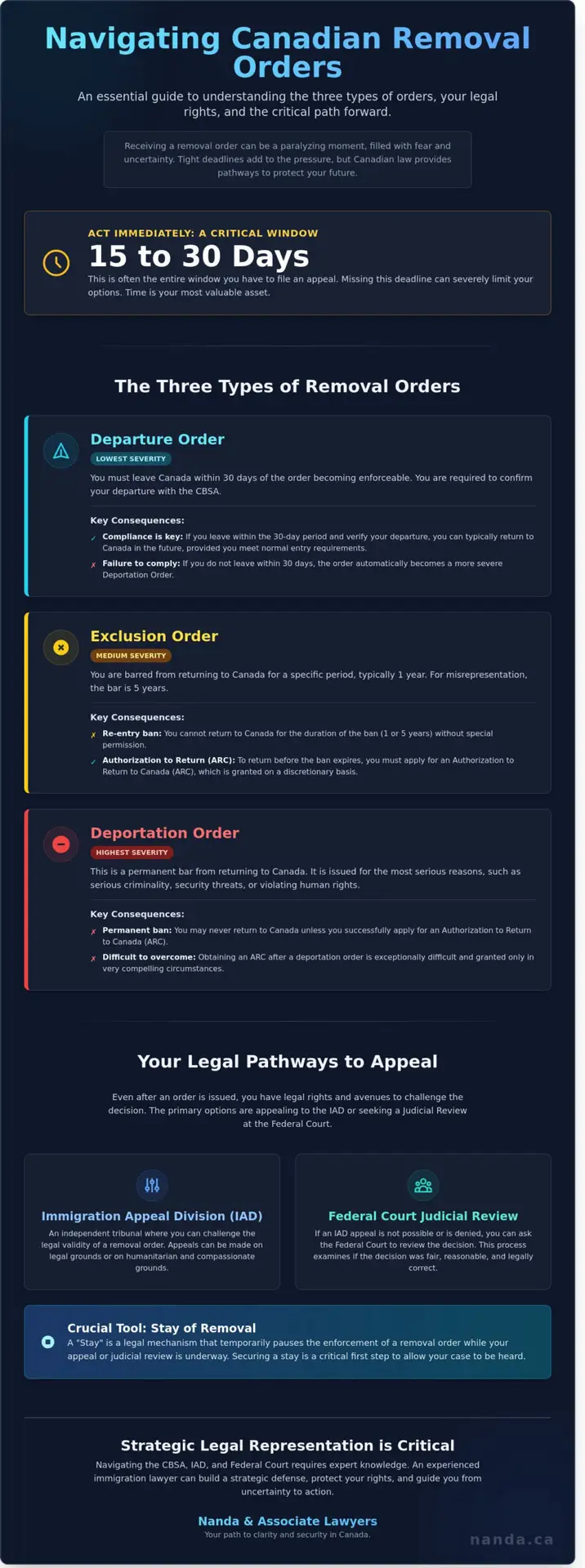
The legal framework governing deportation or removal orders in Canada is established under the Immigration and Refugee Protection Act (IRPA). When the Canada Border Services Agency (CBSA) issues a notice, it falls into one of three distinct categories, each carrying different consequences for your future. Understanding these distinctions is vital for residents in Mississauga and Brampton who need to protect their status. The type of order you receive dictates your timeline for departure and whether you’ll ever be allowed to return to Ontario.
Departure Orders and the Certificate of Departure
A Departure Order is the least restrictive directive, requiring you to leave Canada within 30 days of the order becoming enforceable. To fulfill this obligation, you must verify your exit with a CBSA officer at a port of entry, most commonly at Pearson International Airport. During this process, an officer issues a Certificate of Departure (Form IMM 0056B). This document is your proof of compliance. If you leave within the 30-day window and confirm your exit, you won’t typically need special permission to return to Canada in the future, provided you meet standard entry requirements.
Failing to exit within the allotted timeframe carries a heavy penalty. If you don’t leave within 30 days or fail to confirm your departure with the CBSA, the order automatically becomes a Deportation Order. This shift is significant because it changes a temporary exit into a permanent bar. If logistical hurdles like expired travel documents prevent your departure, it’s essential to seek legal counsel. Our immigration lawyers in Mississauga can assist in communicating with the CBSA to manage these complex timelines effectively.
Exclusion Orders vs. Deportation Orders
Exclusion orders generally result in a one-year ban from Canada. However, if the order is issued for misrepresentation under Section 40 of the IRPA, the ban extends to five years. This frequently occurs when an individual provides false information on an application or during an interview. Enforcing removals from Canada is a core mandate of the CBSA, which removed over 15,000 individuals in the 2023 fiscal year to maintain the integrity of the immigration system.
A Deportation Order is the most severe deportation or removal orders category. It’s a lifetime ban. If you’ve been deported, you’re permanently barred from entering Canada unless you apply for and receive an Authorization to Return to Canada (ARC). The ARC process is rigorous; you’ve got to prove that your return is justified and that you’ve addressed the reasons for your initial removal. For families in Brampton, the stakes are incredibly high. A deportation order doesn’t just affect the individual; it often leads to the long-term separation of parents from children or spouses from their partners. We focus on exploring every available remedy, such as Humanitarian and Compassionate applications, to mitigate these life-altering consequences and provide a path toward stability.
Legal Pathways to Appeal a Removal Order at the Immigration Appeal Division (IAD)
The Immigration Appeal Division (IAD) serves as a vital tribunal where individuals can challenge deportation or removal orders issued by the Canada Border Services Agency (CBSA) or the Immigration Division. Not every person facing removal has the automatic right to an appeal. Permanent residents, protected persons, and foreign nationals holding a permanent resident visa generally possess this right. However, the Immigration and Refugee Protection Act (IRPA) restricts access to the IAD for those deemed inadmissible due to organized criminality, security threats, or serious crimes. Under Section 36(1) of the IRPA, a crime is considered "serious" if it’s punishable by a maximum prison term of at least 10 years or if the individual received a sentence of more than six months in Canada.
Appeals at the IAD focus on two primary areas: legal errors and humanitarian and compassionate (H&C) considerations. A legal error exists if the original decision-maker misinterpreted the law or ignored critical evidence. In Mississauga-based proceedings, the IAD member reviews the case de novo, meaning they can look at new evidence that wasn’t available when the initial order was issued. This is a powerful opportunity to present a complete picture of your life in Canada. Our immigration lawyers in Mississauga specialize in building these comprehensive disclosure packages. We ensure that every piece of evidence, from employment records to character references, is filed at least 30 days before the hearing to meet strict tribunal deadlines.
The hearing itself is a formal process where you’ll provide testimony under oath. A Minister’s Counsel will represent the government and cross-examine you to test the credibility of your claims. Having professional representation ensures that your testimony remains focused and that your rights are protected throughout the questioning. We prepare our clients for the specific atmosphere of the Mississauga hearing rooms, focusing on clear communication and the strategic presentation of facts that align with current IAD jurisprudence.
Humanitarian and Compassionate Grounds
H&C grounds allow the IAD to grant relief even if the removal order is legally valid. The board prioritizes the "best interests of the child," examining how your departure would affect children under 18 who are directly impacted by the case. We also highlight your degree of establishment in Mississauga. This includes your history of local employment, financial contributions, and ties to community organizations. Understanding the different types of removal orders in Canada is essential here, as the level of hardship you must prove can vary. We meticulously document the risks you’d face in your country of origin, such as lack of medical care or social isolation, to create a persuasive argument for your stay.
Judicial Review at the Federal Court
When an IAD appeal isn’t available or is unsuccessful, the next step is a Judicial Review at the Federal Court of Canada. This isn’t a second chance to tell your story; it’s a technical review to determine if the previous decision was "reasonable" or "correct." The process begins with the "leave" stage, where a judge decides if the case has a "fairly arguable" point. Statistically, the Federal Court only grants leave in approximately 15% to 20% of applications, which underscores the need for precise legal drafting. Our civil litigation lawyers are well-versed in these court procedures, handling the strict 15-day or 60-day filing windows with the exactness required to keep your case alive and seek a stay of deportation or removal orders.
How to Apply for a Stay of Removal or a Deferral in Ontario
A stay of removal acts as a legal pause button on the enforcement of a removal order. It doesn’t cancel the order entirely; instead, it provides a temporary reprieve that prevents the Canada Border Services Agency (CBSA) from physically removing you from the country. We understand how overwhelming it feels when a departure date is set, but several mechanisms exist under the Immigration and Refugee Protection Act (IRPA) to delay this process. These stays fall into two primary categories: statutory and discretionary. Statutory stays occur automatically by law, such as when an appeal is actively pending before the Immigration Appeal Division. Discretionary stays are granted by CBSA officers or the court based on specific humanitarian factors or short term logistical needs.
The CBSA also utilizes Administrative Deferral of Removals (ADR) and Temporary Suspension of Removals (TSR) for broader humanitarian reasons. An ADR is typically issued when a country faces a temporary period of instability, while a TSR is reserved for nations experiencing extreme environmental disasters or total political collapse. For example, as of early 2024, ADRs have been applied to specific regions to ensure individuals aren’t returned to active danger zones. These measures reflect Canada’s commitment to international human rights standards, ensuring we don’t return people to life-threatening conditions. If you’re facing deportation or removal orders, determining which of these administrative pauses applies to your country of origin is a critical first step in your legal strategy.
Pre-Removal Risk Assessment (PRRA)
The PRRA is a final safety net designed to protect individuals from being sent to a country where they would face persecution, torture, or cruel treatment. Most people become eligible for a PRRA once their removal order becomes enforceable, though a 12 month bar applies if your refugee claim was recently rejected or abandoned. You must focus on "new evidence" that wasn’t available during your initial refugee hearing. This includes changes in your home country’s political climate or personal circumstances that occurred after your last hearing. We help clients compile evidence that meets this high evidentiary threshold to ensure their safety is documented.
Emergency Stays at the Federal Court
When the CBSA refuses to defer a removal, we can apply for an emergency stay at the Federal Court. This involves a rigorous tripartite test established by Canadian case law. First, we must prove there’s a serious issue to be tried regarding the underlying legal challenge. Second, we must demonstrate that you’ll suffer "irreparable harm" if removed, which usually involves a threat to life or physical safety. Finally, the "balance of convenience" must favour the individual over the government’s interest in enforcing the removal. An emergency motion for a stay of removal at the Federal Court represents the final legal safeguard for residents facing imminent deportation or removal orders from Mississauga, requiring a judge to weigh the risk of personal harm against the government’s mandate to enforce the law.
If you’ve received a notice to appear for a removal interview or have a set departure date, you must act immediately to explore these deferral options. Our team provides the authoritative guidance needed to protect your status in Canada.
Book a consultation with our immigration litigation team today.
Why Strategic Legal Representation is Critical for Removal Order Cases in Mississauga
Receiving a notice from the Canada Border Services Agency (CBSA) creates immediate distress for any family. It’s a high-stakes environment where the timeline for action is often measured in days, not months. You’re caught between two massive bureaucracies: the CBSA, which enforces departures, and Immigration, Refugees and Citizenship Canada (IRCC), which manages your legal status. These agencies operate under different mandates and don’t always communicate effectively. A strategic legal approach ensures your rights under the Immigration and Refugee Protection Act (IRPA) are protected during this bureaucratic friction.
If you’re summoned for an enforcement interview at the CBSA office located at 6900 Airport Road, having a immigration lawyer by your side changes the dynamic of the meeting. We provide a necessary buffer during these interviews, ensuring you don’t inadvertently prejudice your case or waive rights you didn’t know you had. Our team understands how to coordinate with enforcement officers while simultaneously pursuing legal remedies to pause the process.
Developing a comprehensive strategy requires looking at every available avenue for relief. This often involves a multi-pronged approach:
-
Pre-Removal Risk Assessment (PRRA): We help you detail the specific dangers you’d face in your home country, adhering to the strict 15-day filing deadline.
-
Humanitarian and Compassionate (H&C) Applications: We gather evidence of your establishment in Mississauga, including your employment history, community ties, and the best interests of any children involved.
-
Stay of Removal: If an enforcement date is set, we can move quickly to request a stay from the Federal Court, showing that your removal would cause "irreparable harm."
Language support is another critical factor in your defense. Mississauga is one of the most diverse cities in Canada, and nuance often gets lost in translation during high-pressure CBSA interviews. Our multilingual legal team speaks over 15 languages, ensuring your story is told accurately and your testimony is never misunderstood by officials. We bridge the gap between your lived experience and the technical requirements of Canadian law.
Working with Nanda & Associate Lawyers
We don’t work in silos. Our collaborative approach brings together litigators who specialize in high-stakes immigration disputes. We have extensive experience appearing before the Immigration and Refugee Board (IRB) and the Federal Court of Canada. In 2023 alone, the Federal Court handled thousands of judicial reviews; we provide the steady, authoritative voice needed to represent Mississauga families in these complex proceedings. We treat your case with the individual care it deserves, focusing on long-term stability.
For employers in Mississauga who may be concerned about the immigration status of their workforce, understanding the broader immigration landscape is crucial. Many businesses find themselves navigating complex federal requirements when seeking to hire international talent, particularly when it comes to securing an LMIA in Mississauga to support their employees’ work authorization.
Next Steps: Securing Your Future in Canada
Don’t trust your future to "ghost consultants." These are unlicensed individuals who lack the legal standing to represent you in Federal Court or at the IRB. They often miss critical 30-day appeal windows, which can result in permanent consequences. To prepare for your initial consultation, bring your original deportation or removal orders, all correspondence from the CBSA, and your current travel documents. We’ll conduct an urgent file review to identify immediate deadlines. Contact our firm today to begin protecting your status: https://nanda.ca/book-consultation/.
Secure Your Status and Protect Your Future in Mississauga
Facing deportation or removal orders is an overwhelming experience that threatens your family’s stability and your place in the Canadian community. You’ve learned that identifying whether you face a departure, exclusion, or deportation order is the first step toward a defense. Acting within the strict timelines set by the Immigration and Refugee Protection Act is mandatory to protect your rights. Our team brings over 20 years of experience in Ontario courts to navigate these high-stakes appeals at the Immigration Appeal Division. We provide multilingual services in 15+ languages to ensure you understand every legal nuance of your case. We don’t just fill out forms; we build a strategic defense tailored to your unique circumstances in Mississauga. You deserve a legal partner who prioritizes your peace of mind and works tirelessly for a favorable outcome. Our collaborative approach ensures that every detail of your appeal is handled with precision and care. Your journey in Canada is important, and we’re here to help you defend it.
Protect your status and book a consultation with our Mississauga immigration lawyers today.
Frequently Asked Questions
Can I stop a deportation order once it has been issued?
You can stop a deportation order by filing a Judicial Review or a Deferral of Removal request through the Federal Court. Under Section 48 of the Immigration and Refugee Protection Act, the CBSA must enforce orders quickly, but legal stays provide a vital pause. Our team works to demonstrate that you’ll face irreparable harm if removed before your case is fully reviewed. We focus on securing your safety while we pursue every available legal avenue.
How long do I have to leave Canada after receiving a removal order?
You typically have 30 days to leave the country if you’ve received a Departure Order from immigration authorities. If you don’t exit within this 30 day window and verify your departure with an officer, the order automatically becomes a permanent deportation. It’s vital to act within these first 720 hours to protect your future eligibility to return. We help you navigate these strict timelines so you don’t lose your rights to come back later.
What happens if I ignore a removal order in Ontario?
Ignoring a removal order results in the CBSA issuing a Canada wide warrant for your immediate arrest. Once you’re apprehended, you’ll likely be held at the Toronto Immigration Holding Centre until your travel documents are ready. In 2023, the CBSA successfully carried out 15,000 removals, which shows they’re active in finding those who don’t comply. Staying in the country illegally also prevents you from applying for most future visas or work permits.
Can I come back to Canada after being deported?
You can return to Canada after a deportation if you apply for and receive an Authorization to Return to Canada (ARC). As of 2024, the government processing fee for an ARC application is C$459.55. Your success depends on the specific reasons for the initial deportation or removal orders and how well you’ve complied since leaving. We assist by gathering evidence to show that your return won’t pose a risk to Canadian society or the immigration system.
What is the difference between a removal order and a deportation order?
A removal order is a broad category that includes departure orders, exclusion orders, and deportation orders. A departure order is the least severe, while a deportation order is a lifetime ban from entering the country. Understanding the specific nature of your deportation or removal orders is essential for building a defense. Our lawyers analyze the specific document you received to determine if an appeal to the Immigration Appeal Division is possible for your situation.
Does having a Canadian child stop a removal order?
Having a Canadian child doesn’t provide an automatic stay, but it’s a major factor in a Humanitarian and Compassionate (H&C) application. Section 25 of the IRPA requires officers to prioritize the "best interests of the child" when making decisions. We’ve seen cases where 2 or 3 specific letters from teachers or doctors about a child’s needs helped stop a removal. Our firm focuses on showing how your absence would cause your child significant psychological or financial hardship.
Can I apply for a PRRA if I am in Mississauga?
You can apply for a Pre-Removal Risk Assessment (PRRA) only after the CBSA sends you a formal notification of eligibility. Once you receive this notice, you have exactly 15 days to complete the application forms and another 15 days to submit your evidence. If you’re in Mississauga, we can help you compile at least 5 distinct pieces of evidence regarding the dangers in your home country. This process acts as a final safety net to ensure you aren’t sent into a life threatening situation.
How do I appeal a removal order based on misrepresentation?
You must file a notice of appeal with the Immigration Appeal Division (IAD) within 30 days of receiving a removal order for misrepresentation. This right is generally reserved for Permanent Residents who are accused of providing false information. The IAD considers 5 main factors, including the seriousness of the lie and your level of establishment in Canada. We represent you at the hearing to argue that your presence in the community outweighs the error made on your initial application.
</existing_article>
Disclaimer
This content is for general information only and does not constitute legal advice or create a lawyer-client relationship. Every case is different—please consult a qualified lawyer for advice specific to your situation.