




Key Takeaways
-
Understand the severe implications of Section 40 of the IRPA, including the potential for a five-year ban from Canada and how to proactively mitigate these risks.
-
Learn the critical steps for responding to a Procedural Fairness Letter (PFL) within strict timelines to ensure your defence is professionally documented and persuasive.
-
Discover how a dedicated misrepresentation immigration Canada lawyer can help you establish an "honest belief" defence and gather the high-quality evidence needed to protect your status.
-
Identify the concept of "materiality" and how strategic legal submissions can clarify omitted information or administrative errors to prevent a finding of inadmissibility.
-
Gain peace of mind by engaging experienced immigration lawyers to navigate the complex intersection of immigration law and litigation with a tailored strategy.
Table of Contents
On May 12, 2025, a dedicated professional in Mississauga faced a life-altering crisis when a single overlooked date on their background declaration led to a formal allegation of misrepresentation. It’s incredibly stressful to realize that the difference between a bright future and a mandatory five-year ban often hinges on a technicality you didn’t intend to overlook. You likely feel overwhelmed by the complexity of the Immigration and Refugee Protection Act and worried that an honest mistake will result in a removal order. Partnering with an experienced misrepresentation immigration Canada lawyer is the first step toward regaining control of your narrative and protecting your status.
Our experienced immigration lawyers understand the weight of this situation and provide the authoritative, reassuring guidance you need during this transition. This article will show you how to effectively challenge allegations and protect your future in Canada with expert legal strategies tailored for Mississauga residents. We’ll examine the essential steps for responding to a Procedural Fairness Letter (PFL), the legal distinction between "intentional" and "accidental" errors, and the proven methods for maintaining your permanent residency or work permit eligibility despite these challenges.
Navigating Misrepresentation Allegations
-
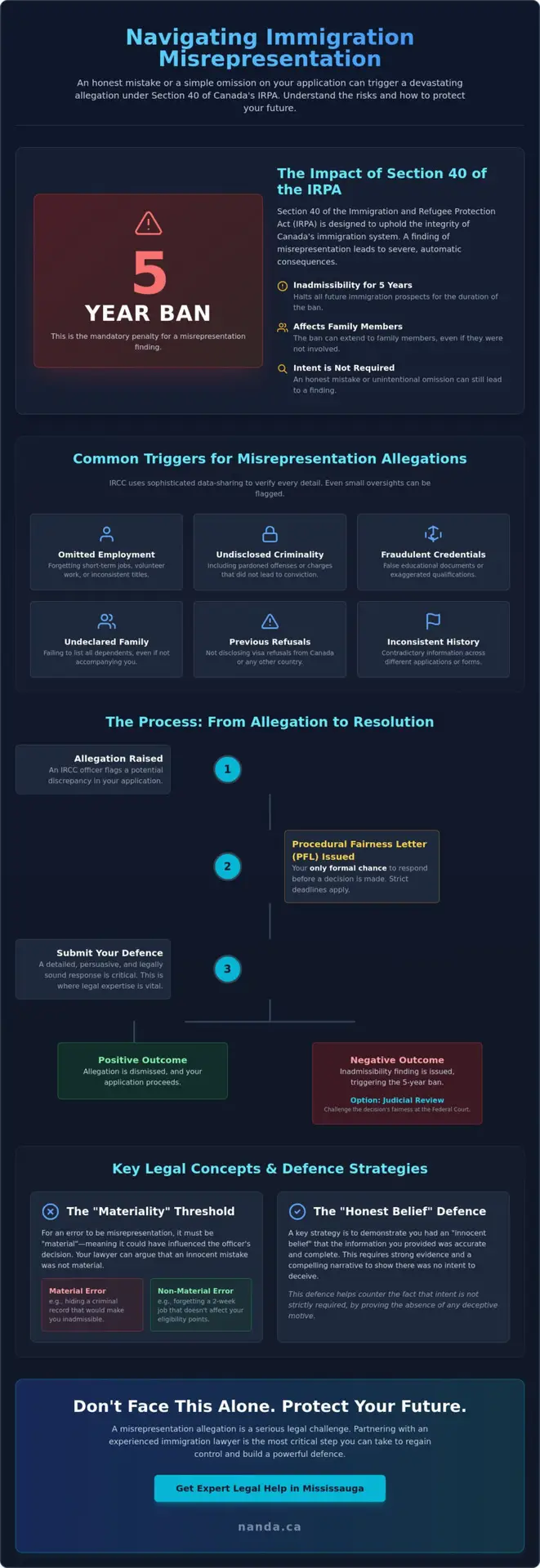
Severe Statutory Penalties: A finding of misrepresentation under Section 40 of the Immigration and Refugee Protection Act (IRPA) results in an automatic five-year ban from Canada. This inadmissibility applies to both the individual and their family members, effectively halting any future immigration prospects during that period.
-
Common Allegation Triggers: Most cases involve omitted employment history, undisclosed criminal records, or fraudulent educational credentials. Failing to declare family members, even if they aren’t accompanying you to Canada, is a frequent cause for a misrepresentation finding.
-
The Procedural Fairness Letter (PFL): This document is your only formal chance to address an officer’s concerns before a final decision is made. A well-drafted response to a PFL can mean the difference between an approved application and a half-decade ban.
-
The Materiality Threshold: For an error to constitute misrepresentation, it must be "material." This means the information could have induced an error in the administration of the law. A misrepresentation immigration Canada lawyer can often argue that an innocent mistake was not material to the ultimate decision.
-
Judicial Review Options: If IRCC issues a negative decision based on misrepresentation, you have the right to challenge it. Legal representation in Mississauga is essential for filing a Judicial Review at the Federal Court, where a judge determines if the officer’s decision was reasonable and procedurally fair.
Introduction to Immigration Misrepresentation
By 2026, Immigration, Refugees and Citizenship Canada (IRCC) has significantly tightened its verification protocols. The department uses sophisticated data-sharing agreements with international partners to cross-reference every detail of an applicant’s history. Misrepresentation is no longer viewed as a simple clerical issue; it’s treated as a fundamental breach of the integrity of the Canadian immigration system. Whether you’re applying for a work permit, permanent residency, or citizenship, the expectation of absolute candor is absolute. Even an unintentional oversight, such as forgetting a weekend volunteer position or a brief previous visa refusal from another country, can be flagged as a violation of Section 40.
The legal consequences are immediate and devastating. Beyond the five-year ban, a record of misrepresentation creates a permanent "red flag" on your file that complicates every future interaction with Canadian border officials. Because the legal threshold for these findings is low, you don’t need to have a specific intent to deceive to be found inadmissible. IRCC only needs to demonstrate that the information provided was inaccurate. Engaging a Mississauga immigration lawyer early in the process provides the strategic buffer you need. At Nanda & Associate Lawyers, we focus on providing comprehensive legal solutions that protect your status. We understand the stress of facing these allegations and work methodically to present your case with the calm confidence required to achieve a favorable outcome. Our team ensures that your response to the government is legally sound, factually accurate, and designed to preserve your future in Canada.
Legal Explanation: Understanding Section 40 of the IRPA
Section 40 of the Immigration and Refugee Protection Act (IRPA) serves as the primary mechanism for maintaining the integrity of the Canadian immigration system. When an applicant provides false information or withholds relevant facts, they trigger a finding of inadmissibility. This isn’t just about active lies; it covers any omission that could lead to an error in how the law is applied. Working with a misrepresentation immigration Canada lawyer helps you understand that even unintentional errors can result in a five-year ban from entering the country. You can review the full, official text of Section 40 of the IRPA to see how broadly these rules are applied by federal officers.
Misrepresentation happens in two distinct ways. Direct misrepresentation occurs when you personally provide false documents, such as an undisclosed criminal record or a "marriage of convenience" arrangement. Indirect misrepresentation is often more complex. This happens when a third party, such as an unlicensed consultant, submits incorrect data on your behalf. Under Canadian law, you’re ultimately responsible for every detail in your application, regardless of who filled out the forms. This makes the choice of your legal representative a critical decision for your future in Canada.
The Materiality Test in Ontario Law
IRCC officers apply what’s known as the materiality test to every application. They ask one central question: could this piece of information have induced an error in the administration of the Act? If a fact is material, its disclosure might have led to a different outcome or further investigation. For instance, failing to mention a 2019 conviction in another country is material because it directly affects your criminal admissibility. While some "innocent misrepresentation" exceptions exist for genuine, non-negligent mistakes, these are extremely rare in practice. A simple typo in a residential address usually won’t trigger Section 40, but omitting a previous visa refusal from the UK or USA almost certainly will.
Inadmissibility and Its Broader Impact
A finding of misrepresentation doesn’t just stop your application; it creates a devastating ripple effect for your entire family. If a principal applicant is found inadmissible, every dependent family member included in the file often faces the same five-year ban. This record is permanently stored in the Global Case Management System (GCMS), visible to border officers for the rest of your life. Such findings often lead to complex immigration refusals and appeals that require a sophisticated legal strategy to resolve. Beyond the immediate ban, you lose your current status and face a difficult road to rebuilding your credibility with Canadian authorities.
If you suspect an error was made in your previous filings, it’s vital to consult with an experienced legal professional.
Timelines and Process: From Allegation to Resolution
The process of addressing a misrepresentation allegation follows a strict legal sequence. It begins when Immigration, Refugees and Citizenship Canada (IRCC) identifies a potential discrepancy or omission in your file. This triggers a series of deadlines that require immediate attention from a misrepresentation immigration Canada lawyer to prevent a five-year ban. The timeline is often compressed, leaving little room for error when your future in Canada is at stake.
-
Step 1: Receipt of a Procedural Fairness Letter (PFL). Applicants typically have between 7 and 30 days to provide a written response.
-
Step 2: Gathering Evidence and Drafting. This phase involves collecting corroborating documents and drafting a formal legal submission to address the specific concerns raised by the officer.
-
Step 3: IRCC Decision. After reviewing your submission, the officer will either clear the concern and continue processing the application or make a finding of inadmissibility.
-
Step 4: Judicial Review. If the application is refused, you have 15 days for domestic decisions or 60 days for overseas decisions to file for Leave at the Federal Court.
Responding to a Procedural Fairness Letter (PFL)
A PFL is the most critical document in your immigration journey because it signals that an officer is prepared to refuse your application based on a finding of dishonesty. You must provide full and frank disclosure in your response. This involves admitting to errors where they occurred while providing context or evidence of a lack of intent to deceive. The Procedural Fairness Letter represents your last opportunity to provide a reasonable explanation for inconsistencies before a finding is made under Section 40 of the IRPA and a ban is issued.
Federal Court Judicial Review Process
When an IRCC officer makes an unreasonable or legally flawed decision, our civil litigation lawyers can challenge the finding through a Judicial Review. This isn’t a re-evaluation of your facts; it’s a review of whether the officer followed a fair process and reached a logical conclusion. You must file for Leave within 15 to 60 days of the refusal notice. If the Federal Court grants Leave and subsequently finds the decision was unreasonable, it will set the decision aside. The case is then sent back for redetermination by a different officer, giving you a fresh chance to secure your status. Working with a misrepresentation immigration Canada lawyer ensures these complex legal arguments are framed correctly to meet the Court’s high standards and protect your long-term interests in Mississauga.
Practical Advice: Defence Strategies for Misrepresentation
Facing an allegation of misrepresentation is a critical legal challenge that requires a precise, evidence-based response. Under Section 40 of the Immigration and Refugee Protection Act (IRPA), the consequences include a five-year ban from Canada. To counter these claims, we focus on establishing a robust defence through several proven legal avenues. One primary strategy involves proving an "honest belief." This requires showing that you took reasonable steps to ensure your information was correct and that any error was not a deliberate attempt to deceive the IRCC. It’s a narrow legal window, but with the right documentation, it remains a viable path for many applicants.
Gathering corroborating evidence is the cornerstone of a successful defence. We assist clients in compiling a comprehensive dossier that may include:
-
Detailed Employment Records: Original contracts, tax filings, and pay stubs that clarify dates or roles that may have been questioned.
-
Verified Bank Statements: Financial history that aligns with the claims made in your initial application.
-
Expert Affidavits: Sworn statements from third-party professionals or former employers that validate your history.
The "Incompetent Representative" defence is another vital tool. Many individuals fall victim to "ghost consultants" or unauthorized representatives who alter documents without the applicant’s knowledge. If a previous consultant lied on your behalf, we help you document the communication trail to prove you weren’t complicit in the fraud. In cases where inadmissibility is already established, we may explore a Temporary Resident Permit (TRP). While a TRP doesn’t erase the misrepresentation, it can allow you to remain in or enter Canada if your presence is justified by compelling circumstances.
If you have received a procedural fairness letter, your response window is limited. Consult a misrepresentation immigration Canada lawyer immediately to protect your future.
Evidence Gathering for Mississauga Residents
Living in Mississauga provides access to various local resources that can strengthen your case. We guide you in obtaining certified true copies of documents and legal declarations from local notary publics to ensure every piece of evidence meets IRCC standards. Our team performs a comprehensive audit of your previous applications. We look for consistency across all filings to identify where discrepancies originated and how they can be clarified with fresh, local evidence.
The Role of Discretion and Humanitarian Grounds
Humanitarian and Compassionate (H&C) factors offer a secondary layer of protection. While H&C considerations don’t technically "erase" a finding of misrepresentation, they allow an officer to grant permanent residency despite inadmissibility. This pathway is reserved for exceptional cases. We focus on the best interests of any children involved or your level of establishment within the Mississauga community. The threshold for success is high, but for families facing separation, it represents a vital lifeline in the Canadian immigration system.
Our firm provides the steady, methodical guidance needed to handle these high-stakes allegations. We ensure your voice is heard through a clear and persuasive legal strategy. If you’re concerned about your status, contact a misrepresentation immigration Canada lawyer today to discuss your options.
Conclusion: Why Local Legal Expertise Matters in Mississauga
Facing an allegation of misrepresentation is one of the most serious challenges a person can encounter within the Canadian immigration system. It’s not a minor administrative hurdle. Under Section 40 of the Immigration and Refugee Protection Act (IRPA), a finding of misrepresentation leads to a mandatory five-year ban from entering Canada and the immediate loss of permanent resident status. You can’t afford to wait or hope the situation resolves itself. Immediate action is the only way to mitigate these risks and protect your ability to remain in the country. Our team understands that these cases often require more than just standard immigration knowledge; they require the sharp edge of a litigation specialist who knows how to contest government findings.
Choosing a misrepresentation immigration Canada lawyer with experience before the Federal Court of Canada is a strategic necessity. Many cases reach a point where an administrative decision must be challenged through Judicial Review. This process is governed by strict timelines, often requiring an application for leave within 15 days for domestic decisions or 60 days for matters arising outside Canada. At Nanda & Associate Lawyers, we provide a multidisciplinary approach that combines deep immigration insights with robust litigation strategies.
We’ve seen how a well-prepared response to a Procedural Fairness Letter (PFL) can change the trajectory of a case before a final decision is even made. We focus on providing comprehensive legal solutions that address the specific nuances of your history and the legal standards set by Canadian authorities. Our firm acts as a versatile resource, ensuring that if your case moves from an officer’s desk to a courtroom, your representation remains seamless and consistent.
Protecting Your Future in Canada
Your status in Canada represents years of hard work and dreams for your family. Don’t risk everything by attempting to navigate a PFL or an inadmissibility hearing without professional guidance. A single mistake in your response or a failure to provide corroborating evidence can solidify a five-year ban that’s incredibly difficult to overturn. We provide the calm confidence and strategic protection you need during this stressful time. If you’ve received a letter from IRCC questioning your truthfulness or the validity of your documents, contact an immigration lawyer in Mississauga immediately. Our diverse team is equipped to handle the most complex cases with individual care and professional gravity. Secure your peace of mind and your future in Ontario by booking a consultation at our Mississauga office today through our online booking portal. We’re here to ensure your voice is heard and your rights are protected under the full extent of Canadian law.
Secure Your Future in Canada Today
Facing an allegation under Section 40 of the IRPA isn’t just a minor hurdle; it’s a direct threat to your life in Mississauga. You’ve seen how critical it is to address these claims with precision, whether through a robust procedural fairness response or a strategic appeal. A single error or omission on an application can lead to a five-year ban from entering the country, making it vital to act quickly to protect your residency and your family’s stability.
Our team at Nanda & Associate Lawyers brings over 20 years of experience in Ontario law to your side. We’ve built a dedicated immigration litigation team that understands the nuances of the Federal Court and the Immigration Appeal Division. Because we offer services in more than 15 languages, we ensure you’re heard and understood throughout every step of the legal process. Partnering with a skilled misrepresentation immigration Canada lawyer gives you the best chance to resolve these allegations and maintain your status.
Book a Consultation with a Misrepresentation Lawyer in Mississauga
You don’t have to face these complex legal challenges alone. We’re here to provide the clarity and dedicated support you need to move forward with peace of mind.
Frequently Asked Questions
What is the penalty for misrepresentation in Canadian immigration?
The primary penalty for misrepresentation is a 5-year ban from entering Canada and a formal finding of inadmissibility under Section 40 of the Immigration and Refugee Protection Act (IRPA). If you’re already in the country, this can lead to the loss of your current status and the issuance of a removal order. This ban applies to all visa categories, meaning you cannot apply for permanent residency or temporary permits until the period expires.
Can I be deported for an accidental mistake on my application?
You can be deported for an accidental mistake because the IRCC places the ultimate responsibility for the accuracy of an application on the applicant. Canadian law doesn’t require intent to find misrepresentation; even a simple oversight regarding a previous visa refusal or a family member’s details can trigger a Section 40 finding. Our team often works with clients to prove that an error was truly immaterial to the application’s outcome.
How do I respond to a Procedural Fairness Letter regarding misrepresentation?
You respond to a Procedural Fairness Letter by submitting a comprehensive written rebuttal and supporting documentation within the strict deadline provided by IRCC, which is often 30 days for overseas applicants. This letter is your one chance to explain the discrepancy and persuade the officer not to issue a ban. Consulting a misrepresentation immigration Canada lawyer is vital to ensure your response addresses the legal requirements of materiality.
Can a lawyer help me if my consultant made a mistake on my behalf?
A lawyer can certainly help if a consultant’s error led to a misrepresentation charge by building a case based on clerical error or incompetence of counsel. While you’re generally responsible for what you sign, we can argue that you acted in good faith and that the error shouldn’t result in a 5-year ban. We help gather evidence of your communications with the consultant to demonstrate you provided truthful information originally.
Is it possible to apply for a PR again after a 5-year ban ends?
It’s possible to apply for Permanent Residency again once the 5-year ban has officially ended. You don’t need special permission to apply after the clock runs out, but you must disclose the previous misrepresentation on all future forms. Because your file will likely face increased scrutiny, working with an immigration lawyer in Mississauga helps ensure your new application is flawless and fully transparent.
What is the difference between a mistake and misrepresentation under Section 40?
The difference hinges on materiality, where a mistake is a minor typo while misrepresentation involves facts that could alter an officer’s decision. Under Section 40, if the omitted or false information could’ve led to a different result regarding your eligibility, it’s considered material. For example, forgetting a middle name is a mistake; failing to mention a 2018 criminal conviction is misrepresentation that carries severe consequences.
Can I appeal a misrepresentation finding to the Federal Court?
You can appeal a misrepresentation finding by filing an application for Judicial Review at the Federal Court of Canada. This legal process doesn’t re-examine the facts but determines if the immigration officer’s decision was reasonable and procedurally fair. You must act quickly, as the deadline to file is 15 days if the decision was made in Canada and 60 days if it was made at an overseas visa office.
Does misrepresentation affect my ability to apply for a Super Visa or Work Permit?
Misrepresentation affects every type of application, effectively barring you from obtaining a Super Visa, Work Permit, or Study Permit for five years. A Section 40 finding makes you inadmissible to Canada, which serves as a blanket rejection for any entry document. If you have family in Ontario you wish to visit, this ban can be devastating, making it essential to challenge the initial finding through proper legal channels.
Disclaimer
This content is for general information only and does not constitute legal advice or create a lawyer-client relationship. Every case is different—please consult a qualified lawyer for advice specific to your situation.