



Key Takeaways
-
Understand how Section 25(1) of the IRPA serves as an exceptional legal pathway for those facing significant hardship if forced to leave Canada.
-
Discover the three essential pillars IRCC officers evaluate when reviewing applications for humanitarian and compassionate grounds in Mississauga.
-
Learn how to navigate the 12-month bar for failed refugee claimants, including critical exceptions for medical risks and the best interests of a child.
-
Gain strategic insights into building a high-quality evidence portfolio that prioritizes credible documentation to demonstrate your local establishment.
-
Recognize the importance of professional legal guidance from experienced immigration lawyers in drafting a persuasive narrative to manage the complexities of discretionary immigration relief.
Table of Contents
-
What are Humanitarian and Compassionate Grounds in Mississauga?
-
Securing Your Future in Mississauga Through IRPA Section 25(1)
Imagine walking your children to their Mississauga elementary school on a Tuesday morning, only to realize that a single administrative oversight could end your life in Canada within months. For many families in our community, the threat of removal isn’t just a distant possibility; it’s a daily weight that affects every decision. You’ve likely spent years building a foundation here, and applying for permanent residency based on humanitarian and compassionate grounds often feels like the final hope for stability. It’s natural to feel overwhelmed by the 12-month bar rule or the high threshold for proving your establishment in the Peel Region.
Our immigration lawyers understand that your primary goal is long-term safety for your family. This guide clarifies the complex requirements and strategic evidence necessary to navigate this difficult legal path. We’ll break down how to document your community ties and address the best interests of your children to build a compelling case. By the end of this article, you’ll have a clear roadmap for navigating the 2026 immigration landscape and securing your future in the city you call home.
Permanent residency based on humanitarian and compassionate grounds
Applying for permanent residency based on humanitarian and compassionate grounds is an exceptional legal remedy. It exists for individuals who don’t qualify for standard immigration streams but face unique circumstances that justify a special exemption. Under Section 25(1) of the Immigration and Refugee Protection Act (IRPA), the Minister has the authority to grant permanent resident status if the applicant’s situation warrants it. This process is deeply rooted in the broader framework of Canadian immigration and refugee law, providing a vital safety net for those who would face unusual, undeserved, or disproportionate hardship if they were forced to leave the country.
In Mississauga, proving your case requires more than just a desire to remain in Canada. You’ve got to show deep, tangible roots. Here are the core pillars of a successful application:
-
Exceptional Hardship: You must demonstrate that being forced to leave Mississauga would cause significant suffering. This isn’t just about economic difficulty; it’s about the emotional and physical toll of being uprooted from your established life and sent to a country where you may no longer have support.
-
The Best Interests of a Child (BIOC): This is often the most persuasive factor in any application. Officers must prioritize the well-being, health, and development of any child directly affected by the decision. This includes their integration into the Peel District School Board, their access to specialized medical care, and the stability of their local social circles.
-
Community Establishment: Showing your ties to the local community is vital. This involves documenting your employment history, volunteer work with Mississauga-based organizations, and your active participation in local religious or cultural groups.
-
Discretionary Nature: Unlike points-based programs, H&C decisions are highly subjective. There’s no guaranteed checklist for success, which makes the quality of your evidence and the clarity of your legal arguments paramount.
The Importance of Strategic Representation
Because these applications rely on the discretion of immigration officers, a generic approach simply won’t work. We focus on building a comprehensive narrative that highlights your unique contributions to the Mississauga community. Working with an immigration lawyer in Mississauga ensures that your application is tailored to meet the strict standards set by Immigration, Refugees and Citizenship Canada (IRCC). Our team provides the professional guidance needed to handle these sensitive cases with the care they deserve, aiming for long-term stability and peace of mind for your family. We understand that every case is different, and we’re committed to providing a clear path forward through these complex legal waters.
What are Humanitarian and Compassionate Grounds in Mississauga?
Applying for permanent residence through humanitarian and compassionate grounds is a unique legal pathway designed for foreign nationals who find themselves in exceptional circumstances. Unlike standard economic or family class streams, this process is governed by Section 25(1) of the Immigration and Refugee Protection Act (IRPA). It grants the Minister of Immigration the authority to waive certain requirements of the Act if the applicant’s situation warrants special relief. It’s a vital safety net for those who don’t qualify for other programs but face significant hardship if forced to leave Canada.
This pathway is strictly an exceptional measure. It isn’t a shortcut or an alternative to traditional immigration categories. For Mississauga residents, this often becomes a relevant option when a work permit expires, a sponsorship fails, or a refugee claim is ineligible. We see many individuals who have built deep roots in the Peel Region, contributing to the local economy and community, yet find themselves without a clear legal status. In these instances, the law allows for a plea based on the human reality of their lives rather than just rigid checkboxes.
The Role of Discretion in IRCC Decisions
Decisions on these applications are discretionary, meaning Immigration, Refugees and Citizenship Canada (IRCC) officers weigh evidence subjectively. There’s no fixed checklist that guarantees success. Officers look at the "global" picture of an applicant’s life. They balance factors like financial stability in Mississauga, volunteer work, and family ties against the reasons they can’t meet normal requirements. Because the outcome depends on an officer’s judgment, a persuasive narrative is essential. We focus on presenting a cohesive story that illustrates why a negative decision would be unconscionable. For a detailed breakdown of the formal requirements, the Government of Canada provides the Humanitarian and Compassionate Considerations Guide as a foundational resource.
Who is Eligible to Apply from Within Mississauga?
To apply, a foreign national must currently reside in Canada. In Mississauga, this often includes people who have lived here for several years and have established a "significant degree of establishment." It’s important to distinguish this from a refugee claim. While refugee claims focus on a well-founded fear of persecution or risk to life, humanitarian and compassionate grounds focus on hardship and the best interests of any children involved. You generally can’t have a pending refugee claim and an H&C application active at the same time. If you’re unsure about your current status, consulting with immigration lawyers in Mississauga can help clarify if this exceptional pathway is the right strategic move for your family’s future.
The 2026 landscape for these applications remains rigorous. Officers specifically examine how well you’ve integrated into the local community. This includes your employment history, your ability to speak English or French, and your involvement in local organizations. If your situation feels precarious, it’s often helpful to book a professional assessment to evaluate the strength of your evidence before submitting a formal request to the IRCC.
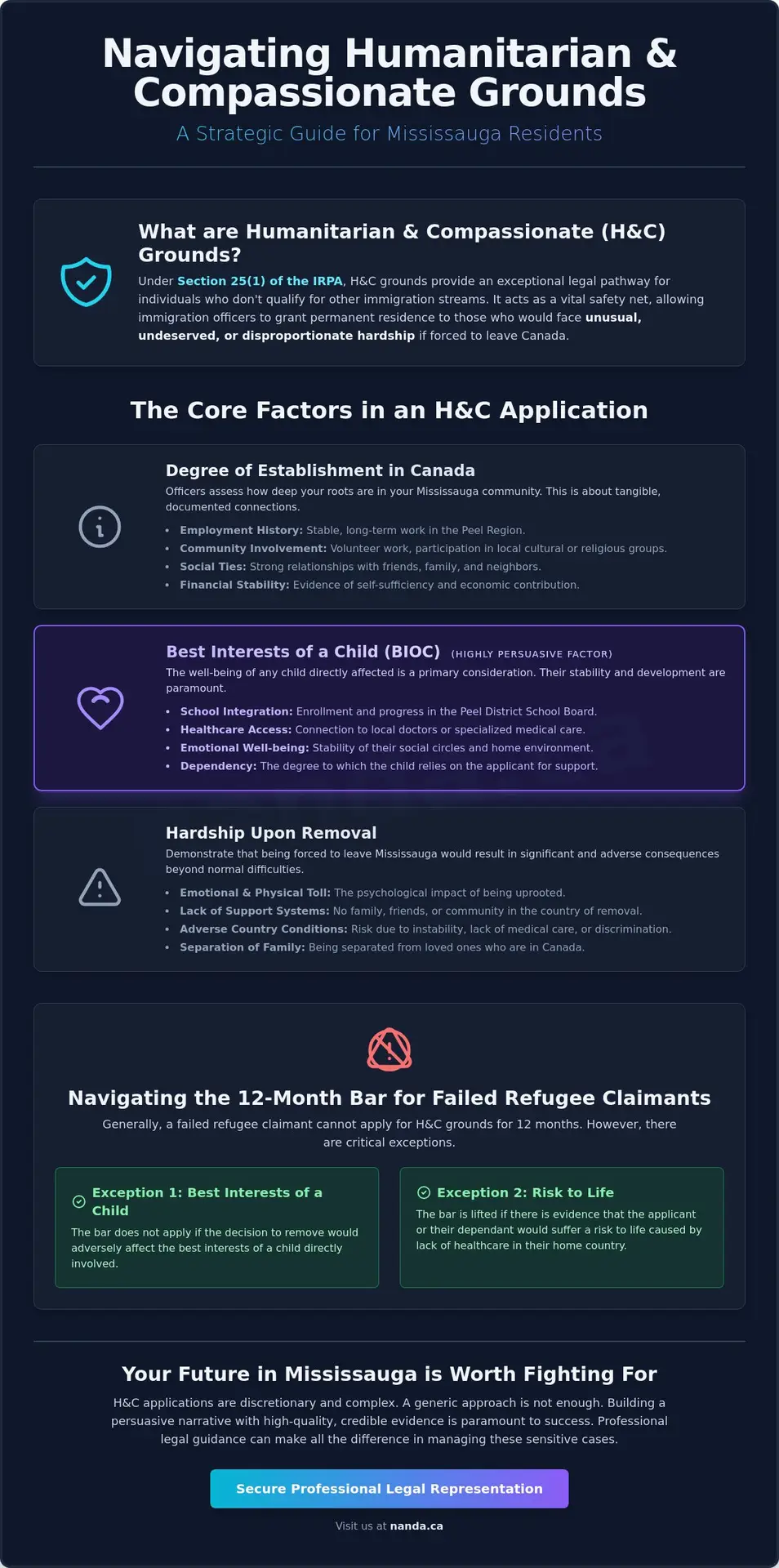
The Three Pillars of a Successful H&C Application
Success in an H&C application depends on how well you weave together three distinct legal arguments. IRCC officers don’t view these factors as separate checklists; they look for a cumulative effect that justifies an exemption from standard immigration requirements. If one pillar is weaker, the others must be exceptionally strong to compensate. Providing objective, third party evidence is the only way to move a case from a simple request to a compelling legal necessity. Our immigration lawyers in Mississauga focus on building a narrative supported by facts, dates, and local context to meet the high threshold set by the Immigration and Refugee Protection Act.
Establishment in the Mississauga Community
Proving your life is rooted here requires more than just residency. We look for deep integration that shows you’ve become an asset to the province. This includes steady employment in the Peel Region or active volunteering at local food banks and community centers. Officers value participation in cultural events at Mississauga Celebration Square or long term membership in local religious organizations. Documentation like Canadian bank statements, records of property ownership or leases, and reference letters from Mississauga based non-profits provide the objective proof needed to demonstrate that your removal would cause a significant loss to the local community. It’s about showing you’ve built a life that’s inseparable from the fabric of the city.
Hardship in the Country of Origin
The legal threshold for hardship is high. You must prove that returning to your home country would result in "unusual and undeserved" or "disproportionate" hardship. IRCC rarely grants status based solely on the cost of living or general lack of jobs in another country. Instead, we focus on contrasting the stable, safe environment you’ve built in Ontario with specific, documented risks back home. This might include a lack of necessary medical care available at facilities like Trillium Health Partners or systemic discrimination that doesn’t exist in Canada. According to the official guidelines for Humanitarian and Compassionate Grounds, the officer must consider your personal circumstances in relation to the conditions in your country of origin.
Best Interests of a Child (BIOC)
The well-being of any child affected by the decision remains a primary consideration for officers. This pillar often carries the most weight in a humanitarian and compassionate grounds application. We gather evidence from the Peel District School Board to show academic progress, social integration, and extracurricular involvement. Letters from local healthcare providers can document specialized medical or psychological care the child receives in Mississauga. The goal is to analyze the emotional and developmental impact of removal. If a child has spent their formative years in Canada, uprooting them from their Mississauga home and school environment is often viewed as a significant detriment to their future stability and mental health.
Navigating the 12-Month Bar and Other Restrictions
The 12-month bar is a significant hurdle for many seeking status in Ontario. If the Immigration and Refugee Board (IRB) rejects your refugee claim, you’re generally prohibited from applying for permanent residence through humanitarian and compassionate grounds for one full year. This cooling-off period starts the day your claim is finally rejected or abandoned. There are two critical exceptions to this rule. First, if you have a life-threatening medical condition that cannot be treated in your home country, the bar may be waived. Second, if the 12-month delay would adversely affect the best interests of a child under 18, you may be eligible to apply immediately.
You can’t pursue a refugee claim and an H&C application at the same time. This is a strict "one or the other" rule designed to prevent duplicate processing. If you have an active refugee claim, you must withdraw it before submitting an H&C application. This decision carries immense risk; withdrawing a claim usually means losing the right to a hearing. Our team helps you weigh these risks against the strengths of your H&C case to ensure your strategy is sound and protects your future in Canada.
Strategic Timing for Your Mississauga Application
Filing your application at the right moment is vital for residents in Mississauga. An H&C application doesn’t provide an automatic stay of removal. Even with a pending application, the Canada Border Services Agency (CBSA) can still enforce a deportation order. You might need to seek a deferral or a stay through the federal court if a removal date is set. For those dealing with complex rejections, consulting an immigration lawyer in Mississauga helps clarify whether a judicial review is a better path than a fresh H&C filing.
Medical Inadmissibility vs. H&C Grounds
Applying under humanitarian and compassionate grounds often serves as a bridge for individuals who are otherwise inadmissible due to health issues. We help clients gather evidence from Mississauga-based specialists, such as those at Trillium Health Partners, to prove their condition requires Canadian standards of care. If your home country lacks the infrastructure or medication to manage your illness, this creates a hardship factor that officers must consider. Providing specific documentation from local Ontario doctors often makes the difference in these high-stakes cases.
Building a Compelling Evidence Portfolio in Mississauga
A successful application for permanent residence based on humanitarian and compassionate grounds relies on the strength of your documentary evidence. It’s a common mistake to assume that submitting a large volume of papers will guarantee success. In our experience, IRCC officers value the credibility and relevance of documents over sheer quantity. We focus on building a narrative that proves your deep-rooted connection to the Mississauga community through verified facts. Your portfolio should be organized to mirror the IRCC decision-making template, specifically addressing establishment in Canada, the best interests of any children involved, and the hardship you’d face if returned to your home country.
Every piece of evidence must serve a purpose. We recommend a structured approach that begins with gathering third-party verification. Affidavits from Mississauga residents carry significant weight because they provide an external perspective on your character and contributions. These statements shouldn’t be generic; they need to include specific details about your interactions, the dates you met, and how you’ve integrated into the local fabric. Clear, logical organization helps the processing officer navigate your story without confusion.
Documenting Your Mississauga Integration
Proving your "establishment" means showing you’ve built a life here. We suggest collecting letters of support from neighbours in areas like Erin Mills or Port Credit who can vouch for your presence and positive influence. If you’ve been employed at a Mississauga-based business, a detailed letter from your employer outlining your roles and reliability is essential. We also prioritize records of local volunteer work, such as hours spent at the Mississauga Food Bank or community centres. Financial records, including utility bills and bank statements from Ontario-based institutions, demonstrate your active participation in the local economy.
Preparing for the Two-Stage Approval Process
The H&C process is unique because it happens in two distinct phases. Stage 1 is the Approval in Principle (AIP). Receiving AIP is a major milestone because it means the officer has accepted your humanitarian and compassionate grounds as valid. At this point, you may become eligible for a work permit or study permit while the rest of the application is finalized. Stage 2 involves the final granting of permanent residence, which only occurs after you pass mandatory medical, security, and background clearances. If your life changes during the waiting period, such as a new job or the birth of a child, you must update the IRCC immediately to keep your file accurate.
Building a persuasive case requires a meticulous eye for detail and a deep understanding of immigration law. If you’re ready to begin organizing your evidence, our team is here to provide the guidance you need. Contact an immigration lawyer in Mississauga to discuss your situation today.
Professional Legal Representation for H&C Matters
Applications based on humanitarian and compassionate grounds are widely regarded as the most intricate files in Canadian immigration. Unlike points-based systems that rely on objective criteria like age or education, these cases depend on the subjective discretion of an immigration officer. This means your narrative must be more than just a collection of personal facts. It needs to be a persuasive legal argument that clearly demonstrates why your removal would cause unusual, undeserved, or disproportionate hardship. We provide the authoritative legal voice required to bridge the gap between your personal experiences and the strict requirements of the Immigration and Refugee Protection Act.
Capturing the best interests of a child or the depth of your establishment in Ontario requires a sophisticated approach. A single oversight in your evidence or a weak explanation of your ties to the community can result in a permanent refusal. By engaging professional representation, you ensure that every aspect of your life is presented through a lens of legal relevance and strategic clarity. We focus on creating a comprehensive legal solution that addresses potential concerns before they become grounds for a denial.
The Nanda & Associate Approach to H&C
Our team brings extensive experience appearing before federal authorities to support Mississauga residents. We recognize that Mississauga is a vibrant, diverse hub where 53.2 percent of the population was born outside of Canada. To serve this unique community, our multilingual team ensures your story is captured with cultural nuance and linguistic accuracy. We offer peace of mind through a methodical process that includes:
-
Meticulous document review to ensure every claim is backed by verifiable evidence.
-
Strategic planning that highlights your specific contributions to the local workforce and community.
-
Dedicated support in drafting a narrative that resonates with decision-makers while maintaining legal gravity.
We don’t just fill out forms; we build a robust case designed to withstand the highest levels of scrutiny from the IRCC.
Conclusion: Securing Your Future in Mississauga
Applying for permanent residency through humanitarian and compassionate grounds remains a powerful, life-changing pathway for those who have built deep roots in Canada despite their lack of status. It’s a high-stakes process that requires a delicate balance of legal precision and human empathy. Seeking strategic advice before you submit your permanent record is the most effective way to protect your family’s future and your long-term stability.
At Nanda & Associate Lawyers, we’re committed to helping local families find a seamless path to legal status. If you’re ready to discuss your options with a dedicated immigration lawyer in Mississauga, we invite you to take the first step toward security. Our firm is large enough to offer multidisciplinary expertise but personal enough to treat your case with the individual care it deserves. Contact us today to schedule a personalized consultation at https://nanda.ca/book-consultation/.
Securing Your Future in Mississauga Through IRPA Section 25(1)
Applying for permanent residency based on legal exceptions requires a meticulous strategy that balances technical requirements with human stories. Success hinges on proving significant establishment in Canada, the best interests of any children involved, and the adverse consequences of returning to your home country. Since the 12-month bar and specific IRPA Section 25(1) regulations can complicate your timeline, navigating these hurdles with precision is vital for a positive outcome. Our firm focuses on building a robust evidence portfolio that reflects your unique contributions to the local community while providing the calm confidence you need during this transition.
Nanda & Associate Lawyers has served the Mississauga community since 2003, providing sophisticated representation for complex immigration matters. Our team offers multilingual support in over 15 languages, ensuring you feel heard and understood throughout the entire process. We provide comprehensive legal solutions tailored to your specific circumstances, drawing on decades of experience with IRPA Section 25(1) litigation. If you are considering an application based on humanitarian and compassionate grounds, book a consultation with our Mississauga immigration lawyers today.
You don’t have to face the complexities of the Canadian immigration system alone; we’re here to help you find stability and peace of mind.
Frequently Asked Questions
Can I apply for H&C while my refugee claim is still active?
You cannot have an active refugee claim and an application for humanitarian and compassionate grounds processed at the same time. Under the Immigration and Refugee Protection Act, you must withdraw your refugee claim before the Immigration and Refugee Board starts hearing your case if you wish to pursue an H&C application. This is a critical strategic decision that requires a thorough review of your specific circumstances in Mississauga to ensure you choose the most viable path for your status.
Does a pending H&C application stop my deportation from Mississauga?
Filing an H&C application doesn’t result in an automatic stay of removal from Canada. The Canada Border Services Agency can still proceed with a deportation order even while your application is in the queue. You may need to seek a judicial stay of removal through the Federal Court if you’re facing an imminent removal date. Our team focuses on providing comprehensive legal solutions to address these urgent enforcement actions and protect your right to remain with your family.
What is the 12-month bar for H&C applications in Ontario?
You’re prohibited from applying for H&C for 12 months following a final negative decision from the Refugee Protection Division or the Refugee Appeal Division. This rule was established to maintain the integrity of the asylum system. Exceptions exist under Section 25 of the IRPA if you have children under 18 whose best interests would be adversely affected or if you have a life-threatening medical condition that can’t be treated in your home country. We help clients determine if they qualify for these specific exemptions.
Can I include my family members in my Mississauga H&C application?
You can include your spouse, common-law partner, and dependent children in your application if they’re currently residing with you in Canada. Each family member must meet the general eligibility requirements, and your submission should detail how the H&C factors apply to the family unit as a whole. We emphasize the importance of the best interests of the child when children are involved, as this is a primary consideration for IRCC officers during the decision-making process.
How long does it take for IRCC to process an H&C application in 2026?
As of early 2026, IRCC processing times for humanitarian and compassionate grounds applications typically range from 18 to 24 months. The process is divided into two distinct stages. Stage one involves the initial assessment of your H&C factors, which currently takes about 14 months to complete. Stage two involves medical, security, and background checks. These timelines vary based on the complexity of your evidence and the volume of applications at the processing centre in Ontario.
What happens if my H&C application is refused?
You have the right to ask the Federal Court of Canada to review the decision if your application is refused. You must file an application for leave and judicial review within 15 days of receiving the refusal notice if you’re in Canada. This isn’t an appeal on the facts but a legal argument that the officer’s decision was unreasonable or procedurally unfair. We provide the dedicated representation needed to navigate these complex litigation processes and seek a fair outcome for your case.
Can I work in Mississauga while waiting for my H&C decision?
You aren’t eligible for an H&C-based work permit until you receive approval in principle, which occurs after you pass the first stage of processing. If you already hold a valid work permit through another program, you may be able to continue working under maintained status. Once you pass the first stage, you can apply for an open work permit. This provides the stability and peace of mind needed while waiting for your final permanent residency to be granted.
Disclaimer
This content is for general information only and does not constitute legal advice or create a lawyer-client relationship. Every case is different—please consult a qualified lawyer for advice specific to your situation.