




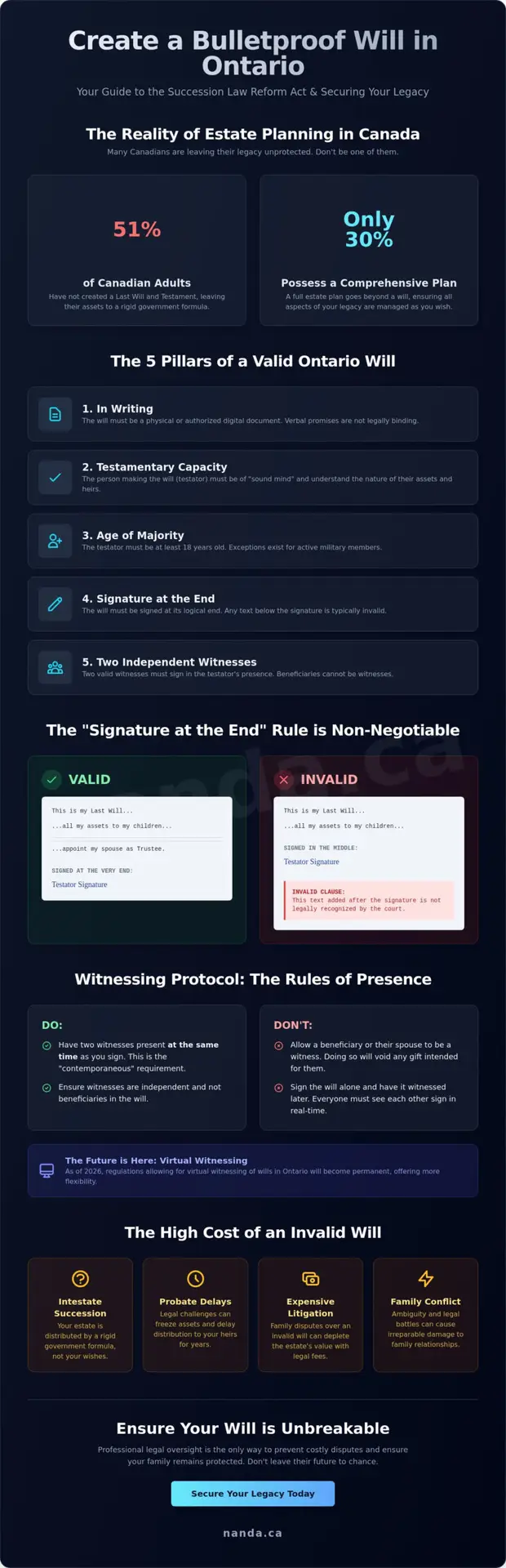
Did you know that 51% of Canadian adults still haven’t created a last will and testament? Even more concerning, a 2023 report indicates that only 30% of Canadians possess a comprehensive estate plan. Understanding the legal requirements for a valid will in ontario is the only way to ensure your legacy doesn’t become a source of conflict for your loved ones. We understand that thinking about these matters feels heavy. It’s natural to feel overwhelmed by the complexities of the Succession Law Reform Act or worry that a simple “DIY” kit might fail your family when they need it most.
This guide provides the clarity you need to draft a document that stands up in court and protects your heirs. We’ll walk you through the essential signing protocols, the permanent role of virtual witnessing in 2026, and how recent legislative changes affect your estate in Mississauga. By the end of this article, you’ll have a clear roadmap to secure your family’s future and gain the peace of mind that comes with a professional legal strategy.
Key Takeaways
- Learn the strict “Signature at the End” rule under the Succession Law Reform Act to ensure your document is legally recognized and enforceable.
- Understand the specific legal requirements for a valid will in ontario, including the permanent 2026 regulations regarding virtual witnessing and independent witnesses.
- Differentiate between formal typed documents and holograph wills to determine which format provides the highest level of protection for your estate.
- Discover how to select a capable Estate Trustee in Mississauga who can effectively manage the probate process and follow your roadmap.
- Recognize the importance of professional legal oversight in preventing future litigation and ensuring your family remains protected from complex disputes.
Key Takeaways and the Importance of a Valid Will in Mississauga
Establishing the foundation for a secure legacy starts with understanding the strict legal requirements for a valid will in ontario. These rules aren’t merely suggestions; they’re the boundary between a protected family and a lengthy legal battle in the Superior Court of Justice. To ensure your estate plan is resilient, we’ve outlined the core pillars of a valid document below:
- Written Format: The document must be a physical or authorized digital record.
- Testamentary Capacity: The testator must be of sound mind and understand the nature of their assets.
- Age Requirement: You must be at least 18 years old, with specific exceptions for military personnel.
- Signature Protocol: The document must be signed at the logical end by the testator.
- Witnessing: Two valid, independent witnesses must be present at the same time as the testator.
For residents in Mississauga, the stakes of estate planning in 2026 have never been higher. With the rising complexity of local assets and the nuances of the Ontario legal system, dying “intestate” (without a will) leaves your property in the hands of a rigid government formula. This often results in your estate being distributed in ways you didn’t intend, potentially leaving certain family members without the support they need. Nanda & Associate Lawyers Professional Corporation takes an authoritative stance on protective estate planning, ensuring that your Last Will and Testament serves as an unbreakable shield for your heirs.
Why Your Will Must Be Legally Compliant
When a document fails to meet the legal requirements for a valid will in ontario, the fallout is often immediate and expensive. The Ontario Superior Court of Justice strictly scrutinizes non-compliant documents; even a small error in witnessing can lead to the entire will being set aside. This creates a vacuum that invites family disputes and significant probate delays. Working with a wills and estate lawyer in Mississauga ensures that every technicality is addressed, providing you with the confidence that your document will withstand future legal challenges.
Understanding the Succession Law Reform Act (SLRA)
The Succession Law Reform Act is the primary legislation that dictates how wills must be structured and executed in our province. It defines “testamentary capacity” as your ability to understand the value of your assets and the claims of those you’re leaving behind. While the standard age for creating a will is 18, the SLRA provides specific exceptions for members of the Canadian Armed Forces on active service. We help you navigate these legislative waters to ensure your document is not just a piece of paper, but a legally binding roadmap for your future.
Essential Legal Requirements Under the Succession Law Reform Act
The Succession Law Reform Act serves as the definitive rulebook for estate planning in our province. To meet the legal requirements for a valid will in ontario, the document must first be in writing. While digital options have expanded, most residents still rely on physical documents to ensure absolute clarity. A critical, often misunderstood rule is the “Signature at the End.” Ontario law mandates that you sign your will at the very bottom of the document. Any text appearing after your signature is generally considered invalid, as the court assumes it was added without your authorization or after the fact.
Equally important is the “contemporaneous” requirement. This means you and your two witnesses must be present together at the exact moment of signing. You cannot sign the document in private and ask neighbors to “witness” it later that evening. Everyone must see each other sign the document in real time. This strict protocol exists to prevent fraud and ensure the document truly represents your final wishes. For a deeper look at these technical standards, you can refer to the Government of Ontario’s Guide to Wills.
The Role of Witnesses in Ontario
Choosing your witnesses requires careful thought. You should never allow a beneficiary or their spouse to witness your will; doing so typically voids any gift intended for them. To streamline the probate process later, we always recommend preparing an “Affidavit of Execution.” This is a sworn statement by one of the witnesses, signed before a notary public or lawyer, confirming they saw you sign the will and that you appeared to be of sound mind. Under Ontario law, a valid witness is a person at least 18 years of age who possesses the mental capacity to testify in court and does not stand to benefit from the will.
Testamentary Intent and Capacity
A will is only valid if you have the “testamentary capacity” to create it. This means you must understand the nature of the document, the extent of your assets, and who your potential heirs are. In Mississauga, we often work with families to protect vulnerable seniors from “undue influence,” ensuring their decisions are truly their own and not the result of coercion. It’s also vital to note the 2026 legal landscape regarding life changes. Since January 1, 2022, marriage no longer automatically revokes an existing will. Conversely, if you are legally separated but not yet divorced, your spouse may have already lost their automatic right to inherit under the latest legislative updates. Ensuring your document reflects these modern shifts is essential for a seamless transition of your legacy.
Formal vs. Holograph Wills: Choosing the Right Format
In Ontario, the format you choose dictates how smoothly your estate passes through probate. A “Formal Will” is a typed document that you sign in front of two witnesses, while a “Holograph Will” is entirely handwritten and signed by you alone. While both can technically meet the legal requirements for a valid will in ontario, they offer very different levels of security. A formal document is designed for “probate-readiness,” meaning it includes the necessary structure to be accepted by the court without extra evidentiary hurdles.
Beware of generic online templates and store-bought “Will Kits.” While they promise simplicity, they often miss the specific nuances of the Succession Law Reform Act, such as the 2022 updates regarding separated spouses. A kit designed for a general audience might not provide the protection you need in Mississauga. For foundational advice, resources like Making a Will in Ontario are useful, but they can’t replace the strategic depth of a tailored plan.
The Risks of Holograph Wills
Handwritten documents are a magnet for estate litigation. Since there are no witnesses to verify your intent, these documents are frequently challenged by disappointed relatives. Proving that the handwriting is truly yours can be a difficult and expensive process for your executor in 2026. These complications often lead to disputes that require the intervention of wills and estate lawyers in Mississauga to resolve, often at a cost that far exceeds the initial investment in a formal document.
Benefits of a Lawyer-Prepared Formal Will
A formal document prepared by Nanda & Associate Lawyers Professional Corporation allows for customized clauses that a handwritten note simply can’t accommodate. We focus on eliminating “latent ambiguities,” which are vague terms that could have multiple meanings and cause confusion for your executor. Beyond the drafting, we provide professional registry and safekeeping. This ensures your document meets every one of the legal requirements for a valid will in ontario and is easily accessible when your family needs it most.
The Step-by-Step Process of Executing a Valid Will
Creating a document that survives the scrutiny of the Ontario Superior Court of Justice requires a methodical approach. Unlike generic guides that offer vague advice, we provide a clear chronological timeline to help you move from uncertainty to a completed estate plan. Following these steps ensures you meet the legal requirements for a valid will in ontario while minimizing the risk of future litigation. This process typically unfolds over several weeks as we refine your strategy and document your wishes.
- Step 1: Inventory of Assets: Begin by listing all assets, including real estate in Mississauga, bank accounts, investments, and digital assets like cryptocurrency. You must also clearly identify your beneficiaries and any specific gifts.
- Step 2: Selection of Executor: Choose an Estate Trustee who is capable of handling the administrative and legal burdens of your estate.
- Step 3: Precise Drafting: Translate your wishes into precise legal language that leaves no room for interpretation or “latent ambiguities.”
- Step 4: The Formal Signing Ceremony: Execute the document following the strict protocols mandated by the Succession Law Reform Act.
- Step 5: Secure Storage and Notification: Place the original document in a safe location and ensure your Executor knows exactly where to find it.
If you’re ready to begin this process, the team at Nanda & Associate Lawyers Professional Corporation is here to guide you through every step with professional care.
Choosing Your Estate Trustee
The role of an Estate Trustee is a demanding one that involves filing tax returns, communicating with beneficiaries, and distributing assets. It’s a significant commitment, which is why we strongly advise naming at least one alternate executor in case your primary choice is unable or unwilling to serve. An Estate Trustee is personally liable for any financial losses caused by their failure to properly manage the estate or pay creditors according to Ontario law. Selecting a person who is organized and detail-oriented is just as vital as choosing someone you trust.
The Signing Ceremony Protocol
The signing ceremony is the most critical moment in establishing a document that meets the legal requirements for a valid will in ontario. You and both of your witnesses must be physically present in the same room throughout the entire process. The testator signs first, followed immediately by both witnesses, ensuring that no one leaves the room until all three signatures are on the page. Nanda & Associate Lawyers Professional Corporation facilitates this process in our Mississauga office to ensure every signature is placed correctly and every witness is valid. This professional oversight provides the “Affidavit of Execution” necessary to streamline the probate process later, saving your family months of administrative delays.
Why Professional Legal Oversight Matters for Mississauga Residents
Navigating the probate process in Mississauga can be a daunting experience for grieving families. While meeting the legal requirements for a valid will in ontario ensures the document is technically sound, professional oversight provides a much deeper level of protection. We focus on building comprehensive legal solutions that stop estate litigation before it begins. By addressing potential ambiguities now, you save your heirs from the emotional and financial toll of a contested document in the local courts. A wills and estate lawyer in Mississauga doesn’t just fill out forms; they build a strategic defense for your legacy.
Our firm understands that Mississauga is a vibrant, multicultural city with residents who often maintain assets across international borders. We provide a bridge for our diverse community by offering multilingual legal support, ensuring every client feels heard and understood. This cultural awareness, combined with our strategic approach to the Succession Law Reform Act, allows us to create tailored plans that protect your global and local interests with equal precision. Meeting the legal requirements for a valid will in ontario is just the starting point for a truly resilient estate plan.
Asset Protection and Business Succession
For local entrepreneurs, an estate plan is inseparable from their corporate strategy. We frequently collaborate with our business lawyers in Mississauga to ensure a seamless transition of company shares and management. One highly effective strategy we employ is the use of “dual wills.” By separating assets that require probate from those that don’t, such as private company shares, we can significantly reduce the Estate Administration Tax. This tax currently sits at 1.5% for estate values exceeding $50,000, and proactive planning keeps more of your hard-earned wealth within your family. We also provide specialized advice for residents with international assets, ensuring your foreign holdings don’t complicate the local probate process.
Conclusion: Securing Your Legacy
A valid will is the greatest gift of clarity you can leave for your loved ones. It replaces confusion with a definitive roadmap and provides your Estate Trustee with the authority they need to act quickly. Whether you’re updating an old document or drafting your first plan, a professional review is essential to ensure your wishes align with the 2026 legal landscape. At Nanda & Associate Lawyers, we’re dedicated to providing the sophisticated, compassionate guidance you need to secure your legacy. Don’t leave your family’s future to chance; take the decisive step toward total peace of mind today.
If you’re ready to protect your heirs and ensure your final wishes are enforceable, we invite you to book a consultation with our dedicated team.
Secure Your Legacy with Strategic Estate Planning
Adhering to the legal requirements for a valid will in ontario is the only way to ensure your final wishes aren’t left to the interpretation of the court. We’ve discussed how the Succession Law Reform Act sets a high bar for document execution, from the “Signature at the End” rule to the permanent 2026 virtual witnessing standards. A properly prepared formal will doesn’t just distribute assets; it provides a strategic roadmap that prevents family disputes and minimizes the Estate Administration Tax burden on your heirs.
Nanda & Associate Lawyers has served the Mississauga community since 2003, providing comprehensive legal solutions for even the most complex international estates. Our diverse team speaks over 15 languages, allowing us to offer personalized guidance that respects the unique cultural and financial needs of our clients. We’re here to provide the sophisticated mentorship and empathetic support you need to protect your family’s future.
Don’t leave your legacy to chance. Book a consultation with our experienced Mississauga estate lawyers today. It’s a simple step that provides lasting security and peace of mind for the people who matter most.
Frequently Asked Questions
What happens if I die in Ontario without a valid will?
If you die without a valid document, your estate is considered “intestate” and is distributed according to a rigid formula in the Succession Law Reform Act. This means the government, not you, decides how your assets are divided among your spouse and children. This process often leads to administrative delays and may not reflect your personal wishes for your family’s future.
Can I use a digital signature for my will in Ontario?
You can use electronic signatures and virtual witnessing in Ontario, provided you follow the permanent regulations established on January 1, 2022. For a digital execution to meet the legal requirements for a valid will in ontario, at least one witness must be a licensed lawyer or paralegal. This ensures the process is secure and that the testator’s identity and capacity are properly verified.
Who can be a witness to a will in Mississauga?
Any person who is at least 18 years old and has the mental capacity to testify can serve as a witness in Mississauga. It’s critical that neither witness is a beneficiary or the spouse of a beneficiary. If a beneficiary witnesses the document, any gift intended for them is typically voided by the court to prevent conflicts of interest.
Is a handwritten (holograph) will actually legal?
A holograph will is legally recognized in Ontario if it’s written entirely in your own handwriting and signed by you at the bottom. These documents don’t require witnesses to be valid. However, they are frequently contested in court because they often lack the precise legal terminology needed to handle complex assets or prevent “latent ambiguities” that confuse executors.
How often should I update my will in Ontario?
We recommend reviewing your estate plan every 3 to 5 years or immediately after a major life transition. Significant events, such as a marriage occurring after January 1, 2022, or a legal separation, can impact your document’s validity. Regular updates ensure your plan remains compliant with the latest legal requirements for a valid will in ontario and reflects your current family structure.
Does a will have to be notarized to be valid in Ontario?
A will itself doesn’t need to be notarized to be valid, but the “Affidavit of Execution” attached to it must be sworn before a notary or commissioner. This affidavit is a vital piece of evidence for the probate process. It proves to the Ontario Superior Court of Justice that the witnesses were present and saw you sign the document willingly.
Can my spouse and I have a joint will?
While joint wills are possible, most couples in Mississauga choose “Mirror Wills,” which are two separate documents with identical provisions. Mirror wills are generally preferred because they’re easier to update if one spouse’s circumstances change. They provide the same outcomes as a joint will but offer significantly more flexibility and clarity for the surviving spouse and the executor.
What is the difference between a will and a power of attorney?
A will only takes effect after you pass away and outlines how your assets are distributed to your heirs. In contrast, a Power of Attorney is a legal document used while you’re still alive but unable to make decisions. It allows a trusted person to manage your financial affairs or healthcare if you become incapacitated due to illness or injury.
Disclaimer
This content is for general information only and does not constitute legal advice or create a lawyer-client relationship. Every case is different—please consult a qualified lawyer for advice specific to your situation.