




Key Takeaways
-
Identify the primary legal grounds for Will challenges under the Succession Law Reform Act to ensure your estate plan remains robust and enforceable in Ontario courts.
-
Discover proactive strategies for avoiding estate litigation by implementing clear documentation and fostering transparent communication among your beneficiaries.
-
Learn how to strategically utilize "No-Contest" clauses and other friction-reducing tools to maintain family harmony and safeguard your final wishes.
-
Establish a methodical review process for your estate documents every three to five years to account for major life events and evolving provincial regulations.
-
Understand the critical risks associated with DIY Will kits and the long-term security provided by a tailored legal strategy designed by experienced Mississauga wills and estate lawyer.
Table of Contents
-
Avoiding Estate Litigation in Mississauga: Key Takeaways and Context
-
Legal Grounds for Estate Disputes under the Succession Law Reform Act
-
Practical Strategies for Preventing Will Challenges and Family Conflict
-
Securing Your Legacy with Professional Legal Counsel in Mississauga
Imagine a Mississauga family gathering in 2026, not to celebrate a legacy, but to face a multi-year legal battle that can drain tens of thousands of dollars in court fees before a single asset is distributed. It’s a heartbreaking reality for many that often stems from minor clerical errors or vague wording in a will. We understand that you’ve worked hard to build your life here in Ontario, and the thought of your family’s relationships being destroyed by financial disputes is likely your greatest concern. You deserve to know that avoiding estate litigation is entirely possible with the right proactive strategy.
Our wills and estate lawyers agree that the complexities of provincial laws can feel overwhelming, especially when you’re trying to protect your loved ones from the high costs and emotional toll of the courtroom. This guide provides you with a clear roadmap to safeguard your final wishes and ensure your assets reach your intended beneficiaries without delay. We’ll preview the essential legal requirements and proven planning techniques that provide the security your family needs during a difficult transition. By the end of this article, you’ll have a professional perspective on how to maintain control over your estate and provide your heirs with lasting peace of mind.
Avoiding Estate Litigation in Mississauga: Key Takeaways and Context
-
Update Plans by 2026: Shifting real estate valuations in the Greater Toronto Area make 2026 a vital year for re-evaluating asset distribution to ensure fairness.
-
Minimize Financial Erosion: Legal disputes can consume a significant portion of an estate’s total value, often leaving beneficiaries with far less than the deceased intended.
-
Prioritize Mediation: Alternative dispute resolution can resolve conflicts faster and more privately than the Ontario Superior Court of Justice.
-
Address Diverse Needs: Mississauga’s unique demographic makeup, including blended families and multi-generational households, requires specialized "litigation-proof" planning.
Estate litigation in Mississauga refers to formal legal challenges regarding the validity of a Will or the actions of an estate trustee. In our local legal landscape, these disputes frequently involve high-value residential properties and business interests. Avoiding estate litigation isn’t just about following the law; it’s about preserving a family legacy. When a dispute enters the court system, it becomes a public matter, often causing irreparable damage to family bonds and depleting the very assets intended for the next generation.
As we approach 2026, proactive planning has never been more urgent. Mississauga has seen dramatic fluctuations in property values over the last decade. A Will drafted in 2016 may no longer reflect the current financial reality or the testator’s true intentions. If your plan doesn’t account for these shifts, you leave the door open for claims based on Legal Grounds for Estate Disputes, such as allegations that the distribution is inequitable or doesn’t provide for dependants as required by Ontario law.
The High Cost of Conflict in Mississauga Estates
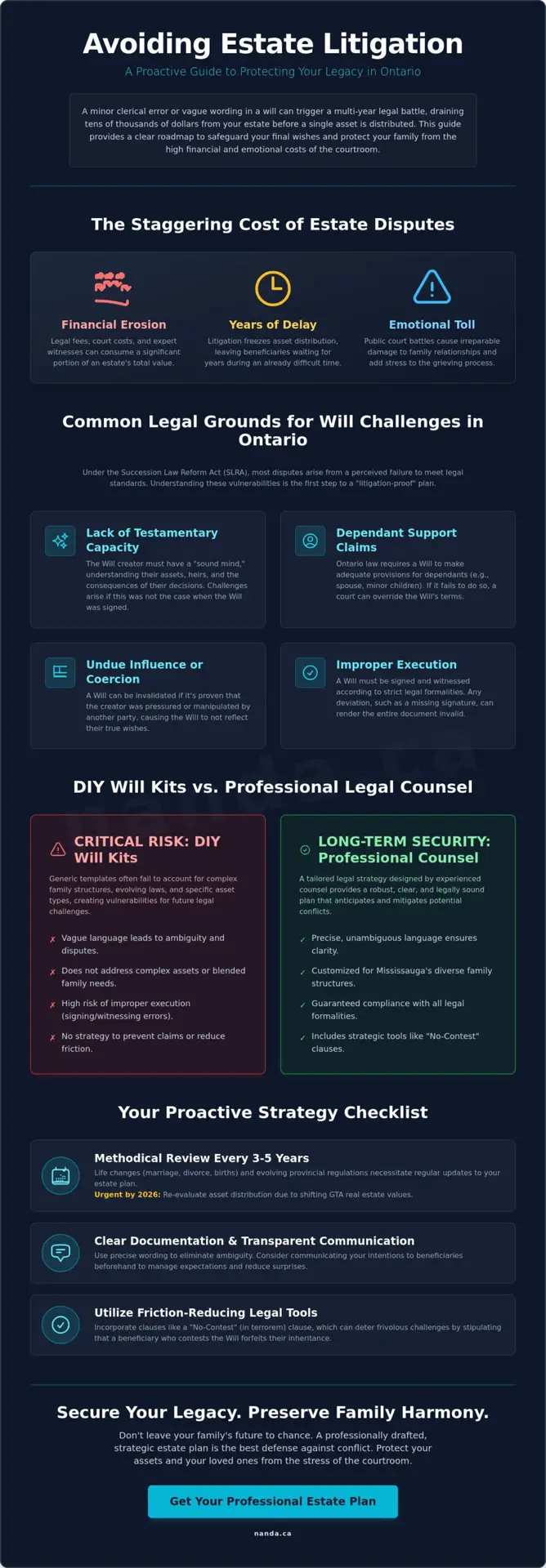
The financial impact of a legal battle is often staggering. Court fees, expert witness costs, and legal representation can quickly drain hundreds of thousands of dollars from the estate. Beyond the money, the emotional cost of a prolonged public trial is a heavy burden for grieving families. Mediation serves as a vital tool here, allowing parties to reach a settlement in a controlled, private environment. If your family is already facing a disagreement, our civil litigation lawyers can provide the strategic guidance needed to resolve the matter before it consumes the entire inheritance.
Why Proactive Planning is the Best Defense
A "litigation-proof" estate plan goes far beyond a basic template found online. It involves a strategic assessment of potential friction points. Mississauga is home to a beautifully diverse population with complex family structures. Whether you’re managing assets across different jurisdictions or navigating the needs of a blended family, a standard Will often isn’t enough. We focus on drafting documents that are clear, legally robust, and reflective of your specific family dynamics. This precision ensures your final wishes are respected and your loved ones are protected from the stress of a courtroom.
Legal Grounds for Estate Disputes under the Succession Law Reform Act
Understanding the legal framework is the first step toward avoiding estate litigation. In Ontario, the Succession Law Reform Act (SLRA) dictates how assets are distributed and what makes a Will valid. Most disputes don’t happen because of simple greed; they arise when there’s a perceived failure to follow these legal standards. When a family member feels the distribution is unfair or legally flawed, they turn to the courts for a resolution. This process is often emotionally draining and can deplete the estate’s value through legal fees.
Testamentary capacity is a frequent point of contention in Mississauga courtrooms. In simple terms, this means the person writing the Will must have a "sound mind." They need to understand the nature of their assets, who their logical heirs are, and the consequences of their decisions. If a Will is signed while someone is suffering from advanced cognitive decline or a medical condition that impairs judgment, it becomes a prime target for a legal challenge. Similarly, undue influence often tears families apart, particularly among siblings. This occurs when a person in a position of power, often a caregiver or one specific child, pressures the testator into changing their Will. If the document doesn’t reflect the testator’s true wishes but rather the desires of the person exerting pressure, it’s legally vulnerable.
Challenges Based on Formalities and Execution
Ontario law is strict about how a Will is executed. For a Will to be formal and valid, it must be signed by the testator in the presence of two witnesses who are also present at the same time. These witnesses cannot be beneficiaries or the spouses of beneficiaries. If these steps are missed, the document may be declared invalid under the Estates Act. While "holograph Wills," which are entirely handwritten and signed by the testator, are recognized in Ontario, they’re much easier to challenge. They often lack clear language or the professional verification that comes with a lawyer’s involvement. Working with wills and estate lawyers in Mississauga helps ensure these technical traps don’t lead to future conflict.
Dependants Relief Claims in Ontario
The SLRA imposes a legal obligation on individuals to provide for those who rely on them financially. In Mississauga, a dependant can be a spouse, a child, a parent, or even a sibling, provided the deceased was supporting them or had a legal obligation to do so before death. If a Will fails to make "adequate provision" for these individuals, the court can intervene to redistribute the estate. Failure to provide for dependants is a top cause of litigation in the province. It’s not enough to simply state your wishes; you must also meet your legal responsibilities to ensure your estate remains protected from claims. Our team can help you review your current plans to ensure they meet these statutory requirements. Book a consultation to discuss your specific situation and start avoiding estate litigation before it begins.
Practical Strategies for Preventing Will Challenges and Family Conflict
Conflict often stems from dashed expectations. When heirs feel blindsided by the contents of a will, they’re more likely to seek legal recourse. Transparency is your most effective tool for avoiding estate litigation. We recommend holding a family meeting to discuss the general distribution of assets. You don’t need to disclose exact dollar amounts; explaining the "why" behind your decisions reduces resentment and clarifies your intent. For smaller personal items with high emotional value, a "Memorandum of Wishes" provides a clear guide for your executor. While it’s not legally binding in the same way as a will, it offers a roadmap that helps prevent siblings from arguing over family heirlooms.
You might consider including a "No-Contest" clause, which seeks to disinherit anyone who challenges the will. In Ontario, these clauses have specific limitations. Courts often find them unenforceable if a beneficiary has a legitimate reason to challenge the will’s validity or if the clause is worded too broadly. Relying on Proactive Estate Planning strategies like professional drafting and capacity assessments is a safer bet than relying on deterrent clauses alone. Clear documentation of your mental state at the time of signing can stop a lawsuit before it starts.
Choosing a Trustworthy and Capable Executor
Selecting the right estate trustee is a pivotal decision for any Mississauga resident. A good executor is detail-oriented, stays calm under pressure, and understands their fiduciary duties. We often see families struggle when parents appoint all three children as co-executors just to be "fair." If those siblings have a history of friction, this setup invites deadlock and legal delays. In cases involving high-value business assets or complex family dynamics, appointing a professional executor, such as a trust company, provides a layer of professional oversight that minimizes personal bias and ensures the estate is managed with clinical precision.
Lifetime Gifting vs. Testamentary Bequests
Reducing the total value of your estate through lifetime gifting can simplify the probate process. By transferring assets while you’re still alive, you effectively remove them from the "probatable" estate and the reach of potential challengers. However, you must be cautious with "Joint Tenancy" arrangements. Many people add a child to a bank account or property title to avoid probate taxes, but this frequently triggers litigation. The law often presumes the child is holding that asset in trust for the estate rather than receiving it as a gift. For a secure approach, consult with wills and estate lawyers in Mississauga to ensure your intentions are documented clearly. This clarity is essential for avoiding estate litigation over whether a transfer was a true gift or a resulting trust.
The Process of Proactive Estate Planning and Documentation
Creating a robust legal framework is the most effective method for avoiding estate litigation. We suggest a methodical approach that leaves little room for ambiguity or family disputes. This process begins with a clear-eyed assessment of your current assets and your long-term goals for your beneficiaries. It’s not a one-time event but a continuous strategy that evolves with your life stages.
Life doesn’t stand still. An estate plan drafted in 2021 might be obsolete by 2026. We recommend a full review every three to five years. Major milestones like a divorce, the birth of a grandchild, or a significant change in Ontario tax laws require immediate updates. If you’re making "unequal" distributions, such as leaving a larger share to one child because they served as a primary caregiver, you must document that reason clearly. We often advise clients to include a contemporaneous memorandum. This private document explains the rationale behind your decisions. It serves as vital evidence if a disgruntled heir claims you were under "undue influence" or lacked the mental clarity to make choices.
To pre-empt claims of mental incapacity, obtaining a professional medical assessment is a strategic move. A physician’s report dated the same day as the Will signing provides a powerful defense against future challenges. This is especially relevant if the testator is of advanced age or has a history of health issues. By being proactive, you’re not just signing a document; you’re building a fortress around your final wishes.
Gathering Essential Documentation
You need a centralized "Master File" to help your executor manage your affairs efficiently. This file should contain a comprehensive list of bank accounts, investment portfolios, real estate deeds, and debt records. Don’t forget to include digital asset logins and previous versions of your Will for context. Keep the original Will in a secure, fireproof location in Mississauga, such as a law firm’s vault or a bank safety deposit box. An executor shouldn’t have to hunt for paperwork during a time of grief.
The Role of Powers of Attorney in Estate Protection
While a Will dictates what happens after death, a Power of Attorney manages your affairs while you’re still alive but unable to act. A Will only takes effect upon death, whereas a Power of Attorney is a legal document that grants someone the authority to act on your behalf during your lifetime. This document is a critical tool for avoiding estate litigation and preventing financial abuse. By appointing a trustworthy person to manage property and healthcare, you reduce the risk of predatory behavior by third parties. It’s a proactive shield for your legacy and your personal well-being.
If you’re ready to secure your family’s future and ensure your wishes are respected, our wills and estate lawyers in Mississauga can help you build a comprehensive plan.
Contact Nanda & Associate Lawyers today to begin your proactive planning process. You can schedule a consultation to speak with our dedicated team.
Securing Your Legacy with Professional Legal Counsel in Mississauga
Using a generic DIY Will kit often creates a false sense of security for many families. These templates frequently fail to account for the specific nuances of the Succession Law Reform Act or the Substitute Decisions Act. Ambiguous language in a pre-packaged form can lead to years of courtroom battles. It’s much cheaper to pay for professional drafting now than to have your heirs spend tens of thousands of dollars in legal fees later. Professional oversight remains the most effective method for avoiding estate litigation.
Mississauga is a diverse hub where many families manage international assets or complex business structures. A standard form cannot address the tax implications of a family corporation or the specific requirements of a multi-jurisdictional estate. Our team understands that cultural nuances and family dynamics require a delicate, personalized touch. We provide services in multiple languages to ensure every family member fully understands the estate plan. This clarity prevents the misunderstandings that often trigger disputes after a passing.
-
Professional drafting eliminates common errors in witnessing and execution that invalidate Wills.
-
Customized trusts can protect beneficiaries with special needs or those who may not be financially responsible.
-
Clear language regarding the distribution of personal effects prevents minor family disagreements from escalating.
-
Regular updates to your estate plan ensure it reflects changes in Ontario law, such as the 2021 amendments regarding substantial compliance.
The Nanda & Associate Lawyers Approach
We provide comprehensive legal solutions that protect your assets and your legacy. Our team has extensive experience appearing before the Ontario Superior Court of Justice; this gives us a unique perspective on how to draft documents that withstand judicial scrutiny. We don’t just fill out forms. We build strategic frameworks for your future. If you want to ensure your wishes are followed, you should speak with our wills and estate lawyers in Mississauga for a detailed consultation.
Conclusion: Taking the First Step Toward Peace of Mind
Proactive preparation remains the only reliable way of avoiding estate litigation. Leaving your legacy to chance or a generic template invites conflict. By choosing professional guidance, you’re investing in your family’s long-term harmony. We’re here to provide the sophisticated mentorship you need to secure your estate with confidence. To begin protecting your family’s future, visit our website to book a consultation with our dedicated legal team today.
Take Control of Your Legacy Today
Effective estate planning isn’t just about distributing assets; it’s about preserving relationships and ensuring your final wishes stand up to legal scrutiny in 2026 and beyond. By aligning your strategy with the Succession Law Reform Act and maintaining transparent communication with your heirs, you’re taking the most important step toward avoiding estate litigation. Our team has seen how proactive documentation and clear legal frameworks prevent the emotional and financial drain of a court battle. We focus on creating comprehensive solutions that address potential family conflicts before they ever arise.
Since 2003, Nanda & Associate Lawyers has helped Mississauga families navigate these complex transitions with calm confidence. Our multilingual legal team speaks over 15 languages, ensuring that your legacy is understood and protected across cultural and legal boundaries. We combine deep expertise in Ontario civil litigation with a compassionate approach to estate law to provide the security you deserve. You don’t have to leave your family’s harmony to chance when professional guidance is available. Book a consultation with our experienced Mississauga estate lawyers today to protect your legacy.
Your peace of mind is our priority, and we’re ready to help you secure a stable future for your loved ones.
Frequently Asked Questions
Can a Will be challenged if it was signed in Mississauga but the assets are elsewhere?
Yes, a Will signed in Mississauga can be challenged in Ontario courts regardless of where the assets are located, provided the deceased was habitually resident in Ontario at the time of death. Under the Succession Law Reform Act, Ontario courts maintain jurisdiction over the administration of an estate if the testator lived in the province. This remains a critical factor in avoiding estate litigation, as conflicting laws in different jurisdictions can complicate the distribution of international or out-of-province properties.
Our team understands that modern families often hold diverse portfolios across borders. We work to ensure your estate plan accounts for these complexities. By addressing jurisdictional hurdles during the drafting phase, we help you create a seamless transition that respects both local Mississauga regulations and the laws governing your external assets.
What happens if a Will is found to be invalid in Ontario?
If an Ontario court declares a Will invalid, the deceased person’s estate is typically distributed according to the terms of a previous valid Will. If no prior Will exists, the estate is governed by the Succession Law Reform Act rules for intestacy. In these cases, the law dictates a specific hierarchy of heirs, starting with a spouse’s preferential share of C$350,000 for deaths occurring after March 1, 2021.
This rigid legal structure often fails to reflect the deceased’s actual wishes and can lead to family friction. When a Will is set aside due to lack of capacity or undue influence, the resulting legal vacuum creates uncertainty. We focus on rigorous execution and witnessing protocols to ensure your documents stand up to judicial scrutiny, protecting your family from the unpredictable nature of intestacy laws.
How long do beneficiaries have to challenge a Will under the Succession Law Reform Act?
Beneficiaries generally have two years from the date they discovered the grounds for a challenge to initiate legal proceedings under the Limitations Act, 2002. However, if a claimant is seeking dependant support under Part V of the Succession Law Reform Act, the application must typically be made within six months of the grant of probate. These timelines are strict and failing to act within these windows can permanently bar a person from seeking their share of an estate.
It’s vital to act quickly if you suspect an estate is being handled improperly. While the two year window is standard for many civil matters, the nuances of estate law often require much faster intervention to prevent the assets from being distributed. We provide the steady, methodical guidance needed to navigate these deadlines and protect your interests before the estate’s value is dispersed.
Is it possible to completely disinherit a child in Ontario without litigation?
You can’t guarantee that disinheriting a child will prevent a legal challenge, especially if the child is a dependant under Ontario law. While the principle of testamentary freedom allows you to choose your beneficiaries, the Succession Law Reform Act requires you to provide adequate support for those you were legally obligated to maintain. We often recommend detailed letters of wishes and clear evidence of mental capacity to help in avoiding estate litigation when a parent chooses to exclude an adult child.
Ontario courts have a long history of reviewing Wills that seem to unfairly exclude family members. If a child was financially dependent on you at the time of death, they have a strong legal standing to claim support regardless of the Will’s instructions. Our approach involves creating a robust defensive record during the planning stage to explain your decisions and minimize the risk of a successful court challenge.
Does a Power of Attorney end once the person passes away?
A Power of Attorney for Property or Personal Care loses all legal authority the moment the grantor passes away. Once death is confirmed, the document is void, and the person named as the Executor in the Will takes over the management of the estate. It’s a common misconception that an attorney can continue to pay bills or transfer assets after death, but doing so without proper probate authority can lead to personal liability.
This transition period is often where legal disputes begin. If an attorney continues to act after the grantor’s death, they may be forced to reimburse the estate for any unauthorized expenditures. We help families navigate this handoff between the attorney and the executor to ensure that the transition is handled with the professional gravity and transparency required by Ontario law.
How much does it cost to defend an estate against litigation in Mississauga?
The financial burden of defending an estate depends on the complexity of the assets and the duration of the court proceedings. Legal costs in Ontario are often subject to cost awards, where a judge decides whether the estate or the losing party pays the legal bills. While we don’t provide fixed price ranges for litigation, 2024 industry data suggests that even preliminary motions in the Superior Court of Justice can require substantial financial reserves.
Proactive planning is the most effective way to protect the estate’s value from being depleted by legal fees. When a dispute reaches the courtroom, the costs can escalate quickly as experts are hired and evidence is gathered. We focus on providing comprehensive legal solutions that prioritize mediation and early resolution, aiming to preserve your family’s legacy rather than spending it on prolonged litigation.
Disclaimer
This content is for general information only and does not constitute legal advice or create a lawyer-client relationship. Every case is different—please consult a qualified lawyer for advice specific to your situation.