



Key Takeaways
-
Understand how to access and interpret GCMS notes to reveal the specific internal reasoning behind an officer’s visa refusal.
-
Learn how the Immigration and Refugee Protection Act (IRPA) and the principle of procedural fairness provide the legal grounds to challenge a decision.
-
Consult with a Toronto Immigration Appeal Lawyer: What to Do After a Visa Refusal to determine if a formal appeal or a strategic re-application is your best path forward.
-
Identify the critical deadlines and jurisdictional differences between filing an appeal with the Immigration Appeal Division versus the Federal Court.
-
Master the tactical use of reconsideration requests and evidence-based strategies to effectively address and overcome previous immigration setbacks with the help of our experienced immigration lawyers.
Table of Contents
-
Key Takeaways and Introduction to Toronto Immigration Refusals
-
Practical Advice: Choosing Between Re-application and Appeal
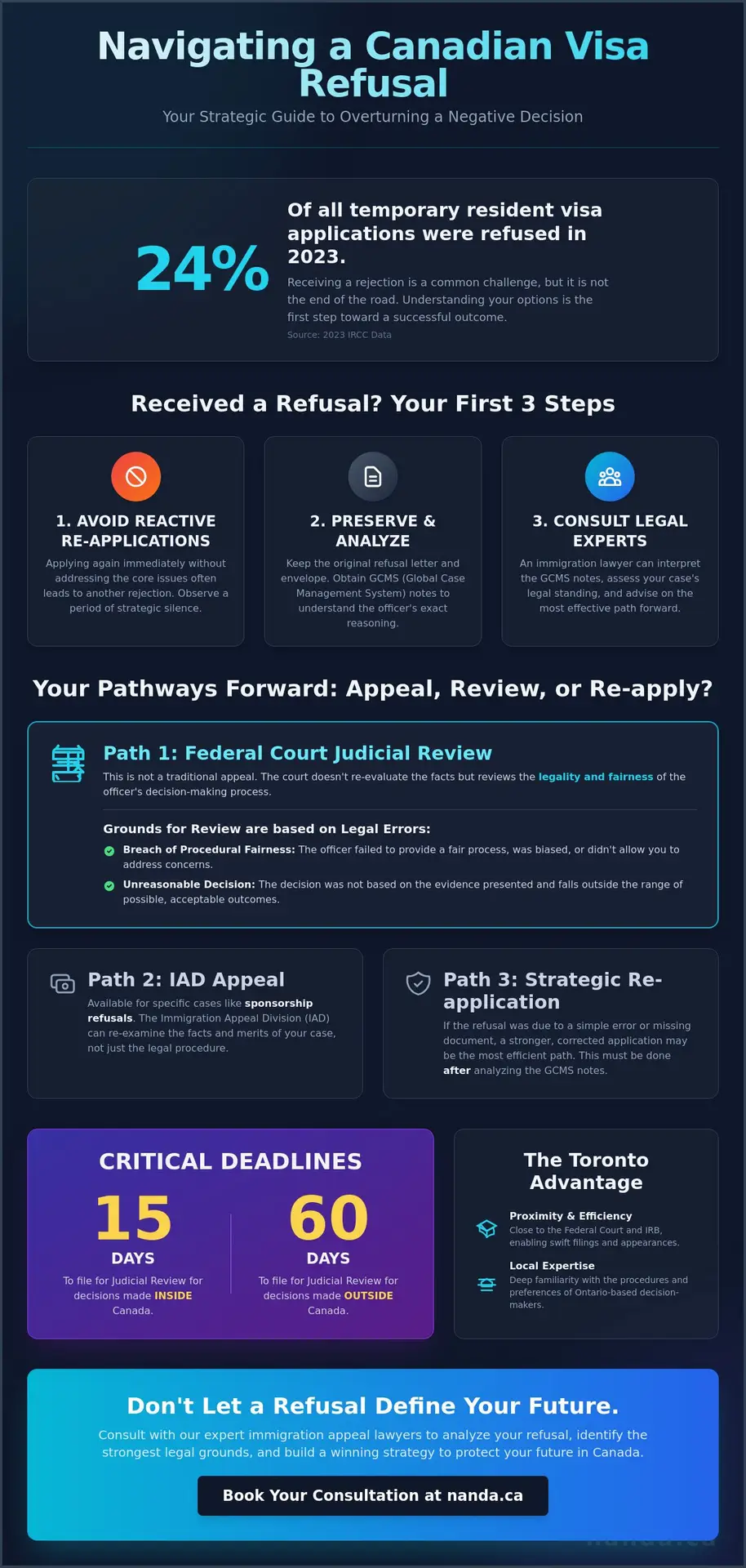
According to 2023 IRCC data, approximately 24% of all temporary resident visa applications were refused, leaving many applicants to wonder if their path to Canada is permanently blocked. Receiving a rejection letter is a heavy emotional and financial burden, particularly when you’ve already committed months to the process. If you’re currently facing this challenge, consulting a Toronto Immigration Appeal Lawyer: What to Do After a Visa Refusal is the first step toward understanding how to protect your status and your future.
It’s natural to feel overwhelmed by the technical language in a refusal letter or to fear that a simple mistake might lead to a permanent ban. Our experienced immigration lawyers believe that every applicant deserves a fair chance to present their case with clarity and precision. This article provides a comprehensive look at the strategic legal steps required to overturn a Canadian visa refusal through the expertise of our legal team. We’ll walk you through the distinctions between an IAD appeal and a Federal Court review, ensuring you have the confidence to choose the right legal path forward.
Introduction to Toronto Immigration Refusals
-
Preserve all documents: Keep the original refusal letter and the postmarked envelope, as these establish the strict legal timelines for your appeal.
-
Avoid reactive re-applications: Submitting a new application immediately without addressing the initial grounds for refusal often leads to a second rejection.
-
Access officer notes: A Toronto immigration lawyer can obtain Global Case Management System (GCMS) notes to reveal the specific reasons behind the officer’s decision.
-
Understand the IRPA: All appeals and judicial reviews must strictly follow the procedural requirements of the Immigration and Refugee Protection Act (IRPA).
-
Local expertise counts: Proximity to the Federal Court and the Immigration and Refugee Board of Canada (IRB) in Toronto provides significant logistical and strategic benefits.
Receiving a visa refusal is an emotionally draining experience that can disrupt years of planning. Whether it’s a study permit, a work visa, or a family sponsorship, a negative decision feels like a closed door on your future in Ontario. At Nanda & Associate Lawyers, we view ourselves as your collaborative mentors during these high-stakes transitions. We understand that a refusal isn’t just a bureaucratic hurdle; it’s a personal setback that requires a sophisticated, calm, and strategic response. This guide serves as an informational resource to help you navigate the complexities of the IRPA and determine the best path forward. If you’re seeking a Toronto Immigration Appeal Lawyer: What to Do After a Visa Refusal, it’s vital to move from a state of distress to a state of informed action.
Immediate Steps After Receiving a Refusal Letter
The moment you receive a refusal letter, the clock starts ticking. You might have as few as 15 days for a judicial review if the decision was made within Canada, or 60 days if it was made at a visa office abroad. Don’t let your emotions dictate your next move. We often see applicants rush to file a new application within 48 hours, only to be rejected again because they didn’t fix the underlying issue. Instead, observe a period of strategic silence to analyze the refusal. We help clients obtain the internal notes from the immigration officer, which provide the "why" behind the "no." These notes offer a roadmap for whether you should appeal, seek a judicial review, or submit a much stronger, corrected application.
Why a Toronto-Based Legal Perspective Matters
Toronto is the primary stage for immigration litigation in Canada. Our firm is positioned near the heart of the legal infrastructure, including the Federal Court and the Immigration and Refugee Board of Canada (IRB). This proximity allows us to handle filings and appearances with a level of efficiency that distant firms cannot match. We’ve spent years appearing before Ontario-based administrative tribunals, developing a deep familiarity with the procedural preferences of the decision-makers here. We don’t just offer paperwork; we provide comprehensive legal solutions designed to protect your interests and restore your peace of mind. Our team’s multidisciplinary approach ensures that your case is handled with the professional gravity it deserves, backed by a powerhouse of shared knowledge.
Legal Explanation: Grounds for Appeal Under the IRPA
The Immigration and Refugee Protection Act (IRPA) is the primary federal legislation governing the entry of foreign nationals into Canada. Every decision made by an immigration officer must align with the authorities granted by this Act. When an application is denied, the legal framework for a challenge often rests on the concept of procedural fairness. This principle of administrative law dictates that applicants have a right to a fair process, an unbiased decision-maker, and a meaningful opportunity to address concerns regarding their eligibility. If an officer fails to meet these standards, the decision may be legally flawed.
In the context of a Toronto Immigration Appeal Lawyer: What to Do After a Visa Refusal, we distinguish between merits-based errors and legal errors. A merits-based error occurs when an officer weighs facts in a way the applicant dislikes. However, a legal error involves a failure to follow the law or the Immigration Appeal Division Rules. The Federal Court reviews these decisions based on the standard of "reasonableness." This means the court doesn’t decide if they would have made the same choice; instead, they check if the officer’s decision is transparent, intelligible, and justified by the evidence provided.
Common Legal Grounds for Overturning a Refusal
One frequent ground for appeal is the misinterpretation of evidence. This occurs when an officer completely overlooks a critical document, such as a property valuation or a letter of employment, that was clearly included in the record. Another common issue is the "fettering of discretion." This happens when an officer follows a rigid internal policy or "rule of thumb" instead of assessing the unique merits of your specific situation. Decisions must also be free from extraneous factors; an officer cannot base a refusal on information or personal biases that aren’t found within the application or the law.
The Burden of Proof and the Onus of the Applicant
While the officer has a duty to be fair, the burden of proof always rests on the applicant. You must provide clear, convincing evidence to satisfy the requirements of the IRPA. A failure to be thorough can lead to more than just a refusal. Under Section 40 of the IRPA, "Misrepresentation" can result in a five-year ban from entering Canada. This is a severe penalty that applies even if the error was unintentional. Challenging these complex government decisions requires the same level of precision found in civil litigation expertise. Our team ensures that your response to a refusal is strategically sound and legally robust. If you’ve received a negative decision, you should book a consultation to explore your options for a formal appeal.
The Appeal Process and Timelines in Toronto
Receiving a refusal letter is a significant setback, but it isn’t the end of your immigration journey. To challenge a decision effectively, a Toronto Immigration Appeal Lawyer: What to Do After a Visa Refusal will guide you through a structured, multi-step legal process. The first step involves requesting Global Case Management System (GCMS) notes. These internal records contain the officer’s actual remarks, which are often far more detailed than the generic checklist provided in your refusal letter. Understanding these specific notes is vital for building a persuasive case that addresses the officer’s actual concerns.
Immigration Appeal Division (IAD) vs. Federal Court
Your legal path depends entirely on the type of application the government refused. The Immigration Appeal Division (IAD) handles matters involving family class sponsorships, residency obligations, and certain removal orders. If your case falls under temporary residence, such as a study permit, work permit, or visitor visa, or if it involves an Express Entry refusal, your recourse is through the Federal Court of Canada. For those living or planning to settle in the GTA, these matters are typically heard at the Federal Court located at 180 Queen Street West in downtown Toronto. Our team of immigration lawyers understands the distinct procedural nuances of both venues.
Critical Deadlines You Cannot Miss
Time is your most significant constraint in immigration litigation. Missing a deadline usually results in the permanent loss of your right to appeal or seek review. The law sets strict windows for action based on where the decision was made:
-
15 Days: This deadline applies to refusals issued within Canada (inland decisions).
-
60 Days: This deadline applies to refusals issued at visa offices outside of Canada (overseas decisions).
These timelines start from the day you receive the decision. If you are unsure which deadline applies to your specific situation, consulting a Toronto Immigration Appeal Lawyer: What to Do After a Visa Refusal immediately is the safest course of action to protect your rights.
The Judicial Review Stages
If your case proceeds to the Federal Court, it follows a rigorous two-stage process. The first stage is the "Leave" stage, where a judge reviews written arguments to decide if the case has a "fairly arguable" point. Statistics from the Federal Court show that many cases are filtered out at this gatekeeping stage. If leave is granted, the case moves to a formal Judicial Review hearing. At this stage, your lawyer presents oral arguments to a judge in Toronto. The court doesn’t decide if you should get a visa; instead, it determines if the officer’s decision was reasonable and followed a fair process. If the judge finds the decision was flawed, the case is sent back to a different officer for a fresh, unbiased review.
Practical Advice: Choosing Between Re-application and Appeal
Deciding whether to fight a refusal or start over requires a cold analysis of why the application failed. A new application is typically faster; current processing times for standard visitor visas can range from 14 to 120 days depending on the country of origin. If the refusal stemmed from a simple lack of documentation, resubmitting a stronger file is often the most cost-effective route. However, if the officer made a legal error or ignored evidence already on file, a Toronto Immigration Appeal Lawyer: What to Do After a Visa Refusal becomes essential to challenge the decision through Judicial Review.
Many applicants attempt a "Reconsideration Request" as a first step. While this is an informal way to ask an officer to review their own work, it’s rarely successful. Statistics suggest that unless there’s a clear administrative blunder, officers seldom reverse their own decisions. It’s also vital to remember that a refusal remains on your permanent record. Under the Immigration and Refugee Protection Act, you must disclose all prior refusals in future applications. Omitting this information can lead to a five-year ban for misrepresentation. If you’re facing a complicated rejection, consulting a Toronto Immigration Appeal Lawyer: What to Do After a Visa Refusal is the most reliable way to identify if the officer breached procedural fairness.
-
Verify all dates: Ensure your history has no gaps in employment or residency.
-
Update financial proof: Provide three to six months of recent bank statements rather than a single snapshot.
-
Address every concern: If the officer cited "lack of family ties," include more evidence of relatives in your home country.
Requesting and Analyzing Officer Notes (GCMS)
The standard refusal letter you receive is a template that offers little insight. The real reasoning lives within the Global Case Management System (GCMS) notes. These internal records reveal the officer’s specific doubts and logic. At Nanda & Associate Lawyers, our team provides tailored strategic approaches to these notes, identifying the exact weaknesses in your file. We use this data to build a "Memorandum of Argument" that directly counters the officer’s skepticism in a way a standard cover letter cannot.
Strategic Evidence Gathering for Toronto Applicants
When you resubmit or appeal, you can’t just provide the same papers. You need "new evidence" that is admissible. This often involves an Affidavit, which is a sworn legal statement that carries significant weight in court. For those with local connections, emphasizing community ties or professional networks in Toronto can strengthen a file. You can find more details on these strategies in our guide on Immigration Refusals and Appeals in Mississauga. If you’re unsure of your next move, book a consultation with our immigration lawyers to protect your status.
Frequently Asked Questions and Conclusion
Receiving a visa refusal is a heavy burden, but it’s rarely the final word on your immigration status. Our team at Nanda & Associate Lawyers understands the anxiety that comes with a letter from Immigration, Refugees and Citizenship Canada (IRCC). We focus on turning that initial shock into a clear, actionable legal strategy. By understanding the common hurdles and timelines involved in the litigation process, you can regain a sense of control over your future in Canada.
Frequently Asked Questions About Visa Refusals
Can I stay in Toronto while my appeal is pending?
A refusal doesn’t automatically grant you the right to remain in the country. If your current temporary resident status expires, you must leave unless you’ve applied for a restoration of status or have received a stay of removal from the court. It’s a common misconception that filing for a Judicial Review grants "implied status." It doesn’t. We work with clients to ensure they remain compliant with the Immigration and Refugee Protection Act (IRPA) while their case moves through the system.
What is the success rate of a Judicial Review?
Success depends on the specific legal errors present in the officer’s decision. According to Federal Court of Canada data from 2022, approximately 15% to 20% of immigration cases are granted "leave" to proceed to a full hearing. However, once leave is granted, the probability of a successful outcome increases substantially. A skilled immigration lawyer in Toronto is essential for identifying the procedural fairness violations that convince a judge to review the case.
How long does a Federal Court hearing take in Toronto?
The litigation process is methodical and follows a strict schedule set by the court. Typically, the entire process from the initial filing to a final decision takes between 6 and 10 months. The "leave" stage generally consumes the first 3 to 4 months. If the court decides the case has merit, a hearing is usually scheduled within the following 90 days. We provide a steady, informative rhythm throughout these months so you’re never left wondering about the status of your file.
Conclusion: Taking the Next Step in Your Immigration Journey
Moving from a state of despair to a structured legal strategy requires the right guidance. The IRPA is designed to ensure that every applicant is treated with procedural fairness. This means visa officers must provide logical, transparent, and justified reasons for their decisions. When they fail to meet this standard, our collaborative team of experts steps in to hold the system accountable. Choosing a Toronto Immigration Appeal Lawyer: What to Do After a Visa Refusal means you aren’t just hiring a representative; you’re gaining a sophisticated mentor to navigate the complexities of the Federal Court.
We believe in providing comprehensive legal solutions that prioritize your long-term stability and peace of mind. Our diverse team understands the nuances of a multicultural clientele and the high stakes of every visa application. Don’t let a single refusal letter define your journey. Let us help you build a persuasive case for the second chance you deserve.
If you’re ready to challenge a refusal and secure your future, our team is here to help. Book a Consultation with our Toronto team today to discuss your options.
Taking the Next Step Toward Your Canadian Residency
A visa refusal feels like a significant setback, but it’s often just a temporary hurdle in a complex legal journey. You have clear pathways to challenge these decisions under the Immigration and Refugee Protection Act. Whether you’re navigating the 30 day window for an appeal or seeking a judicial review, timing and precision are everything. Partnering with a Toronto Immigration Appeal Lawyer: What to Do After a Visa Refusal provides the strategic edge needed to address the specific grounds of your refusal effectively.
Since 2003, Nanda & Associate Lawyers has focused on outcome-oriented litigation to help families and individuals stay together. Our team offers deep experience appearing before the Immigration and Refugee Board and the Federal Court of Canada. We’re a diverse, multilingual firm that supports clients in over 15 languages, ensuring your story is told accurately and persuasively. You don’t have to face the Canadian immigration system alone. Secure your future in Canada—book an immigration consultation with Nanda & Associate Lawyers today. Your residency goals remain achievable with the right legal team by your side.
Frequently Asked Questions
Can I appeal a visitor visa refusal in Toronto?
You cannot appeal a visitor visa refusal to the Immigration Appeal Division (IAD) because it doesn’t have jurisdiction over temporary resident visas. Your primary legal remedy is filing an application for judicial review at the Federal Court of Canada. A Toronto immigration appeal lawyer: what to do after a visa refusal strategy involves demonstrating that the visa officer’s decision was unreasonable or procedurally unfair under the Immigration and Refugee Protection Act.
How long does an immigration appeal take at the Federal Court in Toronto?
A judicial review at the Federal Court typically takes between 6 and 12 months from the initial filing to a final decision. The first stage, known as the leave stage, usually concludes within 120 days. If the court grants leave, a hearing is scheduled within the next 90 to 180 days. These timelines vary based on the court’s current caseload and the specific complexity of your legal challenge.
What is the difference between an appeal and a judicial review?
An appeal allows a higher body like the IAD to look at new evidence and reconsider the facts of your case. A judicial review is different because the Federal Court only examines if the original decision maker followed the law and acted fairly. The court doesn’t usually look at new evidence; it focuses on whether the officer’s logic was sound based on the documents you originally submitted to the government.
Can I re-apply for a visa while my appeal is still in progress?
You’re legally allowed to submit a new application while a judicial review is pending in the Federal Court. However, we often advise caution because a second refusal for the same reasons can weaken your legal standing and create conflicting records. It’s more effective to let a Toronto immigration appeal lawyer: what to do after a visa refusal guide your strategy to ensure the two processes don’t negatively impact each other.
What happens if I win my judicial review at the Federal Court?
Winning a judicial review doesn’t mean your visa is automatically granted by the judge. The Federal Court will set aside the original refusal and order that a different visa officer re-evaluate your application. This second officer must follow the court’s guidance and address the specific errors identified during the review. In 2023, many successful litigants found that this redetermination process resulted in a much higher chance of approval.
Do I need a lawyer for an Immigration Appeal Division (IAD) hearing?
You aren’t legally required to have a lawyer, but the IAD process involves complex rules of evidence and formal cross-examination. Statistics from the Immigration and Refugee Board show that self-represented individuals often struggle with the technical requirements of the Immigration and Refugee Protection Regulations. We provide the professional representation needed to prepare witnesses and present a persuasive case that meets the specific legal tests for family sponsorship appeals.
What are GCMS notes and how do they help my visa appeal?
Global Case Management System (GCMS) notes are the detailed internal records kept by IRCC officers during the processing of your application. These notes are vital because the standard refusal letter often provides only vague, generic reasons for the decision. By reviewing the 5 to 10 pages of internal officer comments, we can identify specific factual errors or logical gaps. This information forms the foundation of a successful challenge at the Federal Court.
Will a visa refusal prevent me from ever coming to Canada?
A single refusal isn’t a permanent bar to entry, provided the refusal wasn’t based on misrepresentation or serious criminality. If an officer finds you provided false information, Section 40 of the IRPA imposes a strict 5 year ban from entering Canada. For standard refusals based on a lack of ties to your home country, you can re-apply or appeal as soon as you have stronger evidence to present to the authorities.
Disclaimer
This content is for general information only and does not constitute legal advice or create a lawyer-client relationship. Every case is different—please consult a qualified lawyer for advice specific to your situation.