



Key Takeaways
-
Ownership Transfer and Legislation: The transition of property ownership in Ontario isn’t just a physical exchange of keys. It’s a formal legal event governed by the Land Registration Reform Act. This legislation mandates that all property transfers follow specific digital standards to ensure the integrity of the provincial land registry.
-
The Critical Role of Title Searches: Your lawyer must perform a detailed title search before the "Requisition Date," which is typically set 10 to 15 days before the scheduled closing. This investigation identifies hidden liens, unresolved mortgages, or restrictive covenants that could prevent you from having "clear title" to your new home.
-
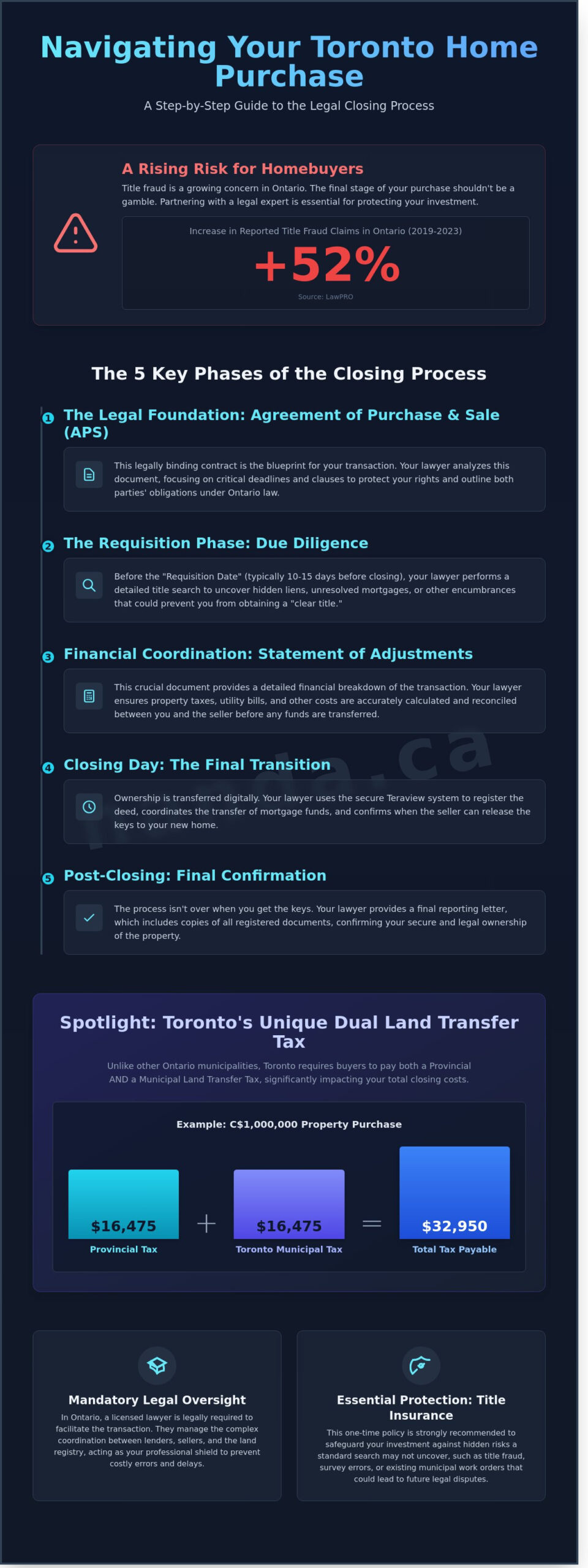
Toronto’s Dual Tax Obligation: Buyers in this city face a unique financial requirement. Unlike most other parts of Ontario, you’re responsible for both the Provincial Land Transfer Tax and the Toronto Municipal Land Transfer Tax. For a property purchased at C$1,000,000, these combined taxes can exceed C$32,000, making it a vital part of your closing budget.
-
Essential Protection via Title Insurance: We strongly recommend title insurance to safeguard your investment. This policy provides coverage against risks that a standard search might not reveal, such as title fraud, existing municipal work orders, or survey errors that could lead to costly legal disputes in the future.
-
Electronic Registration via Teraview: The final stage of the Toronto Real Estate Lawyer for Home Purchase: Step-by-Step Closing Process occurs digitally. Your legal representative uses the Teraview system to electronically register the deed. Only once this registration is confirmed is the transfer of ownership legally complete.
Last month, a buyer in North York sat in a quiet kitchen, staring at a stack of documents and wondering if a hidden property lien could turn their investment into a legal nightmare. It’s a valid concern, especially since LawPRO reported a 52% increase in title fraud claims in Ontario between 2019 and 2023. When you’re managing the complexities of the GTA’s competitive market, the final transition of ownership shouldn’t feel like a gamble. Partnering with a Toronto Real Estate Lawyer for Home Purchase: Step-by-Step Closing Process is the most critical decision you’ll make after your offer is accepted. We’ve seen how easily a missing signature or a delayed mortgage wire can disrupt a move, and we’re here to ensure that doesn’t happen to you.
We agree that the closing period is often the most stressful part of the home-buying journey. You’re likely balancing packing boxes with the fear of unexpected costs or last-minute funding delays. This guide provides the clarity you need to move forward with calm confidence. We’ll walk you through each phase of the legal transfer, from the initial title search to the final delivery of your keys. You’ll gain a clear understanding of the Statement of Adjustments and the specific safeguards we implement to protect your financial future. Let’s explore how a structured legal approach turns a complex transaction into a seamless success.
Introduction to the Toronto Closing Process
Purchasing a home in the heart of Toronto is a significant milestone that represents years of hard work and financial planning. It’s a transition filled with excitement, yet the final weeks can feel overwhelming due to the sheer volume of legal and financial requirements. The real estate closing process is the definitive phase where the contract becomes a reality. During this period, the purchase funds are officially exchanged for the legal title to the property. It’s the moment when your status changes from a prospective buyer to a homeowner.
In Ontario, you can’t navigate this phase alone. The provincial government requires a licensed lawyer to facilitate the transaction because the electronic land registry system is restricted to legal professionals. At Nanda & Associate Lawyers, we understand the weight of this commitment. Our approach to real estate law focuses on providing a seamless experience that prioritizes your security. This guide on the Toronto Real Estate Lawyer for Home Purchase: Step-by-Step Closing Process is designed to demystify the legal requirements, ensuring you move into your new home with total confidence and peace of mind.
The closing involves a complex coordination between your lender, the seller’s legal counsel, and the municipal land registry office. Every document must be executed with precision to avoid delays that could result in financial penalties. We handle the intricate details, from verifying tax adjustments to ensuring your mortgage instructions are fulfilled. Our goal is to manage the logistical pressure so you can focus on the personal joy of your new beginning.
The Legal Foundation of Your Toronto Home Purchase
The Agreement of Purchase and Sale (APS) is the most critical document in your transaction. It isn’t just a set of instructions; it’s a legally binding contract that dictates the terms of your future home ownership. When you hire a Toronto Real Estate Lawyer for Home Purchase: Step-by-Step Closing Process, our first task is to dissect this document. We focus heavily on the "Title Search" clause found in standard OREA forms. This clause establishes the timeframe during which we can legally demand the seller clear up any "clouds" on the title. These clouds might include unpaid property taxes, old mortgages that weren’t properly discharged, or restrictive covenants that limit how you use the land.
The Land Registration Reform Act revolutionized how property changes hands in Ontario. It moved the province away from archaic paper deeds to a secure electronic registry system. This shift requires a real estate lawyer to act as an officer of the court. We’re legally obligated to verify the identities of all parties involved to prevent title fraud, which remains a serious concern in the GTA market. By confirming that the person selling the home actually has the legal right to do so, we provide the security you need to move forward with confidence.
Understanding the Agreement of Purchase and Sale
Timing is everything in a Toronto real estate deal. We pay close attention to the "Requisition Date," which is typically set 15 to 30 days before the closing date. This is the hard deadline for your lawyer to raise objections about title issues. We also scrutinize the sections regarding chattels and fixtures to ensure your expectations match the legal reality.
-
Chattels: These are moveable items like fridges, stoves, and washers that must be specifically listed if they’re staying.
-
Fixtures: These are items physically attached to the property, such as built-in shelving or light fixtures, which are assumed to stay unless excluded.
-
Critical Dates: We track condition periods for financing or home inspections to ensure you don’t miss a deadline that could jeopardize your deposit.
Understanding these upfront or closing costs and the timelines involved helps you prepare your budget effectively. Our review ensures that the contract reflects exactly what you’ve negotiated.
Ontario Statutory Compliance
Several provincial laws govern your purchase. The Planning Act is vital because it ensures the property you’re buying is a legally recognized lot. If a previous owner subdivided the land without proper municipal consent, you might not legally own what you think you’re buying. We verify compliance with Section 50 of the Planning Act to protect your interest.
Additionally, the Family Law Act plays a significant role. If the property is a matrimonial home, the seller’s spouse must provide written consent for the sale, even if they aren’t on the title. Without this consent, the transaction could be challenged later. Our team handles these complexities so you can focus on your move. If you’re ready to start your journey, you can speak with our real estate team to ensure your contract is airtight and your rights are protected.
The Requisition Phase: Conducting Due Diligence in Toronto
The requisition phase represents the most critical window for legal due diligence during your property acquisition. This period is governed by the "Requisition Date," a specific deadline outlined in your Agreement of Purchase and Sale. It’s the final date by which your Toronto Real Estate Lawyer for Home Purchase: Step-by-Step Closing Process must submit a list of title objections to the seller’s counsel. If this deadline passes without formal notice, you may be legally required to accept the property even if title defects are discovered later. We take this deadline seriously, as it’s the primary mechanism for protecting your investment.
During this stage, we conduct an exhaustive search of the abstract of title at the Land Registry Office. This process involves tracing the chain of ownership to ensure the seller has the legal right to transfer the property. We also look for municipal work orders, zoning compliance issues, and property tax arrears. If a seller hasn’t paid their property taxes, that debt stays with the land, meaning you could inherit a bill for thousands of Canadian Dollars if it’s not settled before closing. Being thorough during the closing process is essential to avoid unexpected costs. Once our searches are complete, we issue a formal Requisition Letter. This document acts as a legal demand, requiring the seller to "clean" the title by resolving any liens, debts, or encumbrances we’ve identified.
The Anatomy of a Title Search
A title search is a deep dive into the property’s legal history. We identify easements, such as a utility company’s right to maintain pipes under your driveway, and restrictive covenants that might prevent you from building certain structures. Our team also searches for executions. These are court judgments against the seller for unpaid debts, such as a C$15,000 credit card debt, that could attach to the property. We carefully verify that the legal description, including lot and plan numbers, matches the physical reality of the Toronto property you’re buying.
Title Insurance: Your Safety Net
Title insurance is now a standard component of almost every residential closing in Ontario. While our real estate law team performs rigorous searches, title insurance provides an additional layer of protection against risks that a search might not uncover. This includes protection against title fraud, unknown survey errors, or encroachment issues where a neighbor’s fence is on your land. Most importantly, title insurance allows a deal to close on schedule by "insuring over" minor defects. If a small issue cannot be resolved by the closing date, the insurance company assumes the risk, allowing you to move into your home without delay while maintaining your peace of mind.
Financial Coordination and the Statement of Adjustments
Financial coordination is the engine that drives the final stage of your property acquisition. As your Toronto Real Estate Lawyer for Home Purchase: Step-by-Step Closing Process guide, we prioritize the preparation and review of the Statement of Adjustments. This document serves as the definitive financial balance sheet of the transaction, ensuring that neither party pays more than their fair share of carrying costs. It’s the tool we use to move from the raw purchase price to the exact amount of "cash to close" required on the big day.
The reconciliation process involves a meticulous accounting of property taxes, utility bills, and fuel oil where applicable. If a seller has prepaid the annual property tax in full before the closing date, the buyer must credit them for the portion of the year they’ll own the home. These calculations are precise down to the penny. In the City of Toronto, we also calculate the Municipal Land Transfer Tax (MLTT). This tax is unique to the city and applies in addition to the Ontario provincial Land Transfer Tax, making the financial coordination for Toronto properties more complex than in surrounding regions. Our role is to ensure these numbers are verified and agreed upon by both legal teams before any funds move.
Calculating Closing Costs
The total cash required to close includes much more than just the remaining purchase price. Land Transfer Tax (LTT) often represents the most significant additional expense. However, first-time home buyers in Toronto may be eligible for significant relief. The provincial rebate provides up to C$4,000, and the Toronto-specific MLTT rebate offers up to C$4,475 for eligible purchasers. We verify these entitlements early to provide an accurate "Direction regarding Funds." This document ensures the seller’s lawyer receives the exact balance due while accounting for your initial deposit and any credits identified in the adjustments.
Mortgage Funding and Legal Requirements
When you secure a mortgage, your lawyer acts for both you and the financial institution. We have a strict duty to the lender to ensure the mortgage is registered as a valid "first charge" against the property. This means no other debts or liens can take priority over the lender’s interest. You’ll review the "Standard Charge Terms," which are the detailed legal conditions filed with the Ministry of Government and Consumer Services that govern your mortgage obligations. Our team manages the "gap," the critical time between the lender advancing the funds to our trust account and the final electronic registration of the transfer. This coordination ensures that money and title change hands simultaneously, providing comprehensive real estate legal solutions and security for your investment.
Closing Day: The Final Step-by-Step Transition of Ownership
Closing day is the definitive moment when legal ownership transfers from the seller to you. While it’s often a day of excitement, it requires a disciplined sequence of events to ensure the transaction is legally binding and your interests are protected. Your Toronto Real Estate Lawyer for Home Purchase: Step-by-Step Closing Process involves managing several moving parts in a single day, often within a tight window between 9:00 AM and 5:00 PM. We work diligently behind the scenes to coordinate with your lender and the seller’s counsel to ensure a smooth transition.
The standard closing sequence typically follows these five critical steps:
-
Step 1: Receipt of Funds. Your lawyer receives the mortgage proceeds directly from your bank and combines them with the balance of the down payment you provided earlier.
-
Step 2: Escrow Agreement. The seller’s lawyer delivers the "Escrow Closing Agreement" along with the keys to the property. This agreement dictates that the keys can’t be released until the money is officially received and the title is registered.
-
Step 3: Document Verification. We exchange all necessary legal documents electronically. This includes the Statement of Adjustments and the Direction regarding Title, which we verify for absolute accuracy.
-
Step 4: Registration. Once the funds are confirmed, your lawyer registers the Transfer/Deed and the Charge/Mortgage through the provincial electronic database.
-
Step 5: Completion. After registration is confirmed, the seller’s lawyer is notified to release the keys to you, and the funds are released to the seller.
The Electronic Land Registration System
In Ontario, the days of lawyers meeting at a physical Land Registry Office to swap paper deeds are long gone. The implementation of Teraview, the software interface for Ontario’s Electronic Land Registration System, has revolutionized the Toronto real estate market. Since the province completed its transition to this system in 2010, transactions have become significantly more efficient. Teraview uses high-level security protocols, including encrypted digital signatures, to prevent unauthorized title transfers. This digital infrastructure ensures that the Toronto Real Estate Lawyer for Home Purchase: Step-by-Step Closing Process is both secure and fast, removing the need for physical attendance at a government office.
Mitigating Last-Minute Risks
Even with meticulous planning, obstacles can arise on closing day. A common issue is a delay in mortgage funds because of bank wire processing times. If the funds don’t arrive by the 5:00 PM deadline, we often negotiate an escrow closing or a one-day extension to avoid a breach of contract. Another risk involves property damage, such as a broken appliance or a hole in the wall discovered during your final walkthrough. We address these issues through holdbacks or price credits before the final funds are released. In rare cases where a party refuses to close or a significant breach occurs, civil litigation lawyers may be required to resolve the dispute and protect your deposit. Our team’s collaborative approach ensures you have the right expertise regardless of the challenge.
Don’t leave your property investment to chance on closing day. Book a consultation with Nanda & Associate Lawyers today to ensure your home purchase is handled with professional care and precision.
Mitigating Risks and Post-Closing Legal Obligations
The moment you receive your keys marks the beginning of your responsibilities as a homeowner in Ontario. Use the first 24 hours to conduct a thorough inspection of the property. Check that all chattels included in the contract, such as the refrigerator, stove, or dishwasher, are in the same working order as when you signed the agreement. If you notice new damage or missing items, contact us immediately. Prompt action is necessary because any delay can make it harder to prove the damage occurred before you took possession. You also need to finalize the transfer of utility accounts for water, electricity, and gas to avoid administrative penalties or service gaps.
The Reporting Letter and Final Documents
Your legal journey concludes with the delivery of the reporting letter, typically sent a few weeks after the transaction is finalized. This package is a vital resource that summarizes the entire Toronto Real Estate Lawyer for Home Purchase: Step-by-Step Closing Process. It contains your registered Transfer/Deed, which acts as your official proof of ownership, and your Title Insurance Policy. These documents are essential if you decide to sell or refinance the property in the future. We recommend storing physical copies in a fireproof safe and keeping encrypted digital backups. If you require document authentication for future business or personal transactions, our team can assist with the necessary legal protocols to verify your records.
Long-Term Property Protection
A home is usually a person’s most significant financial asset. Because of this, it’s a priority to consult wills and estate lawyers to ensure your new equity is protected. A major life event like a home purchase should always trigger a review of your estate plan to reflect your current assets and ensure your interests are distributed according to your wishes. Under the Ontario Succession Law Reform Act, failing to update these documents can lead to unintended consequences for your heirs.
Additionally, you should remain aware of your property’s title status. While your title insurance provides a safety net against mortgage fraud and title defects, we help you understand how to stay vigilant against unauthorized changes to your property records. Our goal is to provide more than just a transaction; we provide the peace of mind that comes from knowing your investment is legally sound. This comprehensive oversight is the final stage of the Toronto Real Estate Lawyer for Home Purchase: Step-by-Step Closing Process, ensuring you move into your new home with confidence.
If you’re ready to start your home buying journey with a team that prioritizes your security, we invite you to book a consultation with our experienced legal professionals today.
Secure Your Investment with Expert Legal Oversight
Purchasing a home is one of the most significant financial commitments you’ll ever make. By understanding the requisition process and the intricacies of the statement of adjustments, you’re better prepared to navigate the complexities of the Ontario real estate market. Our team brings over two decades of experience in Ontario real estate law to every transaction, providing the comprehensive legal solutions you need for complex property transfers. We offer multilingual legal support in over 15 languages, ensuring you feel heard and protected at every stage of the journey.
Partnering with a dedicated Toronto Real Estate Lawyer for Home Purchase: Step-by-Step Closing Process helps mitigate risks and ensures your post-closing obligations are met without delay. You deserve the peace of mind that comes from professional, authoritative representation. We’re here to manage the legal heavy lifting so you can focus on the excitement of your new home. Whether you’re a first-time buyer or a seasoned investor, our collaborative approach ensures a seamless transition of ownership. Take the next step toward a successful closing today.
Book a Consultation for Your Toronto Home Purchase
Frequently Asked Questions
How long does the real estate closing process take in Toronto?
A standard real estate closing in Toronto typically takes between 30 and 90 days from the initial signed agreement to the final transfer of ownership. While the timeline is set by your contract, the technical legal work intensifies during the final 10 to 14 days. We manage every deadline to ensure all documents are ready for registration on your scheduled date, providing a seamless transition into your new property.
What is the difference between provincial and municipal land transfer tax?
Buyers purchasing a home within the City of Toronto must pay both the Ontario Land Transfer Tax and the Toronto Municipal Land Transfer Tax. Properties outside the 416 area code only incur the provincial portion. These amounts are calculated based on your purchase price and are due upon closing. Our team calculates these figures for you as a Toronto Real Estate Lawyer for Home Purchase: Step-by-Step Closing Process.
Can I close a real estate deal without a lawyer in Ontario?
No, you cannot legally complete a residential real estate transaction in Ontario without a licensed lawyer. The province requires a lawyer to register the transfer of title and any mortgage documents through the Teraview electronic land registry system. We serve as your essential representative to verify that the title is clear of encumbrances and that the entire transaction is legally binding under Ontario law.
What happens if the seller does not move out on the closing day?
If a seller remains in the property after the deed is registered, they are in direct breach of the Agreement of Purchase and Sale. You should contact your legal counsel immediately to issue a formal notice of default to the seller’s lawyer. We work to resolve these difficult disputes through professional negotiation or litigation to ensure you gain possession of your home as quickly as possible according to the contract.
Is title insurance mandatory for a home purchase in Toronto?
Most Canadian mortgage lenders require title insurance as a mandatory condition for approving your home loan. While it’s not a strict legal requirement for those making a cash purchase, we highly recommend it for every homeowner in the Greater Toronto Area. This policy protects your investment against issues like title fraud, municipal zoning non-compliance, or existing liens that were not discovered during the initial title search.
What is a Statement of Adjustments and why is it important?
The Statement of Adjustments is a document that calculates the final amount a buyer owes by accounting for prepaid expenses. These include property taxes, utility deposits, or fuel oil that the seller paid for beyond the closing date. It’s a vital part of the Toronto Real Estate Lawyer for Home Purchase: Step-by-Step Closing Process because it ensures both parties pay only for the time they actually owned the home.
When do I get the keys to my new home on closing day?
You typically receive your keys in the mid to late afternoon once the land registry office confirms the deed and mortgage are registered. Registration usually occurs between 2:00 PM and 5:00 PM on the closing date after all funds have been transferred. We notify you the moment the transaction is complete so you can collect your keys from our office or a secure lockbox at the property.
How much are the legal fees for a home purchase in Toronto?
Legal fees for a purchase depend on the complexity of the file and the specific disbursements required for your transaction. These disbursements include costs for title searches, software fees, and registration charges paid to the government. We provide a detailed breakdown of these professional services during your initial consultation to ensure complete transparency regarding your closing costs and to help you plan your budget effectively.
Disclaimer
This content is for general information only and does not constitute legal advice or create a lawyer-client relationship. Every case is different—please consult a qualified lawyer for advice specific to your situation.