




Key Takeaways
- A Private Constitution: A shareholder agreement is a private contract that acts as a customized rulebook for your Mississauga corporation, overriding the default provisions of the Ontario Business Corporations Act (OBCA) to fit your specific needs.
- Dispute Prevention: Its primary purpose is to prevent costly and damaging disputes between shareholders by pre-determining how major decisions are made, how disagreements are resolved, and what happens in a deadlock situation.
- Business Continuity: The agreement ensures your business can continue operating smoothly in the event of a shareholder’s death, disability, departure, or bankruptcy, protecting the company’s value and the remaining partners’ interests.
- Asset and Interest Protection: Key clauses like the Right of First Refusal, Shotgun provisions, and non-compete clauses protect your ownership stake and prevent shares from falling into the wrong hands.
- Essential for Growth: A well-drafted shareholder agreement is often required by banks, lenders, and investors in the Mississauga area as it demonstrates professional governance, stability, and a clear plan for the future.
For any entrepreneur in Mississauga, launching a corporation with partners is an exciting venture built on shared vision and mutual trust. In the early stages, conversations focus on growth, innovation, and success. However, the most successful businesses are those that plan not only for the best-case scenarios but also for the inevitable challenges. This is where a shareholder agreement becomes one of the most critical foundational documents for your company.
Many business owners, especially friends or family members going into business together, believe their strong personal relationship is enough to navigate future disagreements. Unfortunately, experience shows that when significant money, stress, and differing opinions are involved, even the strongest bonds can be tested. A shareholder agreement is not a sign of mistrust; it is a hallmark of professional foresight. It is a private constitution for your business that provides a clear, legally binding roadmap for handling critical events, protecting your investment, and ensuring the long-term stability and value of your Mississauga corporation.
According to Shareholders' agreement, this is a well-documented area of ongoing research and practical application.
Understanding Shareholder Agreements Under Ontario Law
At its core, a shareholder agreement is a private, legally binding contract signed by the shareholders of a corporation. Its purpose is to govern their relationship with each other and with the company itself. It outlines their rights, responsibilities, and obligations, and establishes rules for the corporation’s management and operations. While your corporate bylaws set out general procedural rules, a shareholder agreement addresses the specific, often sensitive, “what if” questions that bylaws do not cover.
In Ontario, corporations are primarily governed by either the provincial Business Corporations Act (OBCA) or the federal Canada Business Corporations Act (CBCA). A shareholder agreement works in concert with this legislation but allows you to create customized rules that are better suited to your unique business structure. It is particularly powerful when structured as a Unanimous Shareholder Agreement (USA), where all shareholders are parties. Under the OBCA, a USA can even restrict the powers of the directors, transferring certain decision-making authorities directly to the shareholders—a crucial tool for protecting your interests.
Research published by authoritative definition of a shareholder agreement shows that this is a well-documented area of ongoing research and practical application.
The Legal Foundation: OBCA vs. CBCA
The jurisdiction in which you incorporate your business—provincially in Ontario (OBCA) or federally (CBCA)—determines the default legal framework. For many Mississauga businesses that operate primarily within the province, incorporating under the OBCA offers significant flexibility. The OBCA specifically empowers a Unanimous Shareholder Agreement to transfer directors’ powers and liabilities to the shareholders. This means you and your partners can retain direct control over fundamental decisions, rather than leaving them to a board of directors whose decisions might not align with every shareholder’s vision.
The Concept of a ‘Private Constitution’
Think of the OBCA as the public law governing all Ontario corporations. A shareholder agreement, in contrast, is your company’s private law. It allows you to override or supplement the default statutory rules that may be ill-suited for your business. For example, the OBCA may not provide a practical solution for a 50/50 ownership deadlock. Your agreement can. It creates a predictable framework for governance, ownership transfers, and dispute resolution that is legally binding and enforceable in Ontario courts. To ensure this “private constitution” is drafted correctly and fully compliant with Ontario law, it is essential to consult with an experienced business lawyer in Mississauga.
Why Your Mississauga Business Needs a Shareholder Agreement
Operating a multi-shareholder corporation without a formal agreement is like navigating a ship in a storm without a rudder. It exposes your business and personal assets to significant risk. A professionally drafted agreement is a proactive investment in stability and security, addressing potential conflicts before they arise.
- Preventing ‘Deadlock’: In a company with two 50/50 partners, a disagreement on a major issue can paralyze the entire operation. A shareholder agreement can include mechanisms like a “shotgun clause” or third-party mediation to force a resolution and keep the business moving forward.
- Protecting Minority Shareholders: Without an agreement, a minority shareholder can be vulnerable to a “squeeze-out,” where the majority shareholders make decisions that dilute their ownership or push them out of the company unfairly. The agreement can provide veto rights on certain major decisions, ensuring their voice is heard.
- Ensuring Business Continuity: What happens if a shareholder passes away, becomes disabled, or declares bankruptcy? An agreement dictates the process for the remaining shareholders to purchase the departing shareholder’s shares, often funded by corporate life insurance, ensuring the ownership remains with the intended partners and the business is not disrupted.
- Establishing a Clear Exit Strategy: Sooner or later, a shareholder will want to exit the business. An agreement establishes a clear and fair process for valuing and selling shares, preventing protracted disputes and potential civil litigation.
Conflict Prevention and Dispute Resolution
The most immediate benefit of a shareholder agreement is its role in conflict prevention. By forcing partners to discuss difficult topics upfront, it ensures everyone is on the same page. Should a disagreement arise, the agreement can stipulate a clear process, such as mandatory mediation or arbitration in Mississauga, before resorting to the courts. This saves immense time, money, and emotional strain. Consider a scenario where a partner wants to sell their shares to a direct competitor. A “Right of First Refusal” clause in your agreement would prevent this, giving you the first option to buy those shares and protect your company’s interests.
Research published by Why Your Mississauga Business Needs a Shareholder Agreement shows that this is a well-documented area of ongoing research and practical application.
Succession Planning and Asset Protection
A shareholder agreement is a vital component of a business owner’s overall succession plan. It works hand-in-hand with personal wills and estate planning to ensure a smooth transition of ownership. Clauses like a “Right of First Refusal” or a mandatory “buy-sell” provision upon death ensure that shares do not pass to a deceased partner’s heir who may have no interest or expertise in the business. This protects the company’s valuation and provides stability for the surviving partners, employees, and clients.
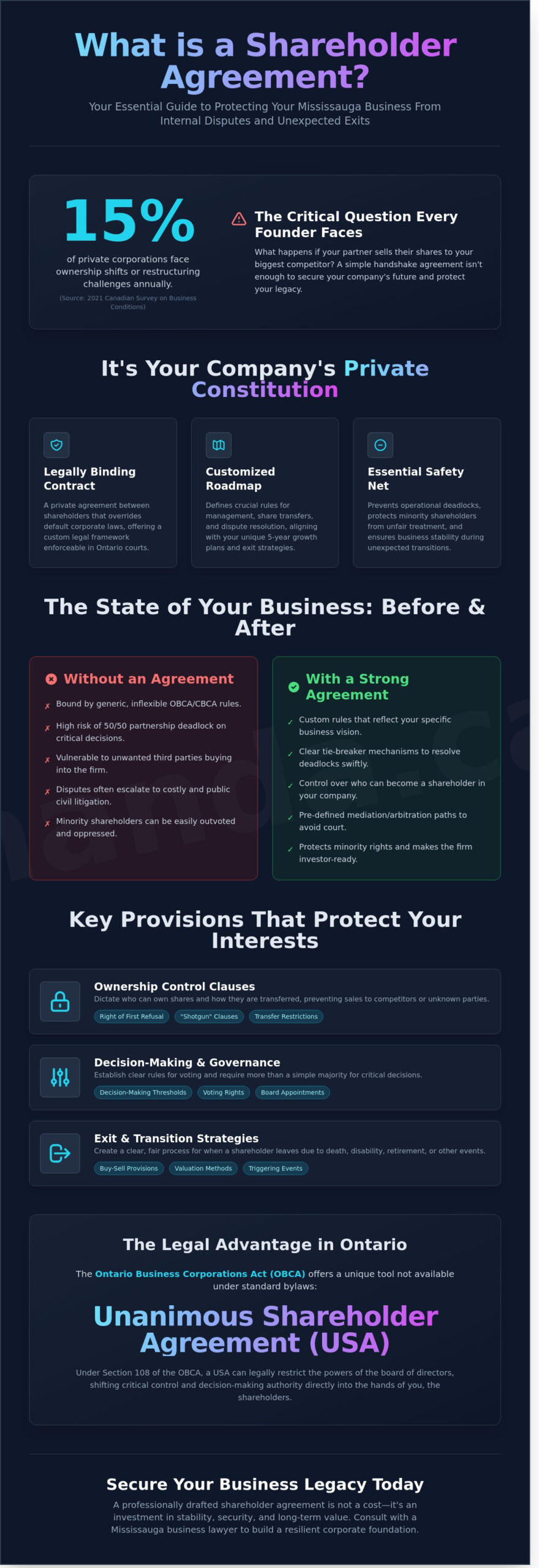
Key Provisions for Protecting Business Assets and Interests
A comprehensive shareholder agreement is tailored to the specific dynamics of your business. However, several key provisions are almost universally included to protect the assets and interests of the company and its shareholders.
- Right of First Refusal (ROFR): This clause prevents a shareholder from selling their shares to an outside third party without first offering them to the existing shareholders on the same terms. This keeps ownership within the original group.
- Shotgun Clauses: A powerful buy-sell mechanism, this clause allows one shareholder to offer to buy the other’s shares at a specific price. The other shareholder must either accept the offer and sell their shares or buy the offering shareholder’s shares at that same price.
- Piggyback and Drag-Along Rights: Piggyback rights protect minority shareholders by allowing them to “piggyback” on a sale initiated by a majority shareholder. Drag-along rights protect the majority by forcing minority shareholders to participate in a sale of the entire company, preventing a small owner from blocking a beneficial deal.
- Non-Compete and Non-Solicitation: These restrictive covenants prevent a departing shareholder from immediately starting a competing business or poaching clients and employees, thereby protecting the value of the company they just left.
Operational and Financial Clauses
Beyond ownership issues, the agreement should define the operational and financial ground rules. This includes establishing dividend policies (when and how profits are distributed), defining reinvestment strategies, and clarifying who has the authority to make major financial commitments, such as signing for significant loans or property leases in Mississauga. It should also mandate requirements for regular financial reporting and transparency among all partners, ensuring everyone is fully informed about the company’s health.
The ‘Shotgun Clause’ Explained
The Shotgun Clause, also known as a buy-sell provision, is often considered the ultimate dispute resolution tool for a private corporation. It is a drastic but effective way to end a deadlock. The mechanism is simple: Shareholder A offers to buy Shareholder B’s shares for $X per share. Shareholder B then has a choice: either sell their shares to A at that price or turn the offer around and buy Shareholder A’s shares at the exact same price. Because the person triggering the clause doesn’t know if they will be buying or selling, they are incentivized to set a fair price. While highly effective, its inclusion should be carefully considered, especially in a Mississauga startup where partners may have unequal financial resources.
The Process of Drafting and Executing a Shareholder Agreement
Creating a robust and enforceable shareholder agreement involves a structured, collaborative process guided by legal counsel. It is not a document to be rushed or downloaded from a template, as it must reflect the unique circumstances of your corporation and the intentions of its shareholders.
- Initial Consultation: The process begins with a detailed consultation to identify the unique goals of the Mississauga corporation and the concerns of each shareholder. This includes discussing future plans, potential exit strategies, and specific anxieties.
- Information Gathering: Your legal team will gather essential information about the company’s share structure, voting rights, capitalization, and any initial agreements or understandings between the partners.
- Drafting and Review: An initial draft of the agreement is prepared. Each shareholder then reviews the key provisions with their legal counsel to ensure they understand the implications of every clause.
- Negotiation and Refinement: The shareholders negotiate the terms to ensure the final agreement is fair, balanced, and acceptable to all parties. This stage is critical for achieving a true “meeting of the minds.”
- Execution and Signing: Once all parties are in agreement, the final document is signed and executed in accordance with Ontario legal requirements, making it a legally binding contract. The agreement should then be stored with the corporate records.
Gathering Necessary Documentation
To draft an effective agreement, your lawyer will need to review your corporation’s foundational documents. This includes the Articles of Incorporation, corporate minute books, and the share ledger. A thorough review ensures the shareholder agreement is consistent with the existing corporate structure. As your business contract lawyer in Mississauga, we handle this verification to ensure a seamless and legally sound process.
Negotiation and Fairness
Fairness is the cornerstone of an enforceable shareholder agreement. To ensure this, it is often recommended that each shareholder obtain Independent Legal Advice (ILA) from their own lawyer. This prevents any future claims that a shareholder was pressured or did not understand what they were signing. The goal is to create a document that all parties believe in, reflecting a genuine consensus that will stand the test of time.
Strategic Advantages: Minority Protection and Long-Term Value
A shareholder agreement is more than just a defensive document; it is a strategic tool that adds significant long-term value to your Mississauga business. It provides a framework for good corporate governance that extends far beyond the founding partners.
For minority shareholders, the agreement is their primary source of protection. It can grant them “veto rights” over fundamental changes, such as issuing new shares that would dilute their ownership or selling major company assets. Furthermore, it manages the difficult “death of a shareholder” scenario with clarity and compassion, protecting both the surviving family’s financial interests and the company’s operational stability. Proactive legal planning is not an expense; it is a fundamental characteristic of a successful and enduring Mississauga enterprise.
Attracting Investment and Financing
When your business is ready to grow, external parties will take notice of your governance structure. Banks, lenders, and venture capital firms in the Greater Toronto Area are often hesitant to invest in a corporation that lacks a shareholder agreement. The existence of an agreement signals that your business is stable, professionally managed, and has a clear plan for resolving internal conflict. It is a critical checkmark in any due diligence process and can make your company significantly more attractive for financing.
Final Thoughts on Corporate Governance
Ultimately, a shareholder agreement provides peace of mind. It allows you and your partners to focus on growing the business, confident that a clear, fair, and legally sound framework is in place to handle any challenges that arise. As your Mississauga business evolves, it is also important to periodically review the agreement to ensure it still reflects your company’s reality. What works for a two-person startup may need adjustment when you have five shareholders and are planning for an acquisition.
If you are operating a corporation with partners, the question is not whether you can afford a shareholder agreement, but whether you can afford to be without one.
Secure your business future—Book a consultation with our Mississauga business lawyers today.
Frequently Asked Questions (FAQ)
Is a shareholder agreement legally required in Ontario?
No, it is not legally mandatory under the Ontario Business Corporations Act. However, it is highly recommended for any corporation with more than one shareholder. Operating without one means you are subject only to the default, and often inadequate, rules of the Act.
Can I write my own shareholder agreement using an online template?
While it is possible, it is extremely risky. Online templates are generic and cannot account for your specific business needs, the dynamics between your partners, or the nuances of Ontario law. A poorly drafted agreement can be unenforceable or, worse, create more problems than it solves.
What is the difference between a partnership agreement and a shareholder agreement?
A partnership agreement governs the relationship between partners in an unincorporated partnership. A shareholder agreement governs the relationship between shareholders in an incorporated company. They serve similar functions but are designed for different legal business structures.
How do I change or update an existing shareholder agreement in Mississauga?
A shareholder agreement can be amended at any time, but it typically requires the unanimous written consent of all shareholders who are party to the agreement. The process for amendment should be outlined within the agreement itself.
What happens if we don’t have an agreement and a shareholder dies?
Without an agreement, the deceased’s shares will pass to their beneficiaries as part of their estate. This means you could suddenly find yourself in business with a shareholder’s spouse or child, who may have no knowledge of the business or different goals. The surviving shareholders have no automatic right to buy those shares.
Does a shareholder agreement protect me from the company’s debts?
No. A primary benefit of incorporation is the “corporate veil,” which generally separates your personal assets from the company’s debts. A shareholder agreement governs the relationship between shareholders; it does not alter this fundamental principle of corporate law. However, you can still be personally liable if you have signed a personal guarantee for a corporate loan.
Can a shareholder agreement prevent a partner from starting a competing business?
Yes. A well-drafted agreement can and should include restrictive covenants, such as non-compete and non-solicitation clauses, that legally prohibit a departing shareholder from engaging in competitive activities for a reasonable period and within a specific geographic area.
How much does it typically cost to draft a shareholder agreement in Mississauga?
The cost is not fixed and depends on several factors, including the complexity of the share structure, the number of shareholders involved, and the extent of negotiations required to reach an agreement. It is best viewed as a one-time investment in the long-term health and security of your business.
Disclaimer
This content is for general information only and does not constitute legal advice or create a lawyer-client relationship. Every case is different—please consult a qualified lawyer for advice specific to your situation.